Key Takeaways
- A standard 12 oz double-wall 18/8 distributors wine tumbler usually starts at MOQ 1,000 pcs, with FOB China pricing around USD 2.65-3.80 depending on finish and lid
- Color spray, powder coat, and logo method can change lead time by 5-12 days and add 8%-22% to unit cost
- For distributor drinkware orders, pre-production approval should lock steel grade, wall thickness, Pantone, packaging, and AQL 2.5 before mass production
- Typical production in Zhejiang runs 25-35 days after sample approval, with export factories capable of 300,000+ units per month across tumblers and bottles
You are not buying a wine tumbler. You are buying fewer complaints, cleaner branding, stable margins, and a reorder that lands on time. On our line in Zhejiang, QC pulled a 12 oz sample last week and found a lid gap of 0.6 mm; that kind of miss turns into returns fast. So a distributors wine tumbler program needs more than a nice mockup. You need the right steel grade, lid fit, logo method, carton drop performance, and a factory that holds color variance batch to batch. We’ve seen this go sideways.
We see the same pattern every week in Zhejiang, China: a distributor starts with a simple 12 oz stemless tumbler, then adds retail packaging, a second logo position, and 3 mixed colors. The quote moves. The MOQ moves from 1,000 pcs to 3,000 pcs if the colors are split badly. If nobody locks the specs, the claims start after arrival; sometimes it is a PO typo on coating color, sometimes the buyer flagged a logo position that shifted 2 mm from the approved artwork. A good canteen manufacturer in China should catch that before deposit, not after production. Frankly, this is the wrong stage to “figure it out.”
Start with the real sales brief
A buyer searching for distributors wine tumbler often starts by asking for price. That is the wrong question to ask. First, lock the sales brief: what SKU you will sell, which channel gets it, and what the factory needs to run on the line. For distributors, importers, and private-label brands in Europe or North America, that brief drives about 80% of the production result. We see this on sample review every week. A 0.3 mm logo line weight or a lid color mismatch can turn a “good price” into a bad program.
Take a realistic case. You need 8,000 units of a 12 oz stemless wine tumbler for spring delivery. 4,000 units go to promo distributors, 4,000 to specialty retail. Promo wants matte black and white, one-color screen print, fast repeat orders. Retail wants dusty pink, sage green, and navy, each with an individual kraft box and barcode label. Same body shape, different job. On our planning board, that means separate packaging stations, separate print screens, and usually 2 PO lines even if the cup shell comes from the same mold.
A practical canteen supplier or canteen factory in Zhejiang should ask for these basics before quoting. If they do not, QC will end up pulling the sample later and the numbers will move:
- Capacity: 10 oz, 12 oz, or 14 oz actual brimful and usable fill
- Material: 18/8 stainless interior, BPA-free lid, food-contact silicone if applicable
- Structure: vacuum insulated or single wall
- Finish: powder coat, spray paint, electroplating, or raw steel
- Logo: silkscreen, laser engraving, heat transfer, or UV print
- Packaging: bulk pack, white box, kraft box, gift box, or PDQ
- Market compliance: REACH, LFGB, FDA contact requirements, CA Prop 65 where needed
If the brief is vague, the quote often looks cheap on page 1 and fails in the landed product. We have seen this go sideways. A buyer flagged it after booking because the factory quoted bulk pack, but retail needed kraft boxes with barcode stickers sized 50 x 30 mm. The math does not work if the RFQ leaves out channel details. This is true whether you are buying a custom canteen, customizable growler, or customized drinkware line. Serious canteen distributors and canteen vendors get better results when the RFQ reads like a production document, not a casual inquiry.
Build the tumbler specification sheet
Once your brief is clear, turn it into a spec sheet the factory can run on the line without guessing. For a distributors wine tumbler project, the standard build is a double-wall vacuum body in 18/8 stainless steel: 201 stainless outside for cost-down programs, or 304 inside and outside for retail work. If you leave this open, 6 out of 10 suppliers will quote the cheaper build first. We see this every month. Last week a buyer’s PO even said “304 body” but missed inner vs outer, and the quote came back mixed steel.
For a dependable mid-market unit, we usually suggest these baseline specs. This is the safe starting point, not the finish line.
- Capacity: 12 oz / about 350 ml
- Inner steel: SUS304, 0.4 mm
- Outer steel: SUS304 or SUS201, 0.4 mm
- Mouth diameter: 88-90 mm
- Vacuum rate: no leakage, no vacuum failure after process test
- Lid: AS or SAN slider lid, clear, BPA-free
- Finish thickness: powder coating with even coverage, no exposed steel spots
Buyers often mix up looks and factory reality. That is the wrong question to ask. A soft-touch finish looks better on the screen, but it marks faster during carton rub tests. Metallic paint shifts between batches; on one run, Delta E moved past the approved chip and QC pulled the sample. A large wrap logo also stretches on a curved body, especially near the shoulder radius. The better customizable canteen program is the one we can repeat at 8,000 pieces, not the one that only looks good on the first sample.
Where costs move fast
On an 8,000-piece order, moving from plain powder coat to a special rubberized finish can add USD 0.18-0.30 per unit. Changing from one-color silkscreen to laser engraving may add USD 0.08-0.15 depending on logo size. Adding a gift box can add another USD 0.35-0.65 plus cubic volume impact on freight. The math does not work if you save 12 cents on decoration and lose 18 days because the insert fit was wrong and the buyer flagged crushed corners at drop test.
You do not control claims by negotiating 5 cents out of the unit price. You control claims by specifying the product tightly enough that the factory in China cannot interpret the gaps.
The same rule applies to custom growler, customizable canteen, and canteen customized projects. Precise inputs give consistent output. We ship smoother when the spec sheet includes steel grade, wall thickness, finish callout, logo size in mm, and packaging detail down to carton drop orientation.
Quote comparison without fooling yourself
Compare quotes on the same basis, or the price means nothing. We see buyers ask 3 canteen suppliers for numbers, then pick the lowest line on the sheet without checking steel grade, lid fit, carton spec, or test scope. This is the wrong question to ask. On our line, QC pulled one “cheap” sample last month and the lid weight was 18 g lighter than the approved sample.
A clean quote table for a distributors wine tumbler order should include:
- MOQ by color: often 500-1,000 pcs per color, 1,000-3,000 pcs per design
- Unit price basis: FOB Ningbo, FOB Shanghai, or EXW Zhejiang, China
- Sample charges: USD 50-120 for a blank sample, USD 80-200 for logo proofing
- Tooling: usually none for standard body shapes, possible setup cost for special packaging
- Production lead time: commonly 25-35 days after deposit and artwork approval
- Testing included or excluded: salt spray, dishwasher, migration, drop test, leak test
For a real working range, a standard vacuum wine tumbler from an established canteen factory in Zhejiang may quote at USD 2.65-3.10 FOB for 5,000 pieces in basic colors with one logo. If you add premium coating, individual boxes, and tighter cosmetic standards, the same tumbler moves to USD 3.35-4.20 FOB. We’ve seen this go sideways when the buyer flagged a scratch limit of 0.3 mm only after sampling, because that standard changes sorting time and rework on the line.
Ask one more commercial question. How does the supplier handle overrun or underrun? In metal drinkware, +/-5% quantity tolerance is still common unless the PO states otherwise. If your customer needs exact counts for kitted programs or Amazon FBA routing, write it into the PO early. We ship exact-count programs too, but the math doesn't work if the factory learns that after cartons are printed.
The same discipline helps if you also source a custom canteen, customized growler, or distributor growler range from the same supplier. One factory can run these categories well, but only if the commercial terms match across SKUs. We had one PO where “FOB SHAGNHAI” was typed by mistake, and that small error turned into a freight argument no one needed.
Sampling, branding, and pre-production control
After the quote is accepted, the job can still go sideways at sample stage. We have seen a buyer sign off a tumbler because the color was "close enough," then complain when the first 5,000 pcs looked the same. Don't do that. Approve against a checklist, because the signed sample becomes the line reference during mass production.
For a distributors wine tumbler order, sample approval usually moves in three layers:
- Blank sample: checks size, hand feel, lid fit, and body construction
- Pre-production sample: checks Pantone, logo position, packaging, and barcode
- Golden sample: signed by buyer and factory, then kept for QC reference
If the order is for a canteen promotional campaign, you can accept a little visual variation that a retail shelf program would reject. Say that upfront. A one-color screen print on matte powder coat is stable and cost-friendly. A large metallic logo on a curved tumbler body is a different job. The math doesn't work the same.
At this point, a good canteen vendor or canteen manufacturer in China should issue a pre-production checklist covering:
- Approved artwork dimensions in mm
- Pantone references or sprayed color chip approval
- Packaging pack-out, such as 24 pcs per export carton
- Carton gross weight limit, under 15 kg for easier handling
- Barcode location, FNSKU if needed, and carton shipping marks
- Critical defects definition, including scratches, missing logos, and lid cracking
For mixed-SKU jobs, ask the canteen supplier to approve by SKU, not by family. A navy tumbler in a white box and a sage tumbler in a kraft gift box use different controls. Same on customizable drinkware or customized canteen assortments. We had one PO with a wrong carton mark code on 2,400 pcs; the buyer flagged it before ship, and we reprinted the labels the same day. One typo can turn a clean run into a chargeback.
Mass production and inspection checkpoints
The order is live now. Buyers usually do one of two things: disappear until the balance payment, or set 3-4 control points and keep the line honest. You do not need to sit on a factory floor in Zhejiang all day, but you do need checkpoints. We have seen a 300,000-unit monthly factory miss a simple logo position note because the PO said “mat black” in one file and “pantone black” in another. That is how rework starts.
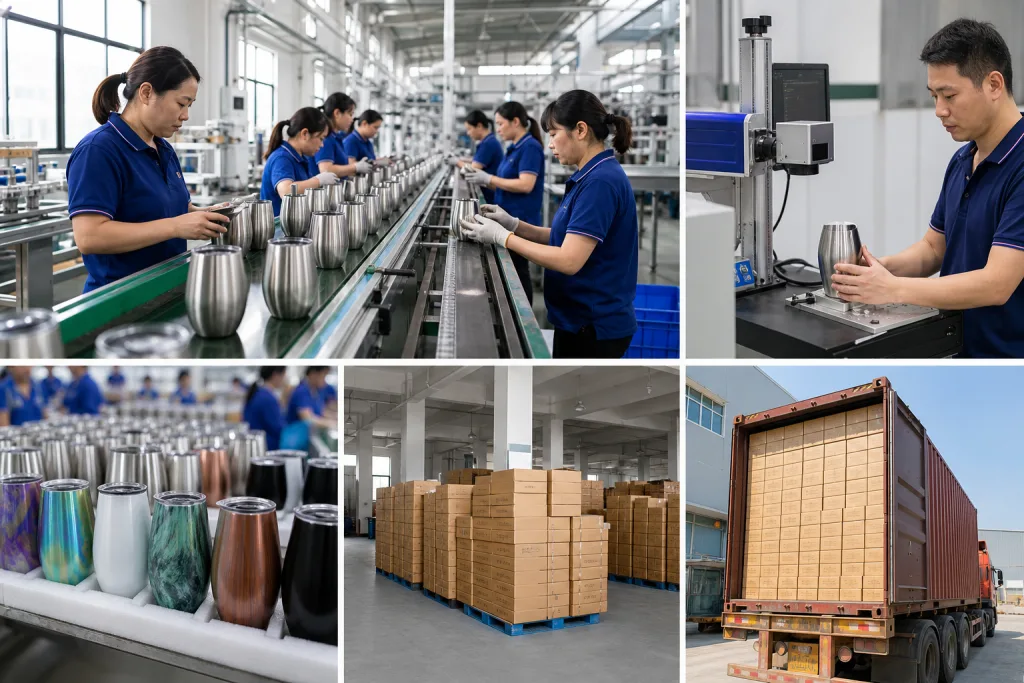
For a typical wine tumbler order, the flow is body forming, welding, polishing, vacuuming, leak testing, surface finishing, logo application, lid assembly, packing, and carton sealing. Each step has a known failure point. On the line, QC usually checks weld seams with a go/no-go gauge after polishing, because a small lip at the rim—0.3 mm is enough—will show up fast once powder coat goes on.
What to inspect before final shipment
- Vacuum performance: random heat retention checks and vacuum integrity checks
- Cosmetics: dents, scratches, uneven powder coat, dirty print, off-center logo
- Lid fit: slider movement, crack risk, seating consistency, no sharp edges
- Packaging: barcode readability, carton count, inner partition protection
- Drop resistance: carton drop test based on your packaging type
Most B2B buyers use an AQL inspection before balance payment. A common setup is AQL 2.5 for major defects and 4.0 for minor defects, but the real question is defect definition. This is the wrong question to leave vague. For branded drinkware, write the cosmetic limit into the spec sheet: logo shift, print blur, color delta, scratch length. A logo 3 mm off-center may pass for canteen promotional use and still fail at retail. We had one buyer flag 2.5 mm on a 20,000-piece run because the front-facing shelf display made the offset obvious.
If you are shipping to Europe, ask for the relevant declarations and test reports for food-contact materials before mass packing starts, not after the cartons are sealed. If you are shipping to the US, confirm the material compliance target at the quotation stage. We ship faster when this is settled early. If the factory claims BSCI, ISO 9001, or audit status, ask for the current report, not a badge in the email footer. QC pulled a sample once where the silicone lid ring matched the approved drawing, but the supplier had changed the compound lot without updating the file. Paperwork matters.
Reliable canteen manufacturers and canteen vendors in Zhejiang usually prefer clear inspection standards because they cut down the argument later and keep shipment dates from slipping 12 days to 18 days. The same discipline works for custom growler, distributor canteen, and customized drinkware programs. MOQ, print position tolerance, carton drop standard, even the barcode scan grade—put it all in writing. The math does not work any other way.
Freight, claims, and the reorder decision
The order does not end when the cartons leave Ningbo. It ends when your customer receives saleable units and you can place the repeat PO without reopening artwork, pack-out, and lid fit. That is where distributors wine tumbler buying turns into margin math. We have seen this go sideways over a 2 mm logo shift that looked minor on the line but triggered a claim at the reseller end.
For shipment planning, lock carton size and loading quantity early. A 12 oz wine tumbler packed 24 pcs per carton may ship around 48 x 36 x 26 cm depending on packaging style. If you switch to gift boxes, CBM climbs fast, and freight per piece can jump from USD 0.18 to USD 0.31 while the box itself only adds USD 0.06. For low-price promo programs, the math does not work. We usually run a quick container-load table before mass packing, because one insert change can cost more than the tumbler upgrade.
Before shipment, line up four documents: PI, final packing list, carton marks, and inspection result. If you need palletization, carton labels, retailer routing marks, or FNSKU, approve that before packing starts. Not after 3,000 pcs are already taped out on the line. QC pulled the sample more than once because the buyer flagged a carton mark typo on the PO, and rework on outer cartons is slow, messy, and avoidable. This matters a lot for distributor drinkware and canteen distributor accounts shipping to 2 or 3 resellers under one program.
When claims happen, split them by root cause. Do not mix everything into one debit note.
- Production defects: vacuum failure, coating issues, logo falloff, lid crack
- Packaging defects: weak dividers, poor drop performance, crushed gift boxes
- Specification gaps: buyer expected dishwasher-safe print but approved standard silkscreen
A serious canteen supplier tracks defect rate by issue type and batch number. Our rule on custom metal tumbler programs is simple: under 1.0% post-arrival claims, the process is healthy; above 2.0%, stop and review before the next PO. Check coating line temperature records, carton compression test data, and inspection criteria at AQL 2.5. This is the wrong question to ask only after goods arrive.
The best first order is not a perfect one. It is a controlled one that gives you clean numbers for the repeat. If batch A shipped with 0.6% claim rate and batch B with a new gift box shipped at 2.3%, you know where to look. That is how you build a scalable line across distributors wine tumbler, custom canteen, customizable growler, and broader custom drinkware categories from Zhejiang, China without paying twice for the same mistake.
Send your wine tumbler spec for a workable quote
Share target quantity, finish, logo method, packaging, and delivery window. We will review manufacturability, MOQ, and QC points before you place the PO.
Frequently asked questions
What MOQ should I expect for a custom distributors wine tumbler order?
For a standard 12 oz vacuum wine tumbler, most export factories in China will quote MOQ at 1,000 pcs per model, with 500-1,000 pcs per color depending on coating and logo complexity. If you want mixed colors with the same print, 3,000-5,000 pcs total usually gives better pricing and easier production scheduling. Retail gift boxes, custom inserts, or unusual finishes can push the practical MOQ higher. If you are working with a canteen factory that already runs similar bodies, they may support trial orders at 500 pcs per color, but unit cost often rises by USD 0.20-0.45. Always confirm whether MOQ is based on total order, per color, or per SKU.
How much does a custom wine tumbler usually cost from China?
A realistic FOB China range for a 12 oz double-wall stainless wine tumbler is USD 2.65-3.10 for a basic powder-coated unit with one-color logo at 5,000 pcs. Better lids, premium finishes, gift boxes, or laser engraving can move that to USD 3.35-4.20. At 1,000 pcs, expect a higher range because setup and coating efficiency are worse. If a quote is well below market, check whether the outer wall is 201 steel, whether the lid grade is lower, and whether packaging is just bulk-packed. For distributor drinkware programs, the landed difference between a cheap quote and a stable quote is often smaller than the cost of one claim cycle.
What quality checks matter most for wine tumblers?
For B2B buyers, the most important checks are vacuum integrity, leak resistance, coating adhesion, logo durability, and packaging protection. Use a pre-shipment inspection with AQL 2.5 for major and 4.0 for minor defects unless your customer requires tighter levels. Confirm cosmetic limits in writing, because visible drinkware is judged quickly by end users. Ask the factory to verify dimensions, lid fit, and carton count during production, not only at final inspection. If you are buying from Zhejiang or other China production hubs, also confirm food-contact compliance documents such as REACH or LFGB depending on destination market. A signed golden sample remains one of the simplest and strongest QC tools.
Should I source wine tumblers and canteens from the same supplier?
Often yes, if the supplier is genuinely a canteen manufacturer with stainless steel vacuum capability across multiple body types. Many factories in Zhejiang, China produce tumblers, sports bottles, and growlers on related forming, welding, coating, and packing lines. That can simplify artwork control, packaging consistency, and payment terms across your custom canteen and distributors wine tumbler range. But do not assume all canteen suppliers are equally strong in every category. Check whether they have existing molds, monthly capacity, and inspection standards for each item. One supplier can be efficient if they quote transparently, keep stable lead times around 25-35 days, and manage mixed-SKU orders well.
How do I reduce claim rates on customized drinkware orders?
Reduce claims by locking the specification before deposit and by matching the decoration method to the sales channel. For example, one-color silkscreen on powder coat is usually safer for promotional volume than large metallic prints. Approve a golden sample, define carton drop requirements, and state cosmetic tolerances in millimeters where possible. Ask for production photos or in-line checks on first orders, then run a final AQL inspection before balance payment. Also track claims by defect type after arrival. If vacuum failures are 0.2% but packaging damage is 1.4%, the problem is not the tumbler body. Good canteen vendors and canteen distributors improve fastest when the post-shipment feedback is numerical, not general.