Key Takeaways
- Start RFQ with 12-15 fixed specs; changing bottle size or lid after sampling can add 7-15 days.
- For stainless steel vacuum bottles, common MOQ is 1,000-3,000 units per color, with FOB China pricing often USD 2.80-6.50 depending on size and finish.
- Pre-production samples should match Pantone, logo position within ±1.5 mm, and pass leak and 1.0-1.2 m drop checks.
- Write PO line items for AQL, packaging, carton marks, ship date, and compliance documents, not just unit price.
You do not usually lose money on custom drinkware from one big mistake. It slips out in small gaps: the RFQ leaves out lid type, QC approved the sample without a drop test, the PO says “black logo” but not Pantone 186 C, carton marks are vague, and bulk shows up 12 days after the launch window. We see this with distributors water bottles for resale, retail programs, and corporate orders.
If you are sourcing from Zhejiang, China or comparing a canteen manufacturer in China with other options, the right approach is plain. Define the product, lock the sample, write the PO like a control sheet, and inspect to AQL before balance payment. We run that way on the line, and it saves a lot of back-and-forth.
Start with the RFQ details
Most sourcing problems start before any Zhejiang factory sends a quote. Your RFQ is either tight enough to control the result, or it is a shopping list built on guesses. If you are buying distributors water bottles, or working with a canteen supplier for resale, write it like a technical brief, not a promo note.
At minimum, lock the bottle family, capacity, build, finish, logo method, packaging, compliance, and target quantity by SKU. If you send three canteen manufacturers “a 500 ml custom canteen with logo,” you will get three structures, three steel grades, and three prices. We saw that exact PO typo last month. It burns a week.
What to lock before quotation
- Body material: 18/8 stainless steel, 18/0 stainless steel, Tritan, glass, or aluminum.
- Construction: single wall or double wall vacuum.
- Capacity and weight target: for example 500 ml, 280-320 g.
- Wall thickness: commonly 0.4 mm inner and 0.5 mm outer for vacuum stainless models.
- Lid style: screw cap, straw lid, flip lid, carry loop, bamboo top.
- Decoration: silkscreen, heat transfer, powder coat plus laser engraving.
- Packaging: white box, kraft box, color box, barcode label, insert card.
- Compliance: REACH, LFGB, FDA, CPSIA or ASTM where relevant.
A good RFQ also spells out the commercial side. Put quantity tiers like 1,000, 3,000, and 5,000 pieces; the destination port; and whether you want EXW, FOB Ningbo, or DDP. QC pulled the sample on a 500 ml vacuum bottle at 298 g, then the buyer flagged the carton at 13.2 kg gross. That is the wrong question to ask if the pack spec is missing. In Zhejiang, a line running 500,000 to 800,000 units per month can turn fast quotes, but only when the brief is clean.
Add the expected PO line items into the RFQ draft. Mold charge if any. Sample fee. Carton size limit. Carton gross weight cap. Standard lead time. For a custom drinkware run, that first page already tells you whether you are talking to a real canteen vendor or a trader filling gaps from memory.
Compare quotes without fooling yourself
Once quotes land, a lot of buyers look at FOB only. Wrong move. That is how you pick the wrong canteen factory fast. Two bottles can both look like a 600 ml customizable canteen, but one uses thinner steel, a lighter lid, rougher inner polish, and a shorter logo curing cycle on the line. The lower price is not magic. The spec changed somewhere.
Set up a comparison sheet with technical items and commercial terms side by side. Ask each canteen manufacturer or canteen distributor candidate to confirm the exact RFQ spec in writing, line by line. We usually mark wall thickness in mm, steel grade, unit weight in g, and print method in one column so nobody hides behind a pretty photo. If they will not confirm it, treat the quote as provisional. This is the wrong question to ask: “Who is cheapest?” Ask instead: “What exactly am I buying?”
The useful quote is not the lowest one. It is the one you can convert into a stable bulk order without rewriting half the spec.
For distributor drinkware projects, these fields matter more than buyers expect. QC pulled this before on a sample set: same artwork, same shape, but the PO had one lid code typed wrong and the whole quote shifted.
- MOQ by SKU and color: 1,000 pcs per size is common for standard custom drinkware, but special coatings or lid assemblies can push MOQ to 3,000 pcs.
- Tooling exposure: new lid molds or special bases can add USD 2,000-8,000, and buyers often miss trial-shot cost on the first mold test.
- Sample lead time: 5-7 days for existing models, 15-25 days for new tooling, depending on whether the mold shop needs a second fitting.
- Bulk lead time: often 25-40 days after sample approval and deposit; in peak season we have seen 28 days become 38 because one spray line was full.
- Testing included or extra: migration tests, thermal retention tests, dishwasher tests; ask which lab, which standard, and who pays if the first sample fails.
- Packaging cost: a color box can add USD 0.25-0.90 per unit, and a 5 mm EPE insert or barcode label can move the carton count too.
If you are sourcing a custom growler or customizable growler, compare neck finish, gasket material, handle structure, and carbonation suitability. We have seen this go sideways. A customized growler for beer programs does not carry the same risk as a gym bottle. The buyer flagged leakage once, and the problem was not the body; it was a gasket hardness mismatch on the cap.
Ask for factory credentials early: BSCI or Sedex audit status, ISO 9001 if available, and export experience to Europe or North America. A lot of canteen suppliers in China can make one decent sample. Fewer can hold consistency across 10,000 units while meeting carton specs, barcode labeling, and booking dates. Carton drop test results and pallet height matter here, not sales talk. That is the real comparison.
Turn the sample into a control point
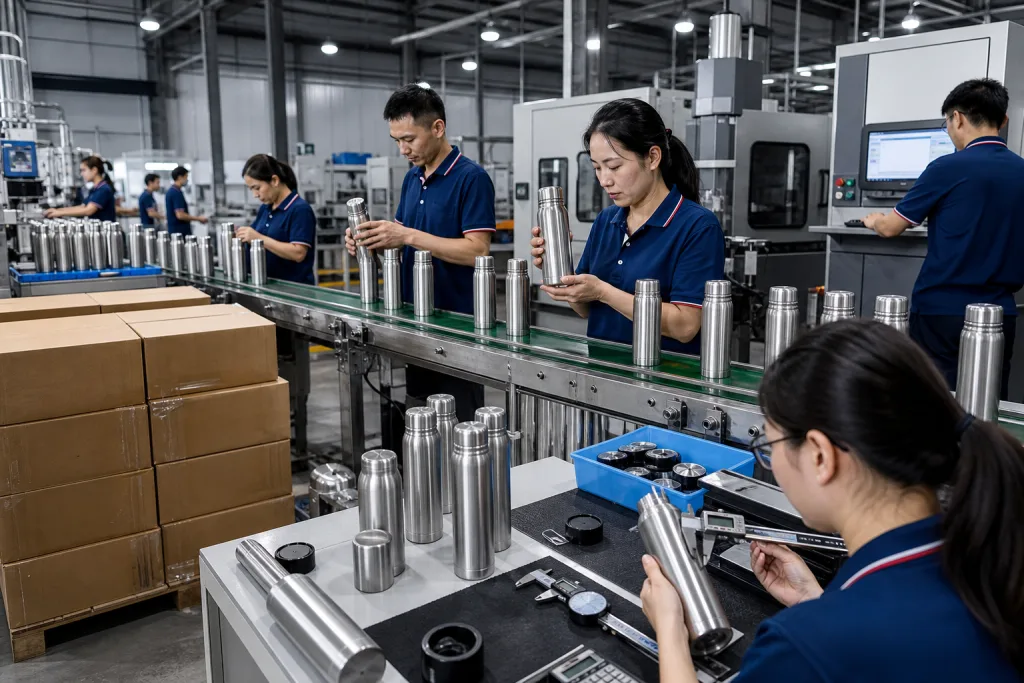
The sample stage decides whether the project stays under control or drifts. For a custom canteen, canteen custom project, or customized drinkware launch, the approved sample is not just for sales photos. It is the bulk standard. On our line, QC tapes the signed sample card to the first article station, and the operator checks against it before mass production starts.
Ask for the correct sample type. A random stock sample helps you judge shape and hand feel. It is not an approval sample. You need a pre-production sample with your actual finish, logo, packaging, and accessories. If you are buying from Zhejiang or another part of China, tie every approval to one exact revision code. We have seen this go sideways over one PO typo—Rev A on the carton mark, Rev B on the logo file.
What to check on the sample
- Dimension tolerance: height, diameter, mouth opening, and weight. Use a caliper and record the actual mm and g, not “same as sample.”
- Logo placement: usually within ±1.5 mm from approved artwork position. QC pulled the sample and measured from the weld seam, not by eye.
- Color: Pantone or coated finish reference under neutral light. Check under a 6500K light box, not warehouse lighting.
- Leak performance: inverted for 2 hours, then shaken. We usually put 3 filled pieces on absorbent paper so any seep shows fast.
- Thermal performance: for vacuum bottles, measure heat retention after 6 and 12 hours. Record the water start temperature and room temperature, or the math does not work.
- Odor and taste: especially on plastic components and silicone seals. The buyer flagged this before on a new straw lid with a strong silicone smell.
- Packaging fit: inner box drop resistance and barcode scan quality. Run at least a 76 cm drop test and scan the barcode off a packed unit.
If your sales channel is promotional, a canteen promotional order usually needs tighter logo review than a retail shelf item. Silkscreen adhesion, laser depth, and wrap seam alignment drive returns. We ship plenty of promo orders where the buyer cares more about a 1 mm logo shift than a small carton scuff. For a custom growler, check cap torque and pressure hold if it is used for specialty beverage programs; on one project, the line found 0.3 N·m torque variation and the lid started weeping.
Your PO draft should start here. Add line items for approved artwork code, Pantone reference, print size, accessory count, insert language, and master carton configuration. Example: “24 pcs per master carton, max gross weight 14 kg, FNSKU on outer polybag, carton mark per buyer layout rev B.” This is the wrong question to ask late. We have had buyers approve the bottle, then stop shipment over a missing French insert line.
Once approved, ask the canteen vendor to keep the signed sample and send you a labeled retained sample photo set. Front view. Bottom stamp. Packing shot. That sounds basic, but it stops the standard fight later: “bulk follows sample” only works when both sides are pointing to the same retained piece, with the date, PO number, and revision label visible.
Build the PO line by line
A purchase order for distributors water bottles should read like the line setup sheet on our floor. If the PO only shows quantity, price, and ship date, the factory fills in the blanks for you. That is where mistakes start. We see this on rushed orders: sales reads one spec, printing reads another, and packing follows the carton note from an old job. Good China factories want a detailed PO because it keeps sales, purchasing, printing, and packing on the same page.
Break the PO into separate line items or attachment schedules for product, decoration, packaging, quality, and shipping. Do not bury this in one paragraph. It matters whether you buy from a canteen factory direct, from canteen distributors, or through a canteen supplier running 2 or 3 subcontractors. On mixed-source orders, this is where things go sideways if one lid vendor is working off Rev A and the bottle shop is on Rev B.
Core PO items to include
- SKU description: “500 ml double wall vacuum bottle, 18/8 inner and outer, powder coat navy, PP screw lid with silicone seal.” Add key dimensions if they matter, like mouth dia. 45 mm or base dia. 70 mm.
- Quantity split: by color, by logo, by market, by barcode version. If navy is 3,000 pcs and white is 2,000 pcs, write that out.
- Unit price and term: EXW or FOB Ningbo/Shanghai, currency in USD. If the buyer flagged freight swings last season, lock the term clearly.
- Sample reference: approved sample code and date. QC pulled the sample more than once because the PO said “as approved” with no code.
- Packaging: inner box type, insert, polybag, carton count, carton dimensions. Write the carton spec, like 24 pcs/ctn, K=A board, 58 x 39 x 27 cm.
- Marks and labels: FNSKU, EAN, suffocation warning, country of origin mark. One wrong barcode on a master carton can hold the whole shipment.
- Compliance documents: REACH declaration, LFGB report, FDA statement, ASTM or CPSIA where applicable.
- Inspection clause: AQL 2.5 major / 4.0 minor unless otherwise agreed. This should sit in the PO, not in someone’s email from 6 weeks ago.
- Delivery window: ex-factory date or FOB ready date with penalty or remedy language if needed. “Late” is vague; “FOB ready by Oct 18” is usable.
- Payment terms: common terms are 30% deposit, 70% balance after inspection and before shipment. If tooling is involved, spell out who pays and who owns it.
If this is a customized canteen program with retail packaging, add one approval gate for pre-production packaging photos before mass packing starts. Do it before the line seals the first 500 boxes. We have seen a single PO typo on color name print 4,800 wrong gift boxes, and the math does not work if you catch it after packing.
Set substitution rules in writing. For example, no changes to gasket material, coating supplier, or carton board grade without written approval. A solid canteen manufacturer will accept that because it protects both sides. If they push back on basic control points, the wrong question is “why are they difficult.” The better question is what else they plan to change without telling you.
Watch production before problems compound
Once the deposit lands, new buyers often go quiet until the ETD is close. That is where orders slip. A bulk problem is cheaper to fix on day 7 than day 27, when 6,000 bodies are already off the line. You do not need to chase the factory every morning, but you do need stage checks.
For a 30- to 35-day lead time, ask for three updates at set points: raw material readiness, in-line production photos, and packing progress. On logo-heavy orders such as canteen customized promotional runs, ask for early print samples from the actual line, not a clean office mockup. We run into this all the time: a 1.5 mm logo shift looks harmless on WeChat and turns into a claim across 8,000 units.
- Day 3-5: confirm raw steel, lids, seals, and packaging materials are booked. Ask for coil, lid, and carton photos with date stamps, not a yes/no reply.
- Day 10-15: review in-line body finish and logo application photos or video. QC should pull the sample from the line, with close shots of the weld area and print position.
- Day 20-28: confirm packed quantity, carton marks, and booking readiness. We also ask for outer carton dimensions and one pallet photo before truck loading.
If your item is a customizable drinkware range with multiple lids, watch component matching hard. Mixed lids, wrong straw colors, and missing seals are standard assembly misses on busy days. We have seen a PO with one typo on lid color code turn 4 SKUs into a sorting mess. For distributor canteen or distributor growler projects with several SKUs, request a packing matrix that shows bottle-to-lid-to-box combinations. This is the right document to ask for.
Quality control should be planned, not improvised. Standard pre-shipment inspection usually happens when 80% to 100% of goods are packed. Use an agreed AQL plan and include functional tests: leak test, vacuum check where needed, barcode scan, drop check on packaged units, and assortment count verification. The wrong question is whether inspection costs money; the real question is whether a missed issue costs more. If you are selling into Europe, document REACH and food-contact compliance before vessel departure. We have seen this go sideways when customs asks first and the file is still sitting with the lab.
A reliable canteen manufacturer or canteen vendor will not be offended by inspections. Serious factories expect them. The buyer flagged a dented base once in a 10-carton spot check, and that small catch saved a full rework later. For North American and European distributor drinkware business, repeat orders come from consistency, not promises.
Ship, receive, and review the factory
The last step is not booking freight. It is closing the order cleanly so the next PO runs smoother on the line. For distributors water bottles, especially repeat programs with a canteen supplier or canteen manufacturers in China, the post-shipment review saves money on the next order.
Before balance payment, match the inspection report, final packing list, and shipping marks against the PO line by line. Check carton count, net and gross weight, pallet requirement if any, and HS code usage. We still see simple misses here: one PO showed “24 pcs/ctn,” while the export carton file was set at 25 pcs/ctn, and QC pulled the sample only because the carton weight was off by 0.8 kg. If your channel is Amazon or large retail, check FNSKU, pallet labels, and appointment rules again. A bottle order can pass factory inspection and still get rejected at warehouse intake because the labels are wrong. We’ve seen this go sideways.
After goods arrive, record actual results against expectations:
- On-time performance: was shipment within the agreed window or late by 5, 10, or 15 days?
- Defect rate: what percentage showed leaks, cosmetic defects, or print issues?
- Packaging accuracy: were carton marks, barcode labels, and inserts correct?
- Claim handling: did the supplier respond within 48 hours with a practical solution?
This review shows whether the source should stay as a preferred canteen factory, move to backup canteen vendor status, or come off your list. The buyer flagged it. The sample looked good, the FOB price looked sharp, and they kept the supplier for 3 more POs. This is the wrong reason. If 2.3% of bottles arrive with print rub or 180 cartons carry the wrong mark, the math doesn’t work.
For long-term programs in Zhejiang and broader China, keep a live vendor file with sample history, complaint rate, lead-time reliability, and MOQ flexibility. We run these files with photo records, cap torque notes, and carton specs like 58 x 39 x 42 cm, not generic comments. A strong canteen distributor or factory partner gets easier to work with over time because they already know your artwork tolerance, your carton drop test standard, and the label position your buyer flagged at 3 mm high on the last shipment. Sourcing gets easier this way. Not by taking more risk, but by writing down the details that worked and repeating them.
Send your RFQ and get a practical quote
Share bottle specs, target quantity, logo file, and packaging needs. We will review the details, flag risk points, and quote workable MOQ, pricing, and lead time.
Frequently asked questions
What MOQ should I expect for custom water bottles for distribution?
For standard stainless steel custom drinkware, a realistic MOQ is 1,000 pieces per size and usually per color. If you want one body color with one logo, some China factories can start at 500-1,000 pieces on existing models. If you need special lids, custom molds, or retail color boxes, MOQ often moves to 2,000-3,000 pieces. For a custom growler or customized growler with a more specialized cap system, MOQ can be 1,000-2,000 pieces depending on tooling. Ask the canteen manufacturer to quote by quantity tier: 1,000, 3,000, and 5,000 pieces. That shows the real cost curve and helps you avoid overbuying your first PO.
How long does a custom bottle order from China usually take?
If you use an existing model from a canteen factory in Zhejiang, stock sample time is often 2-4 days and a pre-production logo sample is usually 5-7 days. Bulk production after sample approval and deposit is commonly 25-35 days for 1,000-5,000 units. During peak season, especially before Q4, lead time can stretch to 40-50 days. New molds can add 15-25 days before mass production starts. Add ocean transit separately. FOB China timing is only factory readiness, not delivery to your warehouse. Put one date in the PO for sample approval cutoff and another for cargo-ready date so the schedule is clear.
What compliance documents should I request for distributors water bottles?
That depends on your market and product material, but for Europe and North America you should usually request a REACH declaration, food-contact test reports where applicable, and material statements for plastics, silicone, and coatings. For children’s items, ask whether CPSIA or ASTM-related requirements apply. For EU food-contact programs, many buyers request LFGB-related testing on finished components that touch liquid. If the bottle is stainless steel with PP lid and silicone seal, get documents covering all three materials, not just the steel body. Also ask for country-of-origin marking confirmation and carton label details before shipment. Compliance is much easier to control before production than after a customs or retail audit problem appears.
Should I buy from a factory directly or through a trading company?
Direct factory buying usually gives you better technical control, faster answers on construction, and clearer accountability on defects. That matters when you need customized drinkware, canteen customizable options, or a distributor growler program with several packaging variations. A good trading company can still be useful if they manage mixed-product orders, consolidate shipments, or add stronger English communication. The key is transparency. Ask who owns production, where the factory is in China, what monthly capacity is available, and who handles claims. If a supplier cannot tell you the actual plant location in Zhejiang or elsewhere, or cannot provide basic audit and inspection support, the risk goes up quickly.
What are the most common mistakes first-time B2B buyers make on custom bottles?
The biggest mistakes are vague RFQs, approving the wrong sample type, and issuing a thin PO. Buyers often forget to lock wall thickness, lid material, Pantone color, barcode placement, carton dimensions, and AQL terms. Another common error is comparing FOB prices without checking whether the canteen supplier quoted the same packaging and finish. On a 3,000-piece order, a packaging mismatch alone can create a USD 600-1,500 budget gap. Finally, many buyers wait until the end for inspection. You should review production progress mid-run and inspect when 80%-100% is packed. That catches print, packing, and assortment problems before balance payment and before the goods leave China.