Key Takeaways
- Start with 3 core decisions: channel, steel spec, and decoration; these drive 80% of cost and complaint risk.
- For most custom thermos programs, MOQ is 1,000-3,000 pcs per color, with lead time around 25-45 days after sample approval.
- A realistic FOB target for a 500 ml stainless steel vacuum flask is often USD 3.20-5.80 depending on 18/8 steel, coating, lid build, and print method.
- Use written QC gates such as AQL 2.5, leak test at 100%, and material compliance for REACH, LFGB, or FDA before shipment.
You are not buying a bottle. You are buying your margin, your complaint rate, and whether the shipment lands on time. We’ve seen distributor vacuum flask programs go sideways for plain reasons: the capacity mix was off by 2 SKUs, the logo finish failed a 3M tape pull test, or the supplier thermos quote looked fine until drop-test rejects, carton upgrades, and rework labor hit the sheet.
If you are sourcing from Zhejiang, China or elsewhere in China, the right question is not who gives the lowest FOB price this week. That is the wrong question to ask. The real question is which manufacturer thermos setup fits your sales channel and MOQ. A 500 ml customized thermos for corporate gifting runs differently from a 750 ml distributor thermos for camping stores; even the outer carton count and lid style change the math. You need a clear comparison point before you check factories, samples, and landed cost, or the buyer flagged price gap on Monday turns into a spec mistake on the PO by Friday.
Start with the buying decisions
The best distributors vacuum flask decisions usually come down to four choices. Lock these first. The rest gets easier on the line and in purchasing.
- Channel fit: Outdoor retail, e-commerce, and promotional thermos projects do not buy the same bottle. Retail buyers ask about shelf impact, color consistency between batches, and repeat-order control; we check that with a gloss meter before mass production. Promotional projects push unit cost hard and usually accept simpler decoration. Amazon or distributor thermos programs live or die on carton discipline, barcode accuracy, and low return rates. We have seen one PO held because the buyer flagged a barcode print offset by 2 mm.
- Capacity and form: 350 ml, 500 ml, 750 ml, and 1,000 ml are the common commercial sizes. For outdoor retailers, 500 ml and 750 ml usually carry the best turn rate. For event gifting, 350 ml and 500 ml are safer because freight cost per unit stays under control. This is where buyers often ask for 8 sizes at once; the math doesn't work unless volume is there. A new mold trial and fit check on the neck gauge costs time, and MOQ gets split too thin.
- Thermal performance level: Do not buy the highest hold time if the channel does not need it. A 12-hour hot / 24-hour cold claim can be enough for promotional brands. Serious outdoor channels often ask for 12-18 hours hot and 24-36 hours cold, verified on pre-production samples. We run a hot-water retention test on sample flasks before approval, and QC pulled the sample once because the vacuum loss showed up too early.
- Decoration durability: Silk screen is cheaper. Powder coat with laser mark is tougher. Full-wrap transfer looks better on the shelf, but it adds cost and process risk. We have seen this go sideways on curved bodies where the artwork registration shifted by 1.5 mm and the buyer rejected the first sample set.
At BottleForge Industrial in Hangzhou, Zhejiang, we see buyers save the most money when they cut SKU confusion early. A customizable thermos line with six lid types, four body finishes, and five capacities may look flexible, but it slows approvals and creates MOQ fragmentation. One lid with a silicone seal ring that fits at 0.3 mm tolerance sounds simple on paper, then turns into 20 small purchase lots. A cleaner range usually gives lower scrap, faster sample cycles, and a steadier reorder rhythm.
If you are speaking with a thermos supplier in China, ask them to quote one “good-better-best” structure, not fifty options. This is the right question to ask. It forces a real trade-off discussion instead of endless sample churn, and we ship faster when the spec sheet is clean.
Match spec to your sales channel
A customized thermos that sells in a hiking shop can flop in a promo catalog. Channel decides the build. We’ve seen buyers start with shape and color first; this is the wrong question to ask if the SKU has to survive returns data.
Outdoor retail
For outdoor retail, the bottle has to feel solid in hand and still look clean after repeated use on the trail. Buyers usually expect 18/8 stainless steel, powder coating, a sealing gasket that seats flat, and a lid that still threads smoothly after 500 open-close cycles on the line test. Wall thickness on the outer body is commonly 0.4 mm to 0.5 mm, with inner wall around 0.4 mm. If a factory builds it too light, you might save USD 0.12 per piece and lose that back fast in dents, cap complaints, and returns. QC pulled samples last season where the shoulder caved in after a 1.0 m drop test. The math didn’t work.
Promotional and corporate gifting
Here, unit cost usually beats top-end heat retention. Some factories offer a 201 outer with 304 inner, but buyers in Europe and North America often push back and ask for full 304. It makes compliance talks cleaner and gives sales teams simpler copy. We ship a lot of these with one body color and one print position because that is usually the cost sweet spot. Once the PO adds a second print location or a custom lid insert, the line slows down and the setup charge starts to bite. Last month one buyer flagged a logo wrap tolerance over 1.5 mm on a 3,000 pc order, so simple decoration is not boring—it is safer.
E-commerce and distributor packs
In this channel, carton performance is part of the product. If you sell through Amazon, the FNSKU has to scan fast, the inner pack has to survive drops, and master carton weight needs to stay manageable—often under 18 kg, depending on the program. A bulk thermos order can price well and still turn into a claim if 20% of units land with rub marks because the inner partitions were too thin. We’ve seen 250 gsm dividers fail where 350 gsm was fine. The buyer blamed coating quality first; the real issue was pack-out.
You are not buying the same custom thermos if your customer judges it on a trade show table versus on a camping trail two months later.
For most distributor thermos programs, we recommend a narrow opening bottle or straight-wall flask body first. Complex shapes look premium, but they add tooling risk, make brush access harder during production, and widen cap fit variation at assembly. On one new mold, cap torque drifted from 8 to 12 lbf·in across the batch, which is where complaints start. Zhejiang factories with stable monthly output of 300,000-500,000 units guide buyers toward proven molds for a reason. Repeatability is where margin lives.
Choose steel, insulation, and lid wisely
This is the point where buyers get sold on broad wording. We hear “double wall vacuum” on RFQs every week. That is not a full spec. You need the actual BOM, down to the inner wall grade and the lid resin, or the line will quote 3 different bottles under one sentence.
- Steel grade: 304 stainless steel, also called 18/8, is the standard for food-contact inner walls in North America and Europe. For premium outdoor use, some buyers ask for 316 inner wall for better corrosion resistance, especially if the flask may see tea, coffee, sports drinks, or salt exposure. Expect a noticeable cost increase. On one 500 ml program, the buyer flagged tea staining after a 72-hour soak test, and 316 solved it. This is the right upgrade only if the use case justifies it; otherwise the math does not work.
- Vacuum process: Ask whether the body is copper coated internally before vacuum sealing. Copper coating can improve heat retention, but not every program needs it. Get a measured hot-hold test method, not just a marketing claim. We usually ask for the test point at 95°C fill temperature and an 8-hour reading, because “keeps hot longer” tells you nothing on the factory floor.
- Wall thickness: A common safe range is 0.4/0.4 mm or 0.5/0.4 mm for outer/inner wall. Go too thin and dent risk jumps. Go too heavy and freight climbs fast. QC pulled the sample once and found the outer wall at 0.35 mm on a low-price offer; it looked fine in photos and failed after one drop.
- Lid structure: Screw lids with PP and silicone components are the most stable for bulk thermos production. Flip-top or push-button lids add convenience, but they also add springs, pins, extra tooling, and more leak-test failures. We run 100% upside-down leak checks on these lids, and first-order reject rates are usually higher than plain screw caps.
A manufacturer thermos quote should list body material, lid plastic grade, gasket material, insulation type, net weight, and tested capacity tolerance. We also expect to see small details like capacity tolerance checked with a graduated cylinder, not guessed from CAD volume. If your supplier thermos quotation does not show these details, you are comparing guesses, not products.
For a 500 ml thermos custom project, a basic screw-lid model in 304/304 with powder coating may land around USD 3.20-4.20 FOB China at 3,000 pcs. Add a more technical lid, premium gift box, or 316 interior and you may move into USD 4.80-6.50 quickly. That is normal. We ship both levels every month. The mistake is treating them as the same item because the outside shape looks similar on a PDF.
Experienced thermos manufacturers in China will also tell you what not to do: avoid oversized handles on low-cost lids, avoid mirror polish exteriors for outdoor channels, and avoid untested stopper assemblies on first orders. We have seen this go sideways. One buyer approved a big carry handle on a budget mold, and torque cracks showed up before loading at 12 N·m lid testing.
Price the order the right way
Buyers asking for the “best price” on thermos bulk usually mean the best landed margin after defects, delay costs, and markdowns. That is not the same as FOB. We’ve seen a quote win by $0.18 on paper, then lose money after QC pulled the sample and found lid color shift on 6 out of 32 pcs.
Break the comparison into these buckets:
- Unit FOB: Flask, lid, standard polybag, export carton. Ask what steel grade, lid structure, and carton spec are actually included.
- Tooling and setup: New mold, print screens, laser fixture, color match setup. A new silicone ring gauge or cap mold insert changes the cost fast.
- Packaging: White box, color box, PDQ tray, barcode labels, instruction sheet. A box change from E-flute to corrugated gift pack is not a small add-on.
- Compliance and test cost: LFGB, FDA, REACH, CA Prop 65 depending on market and claim set. If the buyer flagged a food-contact claim, lab cost needs to be in the math from day one.
- QC and logistics: Third-party inspection, palletization, port charges, freight swings. AQL 2.5 is cheap compared with a full return on mixed cartons.
MOQ matters because decoration and packaging usually set the break point. A custom thermos with stock body and one-color logo may start at 1,000 pcs. A fully customized thermos with custom mold cap, Pantone body, gift box, and multiple print positions may need 3,000-5,000 pcs to make financial sense. We run into this every week. The wrong question is “what is your lowest MOQ?” Ask where the setup cost stops hurting the unit price. On the line, one extra print position means one extra fixture and more handling.
Lead time changes cost too. Typical timing from Zhejiang, China looks like this:
- Sample revision: 5-10 days
- Pre-production sample: 7-12 days
- Mass production: 25-35 days for repeat items, 35-45 days for new custom builds
If a thermos vendor promises all of that in 15 days during peak season, be careful. We’ve seen this go sideways. The shortcuts usually show up in coating defects, late cartons, or mixed components. One common inspection finding is a 0.5 mm gap mismatch between lid and collar because assembly started before the final sample was signed.
For distributors thermos business, ask for a reorder quote, not just a first-order quote. Some suppliers thermos programs look attractive on the opening order and get worse later because carton counts, printing fees, or color surcharges change once you are tied to a mold set. We ship repeat orders every month, and this is where buyers get pushed. One PO even came in with “mat black” typed instead of “matt black,” and the supplier used it to argue a surcharge on the second run. Get the reorder terms written now.
Decoration drives both cost and complaints
Branding is where a promotional thermos either reads premium or starts flaking after 3 weeks on the buyer’s desk. The right process depends on actual use, not the mockup; on our line, QC pulled a sample last month where the logo looked fine in photos but failed a 3M tape pull.
- Silk screen: Low setup burden and a practical pick for simple logos on smooth surfaces. Best for 1-2 spot colors on straight-wall bodies. The math stops working once artwork gets fussy or the bottle has deep ribs, and abrasion resistance is weaker than engraving.
- Laser engraving: Durable, especially over powder coat, and a safer choice for outdoor retail or premium corporate orders. It reads clean on dark matte surfaces. We run this a lot on 304 stainless vacuum flasks because buyers complain less after 6 months of use.
- Heat transfer or water transfer: Suits full wraps, gradients, and detailed artwork that silk screen cannot hold. It can look strong at retail, but process control on the line decides everything; we have seen wrinkles start near the shoulder radius where film tension was off by 2 mm.
- Digital printing: Good for short-run visual programs and fast artwork changes, especially below MOQ-heavy decoration options. Not the best answer for hard-use field programs. The buyer flagged one farm supply order after scuffing during carton drop tests.
A thermos customizable program should also define the finish under the logo. Powder coat is usually the best commercial choice because it hides small handling marks and pairs well with laser decoration. Spray paint can look sharp on tighter budgets, but consistency and scratch resistance are weaker; we see this first around the bottom edge after carton packing.
If you need customized thermos units for distributor catalogs, ask for a simple decoration test plan: tape adhesion, 50-cycle rub test, dishwasher statement if relevant, and visual inspection under defined lighting. This is the right question to ask. Do not sign off from a sample photo with “looks good”; we have had POs approved that way, then the first issue showed up under 6000K light in final inspection.
In our experience in Zhejiang, China, buyers often overspend on fancy decoration and underspend on the cap and gasket. That is backwards. End users forgive a simple logo. They do not forgive leaks. For thermos promotional work, it is smarter to lock one durable logo position and put the saved budget into better coating or tighter QC; a 1.5 mm silicone gasket upgrade gets fewer complaints than a second decoration pass.
Control quality before containers leave
If you are buying from thermos suppliers in China, your real control point is before shipment. After the container is on water, claims get slow and expensive. We’ve seen a $0.18 silicone issue turn into a full rework argument after loading. Bad timing.
Your purchase order should specify measurable checkpoints:
- AQL standard: AQL 2.5 for major defects and 4.0 for minor defects is common. Put it on the PO in plain words, because we still see typos like “AOL 2.5” on buyer drafts.
- 100% leak test: Every unit, not sampled cartons only. On our line, QC pulled the sample first, then the whole batch ran through the air-pressure leak tester.
- Vacuum retention check: Agree the sample size per lot and the written method. If the spec says 12 hours hot hold, write the fill temperature and ambient room temperature too.
- Coating and logo check: Define color tolerance, adhesion, and abrasion criteria. A cross-cut adhesion test and a logo position tolerance of ±1.5 mm will save you an argument later.
- Carton drop and barcode verification: This matters for retail and FBA flows. We usually run a 76 cm carton drop test and scan outer barcodes before pallet wrap.
Confirm compliance scope early. If you sell into Germany or wider EU retail, you may need LFGB and REACH declarations; for the US, FDA-related food-contact statements come up on almost every stainless program, and ASTM or CPSIA matters if the design is sold toward children. This is the wrong question to ask after mass production starts. A supplier thermos factory already shipping to Europe and North America should know the document pack, the lab lead time, and which lid parts need extra attention.
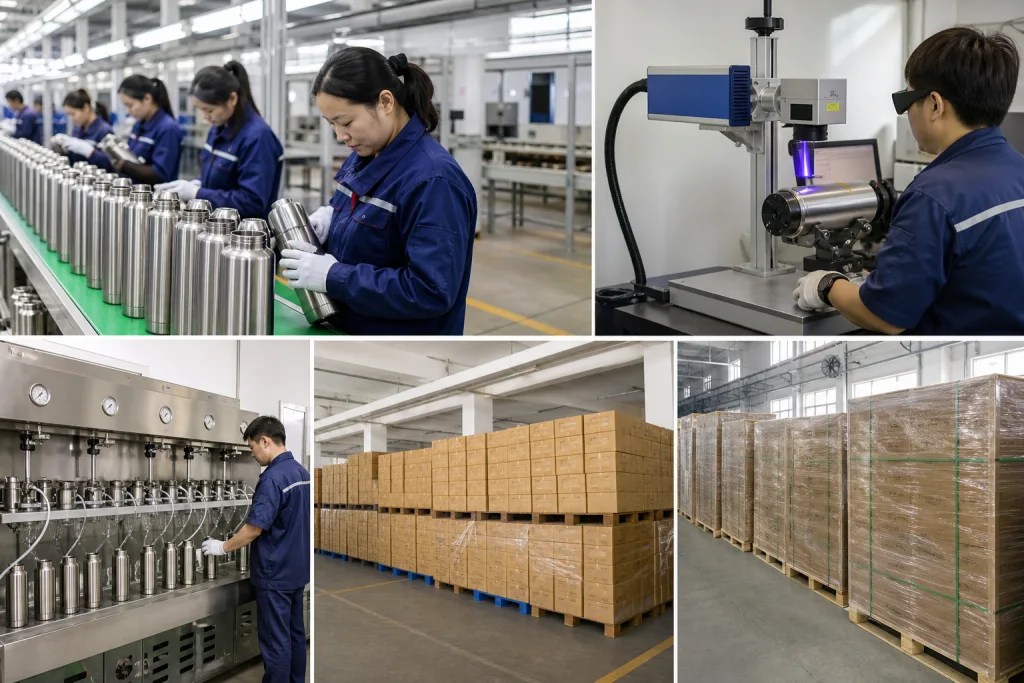
Ask for production photos from the line, not finished-goods beauty shots. You want body forming, the vacuum station, powder coating, the logo station, and packing control points. Show the weld seam. Show the coating rack. Show the metal detector at packing if the factory has one. A factory with ISO-aligned systems, BSCI social audit, and stable inspection routines is easier to scale with than a factory that looks tidy only at sample stage. We’ve seen this go sideways when the golden sample was clean but the bulk lot had 3 mm logo drift.
At BottleForge Industrial, our standard planning for stainless projects from Hangzhou includes pre-production approval, in-line checks, and final inspection before balance payment. That is normal practice, not a sales line. We run first-article signoff before mass production, check lid torque during the shift, and hold shipment if final inspection misses the agreed standard. That discipline keeps a bulk thermos order from turning into a return problem six weeks later.
Get a clear custom thermos sourcing quote
Send your target capacity, quantity, decoration, and channel. We will map the right stainless spec, MOQ, lead time, and FOB range for your program.
Frequently asked questions
What MOQ should I expect for a distributors vacuum flask order?
For a stock mold stainless vacuum flask with one logo, you can often start at 1,000 pcs per size or color. If you want a customized thermos with custom Pantone finish, gift box, or special lid, MOQ usually moves to 2,000-3,000 pcs. A fully new mold can push practical MOQ to 5,000 pcs or more because tooling amortization and production setup need volume. In Zhejiang, China, many factories will quote low MOQs to win the inquiry, then add surcharges that erase the savings. Ask for the real MOQ by SKU, color, and decoration method, plus whether mixed colors in one order are allowed.
How do I compare thermos suppliers without getting fooled by a low price?
Use a line-by-line quote sheet. Confirm steel grade, wall thickness, net weight, lid material, vacuum spec, coating method, logo process, packaging, and testing. A 500 ml unit at USD 3.30 FOB may actually be more expensive than a USD 3.75 offer if the cheaper one uses thinner steel, weaker coating, or excludes barcode labels and inspection support. Also compare lead time, defect policy, and reorder pricing. A serious thermos manufacturer in China should state sample time, production days, MOQ, and compliance scope clearly. If two quotes differ by more than 15%, they are usually not the same product.
Which decoration method is best for outdoor retail versus promotional campaigns?
For outdoor retail, powder coat plus laser engraving is usually the safest choice. It looks premium, survives abrasion better, and keeps complaint rates low. For promotional thermos campaigns, silk screen is often the best value if the artwork is simple and the use case is lighter. Full-wrap transfer can work well for retail gift sets or seasonal launches, but only if your factory controls alignment and adhesion tightly. Expect laser to cost more than screen print, but the difference is often only USD 0.10-0.35 per unit at scale. If you are selling into active-use channels, that small increase can protect margin by cutting reprint and return issues.
What lead time is realistic for bulk thermos production from China?
For a repeat model using an existing mold, normal lead time is about 25-35 days after deposit and approved pre-production sample. New artwork or packaging may add 5-7 days. A new custom thermos with more changes typically needs 35-45 days. Sampling before that can take 7-12 days, depending on logo method and packaging complexity. During peak season, especially before Q4, add buffer. If your thermos supplier says 15-20 days for a first custom order, verify how they handle coating cure time, leak testing, and carton preparation. In Zhejiang and other production zones in China, stable factories protect schedule by limiting rush promises.
What QC points matter most on a stainless distributor thermos order?
The big five are leak testing, vacuum retention, coating quality, logo adhesion, and carton condition. Require 100% leak testing and define your AQL, commonly 2.5 for major and 4.0 for minor defects. Check capacity tolerance, net weight, and threading consistency on lids because cap fit issues create field complaints fast. For branded orders, add rub and tape tests on the logo. If units are going to Amazon or retail distribution, confirm barcode scan rate and carton drop performance too. Good thermos factories in China can support these checks, but only if you put them in writing before production starts.