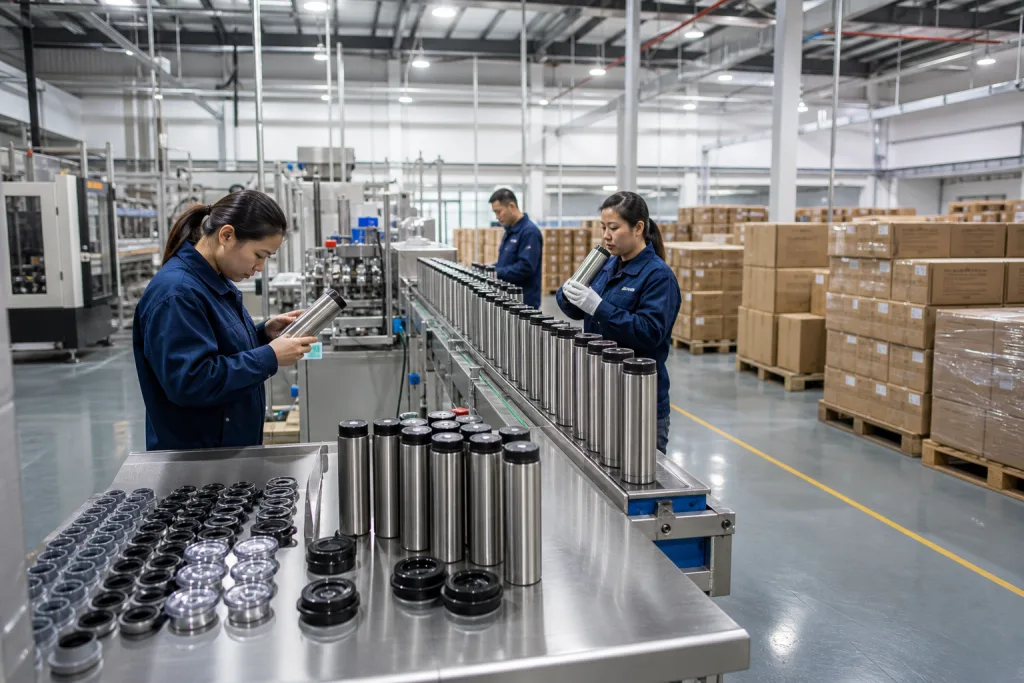
Key Takeaways
- A practical MOQ for a custom travel tumbler is usually 1,000-3,000 pcs per model, with 25-35 day production after sample approval
- 18/8 stainless outer and inner walls with 0.4-0.5 mm thickness is the safer baseline for retail and promotional orders above 10,000 units
- Leak-resistant flip lids reduce complaint rates, but fully leakproof screw lids usually add USD 0.18-0.45 per unit FOB
- For distributor programs, 20 oz and 30 oz sizes typically cover 70%+ of North American demand, while 12 oz and 16 oz work better for office gifting
You do not lose a tumbler order because 18/8 stainless sounds new to the buyer. You lose it after the quote goes out clean, then leakage claims, carton size, or logo abrasion lands 21 days later. We have seen this go sideways. For coffee brands and corporate-gift buyers, the job is not to find a bulk travel tumbler. The job is to match the spec to the sales channel, target margin, and claim risk. On the line, QC pulled a sample last month because the lid torque was 1.2 N·m off spec, and that small miss would have turned into a returns problem fast.
This matters more when you source from Zhejiang, China. Two factories can show the same stainless grade on a PDF and run totally different on tooling control, AQL checks, and print consistency. At BottleForge Industrial in Hangzhou, Zhejiang, we build around 450,000 units per month with MOQs from 1,000 pieces per color, so the pattern is plain: strong distributor programs start with use-case fit, not the lowest FOB. A buyer flagged a logo scratch issue on a PO last season, and the root cause was not the coating itself; it was poor rack spacing during decoration, off by 3 mm.
What buyers compare first
Sourcing a distributors travel mug program means balancing four things: selling price, failure risk, shelf impact, and packing efficiency. Most buyers start with capacity and decoration. We don't. We start with channel fit, because the same tumbler will not work across 3 common cases: a bank promo, a coffee chain private-label launch, and a distributor repeat order. We’ve seen this go sideways when the buyer picked a 30 oz model first, then found the carton height missed their shelf plan by 18 mm.
Here is the practical comparison our export team uses before quoting a bulk coffee travel mug:
- 12-16 oz: better for office desks and commuter sets, with lower freight cost per carton. On our line, these sizes also give tighter carton loading, often 24 pcs instead of 20 pcs in the same outer spec.
- 20 oz: the safest middle ground for coffee brands and coffee mug distributor programs. If a buyer gives us no sales history, this is usually where we start.
- 30 oz: stronger perceived value, but higher steel usage, larger cartons, and more dent risk. QC pulled the sample on one run because the rim took impact too easily after a 76 cm drop test.
- Straight body: easier logo placement, lower tooling complexity, better for coffee mug customized projects. Screen printing registration is cleaner on a straight wall, and the buyer flagged fewer wrap issues on the last 5,000 pc reorder.
- Tapered body: better cup-holder fit and more consumer-friendly, but with slightly less printable area. The math does not work if your main logo needs a wide front panel.
If you buy coffee mug in bulk for resale, ask for the full landed logic, not just FOB. A tumbler that is USD 0.22 cheaper can still cost more after master carton optimization, pallet count, and claim handling. This is the wrong question to ask: “What is your best FOB?” In China, a factory will sometimes cut the shell price, then recover margin through lid quality, logo pass rate, or repacking after inspection finds scratches above AQL 2.5. Ask for unit weight, carton size, gross weight, and AQL standard in the first quote. Not the fifth email.
A useful rule: if two travel mugs are within USD 0.30 FOB, the better lid and decoration process usually wins over the cheaper shell.
Spec table that changes the quote
Here is the spec table buyers actually use to move a quote up or down when they compare a factory-direct coffee mug offer against an export supplier quote. These ranges are normal for Zhejiang and wider China sourcing at 1,000-5,000 pcs per SKU. On our line, once volume drops below 1,000 pcs, the math usually stops working and the “cheap” quote often comes back with cuts in steel weight or lid resin.
Core spec comparison
- Material grade: 18/8 stainless steel is standard for inner and outer walls. Some suppliers switch to 18/0 to save USD 0.20-0.40 on some models, but we have seen tea and lemon-drink items fail salt-spray checks faster, and QC pulled one batch last year for rust spots near the rolled rim.
- Wall thickness: 0.4 mm is common entry level. 0.5 mm gives a better hand feel, dents less in carton drop tests, and holds threads better on screw lids. We check this with a micrometer at the body cut edge before forming.
- Vacuum structure: double-wall vacuum is the standard call for heat retention. Non-vacuum single wall only fits low-cost coffee mug promotional products. If a supplier cannot state a target like 6 hours hot or 12 hours cold, that is the wrong question to skip.
- Powder coating: gives better grip and a more premium finish, usually +USD 0.25-0.55 versus plain spray or natural steel. The line has to control coating thickness, usually around 60-80 μm, or the cup starts looking heavy at the threads and bottom edge.
- Lid type: slide lid is the lowest-cost option. Flip lid drinks better in daily use. Screw lid with silicone sealing is the safer choice for leakproof claims. Buyers push back on this point a lot, but a slide lid and “100% leakproof” on the same PO is where claims go sideways.
- Decoration: one-color silkscreen is the lowest cost. Laser engraving lasts longer and hides handling wear better. Full-wrap transfer works for coffee mug custom made visual branding, but registration has to be watched; the buyer flagged a 1.5 mm logo shift on a recent pre-shipment sample.
Typical FOB pricing for a 20 oz vacuum travel tumbler is around USD 3.10-4.20 with a basic slide lid, USD 3.45-4.65 with powder coating, and USD 3.80-5.20 with a stronger screw lid and premium finish. Tooling for a fully custom lid or body shape can run USD 2,000-6,000, while logo setup is often free or under USD 80. We usually see the spread come from steel weight, lid resin, and finish yield, not from magic margin.
If a coffee mug manufacturer cannot state steel thickness, vacuum retention target, and lid material grade clearly, treat that as a sourcing risk. Ask whether the lid is AS, Tritan, PP, or SAN; whether the gasket is food-grade silicone; and whether the factory can support REACH and LFGB or FDA declarations. We also ask for cup weight in grams and lid weight in grams because that catches quote games fast. A real coffee mug oem manufacturer will answer these points directly; a trading-style quote aggregator often sends back a polished sheet with one typo on the PO and no resin spec.
Use-case fit by sales channel
The best bulk coffee tumbler is the one that fits the channel it sells through. Sounds basic. We still see buyers overbuild corporate gift orders and go too cheap on retail, then the line gets pushback on finish, lid feel, or shelf presentation.
For coffee brands: choose a 16 oz or 20 oz vacuum tumbler with 18/8 steel, powder coat, and a leak-resistant flip or screw lid. Retail buyers usually check three things by hand in the first 30 seconds: coating feel, color match, and sip comfort. On our line, QC pulled samples before because the powder coat delta looked off under 6500K light even though the Pantone was close on paper. If you want coffee mug private label packaging, set the color box layout and barcode position early. For North America, retail-ready packaging often needs FNSKU or UPC placement, and Amazon prep may require suffocation warning text on polybags. This is where POs get messy; we have seen a single UPC digit typo hold carton approval for 2 days.
For corporate gifts: a 12 oz or 16 oz straight-body design often works better than oversized handles or novelty profiles. It loads cleaner into cartons, keeps freight easier to quote, and leaves a better print window for coffee mug customizable branding. A common setup is 24 pcs per master carton instead of an awkward handle shape that wastes cube. If the campaign is date-driven, keep decoration simple: one-color print or laser engraving on in-stock colors shortens lead time by 5-8 days. Buyers ask for full-wrap print on rush orders all the time; this is the wrong question to ask if the event date is fixed.
For distributor stock programs: build around 20 oz and 30 oz families with shared lids. Shared components reduce replacement risk and simplify replenishment. This matters for coffee mug distributors managing multiple customer logos on one common body. We run programs where one PP lid fits two body heights, and that saves shelf space in the spare-parts rack and cuts wrong-pick errors during packing. A shared-lid program can cut spare-part inventory by 30-40%. The math does not work if every SKU needs its own lid tool.
For promotions under USD 5 landed target: avoid overpromising leakproof performance. Use a simple slide lid, standard kraft box, and 1-2 color logo. Buyers searching coffee mug bulk or coffee mug promotional usually care more about delivered cost than 8-hour heat retention. We have had buyers flag “leakproof” claims after a tilt test with 95°C water, so now we push plain language and a basic lid structure at this price point. Keep the claim aligned with the product.
Good sourcing in Zhejiang, China means deciding where the money goes: body steel, lid structure, finish, or packaging. You do not need all four at premium level on every order. Pick the two that affect sell-through most, then hold the rest to spec—on one recent 10,000 pcs run, that decision was the difference between a workable target and a quote the buyer walked away from.
Where custom branding really fails
Decoration issues cause more claims than vacuum complaints. We see the same pattern on the line: buyer signs the pre-pro sample, then bulk cargo lands with the logo shifted 1.5-2.0 mm, white ink turning dull on black powder coat, or laser depth changing from one cavity to the next. If you need coffee mug custom, coffee mug custom made, or coffee mug customized output at distributor scale, write the decoration standard into the PO. If that sheet is missing, we've seen this go sideways fast.
- Silkscreen: economical for 1-2 colors and still a common pick for coffee mug promotional products. On dark powder coat, QC pulled samples with 5-10% color swing between batches when Pantone ink mixing was loose.
- Laser engraving: durable, clean, and a better fit for powder-coated bodies running through daily use. For premium coffee mug private labeling programs, buyers usually like the consistency once the laser power and speed are locked.
- Heat transfer or water transfer: works for full graphics and wrap designs, but the process window is tight. A few degrees off in oven setting or a few seconds too long in transfer time, and scrap climbs.
- 3D decals and embossing: strong shelf look, slower throughput. If the buyer wants 5,000 pcs in 12 days, the math doesn't work.
Ask for a decoration control sheet that shows logo size tolerance, position tolerance, and the adhesion test method. A serious coffee mug supplier should be able to tell you the exact tape test used in-house, whether the line runs a dishwasher simulation or abrasion check on every lot, and what AQL pull QC uses before packing. For distributor orders, we push for a signed golden sample and one carton photo approval before mass packing; one buyer even flagged a PO typo where the logo width was written as 28 cm instead of 28 mm.
Also check if the factory prints before or after final assembly. On some bulk travel mug projects, printing before assembly saves time, but lid fitting can leave handling marks near the artwork, especially around the sip opening where operators grip the body. The right sequence depends on the finish and logo location. This is the wrong question to skip, and a reliable coffee mug factory will answer it clearly without being chased twice.
Audit points before you place PO
If you are comparing a coffee mug supplier directory, a coffee mug supplier list, and three direct factories from China, do not stop at unit price. Check the operation, not the showroom. We’ve seen a clean website lose control on the line over a 0.3 mm lid-thread mismatch.
What to verify
- Quality system: ask whether they run AQL 2.5 for major defects and AQL 4.0 for minor defects, or another standard. Ask who signs the report and when QC pulled the sample. If they cannot define the standard in plain terms, expect inconsistent cartons.
- Compliance: for Europe, confirm REACH, LFGB where relevant, and packaging rules. For North America, ask for FDA-contact declarations and ASTM/CPSIA if the item is marketed to children. We usually ask buyers to match each SKU to each market on the PO, because one typo in artwork or age grading can hold shipment.
- Social audit: BSCI or equivalent is often required for corporate-gift buyers and larger retail programs. If the supplier says “audit in progress” for 6 months, the math doesn’t work.
- Process control: ask for the leak testing rate, vacuum retention sampling plan, powder coat thickness check, and incoming lid inspection method. A real factory should tell you numbers, like 100% leak test on the line, powder coat at 60-80 μm, and Shore A checks on silicone gaskets.
- Capacity and lead time: a realistic factory should state output clearly. Ask for daily output by model, not broad monthly claims. Our normal lead time is 25-35 days for repeat travel tumbler orders after deposit and artwork approval, and that assumes artwork is locked before the first screen is burned.
For first orders, insist on pre-production sample approval, in-line photos, and pre-shipment inspection. A coffee mug manufacturers list means little if the factory subcontracts lids or decoration without traceability. Ask whether lids are made in-house or sourced, whether incoming lots are checked for thread fit and gasket hardness, and whether QC keeps lot records by date and supplier code. We ship smoother when that record starts at incoming inspection, not after a buyer flagged a leak claim.
If your order is under 3,000 pcs and highly customized, be realistic about risk. This is where projects go sideways. Small custom runs are where many coffee mug manufacturer quotes look good but execution slips, because the setup cost gets spread over too few pieces and the line changes too often. Standardizing one body, one lid, and two logo colors usually gives better results than trying to create a fully new platform too early; for a 1,500 pcs MOQ program, that is often the wrong question to ask.
Cost math beyond FOB price
Most buying mistakes show up after the sample sign-off, not before. The trouble starts in freight, pack-out, and claims. We see it on the line all the time: a buyer approves the pre-production sample, then gets hit later by a 58 x 39 x 29 cm carton that wastes pallet space and pushes freight up.
Example: a 20 oz tumbler at USD 3.65 FOB Ningbo packed 24 pcs per master carton can beat a USD 3.42 FOB option once you run the full math. If the cheaper cup uses a larger carton, gives you 8% fewer units per pallet, and brings a 2% higher lid complaint rate, the savings disappear fast. On a 10,000-unit order, that 2% defect gap means 200 problem units. At a landed replacement cost of USD 6-8 landed each, you lose USD 1,200-1,600. This is the wrong question to ask: “What is your lowest FOB?” Ask what the order costs after pallet fill, claims, and reshipment.
For coffee mug private label and distributor replenishment programs, ask suppliers to quote:
- FOB and EXW price
- unit net weight and gross weight
- master carton dimensions
- units per 20GP and 40HQ
- standard packaging and optional gift box cost
- sample charge and refund policy
A strong coffee mug factory direct partner should also tell you where customization creates risk. Metallic paints, soft-touch coatings, and oversized handles look good on a sales sheet, but we have seen them slow output from 12 days to 18 days on the same line. QC pulled the sample on one soft-touch run last year because the coating failed a cross-hatch adhesion check. Buyers still ask for these finishes at 3,000 pcs MOQ, but the math doesn't work if your replenishment program needs stable repeats. Standard diameters, proven lids, and a durable powder coat usually ship with fewer arguments.
This matters even more for China sourcing tied to seasonal deadlines. We ship plenty of Zhejiang programs where the buyer flagged a late carton mark or a lid fit issue, and that small problem turned into missed shelf dates. The best margin is not the cheapest mug. It is the one that lands on time, passes inspection, and reorders next quarter without another quality fight.
Get a travel tumbler quote that holds up
Send your target price, capacity, logo method, and deadline. We will match the right tumbler spec, MOQ, and packing plan for your channel.
Frequently asked questions
What is a normal MOQ for a custom distributors travel mug order?
For a standard 20 oz or 30 oz vacuum tumbler, a practical MOQ is usually 1,000 pcs per color with one logo. If you need a new body mold or custom lid, MOQ often rises to 3,000-5,000 pcs and tooling can add USD 2,000-6,000. For coffee mug private label projects using an existing model, some China factories can mix 2-3 colors within 3,000 pcs total, but decoration setup and carton marking still need discipline. If your order is below 1,000 pcs, stay with stock colors, one-color print, and standard white or kraft boxes. That gives you better cost control and fewer production errors.
How do I choose between slide lid, flip lid, and screw lid for a bulk travel tumbler?
Choose by complaint risk, not appearance. A slide lid is cheapest and works for desk use, usually saving USD 0.15-0.30 per unit, but it is rarely fully leakproof. A flip lid improves drink comfort and is common for commuter products, with a moderate cost increase. A screw lid with silicone gasket is best when you need a leakproof claim, but expect roughly USD 0.18-0.45 more FOB versus a simple slide lid. For coffee brands selling retail, screw or flip lids are safer. For corporate gifts where the tumbler stays mostly upright, a slide lid can be enough if the claim language is careful.
What tests and standards should I ask a coffee mug manufacturer to provide?
Start with food-contact compliance and actual process controls. For Europe, ask about REACH and, where relevant, LFGB-related material declarations. For North America, request FDA-contact declarations, and if the item targets children, check ASTM or CPSIA requirements. On quality, ask how they test leakage, vacuum retention, coating adhesion, and dishwasher resistance. A serious supplier should also understand AQL inspection, commonly AQL 2.5 for major defects and 4.0 for minor defects. If you buy from China, also verify BSCI or another social audit if your end customers require it. Paperwork matters, but the factory should also explain its sampling rate and corrective actions clearly.
How long does production take for coffee mug custom made orders from Zhejiang, China?
For an existing model with standard packaging, plan around 25-35 days after deposit, artwork confirmation, and sample approval. If you need a new mold, special lid color matching, or complex transfer printing, lead time can extend to 40-55 days. Sample development usually takes 5-10 days for logo mockups and 10-15 days for full pre-production samples. During peak season, especially before Q4 gifting demand, add a buffer of at least 7 days. If your deadline is fixed, simplify early: use shared lids, stock powder colors, and one decoration method. That usually protects timing better than pushing a factory to rush a heavily customized order.
Is factory direct always better than using a trading company or supplier directory?
Not always. A coffee mug factory direct source can give you better pricing and faster technical answers, but only if the factory actually controls the key processes. Some factories make shells but outsource lids, coatings, or logo work, which can create traceability gaps. A capable exporter can still add value by coordinating quality and communication. The safer question is whether the supplier can show process ownership, inspection records, and stable lead times. Ask who makes the lid, who does decoration, and who signs off pre-shipment QC. If the answer is vague, low pricing will not help much. Good sourcing in China depends more on operational control than on the label of factory versus trader.