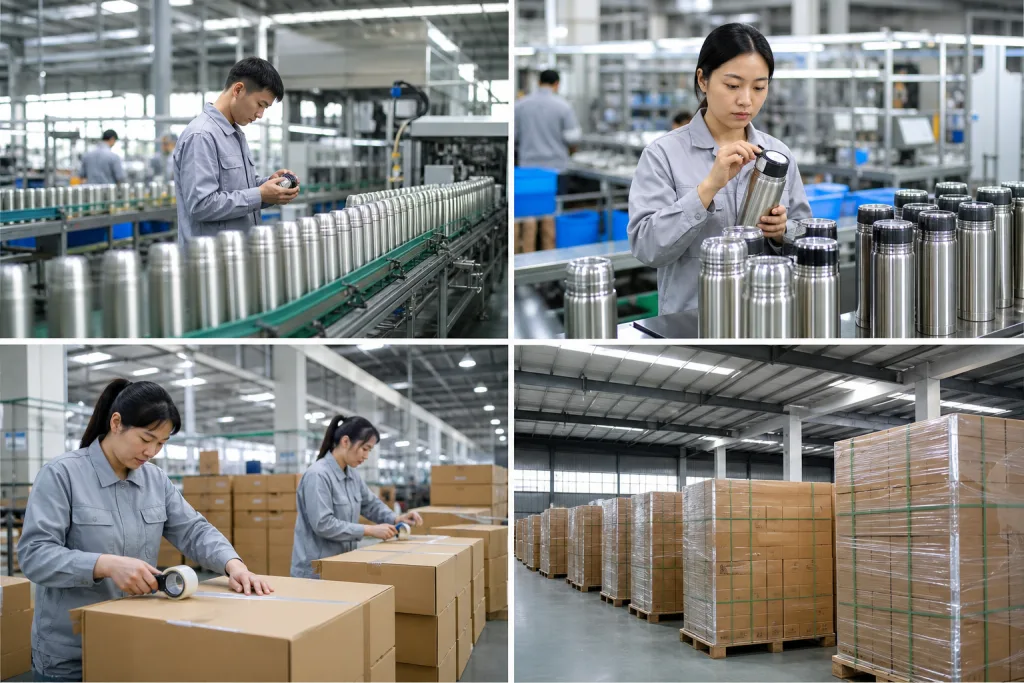
Key Takeaways
- Typical 500ml stainless custom thermos FOB China runs about USD 3.20-6.80 at 1,000-5,000 pcs depending on steel, coating, and lid build
- Common MOQ for a customizable thermos is 500-1,000 pcs per color, but special lids, unique molds, or gift boxes can push MOQ to 3,000 pcs
- Repeat orders usually ship in 25-35 days; first orders with samples, testing, and packaging approval often take 40-60 days
- Decoration, packaging, and leak-risk lid design can change landed cost by 8%-25%, often more than the steel body itself
You probably do not need another glossy custom thermos catalog. You need the cost split. Why does one stainless bottle land at USD 3.20 and another at USD 6.80? Why does one Zhejiang factory run 500 pieces as MOQ while another will not open the line below 3,000? Why does a promised 25-day lead time slip to 40 after the PO hits production? We see this every week with outdoor retailers and promo brands buying a distributors thermos bottle program, and the wrong question to ask is “Which factory is cheapest?”
For bulk thermos sourcing from China, cost and timing come from steel grade, insulation structure, decoration method, packing spec, and whether the factory actually controls its schedule. A thermos supplier, thermos manufacturer, or thermos vendor should answer direct questions: wall thickness in mm, MOQ breaks by color, AQL level, tooling charges, and where the extra 12 days went—vacuum queue, screen printing remake, or carton approval. QC pulled the sample last month on a bottle with a 0.1 mm neck variance, and the buyer flagged cap fit on arrival. That is where programs go sideways, not in the catalog photo.
What actually sets the unit price
When you ask a thermos factory for a quote, the body shape is just the starting point. Price moves on five items: steel, insulation, lid structure, decoration, and packing. For a standard 500ml distributor thermos in 18/8 stainless inside and outside, double-wall vacuum insulated, with powder coating and one-color logo, FOB Zhejiang or Ningbo usually lands at USD 3.20-4.60 at 3,000 pieces. We ran a batch like this last month; QC pulled the sample at 12pcs carton packing, and the buyer flagged the lid print before shipment. Move to a heavier outdoor model with a full stainless cap, tea filter, carry handle, and retail gift box, and the number goes to USD 5.10-6.80. The math does not lie.
Steel spec changes the quote faster than first-time buyers expect. A body built with 0.4mm outer wall and 0.3mm inner wall costs less than one using 0.5mm/0.4mm. That gap is only USD 0.18-0.35 per unit, but it changes dent resistance and how the bottle feels in hand. For outdoor retail, ask for SUS304 interior at minimum. SUS201 on the outer shell can save money on some promo thermos projects, yet most Europe and North America buyers now push for 304 inside and outside because it keeps compliance talks cleaner and cuts corrosion complaints later.
Lid structure is another cost driver that hides in plain sight. A simple PP screw lid with silicone seal may cost under USD 0.45. A stainless-wrapped lid with push button, lock, and multiple sealing rings can go above USD 1.10. We had a PO typo once where the buyer wrote “same bottol body” and missed the lid spec; the sample looked close, but the quote shifted after we matched the old mold. That is why a custom thermos quote with the same bottle body can still differ by more than 20% between suppliers thermos offers.
- Lowest-cost build: existing mold, plain carton, silk screen logo, basic lid
- Mid-range build: powder coat, laser logo, color box, upgraded seal set
- Higher-cost build: new mold part, premium coating, gift box, accessory filter or strap
If a manufacturer thermos quote looks too low, check what got cut. It is usually steel thickness, coating quality, copper plating in the vacuum layer, or carton strength. We’ve seen this go sideways on a 5,000-piece run: the unit price looked great, then the cartons collapsed in drop test at 60cm and the buyer had to pay for a re-pack. Ask for the real spec sheet, not just the headline price.
MOQ tiers that change your math
MOQ is not one number. For a distributors thermos bottle program, split body MOQ, color MOQ, logo MOQ, and packaging MOQ. We run stock-mold stainless vacuum bottles at 500 pieces per model for a plain body, but custom thermos MOQ usually lands at 1,000 pieces because the powder line, print jig, and carton count all need volume.
Here is the usual structure you will hear from a thermos supplier in Zhejiang:
- 500 pcs: existing shape, limited colors, laser mark or simple one-color print, standard export carton
- 1,000 pcs: powder coating, 1-2 body colors, retail color box, common lid options
- 3,000 pcs: exact Pantone matching, more complex print, custom inserts, stronger price break
- 5,000+ pcs: new cap color tooling, private mold discussion, better FOB leverage
Price breaks show up at 1,000, 3,000, and 5,000 pieces. On a 500ml bulk thermos, moving from 1,000 to 3,000 pieces can cut FOB by USD 0.20-0.45. Going from 3,000 to 5,000 may save another USD 0.08-0.20. The math does not work if sell-through is weak. We saw one buyer push for 5,000 units, then flag the slow retail plan after QC pulled the sample and the carton print needed a second round.
Promotional thermos orders often need mixed colors. Ask if the MOQ is per SKU or total order. Some thermos manufacturers let you split 3,000 pieces into three colors of 1,000 each. Others quote 3,000 per color because each powder coat batch and pad-print setup creates waste and line downtime; that is a line decision, not a sales trick.
You do not buy MOQ. You buy the lowest-risk position that still gives you acceptable cost, packaging, and lead time.
For first orders, most distributors thermos buyers should start with an existing mold at 1,000-2,000 pieces instead of paying for a new body tool. New molds can add USD 2,000-8,000 and 20-35 days before mass production starts. One PO typo once turned 2,000 into 200; we caught it before the lid tooling was booked, and the buyer saved a mess.
Decoration and packaging add up fast
A customized thermos usually sells on decoration first, then heat retention. We hear “vacuum hours matter most,” but on the shelf the buyer looks at print sharpness, coating feel, and box presentation. This is where quotes get messy fast. If one supplier includes individual polybag, color box, barcode label, and master carton drop-test spec, while another quotes bulk pack only, the math doesn’t work. On our line, QC pulled the sample more than once because the PO said “gift box” but the buyer actually wanted a 350gsm folding box with EVA insert.
Common decoration costs on a stainless thermos custom order look roughly like this at volume:
- Silk screen: about USD 0.05-0.12 per color per position
- Laser engraving: about USD 0.08-0.18 per position
- Heat transfer / water decal: about USD 0.18-0.45 depending on coverage
- Powder coating: often USD 0.25-0.60 depending on finish and rejection rate
For outdoor retail, powder coating plus laser engraving is usually the safer balance between durability and shelf appeal. We run this combination on 304 stainless bottles with a 60-80μm coating target because it hides handling marks better in packing. For thermos promotional campaigns, silk screen on a painted or powder-coated body is still common since it keeps unit cost down. Buyers do push back on engraving cost, but screen print scratches sooner. We’ve seen this go sideways after one transit test.
Packaging often adds more than decoration. A plain white box may cost USD 0.12-0.20. A retail color box with insert is often USD 0.28-0.55. A rigid gift box can exceed USD 0.90. Then the small items start stacking up: instruction sheet, FNSKU label for Amazon FBA, bilingual compliance marks, carton mark revision, even a desiccant bag. Across 5,000 units, that “minor” add-on becomes a line item you feel. Last month a buyer flagged a 2mm mismatch between bottle outline and box insert cut, and we had to hold packing for one shift.
What you should lock before approval
Ask your thermos manufacturer to freeze these points in the PI and sample approval sheet:
- Artwork size and print position in millimeters
- Pantone reference or coating sample standard
- Barcode type and label placement
- Carton size, gross weight, and drop-test requirement
- Whether replacement lids or spare seals are included
This is the wrong question to ask: “Can you match the sample?” Lock the numbers instead. We need logo width in mm, label location, carton GW limit, and whether spare seals are packed loose or inserted. One missing barcode detail can delay carton printing by 4-7 days. One unapproved logo width can trigger rework. We ship faster when final files come early, not after pre-production sample approval. A disciplined factory thermos process avoids most of this, but only if the buyer sends clean artwork and the PO doesn’t carry a typo in the barcode suffix.
Lead time by project stage
If you are planning a seasonal launch, don’t ask for “best lead time.” Ask for the schedule by stage. That is the right question. On the line, one missed approval can cost 4 days, so a first custom thermos project from China usually breaks down like this:
- Quotation and technical check: 1-3 days
- Pre-production sample: 5-10 days using existing mold
- Artwork and packaging approval: 3-7 days, and we often lose extra time here because the buyer flagged a logo size, carton mark, or even a PO typo
- Mass production: 20-35 days for 1,000-5,000 pcs
- Inspection and booking: 3-7 days
- Sea freight transit: 25-40 days to Europe, 20-35 days to North America depending on port
The honest answer for a first custom thermos order is usually 40-60 days ex-factory, not 20 days. We’ve seen this go sideways when a buyer pushes for a “rush” schedule before the sample is signed. Repeat orders move faster because the artwork file, carton die-line, and process settings are already on record. A repeat 3,000-piece thermos bulk order in an existing color may be ready in 25-35 days, especially if QC pulled the last approved sample and the spray code matches.
Factories in Zhejiang with stable vacuum lines and coating capacity do move faster, but some steps do not compress. The math doesn’t work. Vacuuming time, leak testing, coating cure time, and carton production each have fixed windows. A plant shipping 300,000-500,000 units per month still hits choke points if 8 SKUs land on the same lid assembly bench or the same powder coating oven in one week.
Peak timing matters. Short sentence. Orders placed before Chinese New Year or from September to November usually need a 7-15 day buffer because booking space gets tight and the line is already full. If a manufacturers thermos offer promises 15-day shipment for a brand-new SKU with a custom box, ask which step is being skipped, because one missing drop test, one uncured print, or one delayed carton file at 3 mm bleed can hold the shipment.
A short lead time matters only if the leak rate, decoration quality, and packaging accuracy still meet spec.
Quality checkpoints worth paying attention to
Distributors do not need every lab test on every order, but you do need a quality plan that fits the sales channel. For a distributor thermos going into outdoor retail or promotional resale, ask for documented incoming material control, in-process leak testing, and final AQL inspection. A common shipment standard is AQL 2.5 for major defects and 4.0 for minor defects, though some buyers tighten this for branded retail packs. On our line, QC pulls the first stainless coil cert and checks wall thickness with a digital caliper before cups move to welding.
For stainless thermos, the practical checkpoints are straightforward. This is the part buyers should read twice:
- Vacuum retention and insulation test, for example 12-hour or 24-hour temperature drop standard
- 100% leak check after assembly
- Coating adhesion and scratch resistance spot checks
- Thread fit, lid torque, and seal compression consistency
- Carton drop test and barcode scan verification
On the floor, that means actual controls, not nice words on a spec sheet. We run leak check on every unit after assembly, usually with an air-pressure fixture, and the buyer flagged one batch last year because lid torque drifted 0.3 N·m after a cap mold repair. Small miss. Big claim risk.
If you sell in Europe, ask your thermos supplier about REACH compliance for applicable materials and coatings. For North America, depending on channel and age grading, you may also discuss FDA-contact expectations, California Proposition 65 statements, or ASTM considerations for special use cases. If the item is for children, requirements change again. Do not assume a factory thermos line used for adult bottles automatically meets kids bottle documentation. We have seen POs with “adult bottle lid” typed into a kids program by mistake, and that kind of typo slows approval by 7 days.
Social and management audits also matter for 8 out of 10 importers we quote. BSCI, ISO 9001, or similar systems do not guarantee a perfect bottle, but they usually show better process discipline than a workshop with no records. That matters when you need repeatable custom thermos production over multiple seasons. The audit itself is not the point; the line records are. If a factory cannot show incoming lot traceability or a rework log, we have seen this go sideways.
The cheapest quote often ignores the cost of failure. A 2% leak issue on 10,000 units means 200 complaints, replacements, and lost retailer trust. Saving USD 0.12 per unit does not look smart when returns start arriving. This is the wrong question to ask. Ask what the factory is doing to keep defect rate below 0.5%, who signs off final inspection, and whether QC pulled the sample from packed cartons or from the clean top layer only.
How distributors should quote landed cost
New buyers often stare at FOB and miss the number that hits margin: landed cost. For a distributors thermos bottle, build the sheet line by line: unit FOB, trucking to port, inspection, ocean freight, duty, destination charges, and local warehousing. If you sell into outdoor retail, add sample cost, markdown reserve, and a defect allowance. We run this in a simple Excel template, and if one column is missing, the quote is half-blind.
Here is a plain example. You buy 3,000 pieces of a 500ml custom thermos at USD 4.20 FOB Ningbo. Add third-party inspection at roughly USD 300, freight allocation at USD 0.35-0.70 per unit based on season and how full the container is, then duty, customs-related cost, and local delivery. Your landed cost can reach USD 5.10-5.90 before domestic storage and sales overhead. Add a gift box and an upgraded lid, and the same bottle can land above USD 6.50. QC pulled a sample last month where the gift box added 22 mm to master carton height, which pushed pallet efficiency down. Small change, real money.
That is why experienced thermos distributors usually build quotations from these versions:
- Entry version: standard lid, simple logo, export carton only
- Core version: powder coat, retail box, stronger branding
- Premium version: enhanced lid, giftable pack, accessory parts
This gives you a cleaner selling tool. Promo buyers want a sharp opening price; outdoor retailers usually ask what they get for another USD 0.60-1.20. You do not need to redraw the whole bottle each time. We have seen buyers flag a quote as “too expensive,” then accept it once the retail box, spare straw, and paint finish were broken out. The wrong question is not “what is your best FOB” but “which version fits my channel margin.”
If this is your first China buy, ask for a costed breakdown by body, lid, decoration, and packaging. Some suppliers thermos shops push back on this, and we have seen this go sideways after a PO typo changed print size from 35 mm to 53 mm. Good factories will at least give you a workable range. You do not need every internal number from the line, but you do need enough detail to see why the quote moves when one spec changes.
Get a clear thermos quote before you commit volume
Send your target capacity, lid type, logo method, packaging, and quantity. We will reply with MOQ, FOB pricing, and a realistic Zhejiang production schedule.
Frequently asked questions
What is a realistic MOQ for a custom stainless thermos?
For an existing mold, realistic MOQ is usually 500-1,000 pieces per model, but the usable MOQ depends on finish and packing. If you need powder coating, retail color box, and printed logo, 1,000 pieces is more common. If you want multiple body colors, some China factories allow 1,000 per color within a 3,000-piece total. New mold projects or unusual lids can push MOQ to 3,000-5,000 pieces. If a supplier offers 200 pieces on a fully customized thermos, check whether they are charging a very high unit price or using leftover components. For most distributors, 1,000-2,000 units on a stock mold is the lowest-risk starting point.
How long does a first custom thermos order usually take?
For a first order, plan 40-60 days ex-factory if you want realistic timing. Sampling on an existing bottle shape often takes 5-10 days. Artwork, logo, and packaging approvals can take another 3-7 days, sometimes longer if your internal team is slow. Mass production for 1,000-5,000 pieces usually needs 20-35 days, then 3-7 days for final inspection and booking. A repeat order on the same artwork and carton can often be done in 25-35 days. If your schedule includes sea freight to Europe or North America, add about 20-40 days depending on route and congestion.
What price should I expect for a 500ml bulk thermos?
A standard 500ml stainless steel vacuum bottle with SUS304 inner, common screw lid, powder coating, and simple logo often lands around USD 3.20-4.60 FOB China at 3,000 pieces. A lighter promotional thermos with simpler finish can be below that. A more premium outdoor version with heavier steel, stainless cap, filter, carry loop, and retail gift box can reach USD 5.10-6.80 or higher. Decoration can add USD 0.05-0.45, and packaging can add USD 0.12-0.90 depending on style. Ask for a quote with exact steel spec, wall thickness, lid structure, print method, and carton details. Otherwise, price comparisons are unreliable.
Which quality checks matter most for distributor thermos orders?
Focus on leak rate, insulation consistency, coating durability, and carton accuracy. A practical standard is 100% leak testing after lid assembly, plus AQL final inspection at 2.5 major and 4.0 minor unless your retailer requires tighter limits. You should also confirm vacuum performance, such as a 12-hour or 24-hour temperature retention benchmark, and verify barcode placement if units go to retail or FBA. For Europe, ask about REACH-related material compliance where applicable. For North America, discuss food-contact statements and any channel-specific documentation. A cheap bottle with a 1%-2% leak problem will cost more in claims than you save at purchase.
Should I develop a new mold or use an existing bottle shape?
If this is your first stainless thermos program, use an existing mold unless your brand absolutely needs a unique silhouette. Existing molds cut 20-35 days from development and avoid tooling charges that often run from USD 2,000 to USD 8,000 for body or cap components. They also reduce technical risk because the sealing system and vacuum process are already proven. A new mold only makes sense when you expect larger annual volume, usually 10,000 pieces or more, or when packaging footprint, grip geometry, or channel exclusivity will justify the investment. For most distributors, customization through finish, lid color, logo, and packaging is enough.