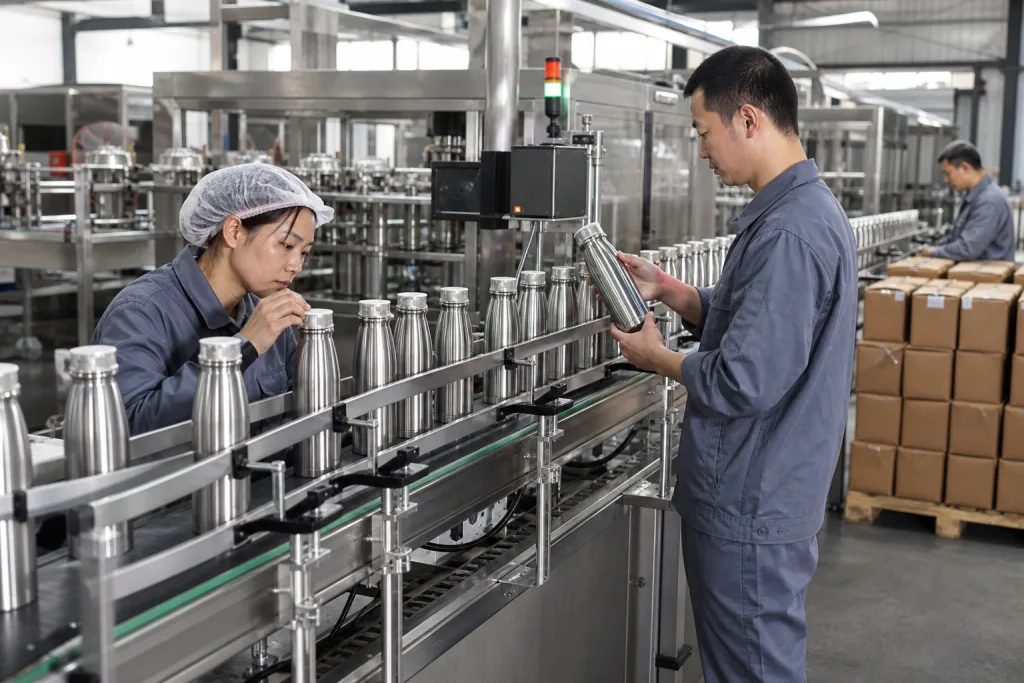
Key Takeaways
- For most distributor tea bottle programs, 18/8 stainless with a 0.4 mm inner wall and 0.5 mm outer wall balances durability and FOB cost at roughly USD 2.80-4.60 per unit.
- A practical MOQ for custom drinkware is usually 1,000 pcs per color for stock molds, while new mold development often starts around USD 2,500-6,000 and 30-45 days.
- Tea infuser design matters more than bottle shape: a 304 mesh basket with 0.3-0.5 mm perforation usually outperforms decorative fine mesh that clogs with leaf tea.
- For Europe and North America, confirm REACH, LFGB or FDA contact compliance, AQL 2.5 inspection, and 72-hour leak tests before mass production.
If you buy for retail chains, promo programs, or regional wholesale, a tea bottle looks simple for about 10 minutes. Then the claim sheet starts growing: double-wall, removable infuser, leakproof lid, powder coat, laser logo, gift box. We’ve seen the sample hit the table and fail on small stuff fast. QC pulled the sample, shook it once, and the filter rattled. Another lot came in with a tea basket that stained after 24 hours in black tea. One buyer flagged a master carton at 62 x 42 x 28 cm because the freight math stopped working. That is the point where people see a distributors tea bottle is not one product. It is a set of trade-offs, and this is the wrong question to ask if you start with color before structure.
From Zhejiang, China, we see the same pattern each season. Buyers ask for a custom canteen or customizable drinkware program, but what they need is a clean spec sheet tied to use case and channel. Retail and promotional do not run on the same logic. Retail buyers often want tighter wall consistency, cleaner decoration alignment within 1.5 mm, and lower return risk. Promo buyers push harder on MOQ, print area, and ship date. We run into this on the line every month. A 500 pcs MOQ idea sounds good until the logo process, gift box packout, and spare infuser all stack up, and the math doesn’t work. China is efficient if you lock the details early. If not, even a good canteen manufacturer will build exactly what is on the PO—even if the PO has a typo on lid color or the market needed a different spec.
Spec table before style talk
You can save 2–3 weeks by comparing tea bottles on five points before anyone asks for Pantone chips or logo files: body material, insulation, infuser design, lid structure, and pack-out. Most buyers start with silhouette because the marketing team wants a clean render on page one. That is the wrong question to ask. Two bottles with the same outline on a PDF can land 20% apart in cost and 40% apart in complaint rate, and we usually see the gap after QC checks thread fit with a go/no-go gauge.
Here is the head-to-head view we use with new distributor drinkware accounts in Zhejiang, China, usually after the buyer flagged “same shape, why higher price?” on the first quote sheet.
- Single-wall glass tea bottle: strong shelf appeal, FOB about USD 1.90-3.20, fragile in parcel channels, good for office gifting, weak for outdoor retail. On the line, breakage risk starts early—glass wall variation of 0.6 mm is enough to show up later in transit.
- Double-wall borosilicate tea bottle: better heat handling, FOB about USD 2.60-4.20, still breakable, works for premium canteen promotional sets. Looks upscale. We have seen this go sideways when the air hole sealing is inconsistent and the outer wall fogs after hot-fill testing.
- Vacuum stainless tea bottle with infuser: best thermal performance, FOB about USD 2.80-4.60, lowest damage rate, strongest fit for canteen distributors and wholesale. We run these hard. A 304 stainless body with vacuum check on the line usually gives the cleanest complaint data.
- Ceramic-lined stainless tea bottle: cleaner taste profile for some tea categories, FOB about USD 4.20-6.80, higher defect sensitivity at the lining stage. The finish sells. The reject risk is real too, especially when QC pulled the sample and found pinholes around the shoulder radius.
If you are a canteen distributor serving outdoor, commuting, and company-store business, stainless usually wins because returns stay lower. We ship fewer replacement cases on stainless, and the math works better once parcel damage is included. If you are targeting boutique tea shops, glass can work, but only if your master carton, divider, and drop-test standards are strict; for one 5-layer export carton, even a 10 mm divider change can cut break claims fast. A canteen supplier that quotes only unit price and skips secondary packaging cost is hiding the real landed picture.
Use-case fit matters more than catalog width. A retail-ready customized canteen for shelf display may justify a color box and insert card. A volume distributor canteen program for events may need a plain white box, one-color print, and tighter pallet efficiency. Same bottle body, different product. Last month one PO even had “gift ox” typed instead of “gift box,” and that small error changed the pack-out discussion before sampling started.
Stainless, glass, or ceramic lined
Material choice is where first-time buyers lose margin fast. If you need a distributors tea bottle that can take wholesale handling and repeat use, start with 18/8 stainless steel, also called SUS304. On our line, this is still the safest baseline for Europe and North America. Some canteen manufacturers quote 201 on the outer wall to cut cost by a few cents per unit. That works on economy items. For anything with tea contact, we still push for a full 304 inner contact surface, because we’ve seen the buyer flag rust spots after a salt-spray check on cheaper builds.
What the numbers mean in practice
- 304 stainless vacuum bottle: 6-12 hours hot retention in normal use, solid corrosion resistance, and broad logo options from silk screen to laser marking. MOQ usually starts at 1,000 pcs on standard bodies.
- 316 stainless inner wall: costs about 8-15% more. It makes sense for higher chloride exposure or a premium story. For plain tea programs, this is often the wrong question to ask.
- Borosilicate glass: cleaner shelf presentation, and tea color shows well. Shipping loss is real unless the pack-out is engineered; QC pulled one drop-test sample last season that failed at 76 cm with a thin base.
- Ceramic-coated interior: helps on taste perception, but coating consistency needs tight process control. We check the inner surface under a cold light lamp because uneven spray shows up fast on white coatings.
For stainless, ask your canteen factory about wall thickness. A stable build is usually 0.4 mm inner and 0.5 mm outer, with a neck finish thick enough to stop lid wobble after torque testing. Thin-wall bottles go below that. They look fine in the sample room. Then dent complaints show up after the first 2,000 pcs ship. For glass, ask for borosilicate thickness and whether the base has silicone protection or a stainless shell. We’ve seen elegant samples go sideways in distributor business because the base ring was glued off-center by 1.5 mm.
If your buyers also ask for custom growler or customized growler lines, stainless is the easier extension path. We run the same decoration methods, similar lid tooling, and shared carton standards across SKUs, which cuts setup time to 12 days vs 18 days on split material programs. That matters if you want one canteen manufacturer to handle mixed programs instead of dividing glass and metal between separate canteen suppliers. The math doesn’t work if every SKU needs a different packing standard and QC checklist.
Infuser design decides repeat orders
Tea bottles fail less often on insulation and more often on the infuser. That is the part buyers under-spec. A full-height basket can look premium on the render, but on the line we see trouble fast: perforation too fine and rolled oolong clogs it; too coarse and QC pulled the sample with leaf dust sitting in the last 15 mm of the bottle. For mainstream black, green, fruit, and herbal tea, a 304 stainless infuser with 0.3-0.5 mm perforation is usually the safe middle ground.
Compare the common layouts head to head. This is the right question to ask.
- Short basket under the lid: lower cost, easier to clean, fine for quick steeping. Less ideal if the user wants to lift leaves out cleanly after brewing. We run this style a lot on 3,000 pcs promo orders because the tooling is simple.
- Full-height basket: gives leaves more room to open and looks better at retail when the buyer wants visible loose-leaf tea. It adds cost, and assembly defects go up because basket straightness and thread fit need tighter control; we have seen 0.8 mm warp create lid rubbing.
- Tea compartment plus strainer plate: a solid compromise for commuters. Fewer loose parts. Easier to repeat on custom drinkware programs, and the buyer flagged fewer after-sales issues on one 10,000 pcs refill order.
Lid material matters too. PP lid structures are common and cost-efficient. Tritan windows look good on shelf, but we have seen them come back scratched after 6 months of office use, and some yellowing shows up sooner on dark tea SKUs. Silicone gaskets should be food-contact grade and seated flat so they do not twist during torque application; our torque meter checks this every hour on the line. We recommend a leak test standard of 72 hours upside down on random samples plus a vacuum hold check during production.
A tea bottle that looks premium but takes 90 seconds to clean will not repeat well, no matter how good the first PO looked.
This shows up fast in canteen promotional campaigns. End users forgive less on a tea bottle than on a plain sports bottle because aroma, leaf residue, and staining are obvious after the first week. If you are buying from a canteen vendor in China, ask for video of basket insertion, gasket assembly, and cap torque control. Ask to see the operator press the gasket into the groove and the torque value on screen. A canteen customizable program stands or falls on those simple steps, and we have seen this go sideways over one PO typo that swapped left-hand and right-hand thread notes.
Decoration options versus order economics
Most buyers know the standard logo methods: silk screen, laser engraving, and digital print. The right choice ties back to order size, bottle finish, and sales channel. For a distributors tea bottle, the cheapest decoration is often the wrong call if the bottle sits on shelf for 90 days and does not move. On our line, QC pulled a sample last month where a bright UV logo looked good in photos but failed a 3M tape test after 20 rubs.
- Silk screen: best value for 1-2 spot colors, with low setup cost. It fits 1,000-5,000 pcs well, and we run it most often on powder-coated stainless because ink hold is stable after oven curing.
- Laser engraving: durable and clean. It works for corporate custom canteen programs, though the buyer flagged one raw silver finish before because the mark looked too light at 0.08 mm depth.
- Heat transfer or UV print: a fit for multicolor artwork, but unit cost climbs fast. Test abrasion resistance first. We have seen this go sideways on gift-channel orders where the artwork passed approval but scratched during carton drop testing.
- Embossed or debossed mold detail: premium look, but new tooling can add USD 2,500-6,000 and 30-45 days. Tooling sounds attractive on paper; the math doesn't work if the program is only 3,000 pcs.
For stock molds from a canteen manufacturer in Zhejiang, typical MOQ is 1,000 pcs per color and 500 pcs per logo layout only if packaging is simple and components are common. That usually means a standard color box, one common lid, and no custom EVA insert. If you need a canteen customized body color, custom lid accent, special infuser, and retail gift box, treat 2,000-3,000 pcs as the realistic starting point. This is the wrong question to ask: "Can you do 500 pcs?" The better question is how many changes you want inside that 500 pcs. Buyers who squeeze all variables into a 500-piece run usually get small-batch pricing that kills margin.
Retail distributors also need a color strategy. Matte black, navy, off-white, and muted green reorder better than trend colors because they fit year-round gifting and company-store demand. We ship those four shades again and again, while seasonal lilac or neon SKUs often stall after one PO. If you serve multiple canteen distributors or a mixed canteen supplier network, shared standard colors cut dead inventory. We have even seen a PO typo switch PMS matching on a lid ring, then 800 pcs had to be sorted by hand. Not glamorous advice. Profitable advice.
For Amazon or other parcel-heavy channels, barcode placement, FNSKU labels, and outer carton dimensions must be fixed before mass production. A canteen factory that handles export daily should be able to quote carton GW, NW, and CBM immediately, not after sampling. If the factory needs 3 days to answer basic carton data, ask more questions. Our packing team checks carton drop height, label position in mm, and pallet stack count before the first 200 pcs are packed.
MOQ, lead time, and factory reality
Most buyers ask MOQ first. That is the wrong question to ask. Ask what sets the MOQ on this tea bottle: color batching on the spray line, print screen setup, infuser sourcing, and carton minimums. We run into this every week. A Zhejiang factory with 300,000 units monthly capacity can still reject a 300-piece custom order because one changeover on the powder-coating line can burn half a shift, and the math doesn't work.
A practical benchmark for stock tea bottle projects looks like this:
- Sample lead time: 5-7 days for existing shape with standard finish, 7-12 days with custom logo and box mock-up.
- Mass production lead time: 25-35 days after deposit and sample approval in normal season.
- MOQ: 1,000 pcs per color for common stainless vacuum bottles.
- Capacity reference: 300,000-500,000 pcs/month for a mid-sized export-focused canteen factory.
These figures move in peak season. Before Q4 gifting and spring outdoor launches, the line gets tight fast. If your canteen distributors need August or September delivery, lock artwork and packaging by June. That is standard timing, not early. New buyers often hold for final brand sign-off, then expect China production to move like digital print. It doesn't. Last season one buyer flagged a box text change after sample approval, and that single PO typo cost 6 days because the outer carton had to be reproofed.
Be straight about your own demand plan. If you want a customizable growler, distributor growler, and tea bottle program together, tell the factory at the start so we can plan shared lids, infusers, and carton sizes. Same for a canteen custom line with matching tumblers and sports bottles. QC pulled the sample on one mixed program here and found the same silicone ring fit 3 SKUs, which cut spare-part stock and simplified inspection. A solid canteen supplier will standardize coatings, cartons, and inspection points across the range. That saves money over 2 or 3 repeat orders.
For payment terms, the common export structure is 30% deposit and 70% before shipment, FOB Ningbo or FOB Shanghai. We ship on that basis all the time. If a canteen manufacturer offers a low price but cannot state lead time, loading port, or spare part policy clearly, the quote is incomplete. We've seen this go sideways after booking, especially when the buyer asks for one replacement infuser per 500 pcs and the factory never priced it.
Compliance and quality control checkpoints
If you sell into Europe or North America, compliance is not a later add-on. It sets the material, the print ink, even the silicone grade. For stainless tea bottles, ask for food-contact declarations and test support for the target market: FDA for the US, LFGB where needed, and REACH for Europe. On one project, the buyer flagged a 0.3 mm logo shift on the carton, and we had to recheck the art file before the line could run. For kids-adjacent use or broad retail, ASTM packaging and labeling checks may also come into play, depending on the program.
On factory control, the basic checklist should include:
- AQL standard: usually AQL 2.5 for major defects, 4.0 for minor on finished goods.
- Leak testing: 100% inline vacuum or air pressure check plus random 72-hour inversion test.
- Coating adhesion: cross-hatch or tape test on painted bodies.
- Insulation test: hot water retention benchmark after 6 and 12 hours.
- Drop test: especially for glass units and gift-box retail packs.
A canteen vendor that talks only about certificates and skips process control is not enough. You want both. BSCI or ISO system audits are useful signals, but they do not replace production checks. Ask if the manufacturer runs incoming inspection on lids, mesh baskets, and gaskets. QC pulled 30 pieces from a 2,000-piece batch once, and 7 bad gaskets came straight from the supplier carton. Most tea bottle defects start with bought-in parts, not the bottle body. This is the wrong question to ask if you only want a certificate copy.
For custom drinkware and customized drinkware projects, pre-production sample approval should freeze these items: Pantone reference, logo size in mm, bottle weight tolerance, carton mark, spare gasket policy, and barcode file. If you skip that, your second PO may come back with a different cap color or a 12 g weight swing. We’ve seen it go sideways on a PO typo too—one buyer sent “2,000 pcs” while the packing list said “20,000 pcs,” and the dispute ate a week. That is how avoidable fights start between brand owners, canteen vendors, and distributor teams.
Best fit by sales channel
The right distributors tea bottle depends on who will resell it, what margin they need, and how fast they expect stock to move. No single SKU wins everywhere. We’ve seen the same 500 ml bottle sell through in 12 days for one channel and sit 18 days in another.
For wholesale distributors
Pick a 450-550 ml vacuum stainless model with a short infuser basket, powder coat finish, and silk-screen logo. That spec range is the safe play on the line because the complaint rate stays lower and the FOB target usually lands at USD 3.00-4.20 depending on lid complexity. We normally run this with 304 stainless and a 1.2 mm silicone seal. It fits a canteen distributor selling into office accounts, travel retail, and seasonal gift business.
For boutique tea retail
Use premium stainless with a visible infuser, or double-wall borosilicate if shelf presentation is doing the selling. Glass needs stronger carton protection—our drop test standard is usually 5-layer outer cartons with dividers—and you should budget for higher breakage reserve if you go that route. The buyer often flags this point after the first damaged shipment. A customized canteen story helps, but the math does not work if the packaging is weak.
For promotional programs
Stay with proven stock molds, simple lid colors, and laser or 1-color print. Promo orders are won on delivery date and logo accuracy, not design tricks. QC pulled the sample last month on a PO where one brand name letter was off, and that was the whole meeting. Keep MOQ realistic, such as 1,000 pcs instead of pushing 3,000 pcs too early, and skip custom accessories unless the customer is paying for the tooling and packing cost.
For outdoor and specialty stores
Add larger capacities or a custom growler family so the range looks planned, not patched together. A customizable growler or customized growler line next to tea bottles can lift average order value if decoration and carton specs are shared. We ship these programs more smoothly when the bottle body diameter stays within the same carton footprint, for example 78-82 mm. This is the wrong question to ask if the buyer only cares about one hero SKU; store sets usually need a family look.
If you are managing multiple canteen suppliers today, use one blunt test: who can send complete specs, compliance scope, lead time, and carton data in one sheet within 48 hours? That is usually the canteen factory worth building with. We’ve seen this go sideways when a supplier quotes fast but leaves out carton gross weight or LFGB scope, then the buyer finds the gap at booking stage. The bottle matters. Export discipline matters just as much.
Get a tea bottle spec sheet that actually helps buying
Send your target price, market, and quantity. We will recommend the right bottle structure, MOQ, compliance path, and packaging from our Zhejiang, China production base.
Frequently asked questions
What is the usual MOQ for a custom distributors tea bottle?
For a stock stainless tea bottle with custom logo, the common MOQ is 1,000 pcs per color. If you want a custom body color, matching infuser, and printed retail box, expect 2,000-3,000 pcs to get workable pricing. Some canteen manufacturers in China will quote 500 pcs, but usually only for laser logo on standard stock with plain packaging. If you ask for special coatings or molded parts at that volume, the unit cost rises fast. For new molds, development often starts from USD 2,500 to USD 6,000 with about 30-45 days added before production. Always ask whether MOQ is driven by bottle body, lid, print, or box supplier, because each component has its own minimum.
Which material is best for tea bottle distribution: stainless or glass?
For most B2B distribution, stainless is the safer choice. A 304 stainless vacuum tea bottle gives better durability, lower damage claims, and easier freight handling. Typical FOB pricing is around USD 2.80-4.60 depending on capacity and lid design. Glass looks stronger on shelf, especially for tea shops, but breakage risk is much higher unless you invest in dividers, stronger color boxes, and stricter drop testing. That adds cost beyond the unit price. If your channel includes parcel shipping, wholesale handling, or outdoor retail, stainless usually wins. If the program is premium gifting or boutique retail with low handling risk, double-wall borosilicate can work, but insist on pack-out specs before placing the PO.
How long should lead time be for customized drinkware tea bottles?
For existing molds, sample lead time is usually 5-7 days with a standard finish and about 7-12 days with logo and custom box. Mass production is normally 25-35 days after deposit and sample approval. In peak season, especially before Q4 gifting, it can stretch to 40 days or more. If a canteen factory in Zhejiang or elsewhere in China promises 15-day delivery on a fully customized drinkware program, ask exactly what is included. Often that timeline excludes packaging or decoration curing. A realistic export plan also includes 2-5 days for final inspection and booking. If your market launch depends on a fixed date, lock artwork and carton details early, because packaging delays are one of the most common causes of missed ship dates.
What quality checks should I require before shipment?
At minimum, require AQL 2.5 inspection for major defects and 4.0 for minor defects, plus a 100% leak check during production. For tea bottles, ask for random 72-hour upside-down leak testing, insulation testing at 6 and 12 hours, coating adhesion tests, and torque checks on lids. If the product includes an infuser, verify fit, mesh burrs, and easy removal after hot water exposure. For glass versions, include drop testing with retail packaging. You should also freeze color reference, logo size, carton marks, and spare gasket policy at pre-production sample stage. Certifications such as REACH, FDA, or LFGB support compliance, but they do not replace actual production control. Ask your canteen supplier for inspection photos or video before balance payment.
Can one supplier handle tea bottles, custom canteen items, and growlers together?
Yes, if the supplier has a broad enough metal drinkware line and stable bought-in component management. Many export-focused canteen manufacturers can run tea bottles, sports bottles, tumblers, and custom growler projects under one quality plan. That usually saves money on decoration setup, packaging standardization, and inspection alignment. The key question is whether they truly control common processes such as vacuuming, powder coating, logo printing, and carton engineering. If they outsource too many steps, you may lose consistency across SKUs. Ask for monthly capacity, common steel grades, standard lid families, and whether one account manager handles all categories. A supplier producing 300,000 units per month with stock molds and export QC is often better positioned than a small workshop offering everything on paper.