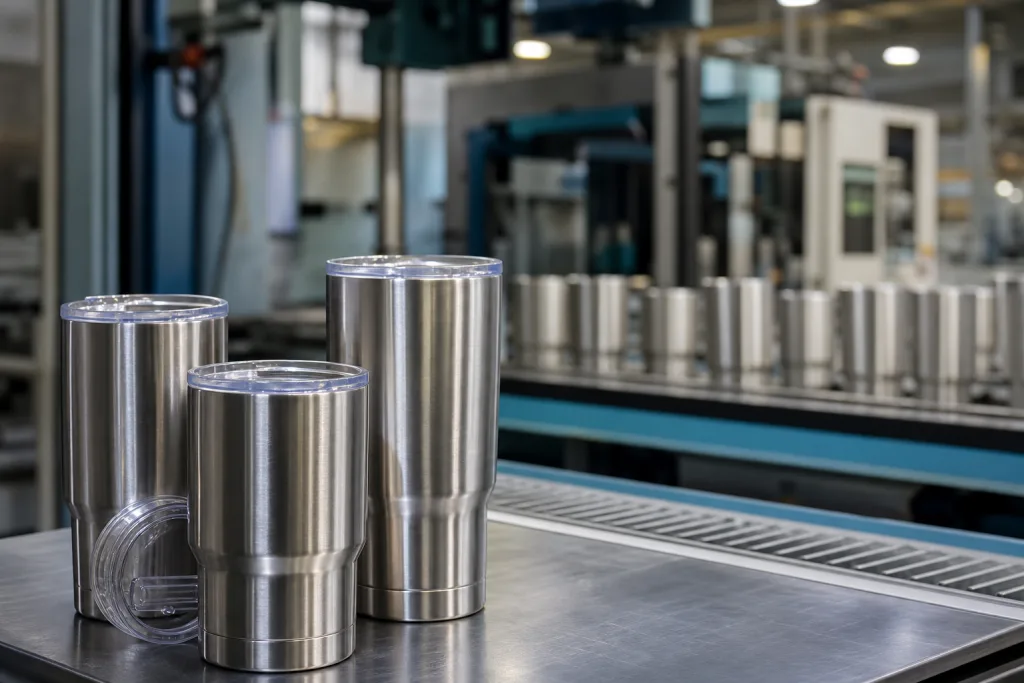
Key Takeaways
- A 20 oz double-wall 304 stainless steel tumbler typically lands at USD 2.85-5.80 FOB China depending on lid, coating, print method, and MOQ from 500 to 10,000 units.
- New custom drinkware projects usually need 7-12 days for pre-production samples and 25-40 days for mass production after sample approval.
- MOQ tiers matter: 500 units is workable for selected stock molds, while 3,000-5,000 units usually unlocks better decoration pricing and carton efficiency.
- AQL 2.5 inspection, REACH testing, and retail packaging upgrades can add 3-8% to total cost but reduce claim risk later.
You usually do not lose money on a stainless steel tumbler because the cup failed. You lose it after the “simple” quote picks up extra cost in a new mold, logo print rejects, a gift box upgrade, or a vessel booking that slips 6 days at Ningbo. We have seen this go sideways. If you are buying for retail, promo, or wholesale distribution, you need a tighter way to cost out a distributors stainless steel tumbler program before you place the PO.
At BottleForge Industrial in Hangzhou, Zhejiang, we build custom drinkware for buyers in Europe and North America, and the same questions hit our sales desk every week: what should a 20 oz tumbler cost, what MOQ actually moves the unit price, and how many days should you allow for sampling, production, and export from China? On the line, QC pulled a sample last month because the powder coat was 18μm light near the base seam. That kind of detail changes the math. A broad range is the wrong answer here. You need the cost broken out piece by piece.
Where tumbler pricing really moves
Ask five tumbler factories for pricing and you may get five close numbers built on five different BOMs. We see this every week. For a distributor program, pricing moves on material grade, steel weight, lid structure, surface finish, decoration, and packing spec. The shell usually carries 45% to 60% of FOB, and 0.05 mm on the wall can change the math more than a buyer expects.
For a common 20 oz vacuum tumbler made in Zhejiang or other manufacturing hubs in China, these are the baselines we usually run:
- 18/8 stainless inner and outer: costs more than 18/0, but it is the normal spec for food-contact premium programs. Buyers who ask to cut this first usually get pushback from their own market later.
- Inner wall thickness: 0.35 mm to 0.45 mm is common. QC pulled the sample last month and measured 0.38 mm on the micrometer, which sat right in the middle of the workable range.
- Outer wall thickness: 0.45 mm to 0.50 mm is common. At 0.50 mm, the cup feels better in hand, but freight and material cost both creep up.
- Copper coating: adds roughly USD 0.08-0.18 per unit but improves heat retention claims. On the line, this is one of the first add-ons we confirm because buyers often miss it on the PO.
- Standard AS lid: lower cost than screw lid or magnetic slider lid. This is the wrong place to chase a big saving if your market cares about leak resistance.
A plain powder-coated tumbler with one-color silk screen is not the same item as a retail-ready piece with a custom mold lid, laser engraving, barcode label, and individual color box. One is a simple production run. The other stacks cost at each station. We have seen quotes at USD 3.10 and USD 4.40 for the same stated size, and both were fair once the full spec sheet was checked—one even had a typo on the packing line that changed from bulk pack to 1 pc color box.
Ask what steel grade, wall thickness, lid material, decoration method, and packing standard are included before you compare quotes. If those five points are not lined up, the comparison is off from the start.
For buyers building a broader custom drinkware line, the same pricing logic applies to a custom canteen, customized growler, or custom growler. A growler uses more steel and a different cap system, so cost rises fast; on a 64 oz body, the weight jump alone is obvious when we put it on the scale. A canteen custom project can look cheaper at first because the body shape is simpler, but we have seen this go sideways once soft-touch coating, bamboo lids, or gift box packing get added after sampling.
Typical FOB cost by order tier
For distributors buying stainless steel tumblers, budget by MOQ tier first. That is the number that moves fastest on the quote sheet. At our Hangzhou, Zhejiang plant, selected stock molds start at 500 units per color, while the line runs with better cost at 2,000 to 5,000 units. Factory output is around 300,000 units per month across tumblers, sports bottles, canteens, and related custom drinkware. On the floor, one 20 oz body usually comes off the weigh check at about 320 g to 360 g, and that steel weight shows up in FOB fast.
Reference FOB China ranges for a 20 oz vacuum tumbler
- 500 units: USD 4.60-5.80
- 1,000 units: USD 3.95-5.10
- 3,000 units: USD 3.30-4.35
- 5,000 units: USD 3.05-4.00
- 10,000 units: USD 2.85-3.70
Those are workable FOB ranges for 304 stainless steel, powder coating, standard lid, and one simple logo process. If you switch to soft-touch finish, electroplating, full-wrap heat transfer, or a more complex leak-resistant lid, add USD 0.20 to 0.90 per unit. If you pack in a plain white box instead of a printed retail box, you may save USD 0.12 to 0.35. QC pulled the sample on one recent matte black order because the lid torque was off by 0.3 N·m, so this is the wrong place to squeeze cost too hard.
Distributors often ask whether a canteen distributor or canteen factory can combine products under one PO. Yes, we ship mixed programs every month, but the math does not work unless shared cartons, print setup, and container loading are controlled from day one. Splitting 2,000 units into four colors and three artworks can raise reject risk and slow packing. We have seen buyers flag this after a PO typo changed one carton mark from 24 pcs to 12 pcs, and the warehouse had to stop the line to sort labels.
For adjacent products, a customizable canteen or customized canteen in the 17 oz to 25 oz range often prices at USD 2.60-4.80 FOB. A customizable growler or distributor growler in 32 oz or 64 oz usually starts higher, often USD 5.50-11.00 FOB, because of heavier steel, larger vacuum area, and specialty cap components. A 64 oz growler body can run more than 0.6 kg before packing, so freight and weld consistency start to matter more than buyers expect.
Decoration and packaging change margins
This is where first-time buyers blow the quote. The tumbler body is only the base cost. In canteen promo business, decoration and packaging decide whether the order makes money or just keeps the line busy. We have seen buyers quote from a plain sample on the table, then get hit later when QC pulled the sample and the PO actually called for logo print, unit box, and barcode label.
Common decoration adders for stainless tumblers in China:
- 1-color silk screen: USD 0.08-0.18
- 2-color silk screen: USD 0.15-0.28
- Laser engraving: USD 0.10-0.25
- Heat transfer wrap: USD 0.22-0.45
- Full digital print: USD 0.35-0.70
If you are building a canteen customizable line for e-commerce or store shelves, packaging hits margin just as hard. This is the wrong question to ask: “What is your cheapest tumbler?” Ask what the packed unit costs in the exact sellable format. On our side, we check box size down to 2-3 mm because a small change in insert fit can slow packing speed on the line.
- Brown mailer box: usually the lowest cost, fine for simple distributor canteen orders.
- White unit box: adds around USD 0.10-0.18.
- Full-color retail box: adds around USD 0.22-0.55 depending on board grade and print coverage.
- Barcode label, FNSKU, suffocation warning, insert card: add labor and material, usually USD 0.03-0.12 total.
The same warning applies to customized drinkware, customized growler, and customized canteen orders. Buyers fixate on bottle cost and miss the setup charges. New logos may need screen charges of USD 20-50 per color per design. New gift box structures may require a sample fee of USD 80-200. If you need dishwasher claim testing, drop tests, or retail transit validation, budget it from day one. We have even seen a PO typo change the print callout from 1-color to 2-color, and the buyer flagged the surcharge only after mass production approval.
Good canteen manufacturers and canteen vendors spell out these adders early. If a quote looks cheap, check whether it leaves out individual polybag, egg-crate divider, export carton upgrade, or spare lids. The math doesn't work if those items show up after deposit. Each line looks small, but on 5,000 units they can move landed margin by 3-5 points, especially once carton weight crosses the next freight break.
Lead time from artwork to vessel
Lead time needs to be split by stage. One lump-sum number is the wrong question to ask. For a practical distributors stainless steel tumbler program from China, we usually quote it like this after the line checks the logo file and the Pantone callout:
- Quotation and artwork review: 1-3 days
- Pre-production sample: 7-12 days
- Sample revision if needed: 4-7 days
- Mass production after approval: 25-40 days
- Inspection and booking buffer: 3-7 days
If the factory runs an existing mold and a standard lid, you stay near the short end. If you are opening a custom canteen, a customizable drinkware assortment, or a customized growler with new tooling, add time from day one. New mold development often needs 20-35 days for prototype and trial run before normal production even starts. We have seen this go sideways when a buyer sends a PO with the lid code typed wrong by one digit.
Peak season changes the math. From August to November, 8 out of 10 canteen distributors and tumbler importers are pushing holiday, Q4 retail, or promo orders through the same window. A 28-day job in March can turn into 40-50 days in October, especially if QC pulled the sample and asked for a second color check on the spray finish. In Zhejiang and across China, vessel space also gets tight in that period.
If your customer needs goods in warehouse by a fixed date, work backward from arrival, not from production start.
For Europe and North America, separate sea transit from factory lead time. That keeps planning honest. A workable model is factory lead time plus 25-40 days ocean transit, then customs and inland delivery. If you need faster replenishment, ask whether the canteen supplier can split the shipment: part by air for launch, balance by sea. The freight bill jumps fast, and sometimes the math does not work, but we ship this way for urgent launches when the buyer flagged a hard warehouse date.
MOQ logic and when to push
MOQ is not just a sales policy. It is line math. Stainless steel drinkware runs through tube cutting, deep drawing, welding, vacuuming, polishing, powder coating, printing, and packing, and each changeover burns time on the line and creates scrap. On one 20oz tumbler run, a color change can eat 40 to 60 minutes before output is stable again. That is why a canteen manufacturer or canteen supplier will push back on 300 pieces with two custom colors and mixed logos—the math doesn't work.
For stock tumblers, 500 units is often workable, especially for a plain body with one one-color logo. For a fully customized drinkware order with custom lid color, Pantone body matching, printed box, and insert, 1,000 to 3,000 units is the normal range. For a custom growler or customizable growler with special cap tooling, MOQ often starts at 2,000 pieces. We have seen buyers ask for 800 pieces with a new PMS body and custom box, then flag the quote as high. That is the wrong question to ask. The better question is which process is forcing the minimum.
You should push on MOQ only when you know which part is driving it:
- Body color MOQ: tied to coating batch efficiency; we run better yield when one powder batch covers a full rack set instead of half-load hangs.
- Logo MOQ: tied to print setup and labor; silk screen mesh setup for one logo is one thing, four logo swaps on 500 pieces is another.
- Packaging MOQ: tied to box printer board run; some box suppliers want 1,000 sheets minimum even if the tumbler order is smaller.
- Custom component MOQ: tied to injection molding or silicone color batch; a lid gasket in custom red might need a full silicone mix lot at 25 kg.
Sometimes canteen distributors assume the whole MOQ is fixed, but a good canteen factory can split the logic by part. Example: 3,000 tumblers total, split into 1,000 each of black, navy, and white, with one common lid and one common carton. That runs clean. 3,000 units split into six body colors, six logo versions, and three packaging types is where we have seen this go sideways. QC pulled the sample once on a mixed run because the PO had "navy" typed for one SKU and "dark blue" printed on the carton file.
At BottleForge Industrial, we usually tell new B2B buyers to test with stock molds and controlled customization first, then move to deeper canteen customized or canteen custom development after sales data is real. Start with one body color, one lid, one carton, and an MOQ you can ship in one batch. A first order at 1,000 pieces teaches more than a fancy 3,000-piece launch that sits in stock for 120 days. It is less glamorous, yes, but it protects cash flow.
Quality costs less than claims
If you buy for distribution, the bigger risk is not an extra USD 0.12 on inspection. It is landing 5,000 units with uneven powder coating, loose lids, or weak vacuum retention, then eating replacements, chargebacks, and lost customer trust. We have seen QC pull a sample with a 0.8 mm lid gap while the golden sample was tight. That shipment turned expensive fast.
For stainless tumblers and related custom drinkware, set the quality protocol before deposit payment. Not after the line starts.
- AQL standard: commonly AQL 2.5 major, 4.0 minor
- Vacuum test: 100% inline or agreed sampling plan
- Coating adhesion: cross-hatch or tape test by batch
- Leak test: according to lid style and claim
- Material compliance: REACH, LFGB, FDA as required by market
If you sell into large retail or corporate channels, ask about factory social and system standards such as BSCI, ISO 9001, or audit history at the quote stage. This is the wrong question to ask after deposit. We ship buyers who need audit files before mass production, and one missing report can push approval to 12 days vs 18 days. Not every canteen vendor needs every certificate, but if your customer asks for them, late discovery slows the whole PO.
Third-party inspection in China often costs roughly USD 250-350 per man-day. Lab testing can range from a few hundred dollars for focused checks to over USD 1,000 depending on the protocol. On paper, some buyers call this overhead. The math does not work that way. One failed shipment costs more, and we have seen buyers flag cartons over a small coating rub issue that an AQL check would have caught in 1 day.
The same discipline applies whether you buy a distributor canteen, canteen promotional bottle, customizable canteen, or distributor growler. The category changes. The buyer job does not. Define the spec, lock the sample, confirm tolerance, inspect before balance payment, and keep records by PO. Even a small PO typo on lid code or straw color can go sideways once the line is running.
How to quote your own customer safely
If you distribute custom drinkware, your customer usually wants one number by lunch. Fine. We still build that number line by line. Start with FOB product cost, then pack cost, testing, inspection, freight, duty, warehouse handling, and a reject allowance. On first orders, we usually park 3% as contingency until the line is stable and QC stops finding surprise issues like logo position drifting 1.5 mm off the approval sample. If you skip that buffer, the math doesn't work.
A practical quoting model for a 3,000-unit tumbler order might look like this:
- FOB tumbler: USD 3.55
- Laser logo: USD 0.14
- Color retail box: USD 0.28
- Inspection and testing amortized: USD 0.09
- Total ex-factory program logic: USD 4.06 before freight and import costs
Then ask the commercial questions that actually change cost. Is this a one-time canteen promo order, or a repeat distributor canteen line with the same body and lid? Will the customer reorder the same art, or are they changing artwork every season? Are they building a canteen customizable platform with 4 colorways, or adding one custom canteen SKU after a sports bottle launch? We have seen this go sideways when a buyer said "repeat program" and the PO later showed 6 mixed colors at 500 pcs each. Repeat business lets you spread setup cost across more units. One-off jobs need more margin, full stop.
Buyers in Europe and North America often want a fast yes or no from a canteen manufacturer in China. The safer move is a clean RFQ with the key specs up front: product size, steel grade, finish, decoration file, packaging standard, target qty, target ship date, destination market, and compliance needs. Send that, and we can quote faster with fewer bad assumptions. We run quotes every day where the only missing item is the steel grade—304 stainless vs 201 changes the number fast. QC pulled one sample last month from a rushed order where the buyer flagged the carton, but the real problem was a typo on the PO for the surface finish.
Get a costed tumbler quote with realistic timing
Send your target quantity, decoration file, and packaging spec. We will quote MOQ, FOB pricing, and lead time from Zhejiang, China without padded assumptions.
Frequently asked questions
What is a fair MOQ for distributors stainless steel tumbler orders?
For a stock 20 oz stainless steel tumbler with standard lid and one simple logo, 500 units is a fair opening MOQ in China. If you need Pantone body color, printed retail box, or multiple logo positions, expect 1,000 to 3,000 units. If your project includes a custom lid or new mold, MOQ can move to 3,000 pieces or more. The right question is not only the total MOQ, but which part drives it: coating, printing, packaging, or molded components. Many factories in Zhejiang can reduce risk by keeping the body standard while customizing only the logo and box for the first PO.
How long does a custom tumbler order usually take from approval to shipment?
If the factory uses an existing mold, allow 7 to 12 days for a pre-production sample and 25 to 40 days for mass production after approval. Add 3 to 7 days for inspection, booking, and export documents. In peak season, especially from August through November, production may stretch to 40 to 50 days. If you are developing a custom canteen, customized growler, or special lid, tooling and trial runs can add another 20 to 35 days. For sea freight to Europe or North America, add transit separately. Most delays happen because artwork, box dielines, or compliance requirements are not locked early.
Which specs affect tumbler cost the most?
The biggest cost drivers are steel grade, wall thickness, lid design, finish, print method, and packaging. A 20 oz 18/8 double-wall tumbler with 0.35 mm inner wall and 0.45 mm outer wall costs less than a heavier-gauge version with copper insulation and a complex slider lid. Decoration can add USD 0.08 to 0.70 per unit depending on method. Packaging can add another USD 0.10 to 0.55. If you compare quotes, ask whether they include 304 stainless, powder coating, individual box, spare parts, and export carton standard. Missing details are usually why quotes look artificially low.
Should I buy tumblers and canteens from the same factory?
Usually yes, if the factory already makes both product types well. A capable canteen factory or canteen manufacturer can help you consolidate sourcing, align colors, and reduce communication time. That matters if you sell a full custom drinkware range including tumbler, custom canteen, and custom growler items. But do not assume every canteen supplier is equally strong across all categories. Ask for production photos, sample references, monthly capacity, and inspection records for each product line. If one supplier is excellent at tumblers but weak on larger customizable growler assemblies, splitting vendors may still be the safer choice despite the added coordination.
How much should I budget for quality control and compliance?
For a normal B2B order, budget about 3% to 8% of product value for inspection, basic testing, and compliance paperwork, depending on your market and channel. A third-party inspection in China often costs USD 250 to 350 per man-day. Focused lab tests for food-contact materials can start in the low hundreds, while broader REACH, LFGB, or retailer-specific protocols can exceed USD 1,000. If your order is only 500 units, that overhead feels heavy, but it is still often cheaper than a replacement claim. For repeat SKUs, you can lower cost by testing only on material or component changes rather than every batch.