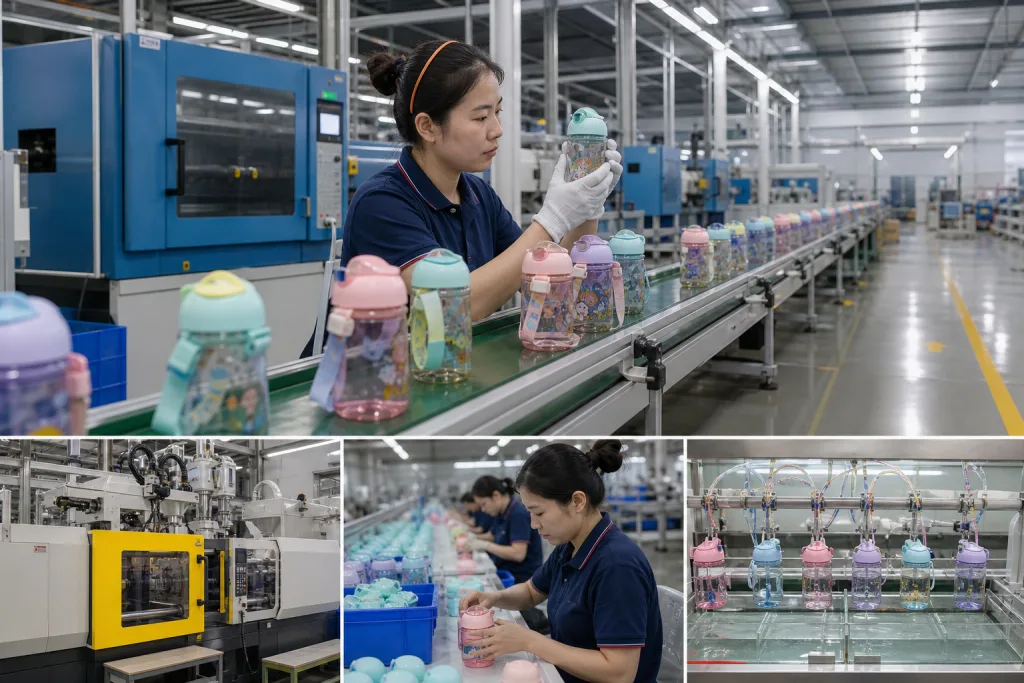
Key Takeaways
- For a custom kids water bottle, practical MOQ usually starts at 3,000-5,000 units per colorway, with 25-35 day production after sample approval.
- A safer school spec is 18/8 stainless steel or BPA-free Tritan with 0.5-0.6 mm body thickness and 100% leak testing before packing.
- Third-party inspection at AQL 2.5/4.0 costs far less than a rework; common check points are odor, print adhesion, drop test, and barcode accuracy.
- From Zhejiang, China, a factory running 600,000 units/month can usually support mixed SKU school programs if carton marks and packing rules are confirmed early.
You are not buying a generic promo bottle. If you run a distributors school water bottle program, you are balancing child safety, school budget limits, decoration accuracy, and delivery dates that do not move. On our line, a catalog sample can still fail on odor after a 24-hour sealed test, leak rate at 0.03 MPa, drop resistance from 1.2 m, or missing compliance paperwork. We have seen first POs go sideways for exactly these reasons.
The better way is to treat the order like an engineered SKU, not a souvenir item. In Zhejiang, China, most failures get prevented before tooling, print, and packing start, if the spec sheet is clear and QC pulled the sample against AQL before shipment. This is the wrong question to ask: “What is your cheapest bottle?” If you lock the bottle structure, confirm the artwork method, and inspect before we ship, your bulk kids water bottle program has a better shot at landing on time and surviving classrooms, cafeterias, and backpacks.
Start with the real school brief
A school district buyer sends a short RFQ: 12,000 bottles for elementary students, delivery before August 15, two logo versions, four body colors, retail-safe packaging not required, budget under USD 3.80 FOB China. That sounds clear, but on the factory side it still leaves gaps. We’ve seen this go sideways fast. On a distributors school water bottle order, if the line has to guess lid type, drop standard, or pack-out, the cost shows up later in rework, delay, or claims.
The first job is to turn that brief into fixed specs. Lock capacity, material, age band, lid style, straw or no straw, cleaning method, unit weight, packaging, compliance documents, and carton limits. This is the right place to get stubborn. For younger children, a 350-450 ml bottle is usually the safer range; once you go above 500 ml, the bottle gets heavier in the hand and easier to drop off a 700 mm classroom desk. For school use, buyers usually run with either a single-wall Tritan bottle or a lightweight single-wall stainless option. If budget is tight, Tritan usually lands around USD 1.55-2.20 FOB for 5,000 pieces with one-color print. A basic 304 stainless custom kids bottle is more often USD 2.60-3.60 FOB depending on lid complexity. Last season, one buyer wrote “4500 ml” on the PO instead of “450 ml.” QC pulled the sample and caught it before tooling approval.
Your brief should also state what the bottle must survive. School use is rough. Bottles get thrown into backpacks, dropped from desks, and washed badly. If you are buying a bulk school water bottle program, ask these questions early:
- Does the spout leak after 20 open-close cycles?
- Can the handle survive a 5 kg pull test for 10 seconds?
- Is the bottle stable when filled and placed on a sloped desk?
- Can the print pass a 3M tape adhesion test after curing?
- Will the bottle meet REACH and CPSIA-related chemical requirements for the destination market?
In Zhejiang, China, experienced factories ask for this level of detail because the math does not work without it. If they do not, ask it yourself. We run leak checks, pull tests, and carton drop reviews before mass production for a reason. A children water bottle wholesale order starts to look like a controlled import program only after the specs are nailed down, not while people are still guessing on the line.
Choose materials and lids with fewer problems
At this stage, the order gets practical fast. School districts usually ask for easy cleaning, no glass, no metal straw, and a low replacement cost per unit. That cuts out a lot of fashionable designs. For children water bottle custom projects, simple parts usually win. Fewer seals. Fewer hinges. Fewer leak claims from the field.
For elementary use, two material routes make sense:
- Tritan body: lighter, lower FOB cost, clear color options, and easier to run for bulk kids bottle promotions; we often see 5,000 pcs school POs land here first.
- 18/8 stainless steel body: tougher look, better hand feel, more scratch resistance, but higher freight weight; one 40HQ load tells the story fast.
A practical distributor spec for Tritan is a 400 ml bottle with a PP flip lid, food-grade silicone seal, and integrated carry loop. A practical steel spec is 350-500 ml single-wall 304 with a PP sipper lid. If you choose double-wall vacuum for schools, cost rises fast and shipping weight jumps; we have seen district buyers push back when a sample goes from 210 g to 335 g. This is the wrong question to ask if the target is fewer replacements. Start with daily handling, not shelf appeal.
Small details that matter more than buyers expect
Ask for body thickness and lid resin by name. For example, a Tritan body around 2.0-2.5 mm wall thickness and a stainless single-wall body around 0.5-0.6 mm are normal commercial specs. On low-priced offers, the issue is not always the material grade. Sometimes the wall is too thin, or the hinge geometry is weak. QC pulled samples before with hinge pins flashing at 0.3 mm, and that is where returns start.
For a children water bottle manufacturer in China, the lid is usually the failure point, not the bottle body. Tell the supplier you want cycle testing on the latch and hinge. A reasonable internal standard is 2,000 opening cycles for school use samples. Also ask for 100% leak testing with inverted air-pressure or vacuum check before packing. On our line, that means each unit gets checked before the master carton, not just one sample per batch.
You are usually better off buying a slightly simpler lid and spending the saved money on better seals, better print cure, and stricter inspection.
This is especially true when you source from children water bottle suppliers in Zhejiang. Factories that ship repeat school programs know returns kill the margin. We have seen this go sideways over one small molded feature that looked good in the drawing but failed after 3 weeks of classroom use.
Lock artwork, labeling, and compliance early
This is the stage where importers burn 7 days for no good reason. The district signs off the bottle shape, then swaps mascot colors, adds a student-name panel, and asks for retail barcodes on only half the order. We have seen this go sideways on the line after the first carton mark was already printed.
For a custom school water bottle project, build an artwork matrix early. List each SKU by body color, lid color, logo method, packaging type, barcode, carton mark, and destination warehouse. If you are handling children water bottle customized orders for both distributors and school districts, finish this sheet before the pre-production sample is issued. We usually run it against the PO line by line, because one typo in a warehouse code can split a 5,000 pc order into the wrong cartons.
Decoration method needs to match the actual use case. For simple district logos, silk screen is usually the lowest-cost and cleanest option, normally around USD 0.05-0.12 per color per unit at scale. For stainless products, laser engraving avoids ink adhesion issues, but it only works if the brand accepts a metal-tone logo. For wrap graphics on Tritan, heat transfer can work, but QC should pull the sample and run a scratch check after curing. We use a 3M tape adhesion check on trial pieces; this is the wrong place to guess.
Compliance paperwork should not wait for a last-minute email. If you sell into North America, ask at the quotation stage whether the buyer needs CPSIA-related testing, California Proposition 65 declarations, or ASTM F963 relevance review for child-oriented use. In Europe, REACH and LFGB-style food contact expectations show up all the time, even when the purchase order is written badly or misses the seal material. Serious children water bottle manufacturers and children water bottle vendors in China already know this document flow, and if they do not, the math does not work once production starts.
- Request a declaration of materials for body, lid, seal, and print ink.
- Confirm test lab scope before mass production, not after.
- Specify barcode type, FNSKU if relevant, and carton labeling format.
- Approve one golden sample signed by both sides.
If a children water bottle factory says “same as usual” and still has no signed specification sheet, slow it down. We ship plenty of repeat orders, but QC still checks the approved sample against the spec sheet before mass production. One day spent here can save 30 days of rework.
Sample approval is where costs move
At sample stage, do not admire the bottle. Break the plan first. On a 12,000-piece bulk children water bottle order, the pre-production sample needs to match the production build: the same lid mold, gasket grade, color masterbatch lot, print process, and packing method. A showroom sample is for shape only. We check this against the BOM and the packing spec on the line, not by memory.
Ask the children water bottle supplier for three levels of samples:
- Stock reference sample: 2-4 days, mainly for size and lid concept.
- Logo sample: 5-7 days, confirms decoration position and color.
- Pre-production sample: 7-12 days, final engineering and packaging signoff.
Now record real numbers. Use a digital scale and log unit weight in g. Fill to stated capacity and verify the actual ml. Have a child or a tester with a smaller grip open and close the latch 10 times, because “easy-open” is the wrong question to ask if the spring force is too high. Run a 30-minute upside-down leak test. Then drop a filled sample from about 80 cm onto tile or concrete 3 times: base, side, cap area. QC pulled one sample last month that scuffed badly on the second drop but still sealed, which is acceptable; cracking or dumping water is not.
If you are buying a children water bottle promotional item at a sharp target price, this is where substitutions show up fast. We have seen a sample built with a softer silicone gasket at 60 Shore A, then mass production switched to a harder grade that leaked more after capping torque changed. We have also seen print color drift because Pantone was approved by eye instead of against a physical chip, and the buyer flagged it only after 3,000 pcs were packed.
A reliable China supplier will issue a sample approval form with tolerances. For example: capacity ±3%, unit weight ±5%, print position tolerance ±1.5 mm, carton drop pass from 76 cm, and no sharp edge allowed on mouthpiece contact surfaces. This is the sheet your team uses when procurement asks why one quote is USD 0.18 higher than another. The math does not work if the cheaper factory saves 2 g on material, shifts print by 3 mm, and still calls it “same spec.”
Production control and AQL inspection
Mass production is where school orders usually go wrong, not where they get easier. On the line, the usual failures are mixed lids and bodies, logos that did not cure after the oven pass, and carton labels packed against the wrong PO. We run plenty of volume in Zhejiang, and 600,000 units per month across categories sounds strong, but that number means nothing if QC pulled the sample and found a blue straw lid on the red school SKU. Capacity is not control.
For a 12,000-piece custom children water bottle order, this is a workable schedule. It assumes normal artwork approval and no late Pantone change from the buyer. We have seen one PO typo in a carton mark delay packing by 2 days, so the dates below only hold if approvals stay clean.
- Deposit received: Day 0
- Material purchasing: Day 1-5
- Color sample and print confirmation: Day 5-8
- Mass production: Day 9-25
- Internal QC and packing: Day 26-30
- Final inspection: Day 31-33
- Balance payment and booking: Day 34-36
For final inspection, most distributors we ship for set AQL 2.5 for major defects and 4.0 for minor defects. That is a sensible commercial level for bulk kids water bottle shipments. Set the defect list before the inspector shows up, not during the walk-through. This is the wrong question to ask on inspection day. A major defect is a bottle that leaks after a 30-minute upside-down test, a wrong barcode, a broken hinge, a sharp edge, or the wrong logo color printed on the school SKU. A minor defect is a print offset under 1 mm, slight color variation within the approved limit, or a light scuff on the bottle bottom.
What should be checked on site
- Quantity by SKU, color, and carton count
- Leak test on sampled units
- Odor check after unpacking
- Print adhesion and cure rub test
- Drop test on packed cartons
- Net and gross weight consistency
- Inner pack and master carton marks
If your children water bottle vendor refuses third-party inspection, treat that as a red flag. A USD 300-450 inspection fee is cheap against replacing 500 leaking units after school distribution, and the math does not work any other way. We have seen buyers chase a lower ex-factory price, then lose more on one barcode mix-up found after delivery. Experienced buyers watch landed claim rate, not just unit cost.
Packing, shipping, and repeat-order economics
This part is not glamorous. It is where distributors keep margin. School programs live and die by the delivery window around term start, and we have seen a 10-day miss do more damage than paying USD 0.07 more per unit to lock a cleaner production slot on the line.
For non-retail school projects, standard packing usually works: one polybag or paper wrap, then 24 or 36 units per export carton depending on bottle size. We usually keep master cartons at 12-14 kg max if the warehouse team will hand-stack, and QC pulled cartons before that failed corner-drop checks once they were packed over spec. If the buyer wants each unit labeled by school or classroom, that is manual sorting at the table, not magic in the carton line. Expect USD 0.03-0.08 per unit and 2-4 extra days.
Freight comes down to timing and cash. Sea freight from Ningbo in Zhejiang, China to the US West Coast is often the cheapest route, but you still need to count 20-30 days on water plus inland handling at both ends. For urgent replenishment, some importers split shipment: 2,000 units by air for launch, 10,000 by sea for balance. We ship this way all the time. The math does not work if you air-freight the whole project unless the buyer already missed shelf or campus delivery.
Repeat orders get easier if you standardize the bottle platform. Reusing the same mold and the same packaging footprint can cut future lead time by 5-7 days, and it removes a lot of avoidable risk because the line already knows the cap torque and carton fit. Typical repeat MOQ for one colorway may stay at 3,000 units, but mixed-color replenishment is usually easier after the first run. One buyer flagged a PO typo on a color code last season, and because the platform was unchanged, we caught it before mass packing. This is where a good children water bottle factory or children water bottle suppliers relationship pays off.
If you are building a long-term distributors school water bottle program, do not chase the cheapest first PO. That is the wrong question to ask. Build a spec schools can reorder for 2-3 years with only logo and color adjustments, and keep the carton size, insert, and bottle body consistent so rebuys move faster. That is how a custom logo kids bottle line becomes profitable for importers, dependable for school district buyers, and manageable for your China supply chain.
Need a school bottle spec reviewed fast?
Send your target price, quantity, artwork, and delivery date. We will review material, MOQ, decoration, and QC points for your next kids bottle program.
Frequently asked questions
What is a realistic MOQ for a distributors school water bottle order?
For a true custom order, not stock leftovers, a realistic MOQ is usually 3,000-5,000 units per design or colorway. If you need multiple colors, some Zhejiang factories will allow mixed colors within 5,000 total units if the bottle body and lid tooling stay the same. For a completely new custom made kids bottle with special mold changes, MOQ can move to 10,000 units or more. If you only need logo printing on an existing model, 1,000-3,000 units may be possible, but unit cost rises. For school district programs, I usually suggest starting at 5,000 units so you can spread setup cost, print setup, and inspection over enough volume to keep FOB pricing stable.
Which material is better for a bulk kids water bottle program: Tritan or stainless steel?
It depends on budget and age group. Tritan is lighter, usually cheaper by USD 0.80-1.50 per unit versus basic stainless, and works well for elementary school programs where weight matters. Stainless steel gives a more premium feel and better dent resistance in daily use, but it adds weight and freight cost. For a children water bottle bulk order under about USD 2.20 FOB, Tritan is often the practical choice. For programs aiming at USD 2.80-3.80 FOB, single-wall 304 stainless becomes realistic. I would avoid heavy double-wall vacuum bottles unless the customer specifically wants insulated performance and accepts the higher landed cost.
How do I reduce defect risk when buying from children water bottle manufacturers in China?
Use a signed specification sheet, a pre-production sample, and third-party final inspection. That is the core. Set defect standards before the order starts: leak = major defect, wrong barcode = major, weak print adhesion = major, light cosmetic scuff = minor. Ask for 100% leak testing in-house and book a final inspection at AQL 2.5/4.0. For school use, also require a simple drop test and odor check. In China, especially in high-output areas like Zhejiang, many factories are capable, but not all manage mixed-SKU orders well. Your paperwork controls that risk. The cost of inspection, usually around USD 300-450, is far lower than a claim on even one pallet of faulty bulk school water bottle units.
What compliance documents should a children water bottle supplier provide?
At minimum, ask for material declarations covering bottle body, lid, seal, and decoration ink, plus food-contact test reports relevant to your market. For Europe, REACH-related compliance and food-contact expectations are common. For North America, buyers often request CPSIA-related support, California Proposition 65 declarations, and lab testing that matches child-use concerns. If the bottle is sold through major retail channels, packaging label review may also be needed. A good children water bottle manufacturer should be able to explain which reports are current and which are model-specific. Do not accept a generic old report that does not match the actual lid resin or print process used on your custom children water bottle order.
How long does a custom school water bottle order usually take?
For an existing model with custom color and logo, 25-35 days after sample approval is normal. Sampling itself usually takes 7-12 days if artwork and Pantone references are clear. If you need new tooling, add 20-35 more days depending on mold complexity. Shipping from China then depends on route: sea freight to North America may add 20-30 days on water, while Europe can be similar or slightly longer depending on port pair. For back-to-school programs, you should work backward at least 90-120 days from delivery deadline. That gives enough time for sample approval, production, AQL inspection, and one correction cycle if the first pre-production sample is not right.