Key Takeaways
- Lock your target price band first; a $1.20 Tritan bottle and a $4.80 double-wall steel bottle serve completely different distributor margins.
- For most custom drinkware projects, MOQ starts around 500-1,000 units per SKU, while new molds usually add 20-35 days.
- Ask for AQL 2.5 inspection, REACH testing, and leak tests on 100% of assembled units before shipment from China.
- Decoration choice changes failure rate; silkscreen is lower cost, while powder coat plus laser usually holds up better after 500+ dishwasher cycles.
You usually do not lose money on a reusable bottle because it leaks. You lose it earlier—at quotation stage—by picking the wrong price band, the wrong print method, or a supplier setup that does not fit your channel. We have seen one bad assumption turn a clean quote into dead stock, margin loss, or complaint emails 6 weeks later. Last month a buyer flagged a 0.8 mm logo line that looked fine on screen but broke up on the silk-print line.
If you are sourcing a distributors reusable water bottle program from China, especially Zhejiang, the job is to make 6 decisions in the right order. Material, capacity, compliance, decoration, MOQ, and replenishment are tied together. A bottle that works for retail often fails in a canteen promotion run, and a custom canteen bottle that looks sharp in a PDF proof can print badly once we run the line. This is the wrong question to ask: “What is your best price?” Start with fit for channel, reorder speed, and decoration limit. We ship programs where 1,000 pcs works, and we have seen 5,000 pcs go sideways because the PO spec was loose.
Start with your margin model
The first call is not color, lid style, or capacity. It is your margin model. A canteen distributor, a regional promo reseller, and a private-label importer do not buy the same way, and the math doesn’t work if you treat them as one bucket. We see this on the line all the time: buyer asks for a 650ml bottle with a flip lid and gift box, then wants the landed cost to fit a school giveaway budget. That target cost decides the spec before artwork starts.
For a practical starting point, split your quote requests into three bands:
- Entry level: single-wall plastic or basic aluminum, usually FOB China around USD 1.10-2.20 at 3,000 units.
- Mid market: Tritan, basic single-wall 18/8 stainless steel, or simple powder-coated steel, usually USD 2.30-4.20 FOB.
- Premium: vacuum insulated 18/8 stainless steel with branded finish options, often USD 4.50-8.50 FOB depending on size and decoration.
If your end customer wants a custom canteen for school, gym, or mass giveaway use, stay in entry or lower-mid in most cases. Standard lids and plain inner boxes save more margin than chasing a fancy finish; on one 5,000-piece run, changing from a color box to a brown kraft box cut packing cost by USD 0.18 per unit. If the buyer wants a customized drinkware line for retail shelves, hand-feel, coating consistency, and shelf presentation matter more. QC pulled the sample on a soft-touch finish last month because the pantone match was fine, but the texture felt cheap in hand.
At BottleForge Industrial in Zhejiang, China, we see the same mistake from new buyers. They send 10 canteen suppliers the words “best price” and no channel target. That is the wrong question to ask. A bottle for Amazon FBA, a bottle for a museum gift shop, and a bottle for a trade-show campaign may share the same silhouette, but the insert card, drop-test standard, and decoration tolerance are different. One PO even said “mat black” instead of “matte black,” and the buyer flagged the finish only after production sample review.
Before you ask any canteen manufacturer or distributor drinkware supplier for samples, write down four numbers: target landed cost, target resale price, initial MOQ, and reorder quantity. Put them on one sheet. We run quotes faster when those numbers are clear, and you get comparisons that mean something. If you cannot state those four numbers, you are not evaluating factories yet—you are still sorting out your sales channel.
Choose the body and lid system
Your second decision is the construction platform. Most complaints we see on the line come from the body-lid match, not the logo print. A bad thread pitch, the wrong gasket Shore hardness, or a loose straw fit will create returns fast, even if the bottle body passed drop check.
The common options are straightforward:
- Tritan or PETG: lower weight and lower cost. Good fit for sports programs and school orders where freight per carton gets watched hard.
- Single-wall 18/8 stainless steel: stronger hand feel without paying for vacuum construction. We ship a lot of these for promo programs at 3,000 pcs MOQ.
- Double-wall vacuum 18/8 stainless steel: the standard choice for insulation and stronger retail pricing. QC usually checks the vacuum pin area first because that spot gets buyer questions.
- Aluminum: light and price-driven, but the premium feel is weaker in North America and Europe. We have seen buyers flag it after sample review even when the FOB price looked good.
For stainless bottles, ask for wall thickness. A common range is 0.4 mm to 0.5 mm for the inner and outer wall on vacuum models. If a quote comes in far below the pack, check whether the steel gauge was cut. This is the wrong place to save money. Thin walls dent more easily after 2 or 3 repacks in distributor channels, and we have seen cartons arrive fine while the shoulder area took hits.
Lids matter just as much. A basic screw cap with a food-grade silicone seal is still the safest option for bulk programs, and the torque test usually proves it. Flip-top straws and multi-part lids look good on a sales sheet, but every extra hinge, spring, or overmolded part adds failure points. If you are buying from a canteen factory in Zhejiang or elsewhere in China for a first order, keep the lid setup simple unless your channel already accepts a higher return rate.
Canteen customizable projects often go sideways when the buyer asks for a fully new lid on a modest order. A new mold for a lid can easily cost USD 3,000-8,000 and add 20-35 days. On an initial order of 1,000 units, the math doesn't work. We have even had a PO typo turn 10,000 into 1,000, and the tooling quote became the whole argument. Start with an existing body and a lid with production history. Save full canteen customized development for repeat orders or larger annual volumes.
If you want fewer surprises, change the surface finish and packaging first. Leave the engineering for later.
Match decoration to actual use
The third decision is decoration. This is where 7 out of 10 canteen vendors oversell the result. A bottle can photograph well and still fail after two weeks of real use. Decoration has to match the substrate, the abuse level, and the artwork file. We see this on the line: a 304 stainless bottle with smooth paint takes ink one way, while a textured powder coat at 60-80 μm behaves differently.
For practical B2B programs, the main choices are:
- Silkscreen printing: lowest setup cost, works for simple 1-2 color logos, usually the best value at 500-3,000 units. We run this most on straight-wall bodies because curved shoulders distort faster.
- Heat transfer: fits complex graphics, but edge wear shows up first on tight-radius surfaces. QC pulled samples last month where the seam edge lifted after rub testing.
- Laser engraving: durable on powder-coated stainless steel, premium look, slower cycle time. A 20W fiber laser gives a clean mark, but output is slower than screen print, so the math doesn't work for every rush PO.
- Digital UV print: works for multi-color artwork and short runs, but adhesion testing is mandatory. We normally tape-test before mass production because the buyer flagged flaking on one 1,200-piece order.
If you are supplying a canteen promotional order for events or company giveaways, silkscreen is often enough. Simple works. If you are building a customizable drinkware retail range, powder coat plus laser usually holds its look longer, especially on dark bottles that get handled all day on shelf and in delivery. For kid-focused programs or high-touch channels, ask for cross-hatch adhesion testing and abrasion checks, not just a pre-production photo. This is the wrong question to ask: “Can you make it look the same as the mockup?” Ask how it looks after 200 rubs and a carton drop test.
A customized canteen or customizable canteen project also needs artwork limits locked early. Fine lines below 0.2 mm, metallic gradients, and wraparound alignment on tapered bodies create scrap fast. We have seen a PO typo turn a 3 mm safe gap into 0.3 mm, and the print registration went sideways. Good canteen manufacturers in China will tell you this directly. Bad ones just say yes and sort it out during production.
For steel bottles, treat dishwasher durability claims with caution. Some finishes survive 500 cycles. Some show wear at 120-150 cycles, especially with aggressive detergent and hard water. If dishwasher resistance is part of the sales claim in your market, ask your canteen supplier for actual test data, not “dishwasher safe” typed on a quote sheet. We ship both types, and the gap is not small.
Set compliance before sampling
The fourth decision is compliance. Set it before sampling. We see buyers wait until the sample looks clean on the photo table, then ask for paperwork later. That order causes delays. For Europe and North America, the compliance file should come up in the first serious call with any canteen vendor, canteen suppliers, or distributor growler source. On our side, sales usually pulls the latest test report set before the first quotation, not after the lid color is approved.
For most reusable bottle programs, confirm the following for the target market. This is not paperwork for later; this is the gate before the line runs.
- Food-contact compliance for the target market
- REACH for EU chemical restrictions
- LFGB where requested by EU buyers
- FDA food-contact expectations for the US market
- Prop 65 attention for California exposure warnings where applicable
- BSCI or equivalent social compliance if your retailer requires it
Then get specific about quality control. A serious canteen manufacturer should agree in writing to an inspection standard such as AQL 2.5 for major defects and to a defined leak-test method. Ask a plain question: is leak testing done by sampling or by 100% line inspection? For screw-cap bottles, 100% air-pressure or vacuum leak testing is common, and we ship more stable claims results when buyers approve that cost upfront. QC pulled one 750 ml sample last month with a silicone ring seated 0.8 mm high; the bottle looked fine and still failed the pressure check. This is where claims start.
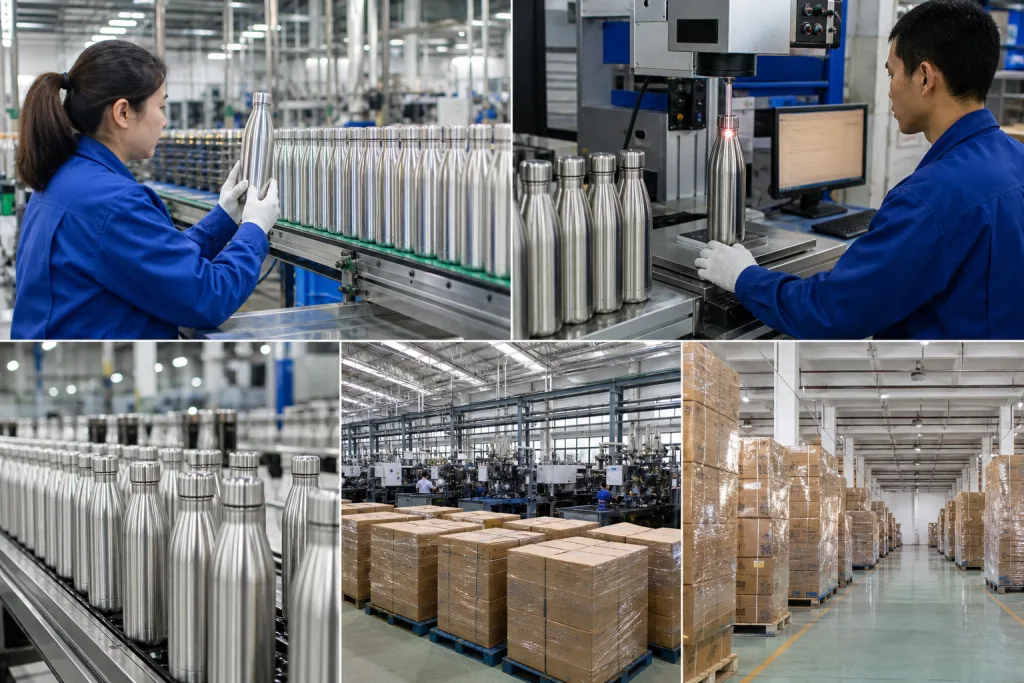
At our Zhejiang operation, standard production lead time is usually 25-35 days after deposit and artwork approval, with MOQs from 500 units for many stocked models and monthly capacity around 300,000 units depending on mix. Those numbers matter because compliance testing, decoration approval, and production scheduling all compete for the same calendar. We have seen this go sideways when a buyer wants a new customized growler with two print positions, a new carton mark, and shipment in 10 days. The math does not work. One PO we received even had the logo code typed wrong by one letter, and that alone cost a day on artwork confirmation.
If you sell to larger chains, ask how cartons are labeled, whether pallet configuration is fixed, and whether barcode formats such as FNSKU or retailer-specific carton labels can be applied. Better yet, ask for the carton marking file before mass production. The buyer flagged this on one shipment after seeing an outer carton short by 12 mm on the label panel, which left no room for the scan block. A bottle that passes lab testing but lands with the wrong outer carton markings is still a costly failure.
Use MOQ and tooling wisely
MOQ is a purchasing barrier, but it also tells you how far you are from a standard item. If you run a stock body, stock lid, one-color logo, and standard box, most canteen distributors can source from China at 500-1,000 units per SKU. Ask for a line drawing or sample photo and confirm the neck finish in mm first. If you ask for a custom Pantone, new mold, gift tube, and bilingual insert, MOQ usually jumps to 3,000-5,000 units fast. We have seen buyers miss this and then push back on price later; the math does not work at 800 pcs.
Break the quote into four cost buckets.
- Unit price FOB
- Tooling or mold charges
- Packaging and labeling charges
- Testing and inspection charges
This is the clean way to compare a standard custom growler program against a more engineered customizable growler or bottle line. QC pulled the sample last month on a project where one canteen factory packed a free white box and another supplier quoted the same box at USD 0.28 extra. If you do not split the costs, the quote looks cheaper than it is.
Our rule on the factory side is simple: if annual volume is below 10,000 units per design, do not open a new body mold unless the shape gives you a real sales edge. A new mold sounds attractive on paper, but we have seen this go sideways after the first PO. Existing mold libraries from experienced canteen manufacturers in Zhejiang, China already cover most commercial demand: 350 ml, 500 ml, 750 ml, and 1,000 ml bottles; 12 oz, 20 oz, and 30 oz tumblers; plus common growler sizes. We run these shapes every week. Put your budget into finish, graphics, and package presentation first, where buyers notice the difference faster.
Check reorder discipline before you place the first bulk order. Ask whether the color formula, Pantone tolerance, decoration position, and master carton specs are locked in a production file. We usually keep logo position with a jig record and photo approval, often within a 2-3 mm placement window. Good canteen vendors keep that data so your second order matches the first. Weak suppliers treat every PO like a new job. That is how you get shade variation, mixed carton marks, or a typo on the PO turning into the wrong bilingual insert.
What you should request on every quote
- MOQ by color and by logo
- Sample cost and refund policy
- Lead time for sample and bulk
- Carton pack quantity and carton dimensions
- Net and gross weight per carton
- FOB port, usually Ningbo or Shanghai
Pick a supplier built for reorders
The last decision is the supplier model. This is where 2nd and 3rd POs are won or lost. A lot of buyers focus on the first shipment and chase the lowest opening quote, then get stuck when carton marks shift, lid color drifts, or delivery slips from 12 days to 18 days on the next run. Your best distributors reusable water bottle partner is the factory that can repeat quality, packaging, and timing across 5 or 6 POs, not the one that cut USD 0.08 on sample pricing. On our line, QC pulled the sample at hour 2 and checked logo position with a 0.5 mm scale because repeatability is the job.
Ask a potential canteen supplier or canteen vendor practical questions. Skip the polished sales deck. Ask what happens on the floor:
- Can they send production photos during the run?
- Do they hold spare lids or seals for after-sales support?
- Can they consolidate mixed SKUs in one shipment?
- Do they understand retailer routing, appointment booking, or FBA prep if needed?
- Can they manage replacement parts for a distributor canteen program?
If you buy both bottles and larger formats, ask whether the same supplier can support a distributor growler line as well. Shared sourcing cuts admin work only if the systems match; otherwise, we've seen this go sideways. One factory approves artwork from a signed PDF, another works from a WeChat screenshot, and then the buyer flagged a 3 mm logo shift on the growler PO. The same applies to broader custom drinkware ranges: tumblers, infusers, sports bottles, and customized growler items should all follow the same artwork approval and inspection discipline, with the same AQL check sheet and the same carton drop test standard.
There is also a China-specific point new importers miss. A trading company works if you need mixed categories across 4 or 5 product types and do not want to coordinate 3 factories yourself. For stable replenishment of one drinkware category, a direct Zhejiang factory relationship usually gives better technical feedback, faster issue resolution, and clearer costing. We ship this way every week. If the first run shows gasket hardness at 60 Shore A instead of 70, wall thickness off by 0.2 mm, or print positioning drifting near the weld seam, the direct factory fixes it faster because the engineer and the line supervisor sit in the same building.
The best sourcing setup is not glamorous. It is a proven bottle platform, a realistic MOQ like 3,000 pcs instead of a fake 500 pcs promise, documented compliance, a decoration method that fits the job, and a China partner that answers detailed questions clearly. That keeps reorder business healthy. The wrong question is “Who is cheapest today?” The right one is “Who will still ship the same bottle, packed the same way, on PO number 7?”
Get a practical quote before you over-customize
Send your target price, quantity, market, and bottle type. We will recommend a proven Zhejiang, China production route with realistic MOQ, compliance, and lead time.
Frequently asked questions
What MOQ should I expect for a distributors reusable water bottle order?
For a standard stock model with one logo and standard export packaging, expect MOQ around 500-1,000 units per SKU from many factories in China. If you need a Pantone body color, custom box, or multiple print locations, MOQ often moves to 1,000-3,000 units. A fully new mold usually pushes commercial minimums higher because tooling must be amortized. For example, a stock 500 ml steel bottle might start at 500 units, but a new custom canteen lid design may require 3,000 units plus a mold charge of USD 3,000-8,000. Always ask whether MOQ applies per color, per logo, or per shipment total, because suppliers define it differently.
How do I compare a canteen factory quote with a canteen supplier or trading company quote?
Break every quote into the same four lines: FOB unit price, tooling, packaging, and inspection or testing charges. Then compare lead time, MOQ, and whether the quote includes standard carton marks, barcode labels, and spare parts. A direct canteen factory in Zhejiang may offer better technical control and faster answers on gasket, coating, and wall thickness questions. A trading company may help if you are consolidating several product categories. Ask both sides for the same data: 0.4 mm or 0.5 mm steel thickness, AQL standard, sample time, and bulk lead time. If one quote is USD 0.30 cheaper but omits packaging and inspection, it is not actually cheaper.
Which material is best for custom drinkware programs: plastic, aluminum, or stainless steel?
It depends on channel and target landed cost. Tritan or PETG works well when you need lighter weight and FOB pricing around USD 1.20-2.50 at scale. Aluminum can be competitive on price and freight weight, but many buyers in Europe and North America now prefer higher perceived value. Stainless steel is the most flexible commercial option. Single-wall steel suits mid-market projects, while double-wall vacuum 18/8 steel is strongest for premium retail and corporate gifting, usually around USD 4.50-8.50 FOB depending on size and finish. For first orders, choose a proven material-lid combination before pursuing a heavily canteen customized concept with new tooling.
What compliance documents should I request before placing a PO?
For EU and North American orders, ask for the compliance file before you approve mass production. At minimum, confirm food-contact suitability for the target market and request REACH information for EU sales. Depending on the channel, you may also need LFGB, FDA-related declarations, and social compliance such as BSCI. If you sell into California, discuss Prop 65 exposure requirements as well. Beyond documents, define the production inspection standard. AQL 2.5 for major defects is common, and you should specify leak-test expectations in writing. On assembled bottles, many importers require 100% leak testing, especially for vacuum bottles and screw-cap sports bottles. Documents alone are not enough without production QC discipline.
How long does a customized canteen or customized growler order usually take?
For a stocked model with standard decoration, sample lead time is often 5-7 days and bulk production 25-35 days after deposit and artwork approval. During peak season, especially from August to November in China, bulk lead time can extend to 35-45 days. If you add a new mold, expect another 20-35 days for tooling, trial sampling, and approvals. Testing can add 7-10 days depending on the lab and scope. If your order includes retailer labeling, FNSKU stickers, or special gift packaging, build in a few extra days for packing setup and final inspection. The realistic answer is usually 4-6 weeks for standard items and 8-10 weeks for heavily customized projects.