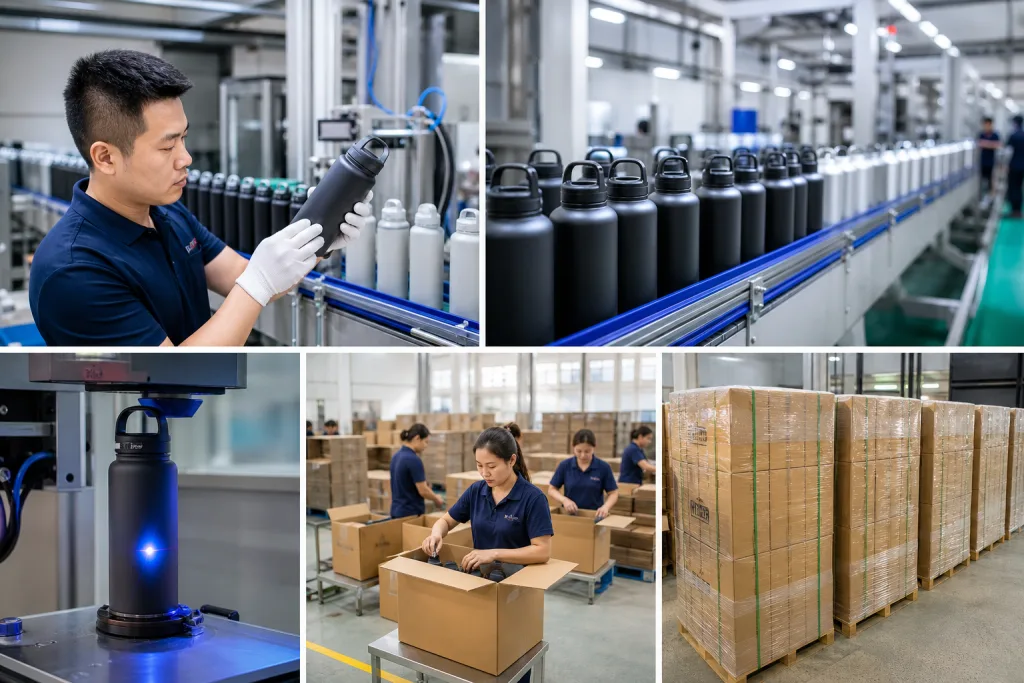
Key Takeaways
- A standard 500-750ml stainless steel bottle often lands at FOB USD 2.10-4.80 at 1,000-5,000 pcs depending on steel grade, wall structure, and decoration
- Typical MOQ is 500 pcs for stock-color bodies and 3,000 pcs for fully customized canteen colors, lids, or packaging
- Normal lead time from approved sample to shipment is 25-45 days, while new molds usually add 18-30 days
- Decoration, packaging, and testing can add 12%-35% to unit cost even when the bottle body stays the same
If you buy refillable bottles for resale, the bottle is usually the easy part. The hard part is landed cost, lead time you can put on a PO, and decoration that does not eat your margin. We see buyers come to our canteen factory in Zhejiang with a target retail price and no cost split behind it. Then the quote moves around. One line adds a mold charge, another misses the inner box, a third assumes a 5-ply export carton at 62 x 41 x 28 cm, and the buyer flags the gap.
You do not need a glossy sourcing pitch. You need numbers. For a distributors refillable water bottle program, the workable orders are usually decided by 4 points: MOQ tier, steel grade, coating yield, and carton loading. This is the wrong question to ask: “What is your best price?” Ask what changes at 1,000 pcs vs 3,000 pcs, whether the body is 304 stainless, how many bottles we run per powder batch, and how QC pulled the sample at packing. If you check those drivers early, you can compare a canteen supplier, canteen vendor, or canteen manufacturer on facts, not assumptions.
What actually sets bottle cost
For a distributor drinkware buyer, bottle cost comes from a few line items you can measure. Body material is the first one. A basic single-wall 18/8 stainless bottle in 500ml usually lands around FOB USD 1.60-2.30 at 3,000 pcs. Move to double-wall vacuum insulation and the quote usually sits in FOB USD 2.80-4.80 for 500-750ml, depending on shape and finish. If the factory runs 18/8 inside and outside with a 0.4mm outer wall and 0.3-0.4mm inner wall, the price climbs. Ask for wall thickness, not just "food-grade steel." QC pulled the sample gauge on the line for one buyer who kept pushing for the cheaper spec, and the numbers did not lie.
Lid construction is the next swing factor. A simple PP screw lid with a silicone ring may add USD 0.18-0.35. A stainless cap, bamboo top, carry loop, or flip straw lid can add USD 0.35-1.20. Two bottles can share the same body and still quote far apart. We had a PO last month with a typo on the lid code, and the buyer flagged it after sampling because the canteen customizable program had turned into a lid program. That happens a lot. This is the wrong question to ask if you only compare bottle photos.
Surface finishing changes the math fast. Standard powder coating runs clean on volume. Rubber paint, gradient spray, pearlescent coating, and full-wrap UV print push up rejection rates and labor time. Expect decoration and finish to add 12%-35% versus a plain brushed or stock powder-coated bottle. We run extra scratch checks with a 1kg drop ball on mixed-color lots, and the matte gradient jobs still take more handwork at the line. Buyers ask for the flashiest sample, then push back on price. No surprise there.
Packaging is the last piece, and it bites margins harder than most new buyers expect. A white box may cost USD 0.12-0.20. A printed retail box with insert can be USD 0.35-0.90. If you sell customized drinkware into Europe or North America retail, carton drop-test results and shelf appearance both matter, but the pack still has to fit your target margin. In Zhejiang, we ship bottle bodies fast; custom pack-out slows things down when the buyer wants barcode labels, inner trays, and a tighter master carton size. We’ve seen that go sideways on a 5,000 pcs order.
- Body material: steel grade, wall thickness, vacuum structure
- Lid: tooling complexity, gasket count, leak-proof design
- Finish: powder coat, spray paint, laser, silk screen, UV print
- Packaging: unit box, insert, master carton size, barcode labeling
MOQ tiers that change pricing
MOQ is not one number. On the line, we quote at least 4 layers: body MOQ, color MOQ, decoration MOQ, and sometimes packaging MOQ. Buyers who ask only for “minimum order” usually get the wrong answer. This is the wrong question to ask. Last month a PO came in with “MOQ?” on one line and no logo size, no lid color, no box spec, so sales had to send 3 different quotes.
For a stock-shape stainless bottle, a practical starting point is 500 pcs per size if you accept available lid tooling and a stock finish. If you want one logo in one position, most factories will run that at 500-1,000 pcs. If you want a custom Pantone body color, matching lid parts, and a printed gift box, MOQ usually shifts to 1,000-3,000 pcs per design. New plastic lid colors often need 3,000-5,000 pcs because masterbatch changeover scrap and molding cycle time matter more than the bottle body. We’ve seen buyers push back on this, but the math doesn’t work at 800 pcs when the lid shop has to purge material out of a 16-cavity mold.
Price breaks usually show up at 500, 1,000, 3,000, and 5,000 pcs. A bottle at FOB USD 3.60 for 500 pcs may drop to USD 3.15 at 1,000 pcs and USD 2.85 at 3,000 pcs if the decoration stays simple. Those savings do not come from steel alone. They come from setup time, powder coating batch efficiency, and lower packing labor per unit. On one 1,000-pc run, QC pulled the sample after coating and the film build was 70 μm, which was fine; at 300 pcs, that same booth setup would have spread too much fixed cost over too few bottles.
If you are a canteen distributor serving smaller accounts, ask whether the factory can split one production lot into mixed carton labels or mixed SKUs. Some vendors allow color assortments under one style if each color hits 300-500 pcs. Others insist on 1,000 pcs per color. This matters in promo business, where orders spike and forecasts are soft. We ship mixed outer marks for some accounts, but not every factory wants that extra warehouse sorting, and the buyer flagged this more than once after seeing plain master cartons with no account code.
You usually get the best buying result by standardizing the bottle body and changing only logo, carton mark, or insert. Customizing every component at low volume is the fastest way to create a bad MOQ.
At BottleForge Industrial in Zhejiang, typical MOQ is 500 pcs for selected stock bottles and 3,000 pcs for deeper custom development, with monthly output above 300,000 units across bottle categories. That scale matters if you need repeat orders to stay steady. We run enough volume that a refill order is not squeezed out by one pilot project, and that shows up in boring but important details like carton stock, spare lids, and booking space before cutoff.
Lead times without wishful thinking
Buyers hear 20 days and think the goods are already on the vessel. They are not. For a distributors refillable water bottle program, split the clock into sampling, approval, production, inspection, and freight booking. This is the wrong question to ask: “What’s your lead time?” Ask instead, “20 days to what point?” We’ve seen POs marked “ETD” when the buyer actually meant ex-factory, and that mistake alone cost 6 days.
Sampling: 3-7 days for an existing model with digital mockup and stock finish. Add 5-10 days if you need pre-production samples with custom paint or logo placement. If a new mold is involved for a custom canteen lid or body base, sample development usually takes 18-30 days after drawing approval and deposit. On our side, QC pulled the sample after logo alignment was off by 1.5 mm at the seam, so do not treat sampling as paperwork.
Production: 20-35 days is normal for repeat styles with standard decoration. Add 7-10 days during peak season or when you need multiple logo processes like laser engraving plus screen print. A customized growler or custom growler with larger volume and more welding usually runs slower than a basic 600ml sports bottle because vacuum yield and leak testing take longer. We run leak test and vacuum hold on the line, and the math doesn’t work if someone expects a 64 oz growler to move at the same speed as a single-wall bottle.
Inspection and booking: Allow 2-5 days for final AQL inspection and rework if needed, then another 3-10 days for vessel booking and cargo handoff, depending on port congestion. From Zhejiang, most export programs move through Ningbo or Shanghai. During pre-holiday periods in China, booking pressure can add a full week without any factory delay. Last season one buyer flagged a late handoff, but the factory was ready; the booking window at Ningbo slipped 4 days.
Working timeline buyers can use
- Existing bottle + simple logo: 25-35 days to ship
- Custom color + printed box: 30-40 days to ship
- New mold or complex lid: 45-65 days to ship
- Repeat PO on approved spec: 20-30 days to ship
If you sell into Amazon FBA, add label prep and carton compliance time. FNSKU application, suffocation warning checks for polybags, and pallet rules can easily add 2-4 days. Carton drop test and label position checks usually sit at the end, and that is where schedules get squeezed. The practical lesson is simple: if your sales team promises a custom bottle in 3 weeks, they are probably counting only factory assembly time and ignoring the real export sequence.
Decoration choices and margin impact
Most buyers underprice decoration because they book it as a logo fee, not as a production step on the line. On custom drinkware, decoration changes labor time, scrap rate, and how fast we pack 24 pcs into an export carton. The lowest-cost option is usually one-color silk screen on a flat, smooth panel, often around USD 0.05-0.15 per unit depending on size and quantity. Laser engraving may run USD 0.08-0.20 and gives a durable result on powder-coated or stainless surfaces, but the visual effect changes with coating thickness and contrast. We have seen a 60 micron powder coat make a logo look softer than the approved mockup, and the buyer flagged it.
Heat transfer, water transfer, and full-wrap digital printing sell well at retail, but the math does not work if you ignore line speed. Full-wrap graphics may add USD 0.25-0.80 and cut throughput because alignment at the jig and curing time are slower. On one 10,000-piece run, the decorated body output was 12 days vs 18 days after the buyer changed from 1-color print to full wrap. If you want a canteen customized for club merchandise or event retail, ask for the expected defect rate in writing. QC pulled the sample on one order where the quote looked cheap, but the supplier allowed visible color shift and edge lift as acceptable cosmetic tolerance. That is not cheap.
For promotional orders, logo position often matters more than print method. Simple fact. A canteen promotional bottle carried in a side pocket can hide one logo panel, so a left-right two-panel layout is often the wrong question to ask. A distributor canteen program usually sells better with a centered front logo and a small back compliance mark. Keep the artwork inside a confirmed print zone and request an approval drawing with dimensions in millimeters. We normally mark the safe area on the drawing and note the shoulder radius, because a 3 mm shift is enough to make a logo look off-center on a slim bottle.
On textured powder coat, fine details can fill in. On laser marking over a curved bottle, the logo can distort near the shoulder if the artwork sits too high. We have seen this go sideways when a buyer sends thin serif text under 0.3 mm stroke width, then expects the sample to match a flat AI file. A serious canteen manufacturer should show you both the artwork file requirement and the physical limit of the bottle geometry. Ask what fixture they run, ask for the max logo height from the base, and check whether QC found stretching on previous samples.
- Silk screen: low cost, best for simple logos on a clean print panel, medium durability; common MOQ starts from 1,000 pcs per color
- Laser engraving: durable, clean premium look, good for stainless and powder coat, but contrast control is limited by surface finish
- UV or transfer print: strong shelf impact for retail artwork, higher defect risk, slower output, and higher unit cost
- Embossed or molded branding: best for proprietary programs, needs tooling budget, and usually needs a new mold insert or lid steel change
If margin is tight, put the money into coating quality and leak-proof lids before complex graphics. We ship replacements for leaking lids, not for plain artwork. Buyers remember returns longer than decoration.
Compliance, testing, and hidden add-ons
A bottle quote that looks cheap on day one can turn expensive after testing, claims, and one bad retailer complaint. Before you pay deposit, ask for the compliance path for your exact market. For Europe or North America, stainless and plastic contact parts may need REACH, LFGB, FDA-related declarations, or Proposition 65 review, depending on the material set and where you ship. Kids items can pull in ASTM or CPSIA-related checks. This is the wrong question to ask late. Testing must match the final BOM, not an old PDF from another order with a 2 mm different straw or a changed gasket source.
Lab tests usually run from USD 150 to over USD 800 per submission, and the gap is real once coatings, seals, and colorants get added. If you change the lid resin, straw material, paint chemistry, or gasket supplier, the old report may stop protecting you. We see this on the line all the time: buyer approves one PP lid sample, then switches to a Tritan-style lid after cost review and still wants to use the first report. The math doesn’t work. Good canteen manufacturers in China will say that directly. Weak ones send a file with the right logo on top and hope nobody checks the material code.
Inspection is another cost buyers should set up properly. AQL 2.5/4.0 is common for general consumer goods, but refillable drinkware needs separate critical defects called out in the checklist: leakage, vacuum failure, sharp edges, odor, and missing safety parts. QC pulled the sample, filled it to the weld line, and ran a 30-minute leak check; that catches issues faster than a pretty carton photo. A pre-shipment inspection may cost USD 300 to USD 500, but one leaking distributor growler batch can burn through that in returns, chargebacks, and retailer penalties.
Also watch for the small extras:
- Barcode or FNSKU labels: USD 0.02-0.06 each
- Hangtags or inserts: USD 0.03-0.20 each
- Drop-test upgrade carton: USD 0.08-0.25 per unit
- Palletization or corner board: project dependent
- Third-party audit support such as BSCI or ISO document packs: usually no unit cost, but ask before onboarding
If you are comparing a canteen supplier and a canteen vendor quote, normalize these extras first. We have seen buyers flag a cheaper quote, then find out later it excluded labels, corner board, and export carton upgrades. One PO even had the FNSKU code typed wrong by one digit. The quote was not cheaper; it was incomplete.
How distributors should quote safely
If you resell to chains, corporate programs, or regional dealers, your quote method has to protect margin without slowing the sales desk. We tell distributors to start with one locked spec sheet for each bottle family, not 6 versions floating in email. Put the core items on one page: capacity, body construction, steel grade, wall thickness, lid type, finish, logo method, packaging, carton quantity, and compliance requirement. On our side, the line reads that sheet against the caliper and the BOM before we price. This is the right question to ask first, because if one factory prices 0.4 mm body and another prices 0.5 mm, your comparison is already broken.
Then build the quote in layers. First calculate ex-factory or FOB bottle cost. Second add testing, inspection, packaging, and local delivery to port. Third add freight, duty, and destination handling. Fourth add your failure buffer. For customized drinkware, a 2%-5% contingency is more realistic than acting like every shipment will be perfect. We have seen this go sideways on mixed-color orders where the buyer flagged carton splits after booking. If you are managing a customized canteen or customizable growler line across several colors, carry extra margin for forecast error and carton splits, especially when one PO typo changes a 24-pack carton to a 36-pack load plan.
For new accounts, do not start with fully open-ended custom development. We usually quote 3 controlled routes so the buyer can decide fast and the factory can hold the lead time on the line:
- Fast program: stock bottle, one logo, white box, 500-1,000 pcs, ship in 25-35 days
- Retail program: custom color, retail box, 1,000-3,000 pcs, ship in 30-40 days
- Exclusive program: custom mold or distinctive lid, 3,000-5,000 pcs, ship in 45-65 days
This is how a distributor growler, distributor canteen, or distributor drinkware business keeps quotes tight. A serious canteen factory in Zhejiang should support all three routes, and they should also push back when the target does not work. We do that every week. If your target price is FOB USD 2.20 and your spec calls for 18/8 double-wall body, custom lid color, laser logo, and printed tube packaging, the math does not work. QC pulled the sample on jobs like this and the cost stack was already off before freight.
That honesty saves time. It lets you revise the spec before sampling gets stuck for 12 days and still ends in a reset. In export drinkware from China, the best supplier relationship is not the one that says yes first. It is the one that gives you a cost and lead-time structure your team can run again across future SKUs, from a customizable canteen to a customized growler.
Get a bottle quote with real cost drivers
Send your target capacity, MOQ, logo method, and packaging plan. We will reply with a practical FOB price range and production timeline from Zhejiang, China.
Frequently asked questions
What is a realistic MOQ for a custom refillable water bottle order?
For B2B buyers, 500 pcs is realistic only for an existing bottle with a stock finish and simple logo. If you need a custom body color, custom lid color, or printed retail box, MOQ is more often 1,000-3,000 pcs per SKU. A new lid mold or unique body shape usually pushes MOQ to 3,000-5,000 pcs because tooling recovery and production setup need volume. If you are a canteen distributor managing smaller customer orders, ask whether the factory allows mixed colors under one style. Some suppliers will accept 300-500 pcs per color inside a 1,000 pc total, which can help you launch without overbuying.
How much does a branded stainless steel bottle usually cost FOB China?
A useful working range is FOB USD 2.10-4.80 for a 500-750ml branded stainless steel bottle at 1,000-5,000 pcs. Single-wall models can go lower, often around USD 1.60-2.30. Double-wall vacuum bottles cost more because of welding, vacuum processing, and higher rejection risk. Add about USD 0.05-0.20 for a basic logo, USD 0.12-0.20 for a white box, and more for premium lids or retail packaging. If a quote sits far below market, check the steel grade, wall thickness, coating quality, and whether inspection, testing, and packaging are included. Cheap bottle bodies are easy to quote. Stable quality is not.
How long should I allow for production and shipment from China?
For an existing bottle with simple branding, allow 25-35 days from approved sample to shipment. If you add custom color matching, custom packaging, or multiple decoration processes, 30-40 days is safer. New tooling usually adds 18-30 days before mass production even starts. After production, leave 2-5 days for AQL inspection and a few more days for vessel booking through Ningbo or Shanghai. If your goods go to Amazon FBA, labeling and carton compliance can add another 2-4 days. Buyers in Europe and North America should separate factory lead time from ocean transit, because the factory is only one part of the calendar.
Which cost items are most often missed in a bottle quote?
The common misses are decoration setup, custom packaging, barcode labeling, compliance testing, and inspection. A bottle body may look competitive until you add a printed box at USD 0.35-0.90, FNSKU labels at USD 0.02-0.06 each, and lab testing from USD 150 to over USD 800 depending on scope. Freight carton upgrades and pallet requirements also get missed, especially for retail or e-commerce projects. Another hidden cost is rework from poor artwork control. If the print zone is not confirmed in millimeters before sampling, you can lose time and money on avoidable corrections. Always compare quotes line by line, not only by unit price.
What should I ask a canteen manufacturer before placing a PO?
Ask for the full specification sheet: capacity, steel grade, wall thickness, lid materials, seal materials, finish, logo method, packaging detail, carton size, and net or gross weight. Then ask for lead time by step: sample days, production days, inspection window, and port handoff. You should also request compliance documents tied to the final material set, not generic old reports. Confirm the inspection standard, such as AQL 2.5/4.0, and define critical defects like leakage, vacuum failure, odor, and sharp edges. Finally, ask what changes the price after approval. A reliable canteen manufacturer in China will tell you exactly which design or packaging changes trigger extra cost or extra days.