Key Takeaways
- Most kids bottle defects come from lids and seals, not the bottle body; target a 0.2-0.3 mm silicone gasket and drop-test the cap from 1.2 m.
- A serious canteen factory in Zhejiang should quote 5,000 MOQ and 30-45 days lead time for standard custom drinkware runs.
- Ask for REACH and LFGB-ready materials, AQL 2.5 for critical defects, and 100% leak testing on every finished unit.
- For distributor drinkware, print durability matters: laser engraving lasts, while low-cure ink can fail after 50-100 wash cycles.
If you buy distributors kids drink bottle programs, the real risk is not the sample on the desk. It is the 20,000-unit run that lands with leaky lids, warped parts, or an odor the end customer catches on day one. We see the same boring failures on the line: silicone seals cut 0.3 mm thin, straps tearing at the buckle hole, print rubbing off after 200 wipe cycles, caps cracking after 3 drops from 1 meter. Then the chargebacks start. Fast.
We build and ship custom drinkware from Zhejiang, China, and the pattern is plain. Buyers who lock the failure points early protect margin. Buyers who approve a nice render and skip the structure review usually come back with claims. For canteen custom work, customized drinkware, or a canteen promotional program for retailers, schools, or distributors, control the parts that break first. This is the right question to ask. Material grade, lid structure, drop test standard, and a factory that can hold MOQ, lead time, and QC discipline at scale matter more than the color mockup. Last month QC pulled the sample because the PO print callout said matte blue, but the Pantone note was gloss.
Where kids bottle programs fail
The first failure shows up at packing: a lid that feels fine on the bench but leaks once kids toss the bottle into a backpack and squeeze it sideways. We ran a 24-hour inverted test on a 500 ml sample, and the weak cap failed at the thread start, not the gasket. For a distributors kids drink bottle order, lock the leak path before decoration. Ask for the gasket profile, torque range, and drop-test result. Not a catalog photo.
The second failure is odor and taste. Cheap plastic keeps a resin smell after molding or washing, and the buyer flags it fast. On one PO, the cap insert came in at 3.2 g and passed visual QC, then failed the smell check after 48 hours in a sealed carton. If you source from a canteen manufacturer in China or Zhejiang, ask for material declarations and a pre-production odor check on virgin resin. For Tritan-style bottles, the body is usually fine; the cap insert or straw is where the problem sits. Use custom drinkware specs that separate the food-contact parts. FDA, REACH, and, for Europe, LFGB need to be on the RFQ.
The third failure is cosmetic, and it hurts distributors because it looks like shipping damage even when it came off the line. Thin-wall PP bottles can ovalize if cooling is uneven; labels lift when the surface energy is wrong. If your canteen distributor program includes school branding or retail packs, ask for a flatness tolerance and an ink adhesion test. We’ve seen this go sideways on a 0.8 mm wall when the mold water path was off by 2 mm. A factory in Hangzhou or elsewhere in Zhejiang should hold a 3% reject cap on appearance if the mold and process are stable.
Spec the lid before the body
Most buyers start with capacity: 350 ml, 500 ml, 600 ml. That is backwards. Spec the lid first, because kids’ bottles usually fail at the opening system, not the body. Straw lid, flip lid, push-pull spout, or screw cap each changes the risk and the assembly on the line. A straw lid adds parts, one more silicone seal, and more leak points; QC pulled a sample last month where the straw tube was cut 3 mm short and the bottle failed after half fill. A flip lid can pinch fingers if the hinge geometry is weak or the spring angle is off. A push-pull spout is simpler, but it needs tighter valve tolerances or it seeps during a shake test. If you want a customized canteen or customizable canteen for younger users, define the age group first, then lock the lid.
For ages 3-6, a smaller bite valve and a lighter cap matter more than bottle volume. Kids in that range struggle with cap weight fast; on some programs we try to keep the lid set under 85 g. For ages 7-12, a 500-600 ml body and a wider mouth for ice cubes usually work. Ask the canteen supplier for exploded views and material breakdowns: silicone gasket thickness at 0.2-0.3 mm, PP or Tritan cap shell, and a tether or strap anchor that survives 10 kg pull force. Ask for hinge pin diameter too; 2.0 mm vs 1.6 mm is not a small difference in abuse testing. If the factory cannot give you those numbers, this is the wrong question to dodge. They are selling you a decoration job, not a reliable canteen customized product.
Tip: specify a 1.2 m drop test on all four sides with water inside, then repeat after 500 open-close cycles. Write it on the PO. We have seen buyers approve a nice-looking sample, then flag leakage after first shipment because no cycle test was listed. A real canteen factory in China will understand this immediately; a weak canteen vendor will keep talking about color swatches and logo position. The math doesn't work. A glossy sample photo does not tell you whether the latch survives 500 cycles or whether the gasket rolls out after the second drop.
Materials that survive school use
Pick the wrong resin and the trouble shows up late. PP is low-cost and fine for promo runs, but if the material is soft or the mixing is off, the bottle scuffs fast and picks up smell. We quoted a 50,000-piece school order last month: PP was 12 days faster on the line, while Tritan-type copolyester added about USD 0.60-1.20 per unit, depending on mold structure and order size. For a customizable drinkware program sold through retailers or distributors, that gap often pays back in fewer cloudy returns.
If you are lining up a custom canteen for kids against a custom growler or customizable growler for adult channels, don’t use the same material spec. A growler can take thicker walls and heavier closures; a kids bottle needs lower weight and rounded edges. We run 1.8-2.2 mm wall thickness on injection PP bodies, and 1.5-2.0 mm on Tritan, based on the shape. The cap should not be the cheapest line item in the BOM. QC pulled the sample on one job because the hinge pin was too thin, and that cost us a rework week.
Get the material papers before PO, not after the cargo leaves. Some factories in China can show resin certificates but go blank on the color masterbatch, and that is where the problem starts. If you sell into North America or Europe, ask for declaration of conformity, food-contact compliance, and batch traceability. A serious canteen manufacturer in Zhejiang should mark lot codes on cartons and finished goods. One buyer flagged a PO typo on the resin code, and the shipment sat while we matched the batch; the math does not work if you cannot trace resin to finished bottle.
Decoration that does not wash off
Printing failures are predictable. We see it on the line. Screen print looks solid on day one, then the edges start breaking after 20 to 30 dishwasher cycles or a week of rough school use. Pad print can hold fine logo detail, but only if ink cure is locked down with oven time and temperature, not guesswork. QC pulled samples last month where the logo looked fine at packing and failed the tape test 24 hours later. Laser engraving is the safe bet for stainless parts and some coated lids because there is no ink layer to peel. If your distributor drinkware line needs to survive retail returns, choose decoration by wear test. The quoted low price is the wrong question to ask.
For a canteen promotional program, buyers often try to fill the whole bottle with branding. We have seen this go sideways. Large wraps drive up rejects because even a 1.5 mm registration shift shows fast on a curved body. One buyer flagged it on a PO after approving flat artwork, then rejected 800 pcs once the wrap seam looked off near the grip area. Keep the logo zone controlled, then run one accent color with one decoration method. On plastic parts, ask for cross-hatch adhesion testing and 50-100 dishwasher cycles if your market expects home washing. On stainless parts, check abrasion resistance with a rub test or scratch test, not only solvent rub.
Good canteen distributors ask for a decoration spec sheet with Pantone target, print position tolerance, and cure method. The weak suppliers just say “no problem” and hope the operator at the semi-auto screen press can save it. That is not process control. In Zhejiang, the better factories treat decoration like any other production step: approved film, jig check, cure record, and AQL pull after packing. We ship reorder programs from that discipline. Without it, a customized drinkware program often dies after the first season.
QC gates you should not skip
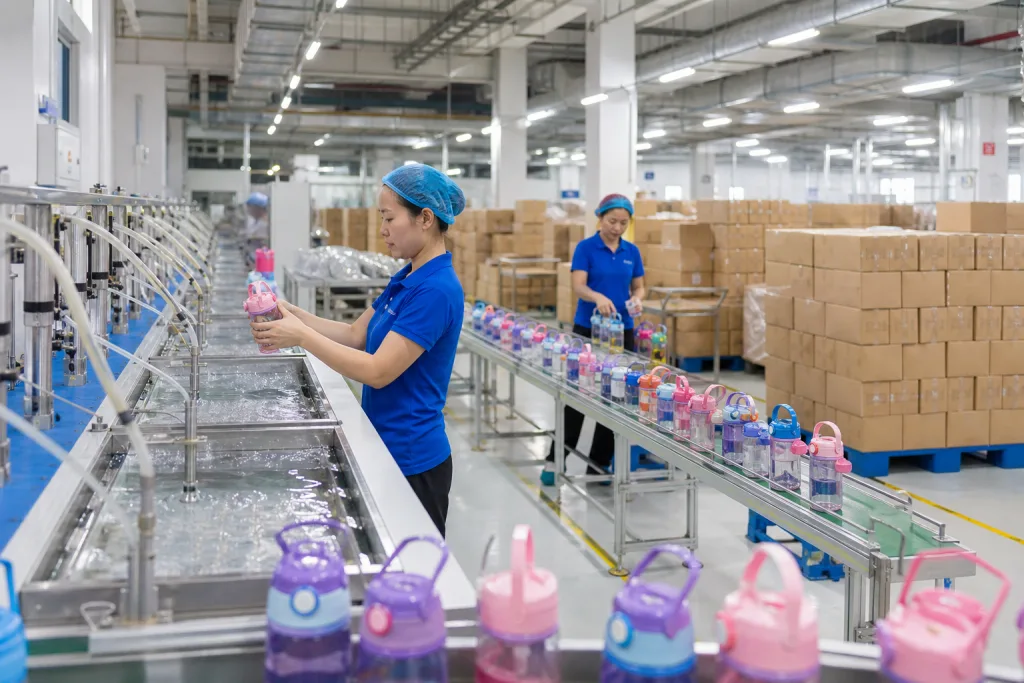
Do not chase perfect QC. Pick the gates that catch claim risk. On kids bottle orders, we focus on four: seal integrity, cap torque, appearance, and drop resistance. On our line, QC pulled the sample every 30 minutes and checks thread fit with a torque tester, because this is where repeat complaints start. A proper factory should run incoming material checks, in-process dimensional inspection, final assembly verification, and finished-goods leak testing. If you are working with a canteen distributor or canteen vendor in China, ask for the test plan before mass production starts, not after the first 5,000 units are packed.
Use AQL 2.5 for major defects and AQL 4.0 for minor defects as a practical baseline. Critical defects should be 0 tolerance: leaks, broken lids, missing parts, contamination, or sharp edges. That part is non-negotiable. For cartons, check 3-5 units per carton on the first shipment and review transit damage rates; on one FBA order, the buyer flagged corner crush because the inner divider board was 1 mm short. If the shipment is going to Amazon FBA, add carton labeling, polybag rules, and FNSKU placement into the inspection checklist. We have seen this go sideways over one label placed on the carton seam. That is how distributor drinkware becomes sellable inventory instead of warehouse noise.
One bad bottle in a school program can cost more than the margin on 200 good units. That is why the factory must prove process control, not just good intentions.
If you are sourcing from Zhejiang, ask for monthly output, sample room discipline, and traceable QC records. Ask to see the log, not a slideshow. A stable canteen factory should be able to produce 300,000-500,000 units per month across multiple lines, depending on mold count and product mix. We ship peak-season repeats off line planning, mold availability, and carton stock; the math does not work if the factory is borrowing capacity from three workshops. That scale matters when your distributor canteen order repeats in peak season.
MOQ, pricing, and lead time
The business side is where buyers misread the market. We see it every week. A workable MOQ for custom kids bottles is often 3,000-5,000 units per color, and 1,000-2,000 units is possible if the factory already has an existing mold and decoration setup on the line. If you need brand-new tooling, expect mold fees from USD 3,000-15,000 depending on complexity. On our side, the first check is usually the cap torque spec and neck finish tolerance in mm, because that decides whether an old mold can run or not. For a canteen manufacturer in China, the cheapest quotation is rarely the lowest landed cost once freight, inspection, and rework are included. Buyers push for the bottom price. We’ve seen this go sideways.
Lead time is usually 30-45 days for standard customized drinkware after sample approval and deposit. New tooling can add 15-25 days. If someone promises 12 days for a fully custom bottle with new mold, tight print registration, and compliance paperwork, they are ignoring a step or hoping you will. This is the wrong question to ask. Ask how long the mold trial, color matching, and leak test take. On our line, QC pulled the sample after a 1.2m drop test and found the straw lid popped open, which added 3 days before approval. For Europe and North America, plan an extra 7-14 days for freight and customs depending on route. This is normal in Zhejiang export operations, not a delay.
Price should be judged by landed cost and failure rate, not unit price alone. A bottle at USD 1.10 that leaks 4% of the time is worse than a bottle at USD 1.45 with near-zero leakage. The math doesn’t work any other way. Last season, one buyer flagged a PO typo on carton count after booking inspection, and the reprint cost wiped out the savings from a lower unit price. Good canteen manufacturers know this. If you are building a multi-SKU distributor drinkware line, lock the lid tooling first, then negotiate color variants and packaging to reduce incremental cost. The lid set is where factories usually recover cost, especially if the same spout and handle can run across 4 SKUs.
How to brief the factory
A usable brief is short and technical. Start with capacity, age group, material, lid type, decoration method, compliance target, carton pack, and test requirements. For canteen custom or canteen customizable programs, send a one-page spec sheet and ask for a pre-production sample with the actual packaging. Sales chat is not enough. We have seen 500ml become 550ml on a rushed PO because the drawing left room for guesswork, and the buyer flagged it only after QC pulled the sample.
Put the non-negotiables in writing: target weight, BPA-free declaration, REACH/LFGB/FDA requirements, drop test height, leak-test method, and whether the bottle must fit cup holders or school lunch bags. If you need a distributor canteen program, define carton count, master carton dimensions, and palletization too. That is the difference between a clean freight quote and a warehouse mess; one 40HQ can move 28,800 pcs or 31,200 pcs depending on carton size, and the math does not lie.
What to ask for:
- 2D drawing with dimensions and tolerances
- Material certificates for resin and masterbatch
- Photo or video of leak test and assembly line
- Sample lead time: 7-10 days for existing mold, 15-20 days for new print setup
- Production plan by color and SKU
We run into this every season: a buyer wants a strong price, then sends a two-line brief and expects the line to read minds. That is the wrong question to ask. A solid brief gets you a bottle that ships cleanly, prints consistently, and holds up in school use without a PO correction at the last minute.
Send your spec, get a production-ready quote
We can review lid design, compliance, MOQ, and pricing before you place the PO. That saves you from leaks, delays, and expensive rework.
Frequently asked questions
What MOQ should I expect for custom kids drink bottles?
For a standard custom kids bottle, expect 3,000-5,000 units per color. If the factory already has an existing mold and only needs new printing, 1,000-2,000 units may be possible. New tooling usually adds USD 3,000-15,000, depending on lid complexity and the body shape. A capable canteen factory in Zhejiang should quote this clearly and separate mold cost from unit price. If the supplier avoids that split, you are probably paying hidden setup charges later.
Which material is safest for children’s drinkware?
For most distributor drinkware programs, PP and Tritan-type copolyester are the practical choices. PP is lighter and cheaper; Tritan gives better clarity and stain resistance. For EU and North America, ask for food-contact compliance documents, plus REACH and, where needed, LFGB support. Wall thickness is usually 1.5-2.2 mm depending on the part. The body is not the only risk: the lid, straw, and gasket need the same compliance review as the bottle itself.
How do I reduce leaks in a kids bottle order?
Spec the lid first, then define the seal. Ask for a silicone gasket around 0.2-0.3 mm, cap torque range, and a 1.2 m drop test with water inside. Require 100% leak testing on finished units, not random spot checks only. In production, watch for thread damage, misassembled valves, and warped cap shells. A good canteen manufacturer should show you test records before shipment. Leak failures are usually assembly or tolerance problems, not just bad design.
What compliance documents should I request from a Chinese supplier?
At minimum, ask for material declarations, food-contact compliance, and batch traceability. For Europe, request REACH support and LFGB-ready materials when applicable. For the US, ask for FDA-related food-contact declarations. If you are buying from China or Zhejiang, also request factory audit info such as BSCI if your retail customer requires it. Keep the documents tied to the exact resin batch and production lot, not just a generic certificate from last year.
How long does production usually take?
For a standard custom drinkware run using existing tooling, 30-45 days after sample approval and deposit is normal. New tooling can add another 15-25 days. Shipping to Europe or North America usually adds 7-14 days depending on route and season. A factory with a monthly output of 300,000-500,000 units should be able to manage repeat canteen distributor orders without stretching lead time, provided you confirm colors and packaging early.