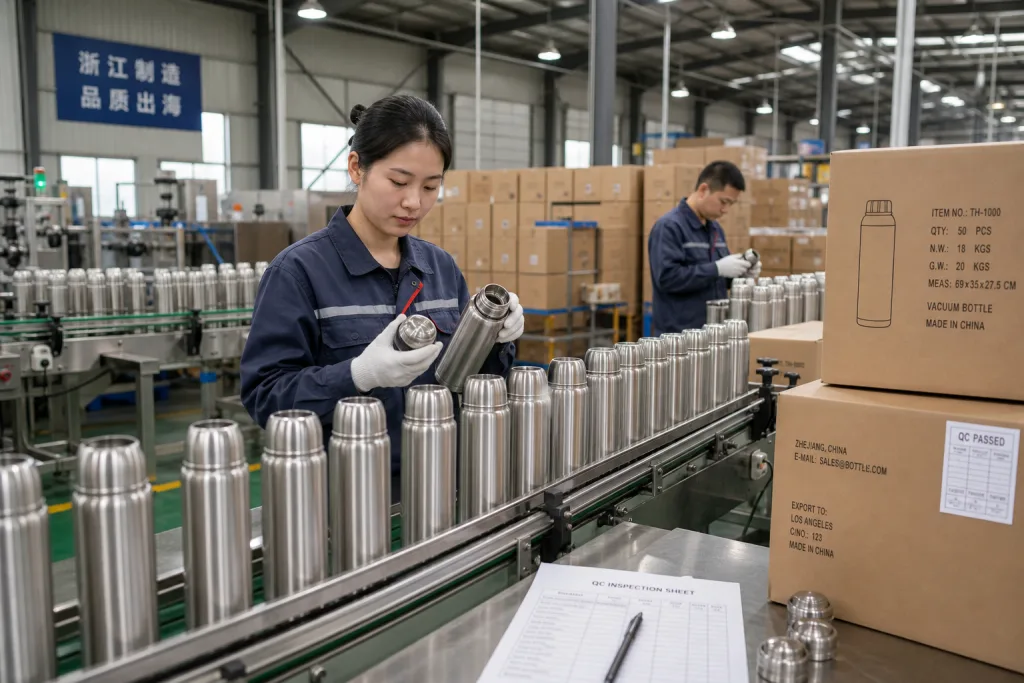
Key Takeaways
- Set insulation targets as numbers: for example, 95°C fill, after 6 hours at 20°C ambient, liquid must stay above 62°C
- Most bulk thermos projects become stable at MOQ 1,000-3,000 pcs per SKU, with 25-35 days lead time after sample approval
- Use AQL 2.5 for major defects and 4.0 for minor defects, plus 100% vacuum and leak testing before packing
- For outdoor and promotional programs, 18/8 stainless with 0.4-0.5 mm inner wall and 0.45-0.6 mm outer wall is a practical baseline
A stainless bottle can look good in a showroom and still come back with claims 30 days after launch. We see the same failures on the line: heat loss from weak vacuum, lids leaking at a 45° tilt test, bodies dented after a 76 cm drop, powder coat chipping at the rim, and logos fading after 50 dishwasher cycles. Promotional buyers get hit in a different way. The PP sample passed, then mass production drifted because the spec sheet said “matte black” but missed a 0.2 mm coating range and logo position tolerance.
If you are sourcing a distributors insulated water bottle from Zhejiang or another part of China, asking which color sells best is the wrong question. Ask where production fails, how early QC pulled the sample, and which numbers must be printed on the PO. We’ve seen this go sideways over one typo in a lid code. At BottleForge Industrial in Hangzhou, Zhejiang, we run thermos development as a failure-mode check first, then move to design after the risk points are pinned down.
Where insulation claims fail
The first failure mode is plain: the bottle misses the temperature claim. A custom thermos can look clean on the sample table and still act like a cheap single-wall cup if the vacuum pull is weak, the copper layer is patchy, or the shell spec is too thin for the job. For a distributors insulated water bottle going into outdoor retail, insulation is the product. Full stop.
Do not accept soft copy like keeps hot all day. Put the test method in the PO. For a 500 ml stainless vacuum bottle, we run 95°C water, cap after 3 minutes, test at 20°C room temp, and require at least 62°C after 6 hours and 48°C after 12 hours. For cold retention, fill with 4°C water and require below 10°C after 6 hours. Bigger bodies can hold heat better, but only if the vacuum is clean.
The usual causes are weak evacuation, a bad seal at the vacuum port, or neck geometry that bleeds heat too fast. We’ve seen a wide-mouth thermos lose more heat than a narrow-mouth one. That is not a defect by itself. It just means the spec has to match the shape, or the buyer will flag it on arrival.
- Material: 304 stainless steel, commonly called 18/8, for inner and outer
- Wall thickness: inner 0.4-0.5 mm, outer 0.45-0.6 mm
- Vacuum test: 100% inspection before coating
- Insulation verification: lab test on first-off samples and random in-line samples
Some China quotes come in low because the line skips copper coating or runs with shaky vacuum control. The math does not work: save USD 0.20-0.50 per unit now, then eat claims later. We had one PO where the buyer typed the size as 550 ml but the carton code said 500 ml; QC pulled the sample, and the mismatch showed up before shipment. For bulk distributor programs, ask for real retention data by bottle size, not a catalog line copied across three SKUs.
Leaks start at the lid
The second failure mode is leakage, and in most cases the steel body is not the problem. The lid stack is. We usually find the issue in thread fit, warped plastic after injection, the wrong gasket hardness, or a cap that seals only after the user cranks it down too hard. This is where promo thermos programs break down: the body sample gets signed off, while the final lid mold is still being adjusted on the line with a thread gauge and feel check.
A reliable thermos manufacturer should lock the lid stack early. Ask for the resin grade for the lid and inner stopper, the gasket material, and whether the design seals on one surface or two. For hot beverage use, PP lid parts with food-grade silicone gaskets are standard. If gasket Shore A hardness is too soft, it can roll during tightening; QC pulled samples like this before with a twisted lip after 20 cap cycles. Too hard, and it will not compress evenly. This is the wrong question to skip.
Ask for these checks before mass production:
- Leak test: 100% inverted test for 30 minutes
- Hot water leak test: sample test with 85-95°C fill to check pressure effect
- Torque range: define opening and closing torque so end users can seal it without excessive force
- Thread gauge approval: confirm bottle neck and lid fit on pre-production run
For a customizable thermos sold by outdoor retailers, add a carry-loop or handle only after hinge cycle life is tested. We usually treat 3,000 opening cycles as the floor for a daily-use lid, and we check the hinge pin area for whitening or crack marks around 0.8 mm edges. Gift-channel distributor programs can be rougher, not easier. We have seen buyers push back with “it’s only for promo,” then returns spike because users toss the bottle into bags and cars and expect zero leaks.
A bottle body defect is visible. A lid defect becomes a return.
At BottleForge Industrial, our stainless line in Zhejiang can run about 300,000 units per month across bottle categories, but lid validation is often what holds shipment. If your custom thermos uses a new lid, budget 10-15 extra days for tooling correction and sealing tests. In practice, that is 10-15 days now versus 60 days of claims later. We ship plenty of repeat programs, and this is where the math doesn’t work if you rush: 5,000 units can pass visual QC and still fail in stores.
Coatings and logos break down
The third failure mode is finish durability. Buyers will spend 3 hours on Pantone matching, then skip adhesion, abrasion, and dishwasher limits. We’ve seen this go sideways. The first bulk thermos shipment lands looking clean, then chips start around the base ring after a week of shelf shuffling, or the logo fades where cartons rubbed during normal handling. On our line, QC pulled samples with edge wear right at the 6 mm contact area near the bottom seam.
For outdoor retailers, powder coating is usually the safer call because it adds grip and hides small handling marks. For promotional brands, spray paint plus screen print cuts cost and opens up more color choices, but scratch resistance is weaker. We ship both. The wrong question to ask is “which one is cheaper per piece.” A manufacturer thermos quote that saves USD 0.15 on coating can turn into a bigger bill in returns, rework, and bad reviews. One buyer flagged this after a keychain test scratched 12 units in a sample set.
What to put in the spec
- Coating type: powder coat, spray paint, or bare stainless
- Adhesion test: cross-hatch tape test on coated samples
- Salt spray: when required for hardware or decorated metal parts
- Abrasion test: define cycles or rub standard for logo durability
- Dishwasher claim: only if tested; otherwise state hand wash recommended
Logo method matters too. A thermos custom project for brand merchandise may use silk screen because setup cost is lower, but laser engraving holds up better on powder-coated or bare stainless surfaces. We run both methods depending on the target price and use case. If your distributors thermos business depends on repeat reorders, a fading logo is not a small defect. It makes the whole product feel cheap. Last month, a buyer rejected a pre-shipment sample because the white print lost density after 200 rub cycles with a dry cloth.
Another issue in China sourcing is color variation across production lots. If you reorder quarterly, keep a signed color panel and set an acceptable tolerance. For matte powder coat, slight variation happens between ovens and batches; oven A and oven B do not always read the same even with the same powder code. We check with a gloss meter and keep the approved panel at the packing table. The fix is simple: lock a control sample before mass production. Arguing after goods are packed does not work.
For customized thermos orders in the USD 3.80-7.50 FOB range, coating quality is usually where the gap in supplier thermos pricing shows up first. You are not just buying a color. You are buying surface prep, curing control at 180-200°C, and inspection discipline. The math doesn’t work if the factory saves money on prep and you pay for claims later.
Dents, seam lines, and ugly bodies
The fourth failure mode is physical appearance: dents, uneven bottom welding, neck distortion, off-center printing, and bodies that wobble on a flat table. Buyers call these “cosmetic.” The buyer on the other side of the PO does not. For distributors insulated water bottle programs, straight seams and a clean weld line are read as durability, and outdoor retail people spot a bad body in 3 seconds.
Most body issues start in drawing, trimming, and welding. If the steel is pushed too thin, dent resistance drops fast. A 0.3 mm outer wall can save weight and cost, but on a 750 ml sports-style thermos it bends easier in transit. For a standard manufacturer thermos run, we recommend at least 0.45 mm outer wall if the bottles are going to retail shelves, not a one-off event. QC pulled the sample, tapped the side, and the 0.3 mm piece rang and caved in sooner.
Put measurable appearance points into your QC criteria:
- Verticality: bottle must stand stable with no rocking on flat glass
- Body dent standard: no visible dents at 50 cm inspection distance under normal light
- Print position tolerance: for example +/-1.5 mm from approved artwork location
- Bottom weld and polish: no sharp edges, no exposed burrs
Packaging matters too. We see this go sideways when a thermos supplier ships decent bottles in weak inner partitions and the neck hits the body in transit. For export from Zhejiang, winter cartons and peak-season loading both take a beating. Specify drop-tested export cartons, dividers where needed, and a master carton weight under 15 kg if your warehouse team will hand-stack. The math does not work if the carton fails before the bottle does.
For larger thermos distributor programs, pre-shipment inspection should cover finished goods appearance, carton compression, and pack count. AQL is useful here: 2.5 for major defects, 4.0 for minor defects is a practical starting point. If your custom thermos is going to a chain account, tighten logo position and body dent limits before the first reorder, not after the first claim. The buyer flagged a PO typo once—“left logo 1.5 mm” became “left logo 15 mm”—and that batch had to be held.
Compliance gaps that delay shipment
The fifth failure mode often never shows on the bottle itself. It shows up when customs, a retailer lab team, or Amazon asks for files the supplier cannot send within 24 hours. Stainless vacuum bottles touch food, so compliance paperwork is part of the product, not extra admin. If your thermos bulk order ships to Europe or North America, lock declarations and test reports before mass production starts. We have seen one missing silicone declaration hold a 12,000-piece shipment at port.
For the EU, ask for REACH and food-contact compliance covering steel, plastic, silicone, coating, and ink used on your SKU. For the US and Canada, check FDA-related food-contact expectations, California Proposition 65 screening, and any retailer chemical list written into the PO. If the bottle is for children, ASTM and CPSIA points matter more, depending on lid design and small-part risk. On the line, the weak spot is often the print area—QC pulled the sample once and found the outside logo ink had changed with no file update.
What fails in practice? A thermos factory swaps the gasket compound, changes ink, or runs a different lid resin lot without updating the BOM file. The sample passed. The shipment file does not. That is enough to stop goods in a warehouse or trigger retesting after arrival, and that retest usually costs 7-10 days. We have seen this go sideways over a 2 mm straw seal that looked identical but came from a new supplier.
- Ask for a bill of materials: body, lid, gasket, straw, coating, ink, packaging
- Lock approved materials: no substitutions without written approval
- Audit standard: BSCI or equivalent social compliance if your account requires it
- Quality system: ISO-style process control helps, but verify actual records
For a suppliers thermos shortlist, do not collect certificates by email and stop there. Match the report scope to the actual SKU, lid structure, decoration method, and capacity. A report on a 350 ml mug does not cover your 750 ml customized thermos with a flip straw lid. This is the wrong question to ask: “Do you have certificates?” The better question is: “Do these reports match this exact item and this exact BOM revision?” We ship plenty of repeat programs, and document control is what keeps them smooth. It cuts relabeling risk, avoids port delays, and protects the launch date. One buyer flagged this after finding a PO typo on the lid material callout, and that small miss nearly forced a full file recheck.
Spec the order before price
The first failure mode is buyer-side: approving a quote before the product is fully specified. We see this a lot. Then you compare three thermos manufacturers, and none of them are quoting the same build. One uses 304/304 steel, one swaps in cheaper outer steel, one includes powder coating, one assumes spray paint, one quotes an individual white box, another bulk-packed. The lowest number is often the least defined number.
If you want stable sourcing for a distributors insulated water bottle program, build the spec sheet before you push on price. Put in capacity, dimensions, net weight, steel grade, wall thickness, insulation target, lid structure, finish, logo method, packaging, test requirements, and defect standard. A 0.3 mm wall or a 12-hour keep-warm claim changes the quote fast. Without that, your custom thermos sample will drift from mass production.
A practical PO baseline for outdoor retailers and promo brands looks like this:
- MOQ: 1,000 pcs per color for existing models; 3,000-5,000 pcs for new body tooling
- Sample lead time: 7-10 days for existing mold with logo, 15-20 days for new tooling revision
- Mass production: 25-35 days after deposit and final approval
- Price range: roughly USD 3.50-8.00 FOB China depending on size, lid, finish, and pack-out
For Amazon or mixed-channel orders, add barcode placement, FNSKU labeling, and carton mark requirements on the artwork file. For promo projects, set the overrun and underrun tolerance, usually within 5%. We had a buyer flag a PO once because the carton mark said 24 pcs, but the pack plan was 25; QC pulled the sample and caught it before shipment. For distributor thermos or supplier thermos programs that need repeat orders, hold one golden sample on both sides. That saves a lot of back-and-forth.
China is still the practical sourcing base for most stainless bottle programs because the supply chain for drawing, vacuuming, coating, lids, and decoration is mature. A 38 mm neck and a laser logo sound small, but they change the line setup. Mature does not mean automatic. Spec the failure points first, and a customizable thermos is easier to buy, sell, and reorder.
Get a stainless thermos spec reviewed before you buy
Send your target size, lid style, logo method, and quantity. We will flag likely production and QC risks before you place the PO.
Frequently asked questions
What MOQ should I expect for a custom stainless thermos?
For an existing bottle body and existing lid, MOQ is usually 1,000 pcs per color or logo version. If you need a new Pantone body color plus custom packaging, 1,000-3,000 pcs is normal. If you want a new lid mold or new body tooling, MOQ often moves to 3,000-5,000 pcs because tooling and setup costs need to be absorbed. In Zhejiang and other bottle clusters in China, many factories quote a low MOQ first, then add restrictions on colors, printing positions, or carton pack-out. Ask whether the MOQ applies per SKU, per color, or per shipment total. Those are not the same thing, and it changes your landed cost.
How do I verify insulation performance before I place a large order?
Ask the thermos manufacturer to state the test method in writing, not just the result. A practical method is 95°C water fill, 20°C ambient room, cap closed after 3 minutes, then record liquid temperature at 6 and 12 hours. For a 500 ml vacuum bottle, above 62°C at 6 hours is a reasonable commercial target. You should test pre-production samples and also take random units from mass production. If possible, ask for 5-10 pcs from the first batch for your own confirmation. Do not compare results from different bottle shapes unless the test conditions are identical. Wide-mouth bottles usually lose heat faster than narrow-mouth models.
Which defects should count as major in a pre-shipment inspection?
For stainless thermos orders, treat leakage, failed vacuum, sharp edges, wrong logo, wrong capacity, unstable standing, and food-contact contamination risk as major defects. Minor defects are usually small coating dust points, slight print tolerance issues within the approved range, or light cosmetic marks not visible at normal inspection distance. A common standard is AQL 2.5 for major and 4.0 for minor, but your channel matters. Outdoor retail often needs tighter cosmetic control than event giveaway programs. You should also require 100% leak testing and 100% vacuum verification at factory level. AQL sampling is useful, but it should sit on top of process controls, not replace them.
What is a realistic FOB price for bulk thermos orders from China?
For stainless vacuum bottles, a realistic FOB China range is about USD 3.50-8.00 per unit for most distributor programs. Entry-level 500 ml models with simple screw lids, one-color print, and basic white box packing can fall near the low end at 1,000-3,000 pcs. A 750 ml customized thermos with powder coating, laser logo, carry handle lid, and retail gift box may land in the USD 5.50-8.00 range or higher. If a quote is far below the market, check the steel grade, wall thickness, coating type, and whether the supplier included the same packaging and testing requirements. Cheap quotes often remove cost from places you cannot see in photos.
How long does production take for a customized thermos order?
For an existing model with standard lid and custom logo, sample time is usually 7-10 days. If you need a new mold revision, fresh color approvals, or a complex gift box, sample time can move to 15-20 days. After sample approval and deposit, mass production is typically 25-35 days for 1,000-10,000 pcs, assuming packaging artwork is also approved. Peak season in China can add 7-10 days, especially before major holidays. If you are buying from Zhejiang for a launch date, add time for third-party inspection and booking. New buyers often forget that packaging confirmation can delay shipment as much as bottle production does.