Key Takeaways
- A $0.18 cheaper flask can create 3% to 8% claim rates if thread tolerances, vacuum hold time, and coating adhesion are not written into the PO
- For most distributor orders, practical MOQ is 1,000 units per color per size, with 25-35 day lead time after sample approval in Zhejiang, China
- 304 stainless body with 0.4-0.5 mm outer wall and 0.3-0.4 mm inner wall is a realistic baseline for mainstream hydration flasks
- Set incoming and final inspection to AQL 2.5 major and 4.0 minor, plus 100% leak testing and vacuum spot checks
You do not lose money on a distributors hydration flask program because the showroom sample looked off. You lose it when 5,000 units show up with lids that seep in transit, logos that scratch after two dishwasher cycles, or carton sizes that add 11% to freight. We shipped a job last quarter where a 1.5 mm carton gap turned into a pallet issue. The math does not work.
We build custom drinkware in Zhejiang, China for European and North American importers, and the pattern stays the same. Buyers with the fewest claims are the ones who lock steel grade, weld quality, coating tests, drop standards, and AQL before mass production starts. QC pulled the sample, checked the 304 stainless spec, and found one PO typo on the carton count before the line ran. This is the wrong question to ask: lowest FOB first. That road gets messy fast, whether you are buying a custom canteen, a custom growler, or a canteen promotional line.
Where flask programs usually fail
Most sourcing mistakes are not dramatic. They are small, repeatable, and expensive later. A hydration flask sample can look clean on your desk, while the line is already drifting on neck threads, powder coat cure, silicone hardness, or base diameter. We have seen a base move by 1.5 mm and the retail insert stopped fitting. Then the buyer flagged it after mass production, not at sample stage. If you handle canteen distribution or private label for 6 or 8 accounts at once, those misses turn into returns, sorting work, and tense calls with your customers.
The first practical move is to stop buying a flask from a photo and start buying it as a technical package. This is the right question to ask. Your PO should state the exact capacity tolerance, steel grade, finish, logo method, insulation target, accessory color, carton spec, and inspection standard. We still get POs with one line like “same as sample,” then the sample has no note for lid Shore A hardness or master carton drop requirement. For a standard distributors hydration flask item, we recommend you lock these points before deposit:
- Material: SUS304 or 18/8 for body and inner liner; specify if lid contact parts must also be 304.
- Construction: single wall or double wall vacuum; note copper coating if required for heat retention claims.
- Wall thickness: common production range is 0.3-0.4 mm inner and 0.4-0.5 mm outer.
- Leak standard: 100% inverted leak test for 30 minutes.
- Finish test: adhesion, color match, scratch resistance, and dishwasher warning if not dishwasher safe.
- Inspection: AQL 2.5/4.0 with critical defects at zero.
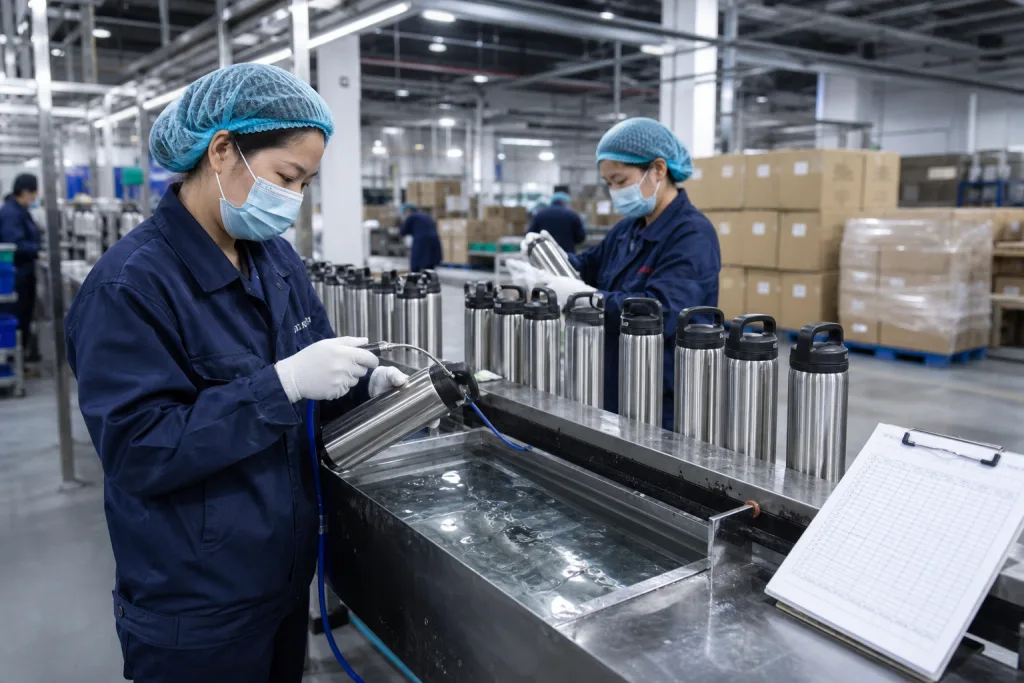
At BottleForge Industrial in Zhejiang, China, our monthly output for stainless drinkware is 300,000 units, but scale does not fix a vague spec sheet. We run 3 leak-test stations, and QC pulled the sample last month because the thread start was rough on one mold set. A large canteen factory can build the wrong product fast if the checklist is soft. The math does not work. If your supplier, canteen vendor, or canteen manufacturer cannot convert your concept into measurable points, your risk stays high even when the price on the quote looks good.
Leakage starts at the neck
The field complaint we see most on custom canteens is still leakage, and buyers blame the gasket first. Most of the time that is the wrong question to ask. The failure usually comes from stack-up: neck roundness, thread pitch, lid seating pressure, silicone compression, and cap torque missing each other by 0.2-0.4 mm. We have seen QC pull a sample that passed on a straw lid and failed on a chug lid on the same bottle body. One thread standard does not automatically fit every lid option, even if the PO says “shared neck finish.”
What should you specify? Start with neck dimensions and torque testing, not just “must be leakproof.” Ask your canteen supplier for the thread drawing, tolerance range, and seal design. For mainstream hydration flask orders, the gasket is usually food-grade silicone in the 50-70 Shore A range. Too soft and it extrudes after repeated closing on the line; too hard and it will not conform to small neck variance. We normally ask buyers to approve a neck gauge before tooling release, because vague leak claims go sideways fast.
Simple leak-control checklist
- 100% air-pressure or inverted water leak test during assembly.
- Cap torque range recorded by line, for example 8-12 kgf·cm depending on lid design.
- Random hot-fill test at 80°C and cold-cycle test to catch seal shrinkage issues.
- Thread gauge approval before mass production.
- Drop test with filled bottle from 80-100 cm onto plywood over concrete.
If you sell into e-commerce or Amazon FBA, leakage is not just a product defect. It ruins labels, softens cartons, and spreads into nearby stock. We ship enough FBA orders to know the math does not work once chargebacks start: a $2.80 FOB unit turns into a claim case fast. On a canteen promotional run with lower-budget lids, tell the factory where you can give up spec. A simpler carry loop is fine. Do not cut gasket material or leak testing. A canteen customized for corporate gifting can ship in a plain white box, but it cannot arrive with liquid inside the master carton; we have seen a 6-piece master fail just from one loose cap at 10 kg load.
You do not need the “best” lid. You need one with stable tolerances, repeatable torque, and a seal that matches the way the bottle will actually be used.
Insulation claims that do not hold
Vacuum bottles get oversold fast, and specs get written too loose. A distributor canteen sample might stay cold through one meeting-room demo, then the line slips in mass production if the vacuum station is not stable. We have seen QC pull samples with bottom weld inconsistency, weak vacuum extraction, missing copper inner coating that was on the PO, or a liner shape that looks fine but bleeds heat. Then the catalog says 12 or 24 hours cold retention, while batch A and batch C do not match.
Ask for numbers you can test. For a 500 ml double-wall vacuum flask, write that water filled at 95°C must stay above 55°C after 6 hours at ambient 20-25°C, or that ice water at 4°C must stay below 10°C after 12 hours. Bottle size and mouth diameter change the result; a 3 mm wider opening is enough to move the data. The wrong question to ask is “Is it insulated?” Ask how the factory tests it, with what fill temperature, and against which pass line.
Separate actual performance from sales language. We ship a lot of canteen projects out of Zhejiang, and plenty of factories can make a bottle that performs well, but not every factory records the process or keeps the same vacuum standard lot to lot. For a custom growler or customizable growler with larger capacity, heat loss is usually higher because the lid opening is wider and the headspace changes. We have seen buyers copy a small flask claim onto a 64 oz growler, and the math does not work.
- Vacuum spot check: pull finished samples from each lot, fill with ice water, and check for surface condensation after 20-30 minutes, then log retention by hour.
- Bottom weld review: inspect weld uniformity and deformation before coating; on our line, QC checks the base ring area first because that is where bad sealing shows up.
- Capacity tolerance: larger bottles can drift by 15-30 ml, enough to affect stated volume and retail labeling.
- Use-case match: a gym bottle, distributor growler, and commuter flask should not share one retention claim; the buyer flagged this on a 1,200-piece order last spring.
If your buyer brief only says “double wall vacuum insulated,” you leave the factory too much room to interpret the spec. Write the test method, the timing, and the pass/fail rule into the order. Put it on the PO, not just in email.
Bad coatings create fast returns
Surface finish is where 1 return case can wipe out the margin on a whole PO. We see bottles look premium for 14 days, then look tired after 30. The common failures are thin powder coat, dirty pretreatment before spray, batch-to-batch color shift, weak logo adhesion, and uneven texture from the line speed drifting. Matte is less forgiving. Finger oil, scratches, and under-cured patches show fast, and QC pulled the sample more than once just because the shoulder gloss was off by sight. If you are buying a customizable canteen line in six colors, color control deserves the same attention as leak control.
Ask the factory how they prep the shell before coating. This is the right question. We run degreasing, rinsing, and curing checks because pretreatment, film build, and oven temperature matter more than a Pantone chip on paper. A practical coating thickness range for powder-coated stainless drinkware is often around 60-80 microns, depending on the finish. Too thin and abrasion resistance drops. Too thick and you start seeing trouble at the threads, base ring fit, and edge definition; we have measured lid engagement go bad with only 0.2 mm buildup around the neck.
Tests worth paying for
- Cross-hatch adhesion test: especially on logo areas and rounded shoulders, where coating tension fails first.
- Color comparison: approved master sample under D65 light, not only phone photos; one buyer approved a navy by WhatsApp and rejected 1,200 pcs under office lighting.
- Scratch and rub test: check with carton friction and normal handling, not just a clean desk sample.
- Dishwasher disclaimer: if the item is hand-wash only, print it clearly on packaging and listing copy; we have seen returns caused by one missing line on the gift box.
Logo method changes the risk. Silkscreen is the value option for canteen promotional orders, but it scuffs sooner than laser engraving or baked transfer in daily use. Laser is permanent on stainless, though it changes the look, and some brand teams push back once they see the steel mark turn slightly gray on 304 stainless. If you run a canteen vendor network across different accounts, standardize finish and logo options by channel. Keep one hard-wearing spec for retail, one lower-cost spec for events, and one premium spec for gifting. The math does not work if every account gets a custom finish stackup at 500 pcs MOQ.
This is where an experienced canteen manufacturer in Zhejiang saves money for distributors. Not by cutting price 5 cents, but by flagging the bad combination before sampling starts: soft-touch coating, metallic logo, and a dishwasher-safe claim on the same bottle. We have seen this go sideways, and the buyer usually flags it only after the first abrasion complaint lands.
Packaging failures cost more than defects
Buyers spend weeks on the flask spec, then treat packaging like an afterthought. That is where margin leaks. A solid bottle in a soft carton still lands chipped, rubbed, or short-packed, and the claim cost is usually higher than the unit defect cost. On our line, QC pulled a sample last month with a perfect body finish and a crushed corner because the outer carton burst strength was underspec. For a distributor hydration flask program, packaging is part of the engineering spec, not artwork.
Start with the sales channel. Retail distribution, Amazon FBA, and promo bulk each need a different pack plan, and this is the wrong question to ask late in the PO cycle. We see buyers approve the bottle first, then come back after mass production asking for FNSKU labels and scan-ready barcode placement. Same flask, three pack results from one canteen supplier:
- Bulk pack: lowest cost, usually 12-24 units per master, with basic dividers and limited individual protection.
- White box: the standard choice for private label and distributor canteen orders, usually cleaner for relabeling and warehouse put-away.
- Gift box: stronger shelf presentation, but often adds $0.25-$0.80 per unit and pushes carton cube up fast.
Then lock the performance spec before production. Ask for carton drop testing, barcode scan checks, and exact carton dimensions, not an estimate. A 2 cm increase in carton height sounds minor on paper; on a 40HQ load, the math doesn't work the same way. We have seen 10,000-unit orders lose enough loading efficiency to add a few hundred dollars in freight from China to Europe or North America, and the buyer flagged it only after the container plan was done.
We recommend documenting these points in every PO:
- Master carton material and burst strength or edge crush requirement.
- Inner protection type: EPE bag, paper wrap, cardboard partition, or molded insert.
- Barcode format, placement, and label size.
- Drop test standard for packaged unit and master carton.
- Carton weight limit, ideally under 15 kg for easier warehouse handling.
For canteen custom and customized growler projects, wide lids, side handles, and add-on parts create dead space fast. We have measured pack-outs where 8 mm on the lid profile changed the insert and left too much air in the box. Ask your canteen vendors to optimize the pack-out, not just the product, or this goes sideways in transit and in the warehouse.
Compliance gaps that stop shipments
The fastest way to turn a clean PO into a claim is to check compliance after production. We have seen cartons ready at the dock, then the buyer asks for one more food-contact report and the shipment sits 12 days instead of 3. Hydration flasks touch food, so generic supplier statements are not enough. Europe usually needs REACH review and food-contact declarations tied to the actual material set. The US and Canada often bring retailer checklists with heavy metals limits, phthalates checks on soft parts, and product safety statements. Kids SKUs also pull ASTM questions fast, even when the item was sold as a flask, not a toy. This is the wrong question to ask: “Do you have a certificate?” Ask which materials, which market, and which test scope.
Not every custom canteen needs a big test bill. The plan has to match the material stack and the sales market. If the bottle body is 304 stainless but the lid carries PP, silicone, paint, and a 2 mm metal pin, the file has to cover the full BOM. On our line, QC pulled the sample lid apart with a small screwdriver set because one buyer flagged “steel body passed” while the odor was coming from the silicone seal. We have seen this go sideways. A steel report alone does not clear the lid assembly.
For factory controls, ask for BSCI or an equivalent social audit if your customer requires it, and ask for the ISO-based quality system the factory claims on the quotation. Then check current files, not a 2-year-old scan with an expired stamp. AQL inspection should be done before final balance payment. If the market is sensitive, book third-party inspection in China. We run final checks at 80% packed or above because that is where wrong barcodes, mixed lids, and carton mark errors show up; last year a buyer PO even carried a logo typo that the line copied until QA stopped it.
- Documents to request: material declaration by component, food-contact test report matched to the actual flask build, REACH statement where relevant, packaging material information, and current factory audit status.
- Inspection timing: during production at 20%-30% and final random inspection at 80% packed or above; at 20% we usually catch print position drift of 1-2 mm before the full run is done.
- Critical defects: leakage after vacuum test, sharp edges around the mouth, wrong logo, wrong barcode, missing accessories, odor contamination from seal rings or paint.
A reliable canteen factory in Zhejiang or elsewhere in China will not be offended by this. Serious factories expect this because serious buyers ask for it, and the ones that push back early usually tell you enough.
How to spec your next order
If you want fewer surprises, make a one-page control sheet for each SKU. Put it next to the PO and artwork file. The goal is simple: your supplier, inspector, and warehouse should all be reading the same product spec, not three versions of it. On our line, a missing note as small as “matte black” vs “rubber black” has already caused a carton hold. This applies whether you buy from one canteen vendor or manage 4 canteen distributors across different markets.
For a standard distributors hydration flask, your control sheet should list the actual checkpoints people use on the floor: SKU photo, approved sample reference date, capacity, net weight tolerance, dimensions, steel grade, finish code, lid assembly details, gasket color, logo method, packaging layout, carton spec, barcode placement, test plan, AQL level, and shipment terms. Put numbers on the items that matter. “Weight tolerance ±8 g,” “logo 35 mm from base,” and “barcode on right panel” are clear; “same as last order” is where claims start. QC pulled a sample last month with the right artwork and the wrong gasket because the PO said “gray,” but the approved sample was closer to Pantone Cool Gray 7.
Typical commercial terms in our Zhejiang, China production base look like this: MOQ 1,000 units per color for stocked models, 3,000 units for more customized drinkware structures, sample lead time 7-12 days, and mass production 25-35 days after sample sign-off and deposit. FOB pricing for a mainstream 500-750 ml vacuum flask usually falls in the low single-digit USD range depending on finish and lid complexity. A quote below that is the wrong thing to chase. The math does not work unless someone cuts inspection, thins packaging, or skips a process step like vacuum hold testing.
Buyers also ask whether they should consolidate a custom growler, customizable drinkware tumbler, and customized canteen in one order. You can, but only if the factory can actually run component planning and QC across categories without slipping the ship date. We have seen this go sideways when 1 lid mold repair delayed 2 finished items that were already packed. Mixed orders look efficient on paper, but one late color sleeve or one barcode sticker typo can hold the full booking.
The practical rule is simple: if you cannot inspect it, do not leave it vague. That one habit protects margin better than arguing over another $0.03 per unit. Buyers push hard on price; fair enough. But a 2 mm logo shift, a 12 g overweight bottle, or an inner box that fails drop test will cost more after arrival.
Send your flask spec for a factory review
We will check drawing risks, MOQ, packaging, and QC points before you place the order, so you can buy from China with fewer surprises.
Frequently asked questions
What MOQ should I expect for a custom distributors hydration flask order?
For a stocked stainless model with custom logo and standard color, 1,000 units per color is a normal MOQ in China. If you need a new mold, custom lid, or fully customized canteen body shape, expect 3,000 to 5,000 units. Gift box upgrades can also push MOQ higher because packaging suppliers often want 1,000 to 2,000 boxes per design. If your program mixes sizes, ask whether MOQ applies per size, per color, or per combined SKU family. A quote that says “1,000 pcs MOQ” without that detail can mislead you. For distributor buyers, the safest approach is to confirm MOQ separately for bottle, lid color, logo process, and packaging before you approve samples.
How long does production take for custom drinkware from Zhejiang, China?
For repeat orders on an approved SKU, 20 to 30 days is common. For a new custom drinkware project, allow 7 to 12 days for pre-production samples and about 25 to 35 days for mass production after approval and deposit. If the order includes new tooling, holiday congestion, or custom gift boxes, lead time can move to 35 to 45 days. Buyers often forget that coating color approval and packaging proofreading add time even when the bottle body is standard. If you need vessel booking and third-party inspection in China, build in another 5 to 7 days. Ask your factory for a schedule by milestone, not a single shipment date.
Which tests matter most for a hydration flask before shipment?
For most distributor canteen orders, the core tests are 100% leak testing, vacuum retention spot checks, coating adhesion, logo rub resistance, and drop testing on packed goods. On the QC side, use AQL 2.5 for major defects and 4.0 for minor, with zero tolerance for critical defects such as leakage, sharp edges, wrong barcode, or wrong logo. If your sales channel includes Amazon FBA, carton label checks and scan accuracy are also essential. For compliance, request food-contact documentation covering all relevant materials, not only the steel body. If your flask has PP, Tritan, silicone, paint, or metal pins in the lid, those parts should be included in the document set.
Is 304 stainless enough, or should I ask for 316?
304 stainless is the practical standard for most custom canteen and hydration flask programs. It gives good corrosion resistance, broad market acceptance, and manageable cost. 316 is useful when the product will face harsher contents or more demanding environments, but it adds cost and is often unnecessary for mainstream water use. What matters more is that the supplier actually uses the specified grade and controls wall thickness consistently, such as 0.4 to 0.5 mm outer wall on common vacuum bottles. Also check lid-contact parts. Some factories advertise a 304 body but use lower-grade metal in hidden components. Ask for a full material declaration, not a single headline claim.
How do I reduce claims if I sell through distributors and promotional channels?
Split your spec by channel instead of forcing one bottle to serve every price point. For retail and distributor drinkware, prioritize durable powder coating, stronger cartons, and a robust leak-tested lid. For canteen promotional projects, you may simplify packaging or use one-color print, but keep gasket quality and leak testing the same. Standardize an approved control sheet, require pre-production approval, and inspect every order at final stage before balance payment. Keep cartons under 15 kg, confirm barcode placement, and request a sealed golden sample for future repeats. These basic controls usually save more money than squeezing FOB down by $0.05, especially when your annual volume reaches 20,000 units or more.