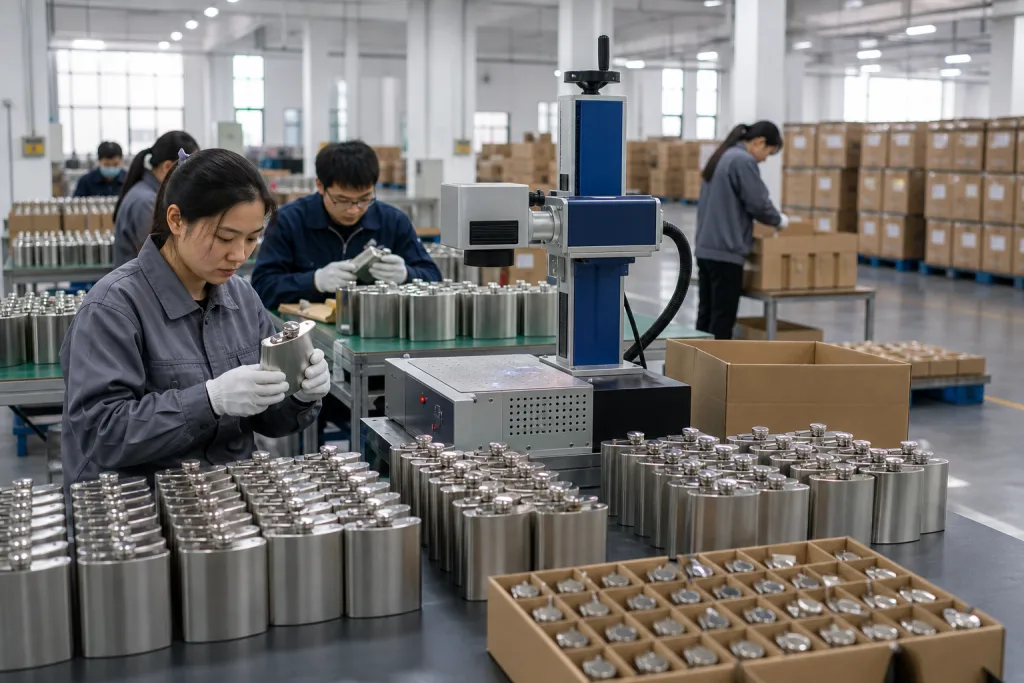
Key Takeaways
- For most B2B flask programs, 18/8 stainless at 0.5 mm body thickness and AQL 2.5 is the safe starting spec.
- Typical MOQ is 1,000-3,000 pcs per SKU; custom gift-box sets often start higher at 2,000 sets.
- A realistic China lead time is 25-35 days after sample approval, plus 5-7 days for export booking from Zhejiang.
- Laser engraving has near-zero color variance, while silk screen usually carries a 3-5% cosmetic sorting loss on dark coatings.
If you buy for retail chains, promo campaigns, or private-label programs, a hip flask looks simple until it starts coming back. The usual problems are odor retention, cap leakage, coating scratches, and decoration that flakes after one season. We ship a lot of 6 oz and 8 oz units, and the buyer usually flags the same thing first: does this belong with barware, gift sets, outdoor canteens, or a broader custom drinkware line?
Most buyers landing in China start with a photo and a target price. Wrong order. Start with steel grade, 0.6 mm or 0.8 mm wall thickness, cap construction, decoration method, and carton drop test results. On our line in Zhejiang, QC pulled the sample, checked the hinge, and found a PO typo on the finish code before production. The math does not work if you treat a flask for gifting like the same SKU as one for a canteen distributor or a distributor drinkware catalog.
Spec table before style talk
If you source a distributors hip flask, lock the spec first and argue about style later. We’ve seen buyers spend 2 weeks on shape and logo placement, then QC pulled the sample and found the cap thread was too shallow by 0.3 mm. A flask can feel solid in hand and still fail a leak test if the weld zone is rough or the passivation was skipped. For B2B buying, put the full comparison on one sheet. Same rule for a custom canteen, a customizable growler, or a distributor growler line.
- Material: 18/8 stainless steel is the normal choice for beverage contact. 18/0 cuts cost, but we’ve seen this go sideways on acidic liquor programs after storage tests.
- Body thickness: 0.4 mm is entry level. 0.5 mm is the safer everyday spec. 0.6 mm adds hand feel and takes denting better when cartons get dropped on the line.
- Capacity: 6 oz, 8 oz, and 10 oz sell best in Europe and North America. 8 oz fits the widest gift-channel demand.
- Cap type: attached captive cap cuts lost-cap claims. Free cap looks cleaner on photos, but the buyer flagged it more than once after retail launch.
- Seam construction: laser weld with polish cleanup usually gives a cleaner leak result than low-cost solder-style repairs. We run air-pressure checks in water tanks, and weak seam work shows up fast.
- Finish: mirror polish shows fingerprints. Matte hides handling marks. Powder coat gives wider brand-color options and helps when the logo color on the PO is Pantone-matched.
- Decoration: laser engraving is stable. Silk screen is lower cost. Emboss, deboss, and badge application need sample review because 1 logo can look sharp on flat art and soft on curved steel.
- Packing: bulk, white box, black gift box, or flask-plus-funnel set. Check the box size early—an insert off by 2 mm can make the flask rattle in transit.
A practical comparison table for an import program usually looks like this: economy flask at 0.4 mm, 6 oz, mirror, bulk pack, FOB China around USD 1.25-1.55 at 3,000 pcs; mid-range flask at 0.5 mm, 8 oz, matte or powder coat, captive cap, white box, around USD 1.85-2.45 at 2,000 pcs; gift-set flask at 0.5-0.6 mm with funnel and rigid box, around USD 3.80-5.80 per set at 2,000 sets. If your target retail is under USD 14.99, the mid-range spec is usually the right balance. This is the wrong question to ask if you only compare piece price. We ship plenty of programs where the cheaper flask loses money after repacking, cap complaints, or dent claims. If you sell to outdoor accounts through canteen vendors or canteen suppliers, matching flask finish and decoration with a broader custom drinkware range usually works better than chasing the lowest unit cost.
Head-to-head by sales channel
Different channels pay for different flask specs. Buyers overbuild promo orders and underbuild retail ones all the time. Margin gets eaten there. We’ve seen a PO for an 8 oz gift flask come in with 0.4 mm body and gift-box expectations, and the math doesn’t work.
Retail gift and souvenir
For museum shops, liquor accessories, and seasonal gift programs, an 8 oz flask with 0.5 mm body, powder coat or satin finish, and captive cap is the safe build. Add laser engraving if the logo has fine lines or small text; our laser mark stays cleaner than screen print once the stroke drops under 0.3 mm. This channel cares about the box almost as much as the flask, so budget USD 0.28-0.75 for upgraded packaging. QC pulled the sample on one gift order because the lid sat 1.5 mm off-center in the insert. Returns usually come from dented corners and crooked prints, not leakage.
Canteen distributor and outdoor catalog
If the same customer also buys custom canteen, custom growler, or customized canteen products, they usually ask for finish consistency across the line. The flask should sit with the outdoor family: matte black, army green, brushed steel, or stone color. It is rarely the hero SKU. It rides along with a canteen customizable range, so MOQ flexibility matters more than a fancy rigid box. We run mixed bottle and flask schedules on the same coating line, and a factory in Zhejiang shipping 300,000 units per month can often combine color runs if planning starts before the weekly powder batch is locked. Buyers push back on this point, but this is the wrong question to ask: not “Can you do 4 colors?” but “Can you hold the same black across the full set?”
Canteen promotional and event programs
For canteen promotional or customized drinkware campaigns, buyers care about landed cost and lead time first. Skip complex embossing, skip two-position prints, and stay with one standard mold. A 6 oz or 8 oz mirror flask with one-color silk screen in a white box is usually enough. We ship plenty of these with a 1-color mesh screen and standard cap assembly, and the line moves faster than any deep custom pack-out. Be direct about use-case fit. Event buyers often assume the flask should work like a vacuum bottle, and the buyer flagged this on one Orlando show order after reading only the hero image. It will not. It is a single-wall stainless vessel, and that needs to be stated clearly on the product sheet.
If your customer says “premium” but gives you a target under USD 1.60 FOB, they do not want premium. They want acceptable appearance at high volume.
This channel logic also helps when you buy distributor canteen, customizable drinkware, or customized growler products from the same canteen factory. One line sheet works. Three quality levels are enough. Fewer arguments later, fewer surprise claims after arrival, and fewer cases where a cap knurl or print angle gets debated on a 5,000-piece reorder.
Steel, cap, and leak risk
The failure point on a distributors hip flask is rarely the flat body panel. It is the neck and cap area. Saving USD 0.05 on material here is the wrong question to ask; we have seen that turn into claims worth 10 times more after arrival. For liquor-contact products, specify SUS304 interior and ask the supplier to show a migration and heavy-metal compliance path that fits REACH. On our line, QC pulled the first-article sample from the neck-forming station before polishing because this area causes most trouble. If you sell to the US, ask for food-contact testing aligned with FDA requirements and, where needed, California Prop 65 screening for coatings and packaging components.
The cap needs a food-grade silicone or PE sealing insert and a thread with consistent engagement. We usually look for at least 1.5 to 2 turns of clean engagement; a short thread may pass a factory water test and still leak after 800 km of truck vibration. The buyer flagged this once on a PO where the cap looked fine but backed off by half a turn in transit. Ask for a 100% vacuum or air-pressure leak check on the line if the factory runs it, or at minimum a 2-hour inverted water test by sampling batch. On higher-volume runs, our practical recommendation is:
- Incoming material check on steel thickness: tolerance within ±0.03 mm
- In-process weld inspection every 2 hours
- Final leak test: AQL 0 for critical leakage defects, AQL 2.5 for major cosmetics
- Drop test: 76 cm packed drop on 6 faces for gift-box SKUs
Body geometry matters too. A wider shoulder looks cleaner on shelf. If the neck transition is too sharp, the fill nozzle sits less stable and polishing wheels skip the curve, so output starts drifting after a few hundred pieces. We run into this on neck gauges with a 0.10 mm swing, and the math does not work if you expect tumbler tooling habits to carry over. That is why some canteen manufacturers and canteen factories that do solid work on tumblers are only average at flasks. The tooling and neck tolerance demands are different.
If you are buying a flask as part of a broader customizable canteen or distributor drinkware assortment from China, ask whether the plant makes flasks in-house or subcontracts them. Nothing is wrong with subcontracting by itself. You need to know who owns quality control, who signs the final inspection report, and where the leak test actually happens. In Zhejiang, China, we have seen export companies ship factory-made tumblers with outsourced flasks in the same order, and this goes sideways when standards are split. One inspection finding last year was simple: the flask vendor used a different cosmetic limit sample than the tumbler vendor. That mix can work, but only if the inspection standard is unified before mass production.
Decoration methods compared honestly
Buyers often lock decoration after the flask shape is approved. That is late. On a curved hip flask face, one print method runs clean and another starts drifting 1.5-2.0 mm at the shoulder, so the right call depends on qty, surface finish, and how long the item needs to stay clean on shelf.
Laser engraving
Best on powder-coated or painted surfaces, especially for fine lines and small text. We run fiber laser on these jobs, and QC pulled the sample last month because a 0.25 mm serif started filling in on one artwork revision. The mark is consistent, hard to scratch off, and there is almost no Pantone argument because you are exposing steel or the underlayer. Unit add-on is usually USD 0.08-0.18 depending on logo size. For North American distributors, this is the safest way to avoid print-color claims. If the buyer wants low complaint risk, this is usually the right question to answer first.
Silk screen printing
Best for low-cost canteen promotional orders and simple one-color artwork. Add-on cost can be as low as USD 0.04-0.10, but print position variance and ink adhesion need checking on the line, not just in the mockup. On mirror polish, the print can look sharp, but every fingerprint and carton rub mark will show. On powder coat, adhesion is better if the coating cure stays stable; we usually cross-hatch test after cure, and the buyer flagged one batch where the white ink chipped at the radius after tape pull. Expect 3-5% extra sorting for strict cosmetic accounts. The math does not work if you want cheap printing and luxury-grade appearance on the same flask.
Emboss or deboss
These methods feel premium. Tooling cost can range from USD 150-400 per design, so it makes sense for repeat programs, not for artwork that changes every season. We have seen buyers put this on a 1,000 pcs trial with two logo versions, then push back on the mold charge after the PO typo changed the artwork file name. It works well for heritage brands, gift shops, and private-label barware. Less suitable for seasonal artwork or short MOQ testing.
Metal badge or wrap
Use this sparingly. It looks expensive on sample day, but assembly adds labor, usually another handwork station, and we have seen edge-lift complaints after 18 days on water versus 12 days on air because carton compression starts working on the badge corners. Unless your customer is targeting a retail price above USD 24.99, this method usually does not lift sell-through enough to cover the cost. Buyers ask how to make the flask look more premium; often this is the wrong question to ask if the shelf price is still mass market.
The same logic applies to customized drinkware, canteen customized orders, and customizable growler programs. If you want one decoration language across flask, bottle, and growler, laser is usually the lowest-risk standard we ship. If you need exact Pantone branding, silk screen on a light, stable coating can work, but approve a golden sample, mark the print position in mm, and keep that sample in China with the PO file.
MOQ, price breaks, and tooling
Hip flasks do not move like sports bottles, so MOQ planning needs to be grounded in actual sell-through. We tell buyers this early. If a flask can share the same powder color, master carton, or white box with 2 other custom drinkware SKUs, we can usually run smaller without breaking the line. Once the project needs its own gift box, EVA insert, funnel, and emboss die, the math changes fast. We have seen buyers ask for 500 pcs with a dedicated box; this is the wrong question to ask because the box supplier alone may want 1,000-2,000 pcs.
Typical factory numbers in China look like this:
- Standard flask, existing mold: MOQ 1,000 pcs per size/color
- Powder-coated flask with logo: MOQ 2,000 pcs per color
- Gift-box set: MOQ 2,000 sets
- Custom mold shape: tooling USD 2,500-6,000, development 20-35 days
Price breaks usually show up at 3,000 and 5,000 pcs, though the jump is often smaller than buyers expect. The first cost drop comes from setup time on the line, not from shaving a little steel cost. A standard 8 oz SUS304 flask might move from USD 2.25 at 1,000 pcs to USD 1.98 at 3,000 pcs and USD 1.86 at 5,000 pcs FOB Ningbo. Good savings, yes. Still, if your distributor canteen catalog is only testing demand, dead stock will eat that margin faster than the unit-price gain. Last month a buyer flagged a 3-cent gap and missed the bigger issue: they were sitting on 1,800 slow units.
Ask line by line what the quote includes: polybag, white box, desiccant, barcode label, export carton marks, and spare caps if any. Do not leave this vague. For Amazon FBA or major retail compliance, outer carton dimensions, drop-test limits, and FNSKU labeling add labor, and sometimes a relabel pass at the packing table. We ship projects where QC pulled the sample because the carton mark on the PO said 24 pcs/ctn but the approved packout was 20 pcs/ctn. Some canteen vendors quote a low flask price, then add USD 0.12-0.25 later for “special packing.” That is not special. It is standard project costing.
If you buy across categories from the same canteen suppliers, combine the flask with custom canteen or customized growler production where it makes sense. That can help you hit a powder batch minimum, such as one full color run, or a carton-order threshold from the packaging vendor. We run this way for mixed orders all the time. Chasing another USD 0.03 from a new source sounds smart, but we have seen this go sideways once the new factory misses color match or packs the funnel loose inside the gift box.
Compliance and inspection that matter
B2B buyers in Europe and North America do not need a pile of random certificates. You need the documents that match the product, market, and material. For a distributors hip flask, we usually start with these checkpoints, and this is where buyers save or lose time on the line:
- Material declaration: stainless grade confirmation for body and cap parts, with the cap insert called out separately if there is one
- REACH: especially relevant for coatings, inks, and packaging accessories sold into Europe; QC often checks the coating batch record before mass packing
- FDA/LFGB path: depending on the market and customer requirement; if the buyer wants Germany, we ask about LFGB on day 1, not after sampling
- BSCI or social audit: often requested by retail chains, even for small giftware, even at 1,000 pcs MOQ
- ISO 9001: useful if the plant claims formal process control; if a factory says they run SOPs but cannot show a revision record, the claim is thin
Inspection should fit the item. A flask is small, but every touch point shows. We have seen buyers reject for fingerprints, coating dust, crooked logos by 1.5 mm, and cap scratches picked up during final packing. Define the defect list early. This is not paperwork for later; we have seen this go sideways once cartons are sealed.
- Critical: leakage, sharp edge, wrong material claim
- Major: logo unreadable, dent over 3 mm, cap thread failure, exposed base metal on colored finish
- Minor: small polish haze, carton mark lightness, slight color shift within approved tolerance
AQL 2.5/4.0 is common, but for premium gift programs, plenty of buyers push AQL 1.5 on majors. QC pulled the sample, ran a leak check, and then found thread drag on 4 pcs out of 200 once during inspection. That is why we tell buyers to build in 2-3 days for pre-shipment correction if the supplier is in Zhejiang and shipping FOB Ningbo or Shanghai. The math doesn't work if you skip that buffer and argue at destination.
One practical point. If the same supplier also offers custom growler, canteen manufacturer services, or customizable drinkware, do not assume all categories pass the same tests. Ask for product-specific reports. A tumbler pass report does not validate a flask cap insert or flask coating system, and the buyer flagged this exact mix-up on one PO where the cap material line was typed wrong.
Choose the right factory match
The best flask supplier is often not the biggest canteen factory. You need a plant, or a managed supply chain, that holds tight metal tolerances, runs decoration with discipline, and packs for export without guesswork. On our line, a 0.3 mm neck-thread drift is enough to turn a clean-looking flask into a leak claim. Start with five questions.
- Do you make the flask body in-house or outsource it?
- What is your monthly capacity for flasks specifically, not total custom drinkware?
- What is your standard leak-test method and sample size?
- What is your normal lead time in low season and peak season?
- Can you run matching finishes across flask, custom canteen, and customized canteen items?
A capable Zhejiang team should answer without dancing around it. A normal reply sounds like this: flask capacity 80,000-120,000 pcs/month, sample lead time 7-10 days, mass production 25-35 days, MOQ 1,000 pcs, and export from Ningbo within 5-7 days after balance payment. Those numbers track with what we ship. QC pulled the sample, ran a vacuum leak test, and logged the result lot by lot. If a supplier offers 500 pcs MOQ, full custom tooling, a gift box, and 12-day shipment in peak season, the math does not work. We have seen this go sideways.
For distributors, range logic matters. If your catalog includes distributor canteen, distributor growler, and other customizable drinkware, one coordinated supplier in China cuts artwork mistakes and mixed-carton headaches. We have seen buyers flag a carton mark that matched the PO name but missed the barcode suffix by one digit. That is enough to hold goods. The wrong question to ask is price first. Ask how they control BOM versions, approved Pantone references, barcode files, and final carton specs.
The best projects are boring. You lock one golden sample, one packaging standard, and one inspection checklist, then repeat with small artwork edits. On one reorder, the only change was a logo position moved 2 mm, and the line kept everything else the same. That is how experienced canteen distributors and canteen vendors buy from China. They do not squeeze every cent on the first PO; they build a specification that still works on the second and third reorder without surprises.
Compare your flask spec with a factory-ready quotation
Send your target price, capacity, finish, and packaging. We will map the right MOQ, lead time, and compliance path from Zhejiang, China.
Frequently asked questions
What is the normal MOQ for a distributors hip flask order?
For a standard existing flask mold, expect 1,000 pcs per size or color as a realistic MOQ from China. If you need powder coating plus custom logo, many factories move to 2,000 pcs because coating setup and print make-ready need volume. Gift-box sets with a funnel or shot cups usually start at 2,000 sets. If your supplier also runs custom canteen or customized drinkware orders, they may combine color production across SKUs to help you reach minimums. That works best when the flask and bottle share the same coating color and carton standard. For full custom mold development, plan tooling at USD 2,500-6,000 and an MOQ discussion only after the sample is approved.
Which material should I choose for liquor-safe hip flasks?
Choose SUS304, also called 18/8 stainless steel, for the body and ideally for exposed beverage-contact parts. It costs more than 18/0, but it is the safer long-term choice for acidic alcohol contact and better corrosion resistance. Specify body thickness at 0.5 mm if you want a solid retail feel without pushing cost too high. Also check the cap insert material, usually food-grade silicone or PE, because that part causes many odor or leakage complaints. If you sell into Europe, ask for REACH-related material declarations and coating compliance. For North America, request food-contact confirmation and coating screening where needed. The steel grade on paper matters less if the sealing system is poor, so review both together.
Is laser engraving better than silk screen for flask logos?
If you want low risk, yes. Laser engraving is usually better for curved flask faces, especially on powder-coated or painted surfaces. The logo stays consistent, there is almost no color variance issue, and scratch resistance is far better than standard screen print. The typical add-on is USD 0.08-0.18 per piece, depending on size and position. Silk screen is cheaper at around USD 0.04-0.10, so it still makes sense for canteen promotional or event programs where cost is tight and the logo is simple. But expect more cosmetic sorting and possible adhesion disputes if the coating cure is unstable. For repeat distributor programs, laser normally saves more in claim prevention than it costs upfront.
How long does production take from sample approval to shipment?
For a standard distributors hip flask with existing mold, a practical schedule is 7-10 days for pre-production sample, then 25-35 days for mass production after sample approval and deposit. If you are ordering in peak season before Q4 gifting, add 7-10 more days. Custom gift boxes, emboss tooling, or multi-item sets can also add about a week. After final inspection, export booking from Zhejiang, China usually needs another 5-7 days for FOB Ningbo or Shanghai shipment. If the order includes matching custom canteen or customized growler SKUs, align approvals early so the coating and decoration schedule is shared. That often shortens the total project time more than pushing the flask line alone.
What quality checks should I require before I pay the balance?
At minimum, require material confirmation, leak testing, decoration approval against a golden sample, and a pre-shipment inspection using AQL. For flasks, leakage should be treated as a critical defect with zero acceptance. A practical inspection plan is AQL 2.5 for major defects and 4.0 for minor defects, though premium gift retail may use 1.5 for majors. Confirm body thickness tolerance within about ±0.03 mm, cap thread function, logo position, and packing drop resistance for boxed sets. Ask for an actual filled-water inversion test or air-pressure test record, not just a verbal promise. If the supplier is combining factory-made bottles with outsourced flask production in China, make sure one unified checklist covers both sources before balance payment.