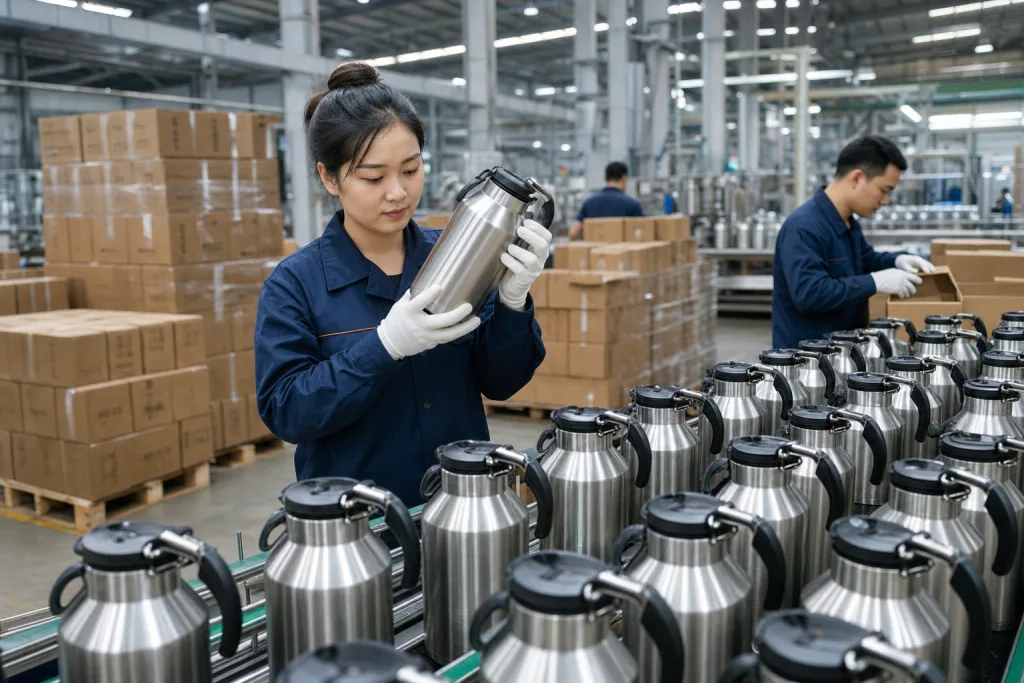
Key Takeaways
- MOQ for a typical custom growler order should start around 3,000 pcs, with 25-35 days production after sample approval.
- A distributor growler program needs QC on wall thickness, lid seal, print position, and carton drop test, not just a visual check.
- FOB China pricing for a 64 oz stainless growler usually lands around USD 4.80-8.40 depending on steel gauge, coating, and logo method.
- For repeat orders, lock the spec sheet, AQL standard, and packaging map before you approve the first mass run.
You are not buying one growler. You are buying repeatability: the same 64 oz body, the same cap torque, the same logo position, and the same carton count every reorder. That is where distributor programs slip. A sample passes, then the lot shows a different powder-coat gloss, a loose lid gasket, or artwork shifted 4 mm. For distributors growler programs, that is margin gone.
If you source from China, especially Zhejiang, think like a procurement engineer, not just a buyer. A decent canteen factory or canteen manufacturer should give you dimensions, material grades, AQL checkpoints, and a real lead time before you send the PO. At BottleForge in Hangzhou, we run 1,200,000 units a month across drinkware lines, and a standard custom growler order starts at 3,000 pcs with 25-35 days production after sample approval. That is the level of detail you should ask from any canteen supplier or distributor drinkware partner.
Start With One Real Order
I’ll rewrite the section in place, keep the HTML untouched, and tighten the language so it sounds like a factory-side sales engineer wrote it.Use one real order, not a theory. We had a North American distributor ask for 8,000 pieces of a 64 oz stainless custom growler for a seasonal bar program. Black powder coat. Laser logo. Individual carton pack. The buyer then said a second color might come later, so we had to set it up to scale without touching the main tooling. That is where a distributor canteen or distributor drinkware program makes money, or burns margin fast.
Before decoration, lock the product build. A normal 64 oz growler runs on 18/8 stainless steel, a 0.5-0.6 mm body wall, and either a 304 stainless or BPA-free polypropylene lid, depending on target price. We saw one quote fail because the wall was pushed down to save a few cents, and the dent rate jumped in transit. If the lid spec is loose, leaks show up. A serious canteen distributor or canteen vendor writes the numbers down: diameter, height, neck finish, coating thickness, logo size. That is the only way the quotes can be compared on the same sheet.
For this order, we ask for a first article sample, then a sealed pre-production sample, then a production match sample kept in the file. QC pulled the sample with a caliper on the line, checked the neck finish, and caught a carton typo before the PO went into mass packing. This step is not ceremony. It is the reference for the canteen manufacturer, the freight forwarder, and your service team when the first claim lands. If the buyer later asks for a customizable growler in another color, we run the same base tooling and change the coating line only, which keeps cost and lead time under control.
Choose The Right Build
Growlers look simple until the first carton drop test. The cheap build usually means thin 201 stainless or a soft coating; it saves about USD 0.18-0.35 per piece, then turns into claims when the buyer’s warehouse starts stacking 5-layer pallets. For distributor growler orders, 304 stainless is the safer baseline. If the wall thickness is 0.4 mm, QC will usually see more oil-canning around the shoulder and weaker crush resistance. At 0.6 mm, the body has a better hand feel and survives the channel better, but a 40HQ loses some loading quantity and freight per unit moves up. The wrong question is “what is the cheapest growler?” Ask what shelf price your customer needs and how rough the channel is.
For a canteen custom program, watch the lid harder than the body. Most leak complaints start at the cap, not the shell. A silicone gasket with 2.5-3.0 mm cross-section is standard, and we run thread checks with a go/no-go gauge before packing. Thread engagement must stay even from cavity to cavity, and the line should check torque at fixed intervals, not only on the golden sample. If the seal is weak, your “customized growler” becomes a return item after the buyer fills 12 samples and finds 2 wet cartons. This is why canteen manufacturers in China that export well usually keep torque checks and vacuum or fill tests in the QC plan.
- Body material: 304 stainless for mainstream export orders, especially food-contact programs for EU and North America.
- Wall thickness: 0.5-0.6 mm for a workable balance; 0.5 mm helps cost, 0.6 mm gives better dent resistance.
- Lid seal: silicone gasket with clean compression, not a loose snap fit that shifts during transit.
- Finish: powder coat for grip, matte paint for retail color matching, or brushed steel when scratches matter less than a clean industrial look.
Some buyers label every RFQ as customizable canteen, customized canteen, or custom canteen and assume the same factory can run it. Not true. We’ve seen this go sideways when a promotional canteen factory accepted a growler order, then QC pulled the sample and found the lid tolerance drifting by 0.3 mm after coating. A canteen factory that handles logo drinkware well may still struggle with tight lid tolerances on a growler. Ask whether they are a canteen manufacturer with metal forming, coating, and decoration in-house, or just a canteen supplier buying bodies, lids, and spray work from three subcontractors. In Zhejiang, the better factories usually control more of the process because export buyers demand the same fit on the 5th sample and the 5,000th piece.
Price The Program Properly
For distributors growler sourcing, your landed cost starts with the FOB quote, not the sales pitch. A plain 64 oz 304 stainless growler in bulk usually sits around USD 4.80-5.60 FOB China at 3,000 pcs MOQ. Add powder coating, and we run closer to USD 5.40-6.30 because the line needs masking plugs, hanging hooks, and a second visual check for orange peel. Add laser logo, individual box, and a heavier cap, and USD 6.80-8.40 is more realistic. If a canteen supplier quotes USD 3.90, ask what changed: steel grade, body thickness, cap gasket, or leak testing. The math doesn't work otherwise.
Ask for the quote broken out by body, lid, logo, box, and carton. Then you can see where your margin is getting eaten. We had one buyer flag a “cheap” box price, then QC pulled the sample and found the E-flute carton was 2 mm thinner than the approved spec. For a canteen promotional version with one-color print and simpler packaging, a solid canteen vendor can cut 8-12 percent from the ex-factory price by changing decoration and pack-out without touching the mold. That helps when a chain buyer sends a bigger PO and wants a price reset by Friday.
Do not miss the hidden costs that hit distributor drinkware projects: carton cube, pallet pattern, barcode labels, and Amazon or retail compliance if your customer needs it. If the product is going to a warehouse club or online fulfillment, ask whether the carton passes a 1.0 m drop test and whether the inner pack has a flat 45 mm barcode area for an FNSKU or retail barcode. Small detail. Big headache. We have seen this go sideways when a factory treats packaging as an afterthought and the 40HQ loads 18 percent fewer cartons than the buyer planned.
Good pricing is not the lowest number. It is the number that survives QC, freight, and repeat orders without surprise credits.
QC The Sample Before Mass Run
I’ll rewrite the section in-place, keep the HTML structure intact, and tighten the voice so it reads like a factory-side sales engineer.This is where first-time buyers burn days. They approve a photo sample and skip the physical check. Don’t do that. For a distributor canteen or distributor growler order, treat the sample like the full PO. Check logo placement with a ruler, verify cap alignment, weigh the unit, and run an upside-down water test for 24 hours. We’ve seen one loose cap turn into a 40-foot container claim. If the factory is in China and you sit in Europe or North America, that mistake costs real freight money.
Use a simple QC checklist. Ask for:
- Dimension check: height, mouth diameter, body diameter.
- Weight check: keep each sample inside your tolerance band.
- Leak test: inverted hold for 12-24 hours.
- Coating check: crosshatch if the finish is painted or powder coated.
- Print check: logo position within 2 mm if the artwork is critical.
For production, ask for AQL 2.5 on critical defects and AQL 4.0 on minor ones, or the retail buyer’s spec. A canteen distributor that works with serious buyers should speak that language already. If the supplier cannot explain AQL, REACH, or food-contact declarations, the math does not work. On our line in Zhejiang, we see this all the time: the sample passes, then QC pulls the first-off and finds no paperwork behind it. That is where orders get stuck.
Check packaging under stress too. A customized drinkware item can look clean on the bench and still arrive dented because the inner tray shifted 8 mm in transit. If your carton has 24 pcs, make the factory show the pack-out layout, not only the outer carton art. Buyer flagged the tray once on a 500-carton run, and the claim rate dropped after we changed the divider. Small detail. Big cost.
Match The Factory To The Channel
I’ll rewrite the section in-place, keeping the HTML structure and making the prose sound like a real export-sales engineer wrote it.Not every canteen maker fits every channel. If you sell through distributors, chain stores, or e-commerce resellers, you need a factory that lives on reorders and file control. A canteen manufacturer in Hangzhou or wider Zhejiang should archive your logo files, Pantone codes, carton specs, and test reports. That matters when the same buyer comes back six months later for 2,000 pieces and wants the exact same customized canteen. We’ve seen this go sideways over one missing AI file. QC pulled the sample, and the shade was off by 1.5 mm on the print position.
Ask what the line runs every month. At BottleForge, our monthly capacity reaches 1,200,000 units across multiple categories, and that scale matters when a channel needs a rush replacement or a mixed container. A small canteen supplier may handle one promo job, but a canteen distributor with repeat accounts needs steady output and a shipping plan that holds. If your customer wants both custom drinkware and a matching custom canteen SKU, the factory should keep color matching tight across product families, not hand you a different shade on the second run. The math does not work otherwise. One buyer once flagged a PO typo on “carton 24 pcs” versus “24 cartons”; that kind of slip costs a week.
Look for export discipline: BSCI or an equivalent social audit, REACH-compliant materials, FDA food-contact support where applicable, and a clear complaint process. A vendor that only says “good quality” is not helping you. A vendor that can explain why the coating passes adhesion and why the lid gasket uses a certain Shore hardness is the one you can build margin with. We check this with a tape gauge and a caliper on the line, not with slogans. That is the real filter.
Run Reorders Without Relearning
I’ll keep the HTML intact and rewrite the prose to sound like a factory-side sales engineer, with concrete reorder details and fewer generic phrases.The best distributor growler programs are boring in the right way. The second order should not send you back to the art file, the mold number, or the cap spec. Keep one master sheet with SKU code, carton count, logo method, approved Pantone or laser spec, and pallet configuration. We run that sheet on every repeat order; when a buyer flags a PO typo or the account owner changes, it saves a day of back-and-forth.
For repeat work, set the reorder point before the first shipment leaves. If you need 8,000 pcs each quarter, tell the factory the forecast window and the raw material lead time up front. Stainless steel and coating slots move around. A 25-35 day lead time is realistic after sample approval, and custom packaging or a multi-color print usually adds 7-10 days. The math does not work if you wait until stock is low and then pay for air freight.
If your channel also sells canteen promotional sets or a customizable canteen line, keep the decoration plan simple. One laser option. One print option. One box format. We’ve seen this go sideways when a warehouse pulls the wrong carton because the line had six variants and the outer cartons looked too close. A 1 mm print gap or a swapped lid color turns into a claim fast.
That is the difference between a canteen custom project that runs clean and a custom drinkware project that becomes a headache. Once the spec is stable, the Zhejiang factory can repeat it with less friction, and QC pulled the sample against the same sheet on every run. You sell with more confidence.
Send the spec, get a real quote
Share your target price, carton count, and logo method. We’ll map the best custom growler build for your channel in Zhejiang.
Frequently asked questions
What documents should a China supplier provide?
At minimum, ask for a commercial invoice, packing list, product specification sheet, material declaration, and any food-contact or REACH-related support your market requires. If your buyer is in North America or Europe, the canteen vendor should also be able to support compliance language for stainless steel and coatings. For retail programs, request barcode data and carton labeling details. If you work with a canteen manufacturer in Zhejiang, ask them to keep artwork files and sample records tied to the PO number. That saves time on reorders and reduces disputes when a future shipment needs verification.