Key Takeaways
- For most borosilicate glass bottle bulk orders, practical MOQ starts at 1,000 to 3,000 pcs per size, with custom color parts often pushing MOQ to 3,000 pcs
- A realistic ex-factory price for a 550 ml borosilicate bottle with sleeve and 1-color logo is often USD 2.10-3.60 at 3,000 pcs, before packaging upgrades
- Production usually takes 30-45 days after sample approval, while replacement sampling and carton corrections can easily add 7-12 days
- AQL 2.5 for major defects and drop-tested export cartons can cut transit claims by more than 30% on fragile glass programs
You are not buying one nice-looking sample for a photoshoot. You are building a repeatable SKU that has to survive freight, pass compliance checks, hit a landed cost, and still present well on a retail shelf. This is where distributor glass water bottle projects usually fail. The bottle body is often acceptable. The spec sheet is loose, the carton is underbuilt, or the China factory gets picked on price before anyone checks wall thickness, drop-test standard, or whether the PO even lists the correct lid color code.
A better method is to run one order step by step, from brief to shipment, and pressure-test every handoff. If you sell to wellness brands and sustainable retailers, a generic custom glass water bottle quote is not enough; this is the wrong question to ask. You need numbers we can run on the line: glass type, wall thickness in mm, MOQ, decoration limits, AQL, breakage rate, and lead time from Zhejiang to your warehouse—12 days vs 18 days changes the math. QC pulled the sample, measured the print registration, and the buyer flagged a 3 mm logo shift last season; we have seen small misses like that turn into expensive rework.
Start with one real order
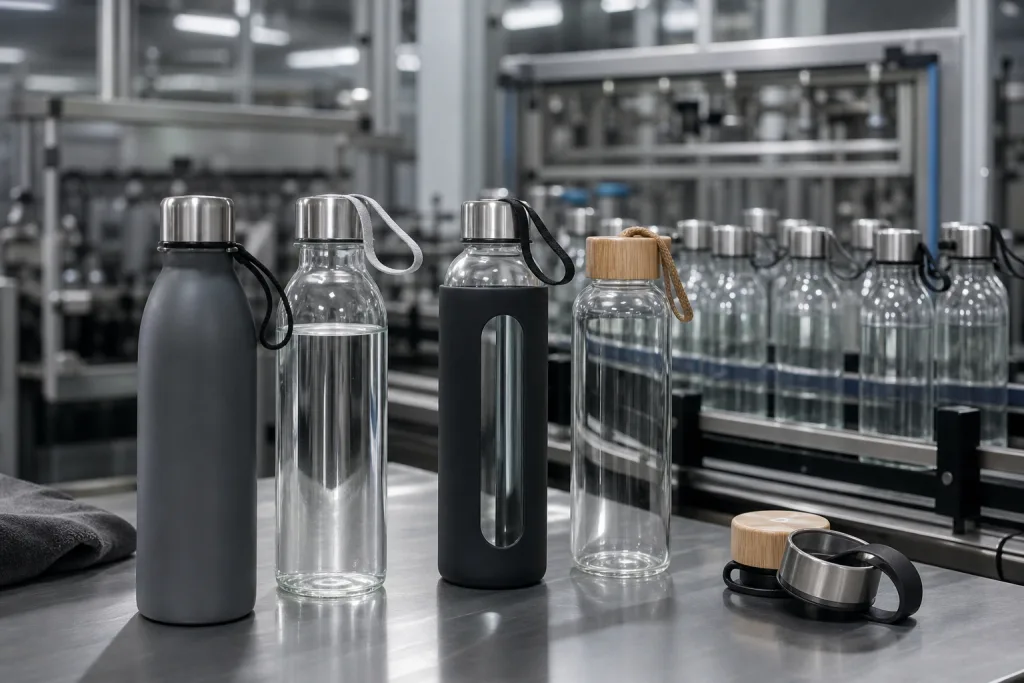
Start with a real PO, not a vague idea. Say you are buying a 550 ml customized glass water bottle for a wellness chain in Europe. The brief is clear: bamboo-look lid, soft-touch silicone sleeve, simple 1-color logo, target shelf price EUR 19.99. Your landed cost has to stay tight or the math doesn't work. First order is 3,000 units, split into two sleeve colors, FOB Ningbo from Zhejiang, China. On our line, that split usually means separate sleeve packing bins and 2 color-approved retain samples at the sealing table.
That is enough to screen suppliers fast. A borosilicate glass bottle manufacturer who actually runs production will ask at least five things before quoting:
- Capacity tolerance: 550 ml nominal or 550 ml brimful
- Glass grade: high borosilicate or regular soda-lime
- Wall thickness: usually 2.5 mm to 3.2 mm for this size
- Decoration method: silk screen, decal, laser on coated sleeve, or pad print on lid
- Retail packaging level: mailer-safe, shelf-ready, or simple white box
If a borosilicate glass bottle supplier sends back one line with a price, stop there. You are not sourcing yet. You are collecting guesses. Around Zhejiang, we see trading firms quote in 20 minutes, sometimes before they even confirm whether the neck finish matches an existing lid mold. QC pulled the sample on one project last month and found a 1.8 mm lid-fit gap, which meant the cap rattled in transit. The buyer flagged it right away.
For distributors glass water bottle programs, the first useful deliverable is not a sample. It is a locked specification sheet. This is the right question to ask first. That sheet should list bottle height, diameter, net weight, sleeve material grade, lid construction, logo size, packaging, compliance requirements, inspection standard, and acceptable defect limits. We usually add carton spec and drop-test target too, because a 24-bottle master carton at 12.5 kg behaves differently from a light promo pack. Once the sheet is fixed, quote comparisons mean something.
Lock the bottle specification early
The costliest mistake on a bulk glass water bottle order is changing structure after samples are signed off. A sleeve revision looks small on paper, then the base cutout misses by 1.5 mm or the lid insert needs a different thread tolerance on the go/no-go gauge. We have seen this go sideways. For a custom borosilicate glass bottle, lock these details before the deposit hits.
Glass body
For wellness brands, high borosilicate is usually the better pick because it runs lighter and handles thermal shock better than soda-lime. Broad temperature claims are marketing; body consistency is what matters on the line. Ask the borosilicate glass bottle factory for actual body weight and wall thickness for each size, not just a catalog photo. A 500-550 ml bottle often lands around 280-380 g depending on profile and base thickness, and QC should confirm that with a digital scale and caliper. Too light, and breakage claims climb. Too heavy, and the freight math does not work.
Lid and leakproof design
Most borosilicate glass bottle vendors sell bamboo outer caps, but the sealing structure inside is usually stainless steel or PP with a silicone ring. That is standard. Focus on leak test data, not the lifestyle pitch. Specify 100% water leak test, or at minimum a controlled in-process test during production with clear sampling frequency. For retailer programs, ask for 4 hours of inverted testing on finished goods. We run this check carton by carton on some orders because buyers have flagged slow seepage at the silicone seat.
Sleeve and decoration
If you need a borosilicate glass bottle customizable for seasonal colors, check sleeve MOQ first. This is the right question to ask early. Standard Pantone-adjacent colors may run at 1,000 pcs per color, while a matched custom shade may require 3,000 pcs, and the sample chip still needs approval under daylight. Screen print logos on glass are clean and low cost, usually around USD 0.05-0.12 per color per unit at volume. Decals look more premium, but QC pulled more edge-lift defects on decal jobs than on simple one-color prints, and they cost more.
On glass, simple sells. Large coverage artwork lifts defect rate, slows packing, and creates more claim risk than most new buyers expect.
If you are sourcing from a borosilicate glass bottle manufacturer in China for repeat orders, standardize the neck finish, lid thread, and sleeve tooling wherever possible. We ship repeat POs faster when those three points stay fixed; one buyer even had a PO typo on the lid spec, and the saved tooling match still kept the replenishment on track.
Price the order like an importer
Here is the part importers check first: cost build-up. For a 550 ml borosilicate glass bottle wholesale order of 3,000 pcs, a normal FOB China range usually breaks down like this:
- Glass bottle only: USD 1.20-1.80
- Lid assembly: USD 0.35-0.75
- Silicone sleeve: USD 0.30-0.65
- 1-color logo: USD 0.05-0.12
- White box + insert: USD 0.18-0.45
So the finished bottle lands around USD 2.10-3.60 FOB. The spread usually comes from wall thickness, lid construction, sleeve fit, and packing spec. On our line, QC pulled a sample last month with a sleeve gap over 1.5 mm, and the buyer flagged it right away. If a borosilicate glass bottle supplier offers USD 1.55 all-in for a set that looks premium, this is the wrong question to ask: not “why so cheap,” but “what did they leave out?” In most cases it is thin glass, a stock lid, a soft white box, no drop test, or no charge-back responsibility for print rejects.
Next is tooling. If you pick an existing bottle mold from a borosilicate glass bottle factory, body mold cost can be zero. A new body mold usually runs USD 800 to USD 2,500 for a clean shape. More if the base detail is deep or the profile needs extra polishing on the mold cavity. Custom sleeve tooling is normally lower. Lid changes are where projects get messy, because thread match and insert structure matter more than the cap shell. We have seen buyers approve a nice-looking lid render, then find the thread pitch was off by one turn on the trial sample.
Ask each borosilicate glass bottle vendor to quote on the same terms. FOB Ningbo or FOB Shanghai is standard for Zhejiang factories. Ask them to split one-time tooling, sample charges, and repeat-order unit price into separate lines on the quote. We ship this way because it shows where the math works and where it does not. A usable quote should also state:
- MOQ by color and by size
- Mass production lead time, usually 30-45 days
- Sample lead time, usually 7-12 days for pre-production samples
- Carton quantity and carton gross weight
- Whether spare parts or replacement units are included
If you sell to sustainable retailers, price breakage into the order from day one. Saving USD 0.08 per unit and then losing 4% in transit is not savings. The math does not work. We run drop checks on packed samples for this reason, and weak inner inserts show up fast.
Check compliance before mass production
Wellness brands love the bottle shape and leave the paperwork for later. That is the wrong sequence. Before you approve a borosilicate glass bottle custom order, pin down the tests your market asks for, not the tests a factory guesses you want. For Europe, that usually means REACH-related material declarations for applicable parts and food-contact documents for silicone, PP, or stainless contact components. For North America, retail programs often ask for ASTM-related packaging tests or category-specific standards, plus CPSIA if the item is sold for children. We have seen POs held 12 days because the buyer approved the cap color and forgot the silicone declaration.
The glass body is only one part of the file. Most compliance trouble shows up in decoration ink, sleeve additives, lid coatings, or packaging ink migration. Ask your borosilicate glass bottle manufacturers for the full bill of materials, down to the gasket and print ink, and have them mark which parts touch water directly. QC pulled one sample last spring where the lid passed, the bottle passed, and the logo ink failed abrasion after 50 rubs. That is how shipments get stuck.
At supplier level, social and process audits still matter for big retail accounts. BSCI and ISO 9001 are common signals, but certificates alone do not run the line. Ask what the factory controls in-house and what they buy outside. A plant in Zhejiang might assemble 300,000 to 500,000 units per month and still outsource bamboo caps or gift boxes. Fine. The problem starts when incoming inspection has no owner, no check sheet, and no caliper record for cap fit at 58 mm.
Your pre-production checklist should include:
- Material confirmation: borosilicate grade, silicone grade, gasket spec
- Logo approval: Pantone reference, position, abrasion expectation
- Packaging approval: barcode, warning marks, country of origin, recycle marks if needed
- Carton spec: 5-ply or stronger export carton, drop test target, inner partitions
- Inspection plan: AQL level, critical defects, leak test method
A borosilicate glass bottle distributor or importer who checks these points before deposit usually skips the email nobody wants: “Production is finished, but there is one small issue.” We have seen this go sideways over a 3 mm logo shift, a missing origin mark, even a typo in the PO barcode. On glass orders, small issues get expensive fast.
Run sampling like a quality gate
Sampling needs to answer buying questions, not just show a nice shape. For a custom glass water bottle, ask for 3 separate sample stages if the factory can run them: a look sample for shape, a decoration sample for artwork, and a final pre-production sample built with the same lid, sleeve, and box planned for mass production. Those are not interchangeable. We’ve seen bulk borosilicate glass bottle orders approved from a bench sample that looked fine, then failed once the line ran at 35 pcs/min.
Here is a practical buyer sequence:
- Approve shape from existing mold or 3D drawing
- Approve logo size and print position on digital mockup
- Approve physical pre-production sample with actual sleeve, lid, and box
- Freeze golden sample signed by both sides
For a borosilicate glass bottle customized for retail, inspect the sample like QC pulled it off the line. Use a caliper for diameter and height, check weight on a 0.1 g scale, and verify fill volume against the spec sheet. Twist the lid on and off 20 times. Fill it, invert it, and leave it overnight. Wash the sleeve and see if it creeps up 2-3 mm. Rub the logo 30-50 times with a dry cloth. This is the gate. Skip it, and claims show up after shipment.
If you are doing Amazon or other e-commerce channels through distributors glass water bottle programs, packaging matters as much as the bottle. Ask the supplier to think like ISTA even if they do not run formal lab tests. At minimum, require divider protection, a snug fit inside the inner box, and outer carton drop checks from 76 cm. We ship this way for 12-bottle master cartons because loose fit is where breakage starts. Also confirm whether labels such as FNSKU or lot codes will be applied in China before shipment; one PO we got had the lot code position typed wrong, and the buyer flagged it before print.
The right borosilicate glass bottle manufacturers do not fight this process. They will push back if the expectation is off, and that is useful. This is the wrong question to ask: “Can you make every bottle look identical?” Glass does not work that way. A good factory should state the limit clearly—small bubbles, light mold lines, or logo position tolerance within the approved standard are normal. You are not buying jewelry. You are buying a bottle program the line can repeat at MOQ 3000 pcs.
Inspect production and protect transit
Once mass production starts, the job is defect control, not artwork talk. Glass needs a tighter outbound check than steel tumblers because one bad loading cycle can wipe out the quality we built on the line. For most distributor glass water bottle orders, I push for a pre-shipment inspection when at least 80% of goods are packed. QC pulled the sample after final taping, not from loose stock on the workshop floor.
Put the inspection standard in writing before the first carton closes. A typical plan might use AQL 2.5 for major defects and AQL 4.0 for minor defects, with zero tolerance for critical defects such as leakage, sharp dangerous edges, incorrect barcode, wrong logo, or missing food-contact parts. Major defects may include visible scratches in the logo area, unstable standing, wrong sleeve color, or chipped rim hidden under the cap. Minor defects might include slight specks or small print position variation within tolerance. We have seen buyers send a PO with one barcode digit wrong, then flag the finished stock later, so this check belongs on the table, not in email.
Do not skip packaging tests. For bulk glass water bottle shipments, require the factory or third-party inspector to check carton dimensions, carton gross weight, sealing tape quality, partition fit, and random drop performance. We usually cap master carton weight at 12 kg for this item class; once a carton gets heavy just to save freight, the math does not work. A strong product in a weak carton is still a weak shipment. We have seen partitions 3 mm too short, and that small gap was enough for shoulder cracks after trucking to Ningbo.
Clarify the spare unit policy before shipment. Many experienced borosilicate glass bottle suppliers add 1% spare units for fragile programs or at least keep replacement stock from the same batch. That matters if your distributor customer opens a claim after receipt. We ship spares with the same print lot and cap assembly because mixed-batch replacements create a second complaint fast. This is the wrong question to ask after the container sails.
Factories in Zhejiang move fast once goods are boxed, so book inspection and freight space early. Missing a vessel because artwork approval slipped by 3 days can cost more than the logo itself. We have seen ETD move from Friday to the next Wednesday, turning a 12 days transit plan into 18 days door-to-port for the buyer. Disciplined buyers track the critical path from deposit to ETD, not just the unit price.
Build the second order now
The first shipment tells you fast if you picked a real borosilicate glass bottle partner or a factory that only quotes fast. After delivery, review the order like the line would: actual breakage rate by carton, retailer comments, lid leak complaints, shelf read, and the real reorder window—12 days vs 18 days matters. We log this into one sourcing file with cap torque, carton drop result, and even small misses like a PO typo on item color.
Your vendor scorecard should track price accuracy, sample match, on-time production, inspection pass rate, claim response time, and daily communication. QC pulled the sample and found a 1.5 mm logo shift once; the supplier fixed it before mass run, and that counts in their favor. Missing one vessel date is recoverable if the paperwork is clean and the corrective action lands in 24 hours. Hitting the target price while hiding weak cartons or unstable decoration is a bigger failure. We have seen this go sideways.
For the second order, push standardization where it helps margin:
- Keep the same bottle mold across 2-3 colorways
- Use one outer carton size where possible
- Align lid components across multiple SKUs
- Batch promotional runs instead of many tiny custom changes
This is where terms like borosilicate glass bottle promotional and borosilicate glass bottle customizable stop sounding good on a sales sheet and start affecting replenishment. The wrong question is “How customizable is it?” Ask how fast the same SKU ships again at 3,000 pcs MOQ with the same lid fit and print position. If the program changes every run, repeat orders get slow, QC gets messy, and the math does not work. Standardize the right points and you cut MOQ pain, shorten repeat lead time, and give QC fewer variables to chase.
If you are choosing among borosilicate glass bottle vendors, borosilicate glass bottle suppliers, or a direct borosilicate glass bottle manufacturer in China, do not judge on sample price alone. We ship from Zhejiang every week, and the long-term supplier is the one that quotes cleanly, runs consistent production, and packs fragile goods well enough to reach your customer’s dock without carton crush or glass rub marks.
Need a workable glass bottle quote, not guesses?
Send your target capacity, packaging level, logo method, and order volume. We will review feasibility, MOQ, and QC risks before you place a deposit.
Frequently asked questions
What is a normal MOQ for distributors glass water bottle orders?
For a standard existing-mold glass bottle, MOQ is often 1,000 to 3,000 pcs per size. If you add custom sleeve colors, bamboo-look caps, or retail gift boxes, the practical MOQ usually moves toward 3,000 pcs. Fully new molds can push the first order higher if the factory wants to spread tooling risk. For wellness brands testing a market, ask whether the supplier can split 3,000 pcs into 2 or 3 sleeve colors using the same bottle and lid. That is usually easier than splitting different bottle shapes. In Zhejiang, many factories will accept a lower trial quantity if you use stock components and simple 1-color printing.
How do I know if I need borosilicate instead of soda-lime glass?
If your product story includes hot-and-cold use, lighter weight, or a more premium feel, high borosilicate is usually the better choice. It generally handles temperature change better and is common in higher-end custom glass water bottle programs. Soda-lime can be cheaper, but it is often heavier and may not support the same positioning for sustainable retailers. Ask the supplier to state material type in writing, plus unit weight and wall thickness. For a 500-550 ml bottle, compare samples side by side. A price gap of USD 0.20-0.50 per unit may be justified if breakage falls and your retail presentation improves.
What defects should I treat as unacceptable on a bulk glass water bottle order?
Set zero tolerance for leakage, dangerous chips, cracked glass, wrong barcode, wrong country marking, wrong logo artwork, and missing food-contact parts such as gaskets. Those are critical defects. Major defects usually include unstable standing, deep scratches in the main view area, wrong sleeve color, heavily crooked print, and poor cap fit. Minor defects can include small specks, light mold lines, or slight print offset within an agreed tolerance. A common inspection setup is AQL 2.5 for major and AQL 4.0 for minor defects. Make sure these definitions are approved before production, not argued about after the goods are packed.
How long does a custom borosilicate glass bottle order usually take?
If you use an existing bottle mold, expect about 7-12 days for pre-production samples and 30-45 days for mass production after sample approval and deposit. New mold development can add 15-25 days depending on shape complexity. Custom packaging, barcode changes, and compliance testing can also add a week or more. During peak season, transit booking from China may become the real bottleneck, not factory production. Build your timeline backward from the in-store date and add buffer for inspection and rework. For glass, a 10-day safety margin is sensible because packaging corrections and replacement parts are common delay points.
Should I buy from a borosilicate glass bottle factory directly or through a trading company?
Direct factory buying can give you better control on pricing, technical communication, and repeat-order consistency, especially when you need a borosilicate glass bottle custom program with stable parts. But a capable trading company can still be useful if they manage mixed sourcing, stronger English communication, or tighter follow-up across outsourced packaging and accessories. The real question is who owns quality and schedule. Ask who makes the glass body, who assembles the lids, who inspects incoming parts, and who handles claims. Whether the supplier is in Zhejiang or another part of China, you want one accountable contact and written control over the whole order.