Key Takeaways
- Most distributors drinkware orders start at 1,000 to 3,000 pcs per SKU; decorated samples usually cost USD 25 to 80 each
- A 0.5 mm 304 stainless body is standard for mainstream canteen custom programs; 0.6 mm usually improves dent resistance but adds cost
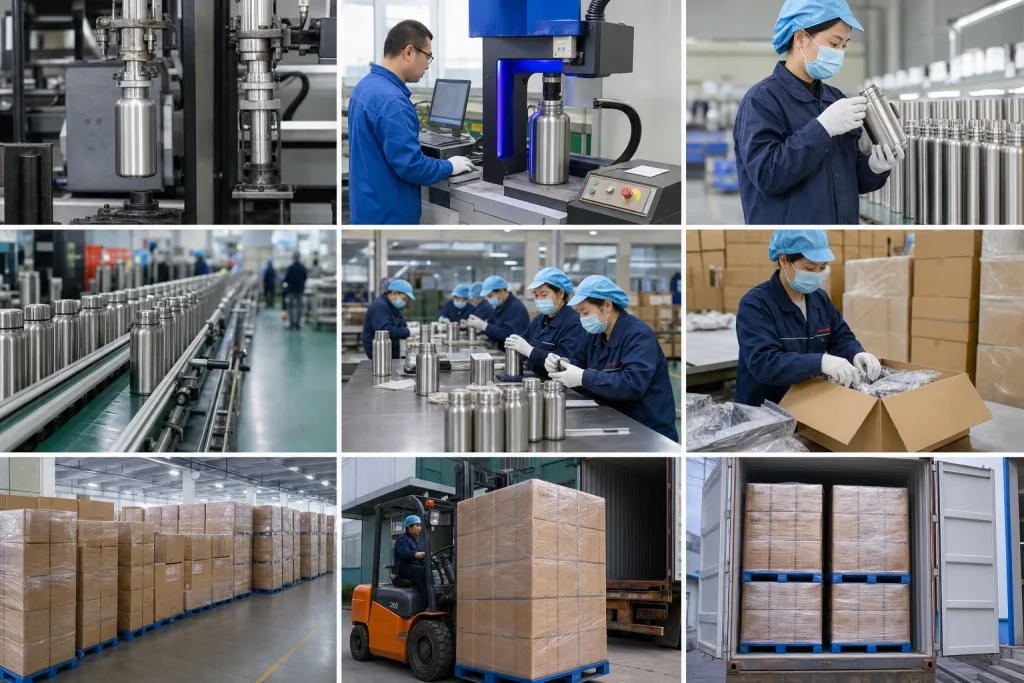
- Typical lead time from a Zhejiang canteen factory is 25 to 40 days after sample approval, with 80,000 to 150,000 units/month capacity
- FOB China pricing for basic customized drinkware often sits around USD 2.20 to 6.50 depending on material, lid, and decoration
If you buy distributors drinkware for retail, promotion, or private label, the first mistake is treating every bottle as the same SKU with a different logo. It is not. A 500ml stainless steel tumbler, a 750ml custom growler, and a canteen built for outdoor use each land on a different price, lead time, and margin. We run that comparison on the line every week. In China, and especially Zhejiang, the factory you pick matters as much as the product spec.
The real question is not whether you want custom drinkware. It is how much MOQ risk you can carry, how much decoration your market will actually pay for, and whether the product has to clear REACH, LFGB, or ASTM testing before it hits your warehouse. QC pulled a sample last week because the laser mark was 0.3mm off center, and that kind of miss becomes a buyer problem fast. If you work with a canteen manufacturer, canteen supplier, or canteen factory, the right call keeps dead stock down and stops FOB surprises from blowing up your margin.
Start with the margin equation
I’ll rewrite the section in-place, keep the HTML exactly intact, and tune the prose to sound like a distributor-side sales engineer.Before you compare colors or cap styles, lock the margin equation first. For distributors drinkware, the cheapest-looking SKU on paper can turn into the most expensive one in the warehouse after decoration loss, freight, testing, carton damage, and slow-moving stock. We’ve seen a canteen distributor chase unit price and lose the month on write-offs.
Use a simple gate: target landed cost, expected wholesale price, and minimum gross margin. If you need a 55% gross margin and your landed cost is USD 4.00, your sell-in price needs to land around USD 8.90. That looks neat until a customized growler with laser engraving, a gift box, and an upgraded lid pushes landed cost to USD 5.70. Then the channel math breaks. The buyer flagged it after the PO typo showed the wrong lid code.
What works is cutting the line by use case:
- Promotional volume: low decoration cost, 1,000+ pcs, fast repeat orders
- Retail private label: stronger packaging, better finish, 3,000+ pcs
- Premium corporate gifting: higher unit value, stricter cosmetic control
For a canteen promotional program, silkscreen is still the cheapest route. For a premium distributor growler line, laser engraving or a 4-color wrap label usually wins on margin. QC pulled the sample on a 0.8 mm print shift, and that was enough to reject the batch. The best buyers are not chasing the lowest quote; they are buying the best margin per pallet.
Choose the right base material
I’ll rewrite the section in-place, keep the HTML intact, and tighten the sales-engineer voice with a few concrete factory details.Base material drives how your custom drinkware sells and how often the buyer calls back. For outdoor, fitness, and corporate channels, stainless steel is the line we run. On canteen customized programs, 304 stainless is the usual starting point because it keeps cost in line, resists corrosion, and clears most brand checks. Aluminum can work if the buyer wants a lighter bottle, but it needs liner control and tighter coating checks.
Glass looks clean and premium, but one cracked carton can wipe out the margin for distributors drinkware, especially when the channel is long-haul and mixed. Tritan and other copolyesters fit a lightweight customizable drinkware line for schools or gyms, but QC pulled the sample and the migration report still has to pass FDA, LFGB, and local limits. For a custom canteen aimed at hiking or military-style merchandising, a double-wall stainless body with powder coating sells better than a fragile swap-in. We’ve seen that go sideways before.
Watch wall thickness, not just headline material:
- 0.4 mm: cheaper, lighter, more dent-prone
- 0.5 mm: common for mid-market canteen factory programs
- 0.6 mm: stronger feel, better for premium retail
A good canteen manufacturer in Zhejiang will quote both weight and thickness. If they do not, ask. The math does not work otherwise. A 0.45 mm shell and a 0.6 mm shell feel like different products, and the gap shows up in coating wear, carton damage, and refund risk. We once caught a PO typo where the buyer wrote 0.6 mm but the spec sheet said 0.5 mm, and that single line would have changed the whole run.
Match decoration to demand
I’ll rewrite the prose in place, keep the HTML structure intact, and make it read like a factory-side sales engineer wrote it. Then I’ll do a quick pass to strip AI-sounding filler and keep the numbers and list structure untouched.Decoration is where a lot of canteen suppliers oversell and buyers under-specify. You do not need every method on one SKU. You need the process that matches your sell-through. On a canteen promo order, 1-color silkscreen or pad print can keep decoration under USD 0.30 per unit at scale. For a branded distributor canteen in North America, laser engraving or heat transfer can support a higher shelf price. We’ve seen buyers try to stack three methods on one bottle; the math does not work.
The real trade-off is visual impact against process risk. Powder coat gives a premium hand feel and hides scratches better, but dark colors show laser contrast more clearly than light colors. A full-wrap printed customizable growler looks strong in ecommerce photos, yet registration errors get expensive above 2,000 pcs. QC pulled the sample on a 0.8 mm print shift last week. If your brand wants a cleaner look, a small logo on matte finish often holds up better than a loud pattern.
Decoration method should follow the channel:
- Mass promo: silkscreen, 1 to 2 colors
- Retail: laser engraving, UV print, or wrap label
- Gift: embossing, etching, premium box
A practical canteen vendor will quote decoration separately from the base bottle. That is the right setup. It lets you compare a customized canteen across multiple factories in China without getting trapped by hidden print or mold charges. One PO typo on a laser size can wipe out your margin fast.
Set MOQ around channel reality
I’ll rewrite the section in-place, keep the HTML structure untouched, and make the prose sound like a factory-side sales engineer.MOQ is not a moral issue. It comes down to tooling and line setup. If you ask a canteen supplier for 18 colors, 4 lid options, and three carton styles, the MOQ moves up because we have to carry stock across more parts. For most distributors drinkware programs, 1,000 to 3,000 pcs per design is the practical band, and 500 pcs works only when the spec stays simple.
For a canteen distributor, the better question is not “Can you do 300 pcs?” It is “What MOQ gives me a clean repeat order and cash that turns in time?” We have seen this go sideways: a buyer pushed for 300 pcs, then paid more freight per unit than the product margin could cover. A 2,000 pc MOQ with 35-day lead time usually beats a tiny run at a much higher unit cost. Lower MOQ cuts risk, but it also weakens your price talk and makes carton economics messy.
Use this rule:
Low MOQ works when you are testing a market. Stable MOQ works when you are building a program.
In Zhejiang, the stronger canteen factories keep shell sizes and lid families in regular production, so QC can pull the sample fast and the setup stays light. That matters when you need a distributor drinkware launch across three territories and a PO typo on one color code would otherwise stall the line for a day.
Check compliance before price
I’ll keep the HTML structure intact and rewrite the prose to sound like a real sales engineer, with concrete compliance details and fewer generic lines.Price matters, but compliance decides whether the shipment clears customs, whether the buyer signs off, and whether you eat chargebacks. For custom drinkware going into Europe, REACH and LFGB questions show up first. For North America, buyers ask about FDA food-contact suitability, Proposition 65, and carton labeling. If your factory cannot pull a test report, the quote is not finished.
Ask for the report tied to the exact material and decoration. A test on one bottle does not cover every version in the order. If the coating moves from matte black to metallic blue, we re-check migration and coating safety. If the lid changes from PP to Tritan, we re-check the food-contact declaration. That is basic risk control. We’ve seen this go sideways on a 12,000-piece order when the buyer flagged a lid swap after PO approval.
Good export factories in China usually support:
- AQL inspection for cosmetic and functional checks
- REACH and food-contact declarations where required
- BSCI or comparable social compliance for bigger retail accounts
Ask for the inspection criteria before mass production starts. A real canteen manufacturer will tell you which defects fall under AQL 2.5 or AQL 4.0, and what marks are acceptable on a brushed or powder-coated surface. QC pulled the sample on our line once and rejected a 0.8 mm scratch that the buyer would have missed in photos.
Build the order around factory fit
I’ll keep the tags and structure intact, then rewrite the prose to sound like a factory-side sales engineer with concrete plant details and less generic wording.The best distributors drinkware program fits the line instead of fighting it. If a Zhejiang canteen factory runs 120,000 units a month on stainless programs, do not push a five-SKU launch with custom lids, mixed cartons, and shaky artwork. We’ve seen that turn into late shipments fast. Build the order around what the plant already runs cleanly.
That is why a focused canteen vendor matters. A decent supplier will tell you which body shapes, caps, and surface finishes are already tooled, which ones need new molds, and which mixes jam the line. QC pulled a sample once and found a 1.2 mm lid gap on a new structure; the buyer flagged it before we loaded cartons. If you want a canteen customizable only in color and logo, lead time is usually tighter. If you want a truly customized canteen with a new lid structure, add 15 to 25 days for tooling and validation.
Here is the filter I use with buyers:
- Use existing mold if you need speed and low risk
- Change finish and print only if your channel is price-sensitive
- Invest in new tooling if you expect repeat orders over 10,000 pcs
In China, especially Zhejiang, the strongest custom canteen projects are built on repeatability. The plant knows the spec, the buyer knows the margin, and the distributor knows what the reorder looks like. That is how a distributor canteen line becomes a business, not a one-off PO with a typo on the lid code.
Get a quote built for your channel
Send your target price, MOQ, and artwork. We will match you to the right custom canteen or distributor drinkware spec from Zhejiang.
Frequently asked questions
What MOQ should I expect for distributors drinkware?
For most distributors drinkware orders, expect 1,000 to 3,000 pcs per SKU if you want normal pricing. You can sometimes do 500 pcs on a simple custom canteen, but the unit price usually rises 15% to 35%. If you add multiple lid colors, gift packaging, or a new mold, MOQ climbs quickly. A Zhejiang canteen factory with 80,000+ units/month capacity will usually prioritize repeatable specs over tiny mixed orders. If your channel is untested, start with one body, one lid, and one logo method. That gives you cleaner cost control and fewer leftover cartons.
How much does a custom drinkware unit cost?
A basic custom drinkware item can start around USD 2.20 FOB China for a simple 500ml bottle with one-color print, but that is the low end. A double-wall stainless canteen custom program often lands in the USD 3.80 to 6.50 range depending on thickness, lid quality, coating, and packaging. A custom growler with premium finish can go above USD 7.00. Decoration can add USD 0.15 to 0.80 per unit. Always separate base bottle, print, carton, and testing so your canteen supplier quote is readable and comparable.
How long is lead time from a canteen manufacturer in China?
For a standard order, a canteen manufacturer in China usually needs 25 to 40 days after sample approval and deposit. If you are using existing molds and simple decoration, 25 to 30 days is realistic. If you need new tooling or complex packaging, add 15 to 25 days. Air shipment can shorten transit but not production. A serious canteen factory in Zhejiang will give you a schedule for sampling, pre-production confirmation, mass production, and final inspection. Ask for these dates in writing before you approve artwork.
Which compliance documents should I request?
For Europe, ask for REACH-related declarations and, where relevant, LFGB or food-contact migration reports. For North America, request FDA food-contact confirmation, packaging details, and any Proposition 65 warnings if applicable. If you sell through a major retail program, ask for BSCI or equivalent social audit documentation. Also request AQL inspection standards and a material list for the bottle, lid, gasket, and coating. A canteen supplier that cannot tie reports to the exact customized drinkware spec is leaving you exposed. Do not rely on a brochure; request the actual test files.
Is a custom growler different from a canteen?
Yes, because channel expectations differ. A custom growler usually serves beer, beverage storage, or gift channels, so finish and closure performance matter more. A canteen customized for sports or outdoor retail needs lighter weight, carry comfort, and leak control. The wall thickness, lid style, and coating may be similar, but a distributor growler often uses a wider mouth and a more premium appearance. If you are a canteen distributor, do not assume one mold can cover both categories. You may be better off with a separate SKU for each channel.