Key Takeaways
- Write leakage, coating, and logo tolerances into the PO; 80% of bulk claims start with missing specs
- Typical MOQ is 1,000 pcs per color for stainless bottles, with 35-45 day lead time from Zhejiang, China
- Use AQL 2.5/4.0 with 0 critical defects and define drop, dishwasher, and salt-spray tests before mass production
- For vacuum bottles, ask for 0.4 mm inner and 0.5 mm outer 18/8 stainless plus 12-24 hour heat retention targets
You do not lose margin on a distributors drink bottle program because the sketch looked weak. You lose it when the pre-production sample passed, the bulk run drifted, and the PO never listed the failure points. We have seen this go sideways. A lid starts leaking after 3 weeks. Powder coat gets chipped after a 78 cm carton drop test. Logo placement shifts 4 mm because the screen fixture was set loose on the line. Then the customer sends debit notes.
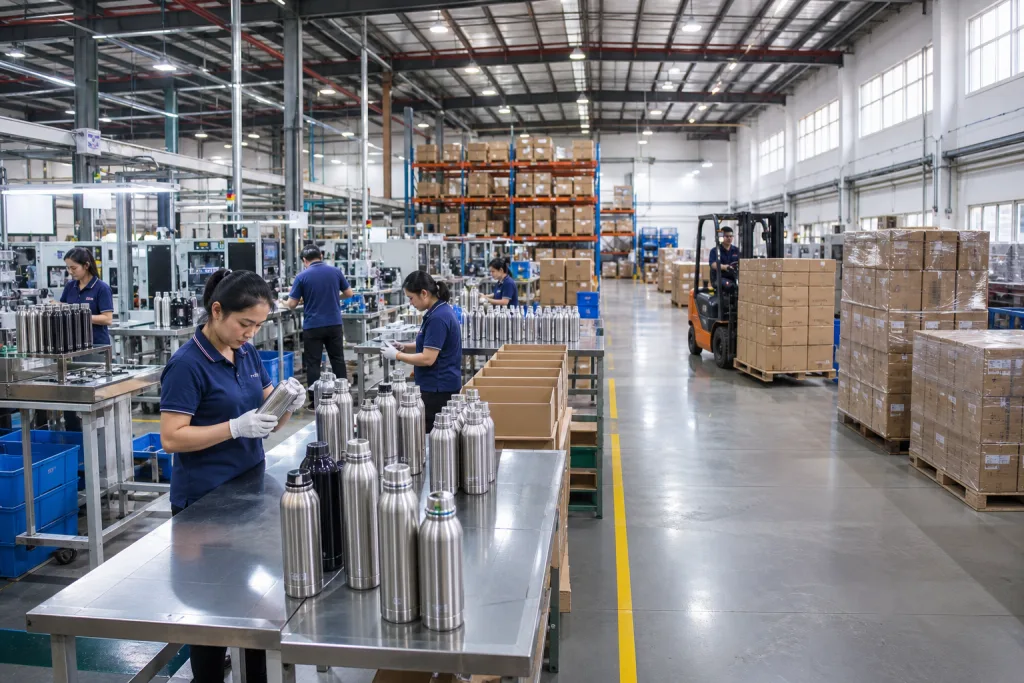
If you buy custom drinkware for distribution, a catalog and one nice sample are not enough. You need a spec that tells the factory what must hold at production scale on a canteen customizable or customized growler order. From our plant in Zhejiang, we see the same 6 problems again and again, and QC pulled the sample on most of them long before shipment. The fix is not complicated: tighter drawings, clear test methods, and realistic tolerances before deposit. This is the right place to be strict.
Where bottle projects actually fail
Most distributor drinkware problems are not random factory accidents. They usually start at the same weak spots: sealing parts that don’t seat right, coating that fails cross-hatch, logo print drifting 3 mm off center, bottle height moving outside drawing, or cartons collapsing in transit. A canteen distributor or distributor growler buyer often looks at shape, color, and logo first. Fair enough. The shelf has to sell. Then the claims show up later, after use, stacking, line-haul shipping, or 200 dishwasher cycles. We’ve seen this go sideways.
For a standard stainless distributors drink bottle, the base product looks simple: 18/8 body, PP lid, silicone gasket, powder coat, single-color silkscreen. On the line, it is not simple. Each part carries its own tolerance, and the stack-up is what bites you. The mouth thread pitch may vary. The gasket hardness may be 50 Shore A on one lot and 60 on another; QC pulled the sample once and the lid closed fine, but the inverted leak test failed at 12 minutes on the softer batch. Powder thickness may be 60-80 microns on one shift and 90-110 on the next. If the canteen manufacturer does not control those variables, bulk consistency disappears fast.
At BottleForge Industrial in Zhejiang, China, our practical rule is this: every visible or functional risk needs a number attached to it. This is the right question to ask. Not “good sealing.” Specify no leakage after inverted test for 30 minutes, room temperature water, 95% fill, torque range 8-10 kgf-cm. We run that test with a torque meter and a marked fill line, not by hand feel. Not “nice logo position.” Specify logo centerline tolerance within plus or minus 2 mm from drawing. Not “durable finish.” Specify cross-hatch adhesion 4B minimum and 48-hour salt spray if the bottle will be used for canteen promotional campaigns outdoors.
If your supplier or canteen factory pushes back on measurable standards, treat it as a warning sign. Serious canteen manufacturers and canteen suppliers already work with drawings, QC plans, and test sheets. One buyer flagged this once because the PO said “mat finished” instead of “matte finish,” and the factory used the wrong texture plate. Small wording issue. Big claim risk. You are not being difficult. You are cutting off arguments before shipment.
Leakage starts at the lid
The number one complaint on a custom canteen or customizable growler order is leakage. Buyers usually blame the bottle. The failure starts at the lid: thread match, gasket compression, cap structure. We’ve opened cartons where QC pulled the sample, it passed, then the bulk run leaked because the molding tolerance opened up by 0.2 mm or the liner sat crooked on the high-speed line.
What to lock down before approval
- Lid material: PP is the common choice and keeps cost down; Tritan looks cleaner, but the tooling bill and unit price go up.
- Gasket material: food-grade silicone, hardness 50-60 Shore A, REACH-compliant for EU orders.
- Torque range: set a closing torque the customer can hit without cranking the cap down too hard.
- Leak test: 100% inverted water test on line for 3-5 minutes for screw lids; random vacuum or pressure test for complex spouts.
For a customized canteen with a flip straw or carry handle, the risk jumps because part count goes up. Every hinge and every inserted straw adds one more place to fail. If you sell to schools, gyms, or mass retail, keep the lid simple unless the margin can pay for heavier QC. We’ve seen this go sideways when a buyer insisted on three moving parts and then flagged leaks on the first 500 pcs.
Good sourcing practice: approve the bottle and the lid as one system. Do not sign off the body first and assume the cap can be swapped later.
For bulk orders above 20,000 pcs, ask your canteen supplier to hold a golden sample and a cap torque standard at the line. We run a retention sample from each production date. On our side in Zhejiang, the usual target for screw-cap bottles is 0 leakage in 100 sampled units after 30 minutes inverted and 10 open-close cycles. If your end market is North America e-commerce, add a 1.2 m drop test in retail pack; impact can unseat a weak gasket. The buyer may push back on the extra test. The math doesn’t work if you skip it and eat returns later.
Vacuum performance drifts quietly
A vacuum bottle can pass visual check and still fail after the first use. That failure costs more than returns. We ship replacements, then the one-star reviews sit there. The usual causes are weak vacuum pull, thin copper coating on the inner wall, or an unstable bottom weld. On the line, QC pulled a sample last month that looked clean outside but lost heat fast because the vacuum value drifted off spec after sealing. Price pressure is usually where this starts, and this is the wrong place to save 0.08 USD.
You should lock the structure before sampling. For most distributor canteen programs, double-wall 18/8 stainless with 0.4 mm inner wall and 0.5 mm outer wall is the practical baseline. For larger customizable canteen formats like 32 oz and 40 oz, 0.5/0.5 mm is often the safer call for dent resistance, though it adds about 40-70 g per bottle and pushes freight up. Ask your canteen factory what thickness they are quoting on the PO and what they run on the micrometer after forming. We have seen buyers get “standard thickness” on email, then 0.35 mm inner wall on production. That math doesn’t work.
Testing needs to match actual use, not lab theater. A common benchmark is hot water filled at 95 degrees C, sealed, then measured after 6, 12, and 24 hours at ambient 20-25 degrees C. For many mid-range custom drinkware programs, a realistic target is 55-60 degrees C after 12 hours and 40-45 degrees C after 24 hours, depending on capacity and lid type. Cold retention can be tested with ice water over 24 hours. We normally log the reading with a probe thermometer and check 3 pcs per batch start, middle, and end, because one golden sample tells you nothing.
- Ask for vacuum inspection records per batch, not only for pre-production samples.
- Specify no sweating on the bottle exterior at room conditions.
- Require bottom weld appearance criteria if the base is exposed.
If you are buying a custom growler or customizable growler for beer or cold brew channels, thermal retention may matter less than carbonation-safe sealing and impact resistance. Say that up front. One buyer flagged heat retention on a 64 oz growler, then later admitted the SKU was for same-day draft takeaway. The real risk was lid leak under pressure, not 12-hour heat hold. The right spec depends on use. Good canteen vendors and canteen distributors do not need the highest spec on every SKU. They need the correct one.
Coatings fail long before the steel
Most bottle bodies do not fail structurally. The coating goes first. We see the same claims on the line: scratches, edge chips, gloss mismatch, orange peel, then rust around the mouth after the rim gets knocked. Shelf appearance drives the result on a canteen promotional order, especially for a launch event or distributor drinkware campaign. Cosmetic rejects get flagged faster than functional ones; QC pulled one lot last month because the ΔE drift was visible under the light box even though the bottles sealed fine.
Start with surface prep. This is where coating jobs usually go sideways. Stainless steel needs full cleaning before powder coating or painting, and if oil stays on the body, the blast profile is uneven, or curing is rushed, adhesion drops fast. Then check thickness. Too thin leaves steel edges exposed. Too thick jams the threads and chips at impact points. On many bottles, 60-90 microns is a workable powder coat range, and we check it with a dry film thickness gauge at the shoulder and near the base radius because those two spots drift first.
Do not ask for “dishwasher safe” with no test definition. That is the wrong question to ask. For a lot of painted bottles, hand wash only is the honest answer, even if the buyer pushes back on the PO. If your market requires dishwashing, lock the method before production: 20 or 50 household dishwasher cycles, then no major blistering, no peeling, and no color shift beyond the agreed standard. If the canteen manufacturer cannot support that claim, do not print it on packaging. We have seen one buyer typo this on a carton mark, and the returns cost more than the order margin.
QC points that reduce finish claims
- Cross-hatch adhesion test to ASTM-style method, minimum 4B.
- Color tolerance against approved chip under D65 light source.
- Salt spray 24-48 hours for coated exterior if outdoor use is expected.
- Thread masking check so lids seat smoothly without coating buildup.
For coastal Europe distribution, rust complaints usually start at chipped rims or untreated accessory hardware, not the bottle body. We have seen 7 out of 10 complaint photos point to the handle ring or carabiner first. If your customized drinkware includes a metal handle, carabiner, or decorative ring, specify the plating grade too. Ask that early. A decent canteen supplier in China will tell you fast which parts are decoration-only, which ones survive daily use, and which MOQ jumps from 3,000 to 5,000 pcs once you change the hardware finish.
Logos look simple until bulk
Decoration claims are where first-time buyers get surprised. The pre-production sample looks clean: centered logo, sharp edge, no argument. Bulk is a different job. We run jigs that wear, bottles that drift by 0.8-1.2 mm on body diameter, operators who make different calls on alignment, and ovens where ink cure can shift from one rack to the next. A canteen customized or custom growler program with two print positions, metallic ink, and low MOQ is harder to hold than a plain one-color bottle. We have seen this go sideways.
There is no single decoration method that wins every project. Silkscreen is the workhorse for 1-2 spot colors, and we usually quote it from 1,000 pcs per colorway. Laser engraving lasts and looks clean, but on some powder-coated surfaces the mark reads softer than the buyer expects; QC pulled the sample once because the logo looked gray, not silver. Heat transfer handles more graphic detail, but the line has to watch alignment and edge lifting at the shoulder radius. UV digital works for short runs and complex art, though outdoor durability depends on the coating stack and actual use. This is the wrong question to ask: “Which method is best?” Ask which method fits the bottle shape, volume, and abuse level.
What matters most is drawing discipline. Your artwork approval should show:
- bottle view with seam or reference point marked,
- logo size in mm,
- distance from base and mouth,
- allowable print shift, usually plus or minus 1.5-2 mm,
- Pantone reference and finish callout.
For canteen distributors serving chain stores, confirm barcode placement and carton marks at the start, not after sample approval. The buyer flagged this on one PO because the wrap art was approved first, then the FNSKU area disappeared. A good-looking customized canteen still fails at receiving if the retailer label zone was not reserved. We regularly see anti-slip base pads cover mandatory coding, and then the math doesn't work because cartons are already printed.
If the logo needs to wrap across a weld line, embossed area, or tapered body, assume a higher reject rate and budget for it upfront.
That is not pessimism. It is production math. On our line, art crossing a weld line can push rejects from 2% to 6% under normal AQL checks. Honest canteen factories in Zhejiang should say so early, before the buyer signs off artwork that the process cannot hold.
Packaging damage is usually self-inflicted
Buyers will spend 2 weeks on Pantone matching and 5 minutes on transit packaging. Then the buyer flagged it when 3% of units landed with dented bases or white rub marks from carton walls. We’ve seen this go sideways. For export from China to Europe or North America, packaging sits inside product engineering. It is not a last-step add-on.
A common inner pack for a stainless distributors drink bottle is 1 polybag plus an egg-crate divider in a 5-layer export carton. For pallet shipments, that setup often runs fine on the line. For parcel networks or Amazon FBA, the math doesn’t work. A single-wall glass bottle needs a different pack again. A custom growler with a swing cap needs neck protection, cap clearance, and movement control; if the neck shifts 8-10 mm in transit, QC pulled the sample for a reason.
Ask your canteen vendor to quote packaging by channel:
- Wholesale pallet delivery: build for cube rate and container loading, not shelf appearance.
- Retail-ready color box: check compression strength, corner crush, and scuff marks after stacking.
- E-commerce / FBA: add drop-tested inner protection plus clear label space for scan compliance.
Specifics decide claims. Export cartons should pass a real drop and compression standard that matches the route, not a vague “export safe” note on the PO. If the bottle weighs 450-650 g, check bursting strength and board grade before mass production; “strong carton” tells us nothing. For Amazon programs, lock carton size, pallet height, and FNSKU position before production starts. We had one PO with the outer mark typo swapped on 2 SKUs, and the relabel bill in a third-party warehouse cost more than upgrading the carton at origin.
Our Zhejiang plant runs about 600,000 units per month across bottles and tumblers, and packaging failures still show up when customers switch channels late. The bottle stayed the same. The shipping abuse did not. Good canteen suppliers ask where the product goes, how 6 or 8 handoffs happen, and whether it ships as full master cartons or split case-packs. This is the right question to ask before you send the PO, not after 1,200 cartons are already on the pallet.
The PO should control the factory
If you want fewer disputes with a canteen manufacturer, the PO and attachments need to work like a shop-floor control sheet. Not legal paperwork. Real production instructions the line can follow. We still see distributor buyers lean on WeChat messages, marked-up photos, and sample notes; then the PO says little beyond item name and quantity. That is where trouble starts. Last month a buyer flagged a lid color issue, but the approved Pantone was only sitting in chat history, not on the signed pack.
A workable pack for custom drinkware should include the approved drawing, artwork file version, material callouts, packaging spec, inspection plan, and test requirements. Put revision control on it too—Rev B beats “latest file” every time. If social compliance matters to your customer, add BSCI or equivalent audit requirement. If the market is EU, include REACH expectations. If it is US children’s product, ASTM/CPSIA issues may apply depending on the item and age grading. Your canteen supplier will not guess your compliance exposure, and this is the wrong question to ask after mass production starts. We have seen POs with a barcode digit transposed and a 3 mm logo shift approved by accident.
For QC, use a clear acceptance plan. AQL 2.5 for major defects and 4.0 for minor defects is common on general drinkware; critical defects should be 0. Write down what counts as critical: leakage, sharp edge, mold contamination, wrong logo, missing safety warning, or incorrect barcode. QC pulled a sample last quarter with burrs on the straw hole, and the buyer had never defined sharp edge as critical. Then lock in the checkpoints:
- Pre-production sample: check materials, color, print, and fit against the approved sample and drawing.
- In-line inspection: check coating thickness, logo position, and assembly torque; on flip lids we often run a torque check at 0.8-1.2 N·m.
- Final random inspection: run AQL sampling and check packaging and carton marks before we ship.
Lead time belongs in the same plan. For stainless programs from Zhejiang, China, 35-45 days after deposit and artwork approval is realistic at MOQ 1,000-3,000 pcs per item. Faster is possible, but the math does not work if raw materials and lids are not in stock. A factory quoting 20 days for a new mold, custom color, and retail box should show you the schedule by step. We have seen this go sideways at the carton stage alone, where a retail box proof adds 3-5 days and barcode label reprint adds another 2 days.
The best relationships with canteen vendors are not built on the lowest piece price. They are built on fewer surprises and cleaner handoffs. If you define the failure modes early, the factory has a fair shot to prevent them. If you leave them buried in chat screenshots, the line will build to the wrong target.
Send your bottle spec for a practical factory review
We will review your drawing, decoration, MOQ, and risk points, then suggest a realistic China production plan with lead time and QC checkpoints.
Frequently asked questions
What MOQ should I expect for a custom distributors drink bottle order?
For a standard stainless steel bottle with one powder coat color and one logo, a practical MOQ is usually 1,000 pcs per SKU in China. If you need multiple colors, many factories will ask for 1,000 pcs per colorway because coating setup and print screens change. For laser engraving on an existing shape, some canteen suppliers may accept 500 pcs, but your unit price will rise. A new mold for a fully custom body or lid is different; then MOQ can move to 3,000-5,000 pcs, plus tooling. If you are testing a market, ask whether the canteen manufacturer can split one container into 2-3 existing bottle shapes while keeping the same decoration style. That reduces inventory risk without losing factory efficiency.
How long does bulk production take from Zhejiang, China?
For existing bottle molds, normal lead time is 35-45 days after deposit, artwork approval, and sample sign-off. That usually covers raw material purchase, coating, decoration, assembly, and packaging. If your order includes a new color box, add 5-7 days if the packaging supplier is not already lined up. A new lid mold or body mold can add 20-35 days for tooling and validation before bulk production starts. During peak season from August to November in Zhejiang, China, realistic schedules stretch quickly, especially for powder coating and print capacity. If your ship date is fixed, build in at least 7 days for inspection and rework. Compression is possible, but it should be negotiated against actual line capacity, not hopeful promises.
Which tests should I require for custom drinkware before shipment?
At minimum, ask for leakage, coating adhesion, logo appearance, and packaging checks. For vacuum bottles, add heat retention and no-sweat testing. A solid baseline is: 100% on-line inverted leak test for screw caps, cross-hatch adhesion 4B minimum, print position within plus or minus 2 mm, and final inspection to AQL 2.5/4.0 with 0 critical defects. If the product is for e-commerce, add a 1.2 m drop test in retail pack. For outdoor or premium canteen promotional use, consider 24-48 hour salt spray on coated parts. If the product goes to the EU, confirm REACH-related material compliance; for specialized categories, request migration or other relevant tests through a third-party lab such as SGS, TUV, or Intertek. Test only what matches the intended use, but write it clearly.
How do I choose between existing molds and a fully customized canteen design?
If speed, lower MOQ, and lower tooling risk matter most, start from an existing mold. You can still build a strong customized canteen program with custom colors, lid combinations, laser marks, silkscreen, and packaging. Existing molds usually get you to market 20-30 days faster and avoid tooling costs that can run from USD 1,500 to USD 8,000 depending on body and lid complexity. Go fully custom when the shape itself is part of your brand, or when a retailer requires a unique silhouette. Just be honest about volume. New molds make sense when annual demand is high enough to spread the cost across at least 10,000-20,000 units. Otherwise, many distributor canteen projects are better served by smart customization on proven factory tooling.
What price range is realistic for distributor drinkware sourced from China?
For existing 500-750 ml single-wall stainless bottles, FOB China pricing can start around USD 1.80-3.20 depending on gauge, finish, and decoration. Double-wall vacuum bottles in common sizes often land around USD 3.20-6.50 FOB for standard configurations. A custom growler with heavier steel, special cap structure, or premium carton can go higher. Decoration adds cost: simple one-color silkscreen may be USD 0.08-0.20, while laser engraving, transfer, or specialty finishes add more. Do not compare prices without matching thickness, lid structure, packaging, and test requirements. A quote that is USD 0.40 lower can disappear quickly if the steel is thinner, the gasket is weaker, or the carton is under-specified. For B2B buying, the useful number is claim-adjusted cost, not only ex-factory price.