Key Takeaways
- Most distributor programs land best at 16 oz or 20 oz, with MOQ starting at 1,000 pcs per color and lead times of 25-35 days from Zhejiang, China
- 304 stainless inner plus double-wall vacuum is the safe default; 201 outer can reduce unit cost by 3-8% on promo projects
- Leak-resistant slider lids suit office and event use, while screw lids with silicone seals cut complaint rates by roughly 20-30% in e-commerce
- Silkscreen is usually USD 0.08-0.18 cheaper than laser per unit, but laser holds up better on powder-coated bulk coffee tumbler orders
You do not usually lose a tumbler order because the cup looks bad. You lose it because the spec missed the sales channel. A 20 oz retail tumbler with powder coat and laser logo is a different SKU from a 16 oz coffee mug promo run for a bank, or a leak-resistant commuter cup packed into a coffee brand subscription box with a 32 cm carton height limit. We see buyers focus on color first. This is the wrong question to ask. If you are buying distributors coffee tumbler programs, the hard part is matching lid style, steel grade, print process, carton count, and landed cost to the real use case, then checking that the sample on the line still matches the PO.
At BottleForge Industrial in Zhejiang, China, we see this every week. A buyer asks for a bulk coffee travel mug, then QC pulled the sample and the real issue was logo rub, 24 pcs per carton, or a 25-day reorder target that the original build could not hit. We run into the same pushback: "the price is $0.30 higher than the last one." Then we check the lid, steel, and pack-out, and the math doesn't work. China gives you 40 options for one cup shape, and we have seen this go sideways when the buyer flagged the wrong lid insert or even a typo on the PO. The practical way to buy is head-to-head: compare the core specs, compare the pack plan, then ship the build that fits your channel.
Start with the spec table
If you source as a coffee mug distributor, coffee mug supplier, or corporate-gift buyer, start with a clean comparison sheet. The table below is how we scope 80% of tumbler projects before we quote. No fancy wording. It cuts back-and-forth, and our sales team usually fills it out after checking lid fit on the sample bench with a go/no-go gauge.
| Type | Typical Size | Best Use | MOQ | FOB China Price | Lead Time |
|---|---|---|---|---|---|
| Single-wall stainless tumbler | 16 oz | Low-cost promo | 3,000 pcs | USD 1.55-2.20 | 20-30 days |
| Double-wall vacuum tumbler | 20 oz | Retail, coffee brands | 1,000 pcs | USD 3.20-4.90 | 25-35 days |
| Handle travel mug | 14-16 oz | Office gifting | 1,000 pcs | USD 3.60-5.40 | 30-40 days |
| Car cup with screw lid | 18 oz | Commuter, e-commerce | 1,000 pcs | USD 3.50-5.10 | 25-35 days |
These numbers are realistic for a coffee mug factory in Zhejiang running standard colors, standard export cartons, and one-position logo decoration. On our line, adding custom pantone coating, individual color boxes, or a new lid mold usually adds USD 0.25-0.90 per unit. If a coffee mug factory direct quote comes in far lower, this is the wrong question to skip: what got stripped out? We have seen quotes miss the lid resin grade, silicone seal ring hardness, print method, or drop-test requirement, then the buyer flagged it after the PO already had a typo on the carton mark.
For most buyers, the decision starts with these points:
- Channel: retail shelf, online, café merchandise, or coffee mug promotional products. Shelf retail usually needs tighter finish control; last month QC pulled the sample for a 0.8 mm scratch near the logo panel.
- Target landed cost: not just FOB, but packaging, freight, and duty. The math doesn't work if you save USD 0.18 on unit price and add USD 0.42 in box and freight cost.
- Failure tolerance: a promo giveaway can accept more cosmetic variation than a coffee mug private label launch. We ship both, but the AQL discussion changes fast once the buyer wants a retail-ready matte powder coat.
Our plant capacity is around 450,000 stainless drinkware units per month, but speed still depends on decoration load. A plain bulk coffee mug program moves faster than a powder-coated, laser-marked, gift-boxed bulk coffee tumbler order; on a 20 oz body, laser marking alone can add 2 days if the line is already booked. That is why a good spec table matters before you ask for samples.
Where each tumbler actually fits
A side-by-side comparison only makes sense after you match the tumbler to the actual use. We’ve seen buyers pull 18 quotes from a coffee mug supplier directory or coffee mug supplier list, then compare a promo cup against a café item and wonder why pricing is all over the sheet. Wrong starting point. Buy for use-case fit first, then squeeze cost after the spec is stable.
Corporate gifts and events
For HR campaigns, conferences, or coffee mug promotional distribution, a 16 oz or 20 oz double-wall tumbler with a slider lid is usually enough. Leak-resistant is fine; fully leakproof often adds cost with no payoff. We run these on straight-body stock molds, keep custom lid colors off the PO, and print one-color silkscreen only. On the line, that cuts one setup and usually trims lead time to 12 days vs 18 days for mixed lid parts. Fast quote. Lower risk.
Coffee brands and cafés
If you are a coffee mug manufacturer partner for a roaster or café chain, brand feel carries the sale. Powder coat, matte texture, and a cleaner logo position matter more than shaving USD 0.15. A 12 oz or 16 oz coffee cup shape with a narrow base often beats a generic 20 oz body because it fits cup holders and looks right on the bar counter. We’ve had buyers flag a wide-bottom sample at 74 mm because it jammed in their car cup holder; the revised 68 mm base passed the next round. This is where coffee mug custom made details earn margin, and the cheap-looking option usually loses.
Distributor resale and wholesale
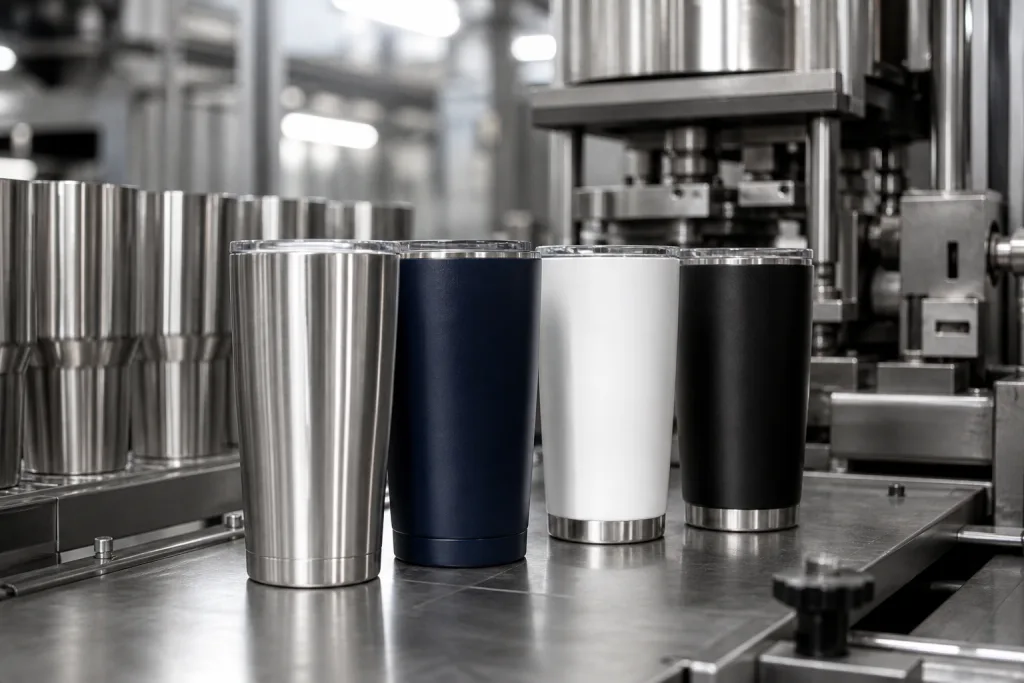
For coffee mug distributors serving multiple accounts, flexibility pays. Standard molds with optional lids, 3-4 stock coatings, and low MOQ logo changes do more work than a fully bespoke shape. A bulk coffee tumbler should move to schools this month and a software company next month without dead stock sitting in 20 cartons. In practice, we ship standard 304 inner, 201 or 304 outer, plus decoration that reads well across black, white, and navy. Bespoke sounds attractive, but the math doesn’t work unless volume is there.
E-commerce and subscription boxes
Online reviews punish leaks and dents fast. Choose screw lids, thicker export cartons, and, if needed, individual white boxes with EPE or molded pulp. QC pulled the sample on one drop test order because the rim picked up a dent at the carton corner, so we changed the insert before mass production. A cup that is USD 0.22 cheaper can cost more if your return rate rises from 1.5% to 4%. We’ve seen this go sideways.
A tumbler is not “good” or “bad” in isolation. It is either right for your channel or expensive for the wrong reason.
That is the practical lens we use in China when advising coffee mug custom or coffee mug customized programs for North America and Europe. The buyer usually asks for the lowest unit price first. That is the wrong question to ask.
Materials, walls, and heat retention
Serious travel tumbler sourcing usually comes down to steel grade and wall build. If you’re comparing a coffee mug factory, coffee mug manufacturer, or coffee mug OEM manufacturer, ask for the full material breakdown on the BOM, not a loose “stainless steel” note. We’ve seen POs marked only “SS body,” then the buyer flagged the quote because no one defined inner and outer grade.
- 304 stainless inner: the standard for beverage contact. Good corrosion resistance. Safe default for coffee, tea, and acidic drinks. On our line, QC checks the inner tube cert before production starts.
- 201 stainless outer: lower cost, acceptable for the exterior on promotional and wholesale orders. This is common on MOQ-driven programs where the target price is tight.
- 304 inner + 304 outer: better premium feel, slightly higher cost, useful for retail and coffee mug private labeling. Buyers usually notice it first in hand weight and finish consistency.
Wall structure changes performance and price. Fast.
- Single-wall: lowest cost, no real insulation, outer wall gets hot. Best for budget coffee mug in bulk programs where use time is short. We ship these more for events than for daily commute SKUs.
- Double-wall non-vacuum: some improvement, still not enough for premium travel use. This is the wrong spec if your buyer expects all-morning heat retention.
- Double-wall vacuum: the commercial standard. Typical heat retention is 6-12 hours depending on fill temperature, lid design, and body diameter. After vacuuming, the line usually does a spot check with the vacuum gauge before sealing off the batch.
We commonly see body thickness around 0.4 mm for the inner wall and 0.45-0.5 mm for the outer wall on stable 20 oz vacuum tumblers. Those numbers work. Go thinner and dent risk goes up during carton drop or pallet transfer. Go heavier and steel cost climbs, freight weight climbs, and the math doesn’t work for most distributor programs.
For distributors coffee tumbler orders, 20 oz is the broadest commercial size because it balances coffee service, commuting, and logo area. Still, a bulk coffee travel mug with a handle at 14-16 oz often fits office users better. The grip feels familiar. The shorter body also improves packing density; in one 60 x 40 x 45 cm master carton, that difference matters more than buyers expect.
If your buyer asks for sustainability, don’t accept vague claims on a sales sheet. Reusable stainless drinkware helps, but you still need compliance documentation. For Europe, ask about REACH. For the US, ask about FDA contact compliance where applicable. If the item targets children, ASTM and CPSIA become more relevant, though that is less common for travel tumbler projects. We’ve seen this go sideways when a buyer asked for “eco material proof” and no one specified the test report list upfront.
Lids, coatings, and logo durability
Most complaints land in 3 buckets: leaking lids, chipped coating, and logos rubbing off. We see those claims far more often than arguments about body shape, so this section matters more than the sketch review on page one.
Lid choices compared directly
- Slider lid: low cost and easy to sip from. Common on promo coffee mugs. Usually splash-resistant, not leakproof. Buyers still ask for “spill proof” on this style, and this is the wrong question to ask.
- Flip lid: better for active use, but hinge quality changes from supplier to supplier. Test cycle life before you place repeat orders; on the line, we usually run 3,000 open-close cycles on a sample set.
- Screw lid with gasket: best pick for commuting and e-commerce parcels. Tooling is more complex, but complaint rates are lower. A 2.0 mm silicone gasket that seats cleanly usually saves trouble later.
- Press-in lid: cheap and fast. Fine for office desk use only. We have seen this go sideways when a buyer tried to use it for car-cupholder travel SKUs.
If you sell online, lock in a silicone gasket hardness that seals, then ask the coffee mug supplier for inverted leak testing by lot. A basic 30-minute upside-down test on filled samples catches obvious failures early, and QC pulled one batch last month because the lid vent was cut off-center by 0.6 mm.
Exterior finish matters more than buyers expect
Spray paint is cheaper. Powder coating usually holds up better against scratches and feels better in hand. On a bulk coffee tumbler order, powder coat can add about USD 0.18-0.35 depending on size and color. For a coffee mug private label program, the math often works because visual rejects drop and shelf presentation improves. We ship both finishes, but the buyer flagged chipped rims on spray-painted 20 oz tumblers more than once during carton-drop review.
Decoration options
- Silkscreen: low setup cost. Best for simple 1-2 color logos. Common for coffee mug bulk orders. Watch registration closely on curved bodies.
- Laser engraving: durable and clean on powder-coated surfaces. Good fit for premium accounts. On 304 stainless with dark powder, the contrast is strong and stays that way.
- Heat transfer: works for multicolor graphics, but QC has to stay tighter or you get edge lift. We usually check adhesion with a cross-hatch tape test before packing.
- Digital print: getting better, though it is still not the default on high-volume stainless projects. For 10,000 pcs runs, speed and consistency still favor other methods.
If your client wants coffee mug customizable programs across 12 small accounts, standardize the body and change only the logo process. That keeps purchasing simpler and the line more stable. In our Zhejiang factory, logo-only changes can keep repeat lead times near 20-25 days after approval, while full color changes often push production back toward 30-35 days. We have even seen a PO typo on Pantone code force a full repaint, and that kind of mistake burns a week fast.
MOQ, packaging, and landed cost
This is where first-time buyers protect margin or leak it without noticing. A factory-direct tumbler quote tells you almost nothing until the packing spec and freight basis are written down. We see this on the line all the time: one buyer compares unit price only, then the carton count drops after a lid change and the landed math no longer works.
Typical MOQ for a standard vacuum travel tumbler is 1,000 pcs per model per color. Some coffee mug manufacturers in China will quote 500 pcs, then recover margin through print charges, poor carton utilization, or higher sample fees. We’ve had buyers push for 300 pcs with a custom Pantone lid; after setup on the screen-print fixture, the cost per piece jumped fast. For single-wall promotional cups, MOQ often moves to 3,000 pcs because the margin is thinner.
Packaging choices change both damage rate and freight:
- Egg-crate master carton only: lowest cost, fine for bulk distributor resale. QC pulled the sample after a 76 cm drop test, and this pack usually passes for non-retail bulk shipments.
- Plain white box: adds roughly USD 0.12-0.20, gives a cleaner presentation, and usually fits smoothly into a standard 5-layer master carton.
- Custom color box: adds roughly USD 0.28-0.65 plus artwork and possibly higher MOQ. Watch the box size. A 3 mm insert change can affect carton count.
- E-commerce protective pack: can add USD 0.35-0.80, but it often cuts returns enough to pay for itself. We’ve seen this go sideways when the buyer flagged dents after parcel shipping and the inner support was too soft.
For coffee mug custom made projects, carton dimensions matter. A slightly taller tumbler might reduce pieces per carton from 24 to 20, which raises freight cost per unit. Buyers rarely check this early enough. Ask your coffee mug supplier for outer carton size, gross weight, and loading quantity for a 40HQ before approving final dimensions. This is the right question to ask early, not after the mold drawing is signed.
If you are shipping to Amazon FBA or a 3PL, specify carton weight limits, barcode placement, and whether you need FNSKU labeling. Rework in a US warehouse is expensive. We often recommend keeping master cartons under 15 kg gross where possible for easier handling. Last month a PO even had the barcode position typed wrong, left side instead of bottom panel, and the buyer had to relabel part of the shipment.
For distributor programs, the safest quoting structure is: FOB China unit price, packaging adder, decoration adder, and estimated loading quantity. That gives you a clean way to compare coffee mug manufacturers instead of guessing from one all-in number. We ship quotes this way because one lump-sum price hides too much, and buyers miss where the cost actually moved.
How to qualify a China factory
A clean sample looks good on the table. It does not tell you if the line stays in control. If you are screening a coffee mug factory, coffee mug manufacturer, or coffee mug manufacturers for repeat wholesale supply, check the production system behind that sample, not the photo finish.
Start with these checks:
- Audit and social compliance: BSCI comes up on European projects all the time. ISO 9001 helps show process discipline, but this is the wrong question to stop at; a certificate alone does not tell you what happens on the floor.
- QC method: ask whether final inspection follows AQL 2.5 or 4.0, what defect categories they use, and whether QC pulled the sample from finished cartons or from the line.
- Welding and vacuum testing: ask how they verify insulation integrity and reject micro-leaks. On our side, we run vacuum checks after welding and watch for pressure drop on suspect pieces.
- Incoming material control: steel grade, lid resin, and silicone parts should be documented. Ask to see the material record, not just a verbal answer, down to the batch note for the lid gasket.
- Lab support: can they arrange third-party testing for REACH, LFGB, or FDA-related requirements? Ask which lab they book and how fast they can turn a report after sample pickup.
At BottleForge Industrial in Zhejiang, China, we normally suggest a pre-production sample, then a mass-production confirmation sample if packaging is customized. If the order is above 5,000 pcs, we usually tell buyers to book third-party inspection before balance payment. The math works. One inspection fee is small next to 5,000 wrong lids, a logo shifted 3 mm, or a master carton with the PO typo copied onto every label.
Ask practical factory questions, not only sales questions. How many units per month? What is the normal repeat-order lead time? Can they hold spare lids for after-sales support? We have seen buyers get dazzled by a fast quote and skip this part, and it goes sideways later. A strong coffee mug supplier answers with numbers: for a standard bulk travel tumbler, repeat production is usually 20-30 days, not 7 days, unless stock components are already reserved and the line slot is open.
Watch communication quality early. If the supplier will not name the steel grade, cannot explain the coating process, or sends a quote without carton data like 46 × 46 × 52 cm and gross weight, the buyer flagged the right issue. Good export factories in China are used to this scrutiny. You are not being difficult. You are doing the job correctly.
Get a travel tumbler quote that matches your channel
Send your target price, capacity, lid style, and packaging needs. We will recommend the right Zhejiang production spec, MOQ, and realistic FOB cost.
Frequently asked questions
What tumbler size works best for coffee brand merchandise?
For most coffee brands, 12 oz, 16 oz, and 20 oz are the commercial sweet spots. A 12 oz or 16 oz bulk coffee travel mug feels closer to café service and usually fits better into gift bundles. A 20 oz bulk coffee tumbler gives you broader resale appeal in North America because commuters expect larger capacity. If your channel is retail shelf or online, start with one 16 oz and one 20 oz option instead of trying four sizes at once. MOQ is typically 1,000 pcs per size per color from China. If your target retail price is USD 19.99-29.99, a 304 inner double-wall vacuum model usually gives the best margin-to-perceived-value balance.
Is a leakproof lid worth the extra cost for distributor orders?
Usually yes for e-commerce, usually no for basic event giveaways. A screw lid with silicone gasket can add about USD 0.18-0.45 per unit versus a simple slider lid, depending on mold and resin quality. For online sales, that extra cost often pays back fast because leak complaints and return rates can drop by 20-30%. For corporate gift orders that will mostly sit on desks, a slider lid is normally enough and keeps pricing competitive. If you are a coffee mug distributor serving mixed channels, it is smart to keep one body shape that can use two lid types. That lets you quote a lower-cost promo version and a higher-spec commuter version from the same platform.
What is a realistic MOQ for custom logo travel tumblers?
For a standard double-wall stainless travel tumbler, 1,000 pcs per model per color is the normal workable MOQ in Zhejiang, China. Some factories will offer 500 pcs, but the unit price usually rises enough that the savings disappear. For fully custom colors, custom packaging, or molded lid changes, the practical MOQ may move to 2,000-3,000 pcs. If you only need a logo on an existing stock color, many coffee mug factory direct programs can stay at 1,000 pcs with one-color silkscreen or laser marking. Sample lead time is usually 5-10 days for logo mockups, and mass production is commonly 25-35 days after sample approval and deposit.
How should we compare quotes from different coffee mug suppliers?
Ask every supplier to quote the same six items: steel grade, wall structure, lid type, decoration method, packing method, and FOB port. Without that, you are comparing different products. A quote for a bulk travel mug with 304 inner, powder coat, laser logo, and white box is not comparable to one with spray paint, silkscreen, and master-carton-only packing. Also request carton size, gross weight, and 40HQ loading quantity, because freight cost can change by 5-12% based on packing density alone. If possible, ask whether inspection follows AQL 2.5 and whether REACH or FDA-related test support is available. Those details tell you more than a low unit price does.
Which logo process lasts longest on a powder-coated tumbler?
Laser engraving is normally the most durable choice on powder-coated stainless tumblers. It removes the outer coating cleanly and creates a permanent mark that does not rub off like surface inks can. For distributor coffee tumbler programs aimed at premium gifts or long-term brand merchandise, laser is usually worth the extra USD 0.08-0.18 per unit over basic silkscreen. Silkscreen still makes sense for coffee mug promotional runs where cost matters more than years of abrasion resistance. If you need multicolor artwork, heat transfer is possible, but ask for adhesion testing and review production samples carefully. On dark matte coatings, laser tends to give the cleanest and most consistent brand presentation.