Key Takeaways
- A 20 oz stainless steel bulk travel tumbler typically lands at USD 2.80-5.90 FOB China depending on steel grade, lid style, coating, and decoration
- MOQ usually starts at 500-1,000 units per color for stock bodies, but true coffee mug custom made projects often require 3,000-5,000 units
- Normal production lead time is 25-35 days after sample approval, with new mold development adding 20-35 days
- AQL 2.5 inspection, REACH testing, and leak testing should be confirmed before deposit to prevent costly rework
Finding a travel tumbler is easy. Pricing it right, landing it on schedule, and avoiding a bad custom run is the hard part. That is what coffee brands and corporate-gift buyers run into on a distributors coffee travel mug program. We have seen a cheap quote turn expensive after a mold charge, a silk-screen print test, a 1.2m drop-test failure, or a lid leak QC pulled only after pilot samples were packed.
At factory level in Zhejiang, China, the useful questions are plain: what drives unit cost, what MOQ changes the math, and how many days each step takes. For example, 1,000 pcs and 3,000 pcs are not the same job on the line, and the math doesn’t work if you ignore setup loss and spare lids. If you are buying a bulk coffee travel mug or building a coffee mug private label line, you need numbers you can plug into your margin sheet, not vague promises. We ship by dates, not adjectives.
What changes tumbler pricing fast
For a distributors coffee travel mug program, four cost drivers move price first: body material, lid build, finish, and decoration. Most buyers start from shape and Pantone color. The ex-factory number shifts on the hidden specs. On our line, even a 0.1 mm wall-thickness change or a heavier lid insert shows up in the quote fast.
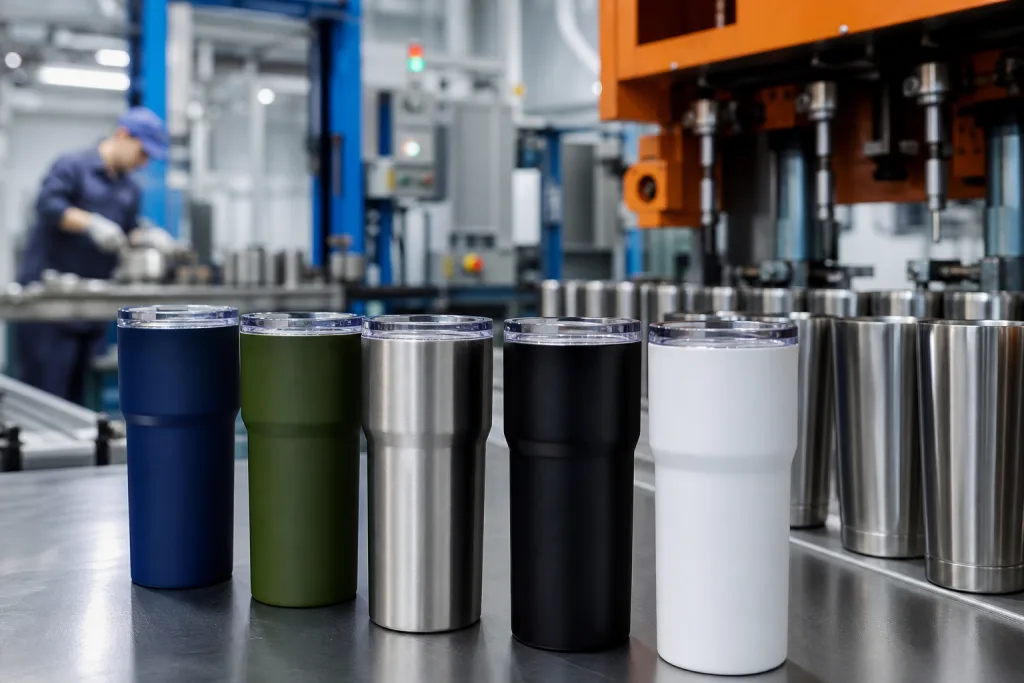
A standard 20 oz double-wall 304 stainless steel tumbler with powder coating and a clear push lid is usually the baseline. In Zhejiang, China, a practical FOB range is USD 2.80-3.60 at 3,000 units if you use a stock mold and one-color silk screen. Move to a 304 inner and 201 outer structure and you may save USD 0.12-0.20 per unit, but many North American and European buyers avoid that mix for premium positioning. We get that pushback every month. Full 304 inside and outside adds cost but is easier to market for quality-sensitive retail channels, and QC can verify the incoming coil against the mill cert before we run.
Lids are where buyers misjudge cost most often. This is the wrong question to ask: “Why is this lid only 20 cents more?” A simple slider lid may be USD 0.18-0.28. A screw lid with silicone seal, flip cap, or dual-drink function can add USD 0.35-0.90. If the lid needs dishwasher-safe color matching or a special gasket hardness, add testing and longer approval time. Last season, a buyer flagged a leak at a 45-degree tip test after 200 cycles, and the rework was more expensive than the original lid upgrade. For a bulk coffee tumbler order, one weak lid can turn a profitable SKU into a returns problem.
Finish changes your quote too. Powder coating is common and stable. Spray paint can be cheaper by USD 0.08-0.15 but scratches faster; we’ve seen cross-hatch adhesion tests fail after carton rub. Electroplated or gradient finishes look premium but may add USD 0.30-0.80 plus a higher defect risk. The math doesn't work if you need promo pricing and a fancy finish at the same time. Decoration is the last layer: silk screen is low cost, laser engraving holds up well, heat transfer wraps fit gift programs, and 360-degree digital print suits small campaigns but raises unit cost fast. On one PO, the buyer even typed the wrong logo width by 8 mm, and that kind of miss can delay approval by 2 days.
If you are sourcing from a coffee mug factory direct partner in China, ask for the quote split by body, lid, finish, print, and packaging. We ship cleaner comparisons that way. A single all-in number from a broad coffee mug supplier directory hides too much, and we've seen this go sideways once freight carton spec and insert type come up after sampling.
MOQ tiers that change your unit cost
MOQ is not a random factory rule. It is the break point where steel yield, powder-coating line changeover, carton count, and logo setup start to make sense on the line. For a stock-shape bulk coffee mug or travel tumbler, the working MOQ in China is often lower than buyers expect if you stay with standard lids, standard colors, and a neutral 5-layer carton. We run this math every day.
- 300-500 units: workable for stock tumblers with neutral cartons and existing lid colors. Price stays higher, often 10-18% above normal volume, because QC still pulls the sample set and the line still stops for setup.
- 1,000 units: the common entry point for a coffee mug customized project with one body color and one logo position. This is where a single silk-screen plate starts to pay back.
- 3,000 units: where factories usually sharpen FOB pricing, because steel purchasing, coating batches, and print setup run cleaner. On our side, powder usage loss drops once the color run is stable.
- 5,000+ units: where custom pantone lids, gift boxes, or mixed decoration methods start to price out better. The buyer flagged this before on a 5,200-unit PO, and the math worked.
Example. A 30 oz powder-coated bulk coffee travel mug might be USD 4.40 at 500 units, USD 3.65 at 1,000 units, and USD 3.18 at 3,000 units FOB Ningbo. That spread is not factory greed. It comes from carton fill rate, less leftover steel after tube cutting, and less downtime on coating and assembly lines; one color change alone can burn 35-40 minutes.
True custom development is a different case. If you want a new body profile, a unique handle, or patented-style lid geometry, you are no longer buying a stock coffee mug in bulk. You are paying for OEM tooling. Then MOQ often moves to 3,000-5,000 units per design, with tooling fees from USD 2,000 to 8,000 depending on body complexity and lid parts count. We have seen this go sideways when the buyer asks for a new handle but still wants stock MOQ; this is the wrong question to ask.
At BottleForge Industrial in Zhejiang, monthly capacity for tumblers is around 450,000 units, but small custom orders still have to fit the production board already locked for the next 12-18 days. So a smart buyer asks for MOQ, MOQ by color, by logo, and by packaging type. Ask those numbers separately. A PO typo on packaging spec can change the answer fast, and those numbers show whether your assortment plan is real or just optimistic.
Timeline from inquiry to container loading
If you need stock for a seasonal launch or a corporate gifting window, the main risk is not unit cost. It is schedule slip between quotation, sample approval, testing, and final production. We have seen a PO say “ship by Sept 15” while the logo file arrived 6 days late and the buyer still expected the original date. A realistic timeline for a bulk travel tumbler order from China should look like this.
Stock model with custom logo
- Day 1-3: quote confirmation, artwork review, and pantone check
- Day 4-7: pre-production sample or virtual proof approval
- Day 8-12: deposit received, material planning, print screens prepared
- Day 13-30: production and assembly
- Day 31-35: inspection, carton marking, booking
So the normal lead time is 25-35 days after sample approval. In peak season, August to November, add 7-10 days. The line gets crowded fast. If you need retail gift boxes, barcode stickers, or Amazon FNSKU labels, add 3-5 days for packing work, because QC pulled the sample more than once for label position off by 2 mm.
New OEM or private label development
- 20-35 days: tooling and mold sampling
- 7-12 days: revised prototype approval
- 25-40 days: mass production after final sign-off
For a coffee mug private label launch, the full cycle often runs 55-85 days. This is the wrong question to ask: “Can you do a new design in 30 days?” Usually no. On new molds, we run first-shot checks, lid fit tests, and leak tests before mass production, and a 0.3 mm lid mismatch is enough to stop the job. Buyers who assume 30 days for a new design usually end up paying for air freight.
Another timing detail gets missed by a lot of coffee mug distributors: accessory dependency. A custom straw, color-matched handle grip, or non-standard silicone gasket can hold the whole order even after the steel bodies are finished. We have seen this go sideways. One outsourced gasket supplier delivered 8,000 pcs two shades off the approved PMS chip, and the buyer flagged it at final inspection. Ask your coffee mug manufacturer for a critical-path sheet that shows which parts are made in-house and which are outsourced. Factories in Zhejiang and other China sourcing clusters usually manage body production well, but small plastic parts still cause bottlenecks.
Decoration, packaging, and compliance costs
Buyers often price the tumbler body and miss the extras that hit the landed number. On a coffee mug custom project, decoration and packaging can swing total cost by 15-40% depending on channel. We’ve seen a PO where the buyer approved the mug spec but forgot the barcode label size, and the box had to be reworked on the line. A promo giveaway mug and a retail gift tumbler are two different buying jobs.
Typical decoration ranges look like this at volume:
- 1-color silk screen: USD 0.05-0.12
- Laser engraving: USD 0.08-0.20
- Heat transfer wrap: USD 0.18-0.40
- 360 digital print: USD 0.35-0.80
For a coffee mug promotional products campaign, silk screen is usually the best value if the logo is simple and stays within one Pantone. We run 1-color prints faster, and setup is lighter. For a premium coffee mug customizable retail line, laser engraving on powder coat holds up better in rub testing, and claim risk is lower. If you need individual name personalization, ask a direct question: is variable data done in-house or sent out? This is the right question. We’ve seen line speed drop from 1,800 pcs per shift to 900 pcs when names were added one by one, and QC pulled the sample twice because two names were offset by 2 mm.
Packaging hits hard. An egg-crate export carton is cheap. A white box with barcode label may add USD 0.12-0.20. A color gift box with EVA or molded pulp insert can add USD 0.45-1.20. The wrong question is “What is your cheapest box?” Ask what survives transit. For e-commerce drops, pass ISTA-style transit testing early, or returns will eat the FOB savings. We’ve seen this go sideways: a 0.5 mm thinner box board saved a few cents, then corner crush failed in drop test.
Compliance is its own cost bucket. For Europe, buyers commonly ask for REACH, LFGB, and food-contact declarations. For North America, FDA, CPSIA where relevant, and retailer-specific heavy metal requirements may apply. A third-party chemical or migration test often costs USD 250-600 per SKU or material family. The math works. A blocked shipment costs more. One failed report can hold 5,000 pcs in the warehouse while the lab reruns migration on the lid straw set. A serious coffee mug supplier should tell you which reports are current, which lab issued them, and what needs updating for your exact configuration.
How distributors should quote landed cost
If you buy as a coffee mug distributor, the factory FOB number is just line one on the sheet. Quote landed cost per sellable unit instead. That means defects, freight, duty, and local handling all sit in the math. We’ve seen buyers focus on ex-factory price, then get hit later by a USD 380 destination charge they never put into the file.
Start with the FOB China price. Add trucking from factory to port, sea freight, insurance, destination charges, duty, customs clearance, palletizing if needed, and an inspection or claim allowance. For a rough planning model on a 20 oz tumbler packed 24 units per carton, ocean freight may add USD 0.18-0.55 per unit depending on season and destination. If the gift box adds even 12 mm to pack height, carton density drops and freight per unit jumps fast. The buyer flagged this on one PO last month after switching from a plain white box to a printed rigid box.
Then add quality risk. This is the wrong question to ask: “Who is cheapest at FOB?” A factory offering a low price but shipping at AQL 4.0 is not automatically cheaper than a supplier running at AQL 2.5. If your defect rate moves from 2% to 6%, the math doesn't work once you count replacements, credit notes, and lost stock. Ask for the inspection standard by defect class: critical, major, and minor. On the line, QC pulled the sample and checked logo position with a 0.5 mm scale because for a coffee mug private labeling order, print defects need to be defined before mass production.
A useful benchmark: if two factories differ by only USD 0.15 per unit, but one gives faster sampling, stable lid fit, and cleaner documentation, the more expensive quote may be the cheaper business decision.
Check payment terms too. Standard terms from China are often 30% deposit, 70% before shipment. Some established buyers get OA or better terms later, but don’t assume that on the first 3 POs. If cash flow matters, ask whether the factory can split shipments or stage production by color with a 1,000-piece MOQ per shade. We ship this way for distributors all the time. It usually works better than pushing for an unrealistic price from a generic coffee mug supplier list.
Questions to settle before you place
Before you issue a PO for a bulk coffee travel mug, settle the items that usually trigger rework on the line. We have seen one lid revision add 12 days to delivery, and the buyer only caught it after QC pulled the sample from the sealing test bench.
- Steel specification: 18/8 304 or mixed 304/201? Inner wall thickness 0.4-0.5 mm? Outer wall 0.4 mm?
- Insulation target: hot retention 6 hours or 12 hours? Cold retention with ice 12 hours or 24 hours?
- Lid leak standard: splash-resistant or leakproof when inverted for 30 seconds?
- Logo method: silk screen, laser, transfer, or UV print?
- Packaging: mail-order safe, retail shelf ready, or simple export carton?
- Inspection: in-line, pre-shipment, or both? AQL level confirmed?
If you are buying coffee mug promotional items for an event, speed often beats perfect Pantone matching; we ship plenty of rush orders where a 7-day ex-factory target matters more than a tiny shade shift. If you are launching a retail coffee mug custom made line, the buyer usually flags different points: color tolerance within approved range, lid fit consistency after 500 open-close cycles, and clean carton presentation. Channel decides the spec. This is the wrong question to leave to a general coffee mug factory sales pitch.
Ask your factory one more blunt question: what usually goes wrong on this model? A straight export team should tell you where the risk sits. On tapered bodies, we see logo placement drift by 1.5-2 mm if the fixture is loose; on matte powder coat, scratches show up fast at packing; on some lids, the gasket shrinks after dishwasher exposure and the buyer flagged seepage on the inverted test. That answer beats a polished brochure every time. Good China factories, including experienced teams in Zhejiang, know repeat orders come from clear answers, not overselling.
If the supplier cannot explain cost drivers, MOQ logic, and lead-time risk with numbers, keep looking. There are 1000+ coffee mug manufacturers in China. We run into this every season: one factory quotes 500 pcs MOQ, another says 3000 pcs, and the math does not work until you see mold sharing, coating batch size, and carton breakage rate. The useful partner is the one that helps you buy right the first time.
Get a clear tumbler quote with real factory numbers
Send your target size, logo method, quantity, and delivery window. We will map MOQ, FOB price, and lead time from Zhejiang, China.
Frequently asked questions
What is a realistic MOQ for a custom travel tumbler with my logo?
For a stock-body travel tumbler with your logo, a realistic MOQ is usually 500 to 1,000 units per color in China. If you want a simple one-color silk screen on an existing 20 oz or 30 oz model, 500 units may be possible, but the unit price will often be 10-18% higher than at 1,000 or 3,000 units. If you need custom pantone coating, a special lid color, gift box packaging, or multiple logo positions, 1,000 units is the safer planning number. For a fully custom shape or new lid tooling, MOQ usually moves to 3,000-5,000 units, and tooling can cost USD 2,000-8,000 depending on complexity.
How much should I budget for a bulk coffee travel mug order?
For a standard double-wall stainless steel bulk coffee travel mug, most buyers should budget FOB China at USD 2.80-5.90 per unit. The low end usually means a stock 20 oz body, standard push lid, powder coat, and one-color logo. The higher end usually means a larger 30-40 oz size, handle, upgraded leak-resistant lid, premium finish, and retail packaging. Add decoration at roughly USD 0.05-0.80 depending on method, and packaging at USD 0.12-1.20 depending on box style. If you need REACH, LFGB, or FDA-related tests, add roughly USD 250-600 per SKU or material set. Sea freight and destination charges still need to be added to get your true landed cost.
How long does production take for a coffee mug private label order?
If you are using an existing tumbler mold, normal production is 25-35 days after sample approval and deposit. Sampling itself typically takes 4-7 days for a logo sample and 7-12 days if you need color matching or special packaging review. During peak season, especially August through November, lead time can stretch to 35-45 days. For a coffee mug private label project with new tooling, add 20-35 days for mold development and first prototypes. That makes a realistic full cycle 55-85 days from confirmed artwork to shipment. If your launch date is fixed, build in 7 extra days for inspection, carton marks, booking, and any rework on lids or printing.
What quality checks matter most for travel tumblers?
Three checks matter most: leak performance, vacuum insulation, and cosmetic consistency. Ask for 100% vacuum inspection and leak testing during assembly, not just random spot checks at the end. Confirm the inspection standard, ideally AQL 2.5 for final shipment, with clear definitions for critical, major, and minor defects. For custom branding, logo position tolerance on tapered surfaces should be approved before mass production. Material compliance is also important: for Europe, many buyers ask for REACH or LFGB-related documentation; for North America, FDA contact compliance is common. If the order is for e-commerce, add carton drop or transit testing. A cheaper tumbler with a 5-6% complaint rate is not a bargain.
Should I buy from a factory direct source or a trading company?
Factory direct is usually better when you need price transparency, technical answers, and stable repeat orders. A real coffee mug factory can explain steel thickness, lid tooling limits, coating yield, and production timing in specific numbers. That matters for a custom travel tumbler program. A trading company can still be useful if you need mixed product categories in one shipment or lower-volume sourcing support, but ask who actually controls sampling, inspection, and after-sales claims. In Zhejiang, China, many capable factories export directly and can handle OEM, AQL inspections, and compliance documentation themselves. If you are comparing offers, ask for production photos, capacity data, and lead time by process. Those answers reveal whether you are talking to the source.