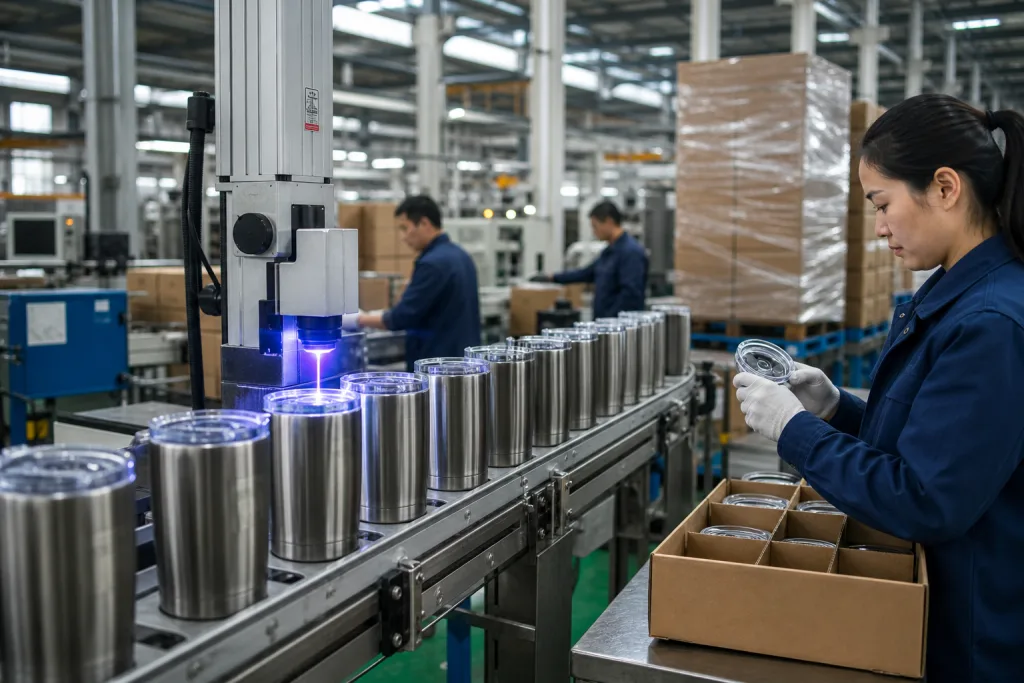
Key Takeaways
- A workable MOQ for a bulk coffee tumbler is usually 1,000-3,000 pcs, with 35-45 days lead time.
- For hot drinks, specify 304 stainless steel, 0.4-0.5 mm inner wall, and a lid seal tested for 5-10 psi.
- A real coffee mug factory should offer AQL 2.5 inspection, REACH-compliant materials, and monthly capacity above 300,000 units.
- Print and coating failures are common; lock down logo position, color tolerance, and dishwasher resistance before mass production.
If you buy for coffee brands or corporate gifts, finding a distributors coffee mug listing is easy. The hard part is screening out the bulk travel mug that fails after the first hot wash, leaks in transit, or gives you a bad print hit after 3,000 units. We’ve seen this on the line: a sample looks clean under the showroom lights, then mass production drifts because the wall thickness is off by 0.1 mm, the lid torque is loose, or the coating cure time gets cut. That is where claims fall apart.
Smart buyers write specs around failure points, not just piece price. This is the right question to ask. A factory direct quote at USD 1.85 can beat a USD 2.40 quote if the first one already includes 304 stainless, 0.4 mm inner wall, REACH-safe coating, and AQL 2.5 inspection. QC pulled the sample on one order because the PO had the logo position typed 8 mm higher than the approved artwork, and that kind of small miss turns into a full rework at 5,000 pcs. If you are buying coffee mug custom made, coffee mug private label, or coffee mug promotional products, you need a clear way to judge the coffee mug manufacturer before the shipment is booked.
Where tumbler projects fail first
Most tumbler projects fail before the first container leaves China. The approved sample looks right, then the factory swaps the lid vendor, changes the powder coat batch, or cuts molding cycle time on the line by 6 seconds to push output. We’ve seen this go sideways. Bulk goods arrive with different lid torque, weaker heat hold, or a logo that starts chipping after one week. In a coffee mug factory, small process drift turns into returns fast.
The usual breakpoints are predictable. QC pulled the sample on all four at least once last season:
- Lid leakage: the silicone ring is too soft, too shallow, or cut 0.5 mm undersize.
- Temperature loss: vacuum sealing is incomplete; the base stays warm after 2 hours instead of 6-8.
- Print failure: silk screen cracks if the coating cure is under 180°C or the surface energy is wrong.
- Dent risk: 0.3 mm steel looks fine on a photo, but dents in carton packing.
If you source a bulk coffee travel mug for retail or gifting, ask the coffee mug supplier for defect photos from prior runs, not just a polished sample video. Ask for leak-test records too. We run upside-down soak tests on the bench, and the buyer flagged one lot last year because the PO said matte black but the carton mark was typed as “matt balck.” A serious coffee mug distributor should tell you where an order fails, what station checks it, and what the reject standard is. That matters more than a glossy coffee mug supplier list. Sample videos don’t prove much.
Spec the steel, not the marketing
“Stainless steel” is not a purchasing spec. For a travel tumbler, write 304 stainless for both inner and outer walls if you want food-safe durability and fewer after-sales claims. On low-cost promo orders, some factories switch the outer wall to 201. That saves a bit on price, then shows up later as weaker corrosion resistance, more odor carryover, and surface staining after a few weeks on shelf. We’ve had buyers push back on rust spots near the base seam, and this is usually where the problem starts. A solid coffee mug manufacturer in China prints the steel grade on the quotation sheet, not buried in a WeChat sample chat.
Use numbers. A workable bulk tumbler spec is 0.4 mm inner wall and 0.35-0.4 mm outer wall, with vacuum insulation if you need 6-12 hours hot retention. If you cut down to 0.3 mm for a lighter bulk program, dent resistance drops fast; QC pulled a sample last month with a 6 mm sidewall dent from routine carton pressure. For office gifting, buyers often ask the wrong question by focusing only on shape or logo area. The base build matters more. If the buyer wants a coffee mug custom made for office gifting, insist on:
- 304 stainless steel, food contact compliance
- Silicone gasket rated for repeated opening and closing
- Powder coat or paint cure at the factory's stated temperature
- Drop-test target: 0.8 m onto plywood, 3 corners
If the tumbler has a colored exterior coating, a Zhejiang coffee mug oem manufacturer should send salt spray or corrosion test data with the offer. Ask for the report, the hours, and the sample photo. We run cross-cut adhesion checks on the line, and the buyer flagged blistering once on a matte navy finish after salt spray. Without test data, you are buying a story.
Lids leak when tolerances drift
Leakage turns a bulk travel mug order into a claims file fast. The lid is usually not the root cause. Tolerance stack-up is. If the cup mouth diameter drifts by 0.3-0.5 mm and the lid ring runs loose on the same lot, you get slow seepage in courier drop tests and full leaks once the mug is tossed into a backpack. We check this on the line with a digital caliper at the cup neck, and QC pulled the sample twice last month after finding one mouth diameter at +0.4 mm. For coffee mug customized orders, lock the cup neck drawing and the lid drawing together, or the math doesn't work.
Ask for these checks before approval:
- Seal test: invert the filled mug for 30 minutes at 50-60°C.
- Thread or press-fit consistency: 10 sample lids from different cavities must close with the same torque or snap force.
- Steam vent behavior: if there is a sip hole, confirm no splash at 45-degree tilt.
If you sell through a distributor channel, one leaker costs more than one mug. We have seen a 2,000-piece run trigger 37 replacement requests in 12 days, and the buyer flagged the freight bill before the claim count was even closed. The hit is the replacement, the customer service time, and the trust you lose in your coffee mug promotional products program. For export buyers, this is the right question to ask early: can the factory explain lid tolerance in millimeters, cavity by cavity, and show the check record? If not, do not place a coffee mug custom order yet.
Printing breaks when artwork is rushed
Artwork is where 1 out of 4 coffee mug distributor projects gives away margin. A logo that looks clean in PDF often breaks on curved steel once it hits the jig, especially if the line width is too thin or the ink cure does not match the coating. We’ve seen QC pull a sample where a 0.8 mm line looked fine on screen and disappeared after baking. For a coffee mug promotional run, keep fine text above 1.2 mm stroke width and skip tiny reversed-out details unless you are using laser engraving. This is the wrong question to ask: “Can you print my file as is?” Ask what will still read after production and transit.
Common print failure modes:
- Color mismatch: Pantone target vs factory ink batch drift of ΔE 2-4.
- Cracking: soft-touch paint or under-cured coating flexes in transit.
- Peeling: surface pretreatment was skipped or the mug was handled with oil on the line.
If you want coffee mug private labeling, ask for one physical pre-production sample with the exact logo placement, then sign off on a position tolerance of ±2 mm. We ship approved samples with a marked centerline because buyers argue over 3 mm once bulk cargo lands. For larger retail programs, laser engraving is often safer than multi-color screen print because it survives abrasion better and removes one variable. The math doesn’t work if you save a few cents on print and lose the reorder over rub-off complaints. You are buying repeatability from a coffee mug supplier factory direct in China.
MOQ and pricing that make sense
Most factory quotes start to make sense at 1,000-3,000 pcs per SKU. Below that, tooling, setup, and packaging push the unit price up. For a standard bulk coffee mug or bulk coffee travel mug, FOB China usually sits at USD 1.55-3.20, depending on material, lid type, coating, and packaging. A vacuum-insulated bulk coffee tumbler with a painted body and printed logo always costs more than a simple single-wall cup. We run that math on the line every week.
What moves price up fast:
- Custom mold lids: add USD 0.20-0.60 per unit amortized
- Gift box insert: add USD 0.15-0.45
- Laser logo or multi-color print: add USD 0.06-0.30
- Individual polybag + barcode label: add USD 0.03-0.08
Do not compare only unit price. Compare landed cost, carton pack count, palletizing, and breakage allowance. A buyer once flagged a PO with the wrong carton quantity, and the math did not work after freight. A coffee mug supplier directory can show 30 names, but capacity and process control decide the outcome. A factory in Zhejiang that ships 300,000 units/month, runs a 35-day lead time, and passes AQL 2.5 inspection will usually support a coffee mug distributor better than a trading-only seller with no line control.
Factory checks you should demand
If you buy from a coffee mug factory in China, ask for proof, not promises. Start with the basic file set: ISO 9001, BSCI or a similar social audit if your brand asks for it, REACH material statements for Europe, and food-contact declarations for the market you ship into. For North America, confirm the product path for FDA food-contact expectations and any state-specific items your importer has to clear. We’ve seen buyers ask for “all certificates” without matching them to the selling market. That is the wrong question to ask.
Practical control points:
- Incoming QC: steel thickness measured by micrometer, not eyeballing; on our line, QC pulled the sample and logged 0.4 mm vs 0.5 mm before unloading the full lot
- Inline QC: lid fit checked every 2 hours; a simple go/no-go gauge catches thread mismatch fast
- Final QC: AQL 2.5 major, 4.0 minor is common for export drinkware; if a buyer flagged paint dust on 3 pcs in 200, we sort it there, not after loading
- Packing check: carton drop and transit vibration simulation; we usually run a 76 cm drop test and check corner crush after vibration
A genuine coffee mug factory direct quote should show the inspection plan. It should name the inspection level, sample size, and who signs off at each stage. If the supplier cannot name the inspection level or refuses to share test photos, that is a signal. The better coffee mug manufacturers in Zhejiang also keep traceable batch codes on carton labels and sometimes laser marks on the base, so if one batch goes bad, you isolate 1 lot instead of recalling a whole season. We’ve seen this go sideways over one PO typo and mixed lids.
How to brief a custom order
A clean brief cuts rework. For coffee mug custom made or coffee mug customizable projects, send one sheet with the exact spec, end use, and packing callouts. We run better from one-page briefs than from 14 scattered emails. If the cup is for office gifts, the spec is not the same as a retail shelf unit. A coffee mug private label SKU for Amazon-style distribution needs barcode area, carton compression strength, and tighter print tolerance; on our line, QC pulled samples before because the logo shifted 1.5 mm and the buyer flagged it. A corporate-gift order usually cares more about Pantone match and gift box surface finish. This is the wrong question to ask: “What is your cheapest tumbler?” Start with the sales channel and use case.
Use this brief structure
- Product type: bulk travel mug / bulk coffee mug / insulated tumbler
- Capacity: 12 oz, 16 oz, 20 oz, or 24 oz
- Material: 304 stainless, lid PP/Tritan, silicone seal
- Decoration: silk screen, laser engraving, or full-color wrap
- Packing: white box, gift box, or mailer-ready carton
- Target tests: leak-proof, 6-hour hot retention, drop test
If you expect repeat orders, ask the coffee mug distributor to confirm tooling lead time, sample time, and mass production schedule in writing on the PI or PO. We have seen this go sideways over one typo in a ship date. For most China factory programs, sample approval takes 7-10 days and production runs 25-40 days after deposit, depending on season. In practice, a lid color sample might close in 8 days, while a new spray finish with a fresh screen set can take 12 days. The gap matters. Miss it, and you miss the sales window.
Send your spec and get a factory quote
We’ll review your logo, lid, and packaging against real production limits, then quote a workable MOQ, lead time, and FOB price from Zhejiang.
Frequently asked questions
What MOQ should I expect for a custom travel tumbler order?
For a standard bulk travel mug, 1,000 pcs is the practical starting point. Some coffee mug manufacturers will accept 500 pcs, but unit pricing usually rises 15-30% and setup costs hurt. For custom lids or special coatings, 3,000 pcs is often cleaner. A Zhejiang factory with 300,000 units/month can handle repeat replenishment better than one-off small runs.
How do I know if a coffee mug supplier is factory direct?
Ask for the business license, workshop photos, machine list, and a live video of the production line. A real coffee mug factory direct quote should show mold area, packing line, and QC station. If they cannot state monthly capacity or lead time, they are likely a trader. For export, you want the maker, not a middle layer.
What price range is normal for a bulk coffee tumbler?
FOB China pricing for a bulk coffee tumbler often sits at USD 1.55-3.20 per piece. A simple single-wall cup is lower; a vacuum-insulated 304 stainless model with print and gift box is higher. Add USD 0.20-0.60 for custom lids and USD 0.15-0.45 for better packaging. Always compare landed cost, not just ex-factory price.
Which tests matter most for leak-proof travel mugs?
The key checks are inverted leak testing for 30 minutes, lid torque or snap-force consistency, and a hot-fill retention test at 90°C water. If the mug will ship to retail or corporate gifting, also request a drop test from 0.8 m. For coffee mug promotional products, these tests prevent the returns that wipe out margin.
Can I use the same spec for Europe and North America?
Mostly yes, but do not assume it. For Europe, REACH and food-contact declarations matter, and many importers want BSCI audits. For North America, confirm the compliance path your importer needs and packaging labels for retail or FNSKU use if needed. The mug body may be the same, but carton markings, language, and documentation are not.