Key Takeaways
- A 700 ml PP or Tritan blender bottle typically lands at USD 1.85-3.60 FOB Zhejiang at 3,000-5,000 pcs, depending on shaker type and print method
- Leak risk often comes from lid-thread tolerance and gasket compression, not from bottle body material alone
- Distributors should ask for AQL 2.5/4.0, REACH test files, and 1.2 m drop test data before approving mass production
- Standard lead time is usually 25-35 days after sample approval, while new molds can add 18-30 days in China
If you buy for distribution, a blender bottle is not just a bottle with a wire whisk. It is a spec sheet hiding in plain sight. The wrong lid resin, weak thread fit, or thin wall can turn a clean sample into a return pile 90 days after arrival. We read the line items the way a Zhejiang factory does: material grade, sealing geometry, print method, carton drop test, and the compliance file. On one run, QC pulled the sample and found a 0.3 mm gap at the cap shoulder. That sort of miss costs money.
Most buyers start with color and logo placement, then push price first. That is the wrong order. For distributors blender bottle programs, margin sits in the boring details: 0.4 mm wall swing, 48/400 neck standard, AQL limits, and whether replacement shakers go 1 pc or 5 pcs per polybag. We have seen a PO typo on pack count turn into a useless carton mix. If you also source custom canteen, customized growler, or other custom drinkware from China, run the same check on every spec sheet.
Start with body material
For distributors blender bottle sourcing, put body material on the first spec line, not decoration. This is the right place to start. We usually quote 4 options on the line: PP, Eastman Tritan, single-wall stainless steel, and sometimes recycled PET if the MOQ and color target make sense. Material shifts cost, compliance work, and complaint rate fast. One wrong call here and the buyer flags haze, odor, or weight before anyone talks about logo size.
PP is the price leader. For a 600-700 ml shaker body in food-grade PP, a realistic FOB Zhejiang range is USD 1.85-2.40 at 5,000 pcs with a standard wire mixer ball and one-color silkscreen. We run this resin every week. PP is light, takes drops well, and color matching is easier on the injection side, usually within a small masterbatch adjustment after the first 20-shot trial. The compromise is clear: lower clarity and a more commodity shelf feel. Tritan gives you a cleaner look and buyers in gym retail ask for it again and again. The same size in Tritan can move you to USD 2.40-3.10 FOB because resin cost is higher, and scrap hits harder when the buyer wants tight color consistency on a smoke gray or tinted blue body.
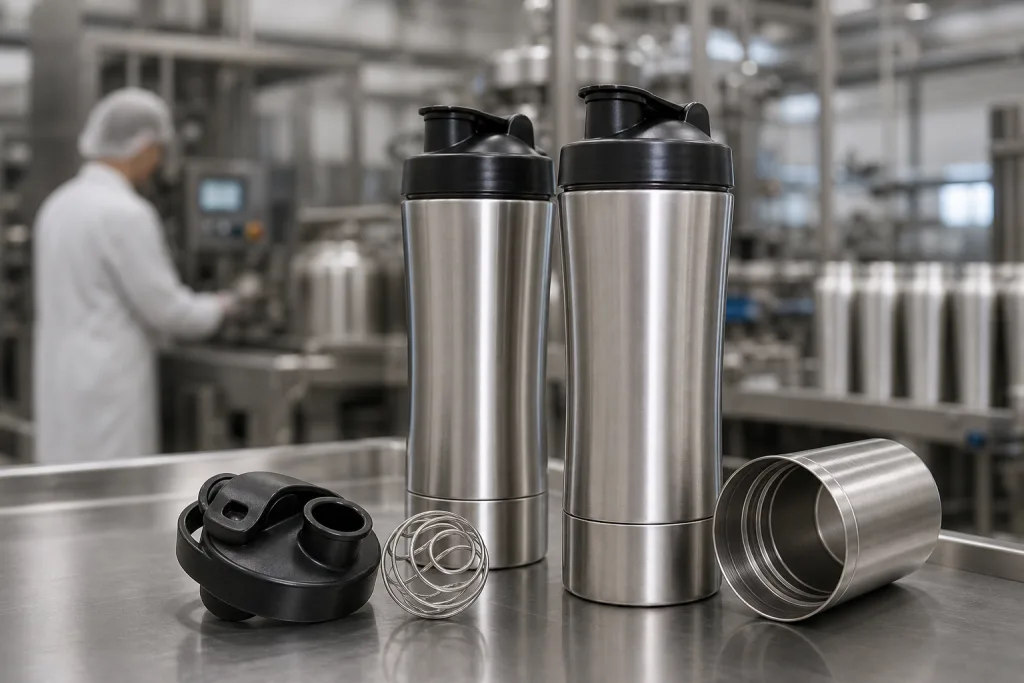
Stainless steel works when the end customer wants insulation or a higher-ticket distributor drinkware program. If not, the math doesn't work. At that point you are no longer competing with a basic shaker bottle; you are closer to custom canteen or customizable growler territory. A 18/8 stainless single-wall mixer bottle is tougher, but it adds weight and freight cost. We have seen online sellers push back on this after carton drop data looked fine, then dimensional weight on the 54 x 54 x 42 cm master carton changed the margin. If your distributor network sells online, freight math sits right next to material cost.
- PP: lower cost, solid drop resistance, less premium look on shelf
- Tritan: clearer body, stronger shelf presentation, higher resin and scrap cost
- Stainless steel: premium hand feel, higher freight, buyer expects more than a simple shaker
Ask your canteen manufacturer or canteen supplier for resin declaration, BPA-free statement, and migration test support. Buyers ask for this early. In Europe, REACH and LFGB-related testing questions usually come before the PO artwork is final; in one case, the PO even had "Trition" typed instead of Tritan, and QC pulled the sample set before we approved the material callout. In North America, buyers often ask for California Proposition 65 screening and ASTM contact safety support if the bottle is sold with accessory packs. A serious canteen factory in China should have test references ready for comparable SKUs, even before final artwork is approved.
Capacity, wall thickness, and weight
Capacity is a cost and packing decision, not just a consumer feature. It changes resin usage, carton count, and which channel the item fits. The common sizes for a distributors blender bottle are 500 ml, 700 ml, 828 ml, and 1,000 ml. On our line, a 500 ml body usually fits promo sets and starter gym kits better because master cartons stay tighter at 24 pcs. The 700-828 ml range is the safer catalog size for distributor canteen and distributor growler crossover programs. It covers protein mix, hydration, and desk use without looking bulky on shelf. Buyers ask for 1,000 ml all the time. Often that is the wrong question to ask if the item still has to fit a standard cup holder or a compact e-commerce carton.
Wall thickness needs a hard number on the PO. We see buyers skip it, then flag body feel after mass production. On plastic bodies, 0.6-0.8 mm is common for lower-cost PP. Premium Tritan bottles often hold closer to 0.8-1.0 mm in critical zones, usually around the shoulder and thread start where QC pulled the sample for drop checks. On stainless bodies, 0.4 mm and 0.5 mm are both seen, and that 0.1 mm difference can materially change dent resistance. If your canteen customizable program is aimed at promotional distribution, do not over-specify thickness where the buyer will not pay for it. The math doesn't work. If the product is intended for retail shelves or repeat reorder by a canteen distributor, under-specifying is worse.
Ask for three numbers on every quote: net weight tolerance, wall thickness range, and capacity measured to brim versus usable fill line.
Weight tolerance affects inspection fast. If the agreed unit weight is 168 g plus or minus 5 g and production arrives averaging 158 g, you likely have a thinner body or lighter lid than sampled. We check this with an inline scale every 30 minutes, and first-article signoff catches the obvious drift before 5,000 pcs are packed. If weight drops that far, the problem usually shows up later as thread deformation or stress whitening around the neck after torque test. Good canteen manufacturers in Zhejiang routinely control this with inline weighing and first-article signoff. Our advice is simple: record sample weight by component, not just total assembled weight. Bottle body 92 g, lid 54 g, whisk 18 g, gasket 4 g tells you more than one total number.
If you source custom growler and custom canteen alongside blender bottles, use the same check method across categories. One spec sheet should let the line, pre-production staff, and final QC verify each point in under 2 minutes. We have seen this go sideways over one typo on a PO, where "0.8" became "0.6" and the buyer flagged the feel only after arrival.
Lid geometry decides leak complaints
Most complaints on blender bottles start at the lid. Not print. Not the bottle body. The lid. The specs that decide returns are thread format, flip-cap hinge design, spout plug retention, gasket material, and the torque window we run on the line.
A bottle can look clean and still leak if the lid thread and neck finish are not stable. We see this often. Some factories build around common neck standards such as 48/400; others use their own neck profile and never document it well. Ask for a cross-section drawing, or at least a neck finish sketch with major diameter, pitch, and thread start count in mm. QC pulled a sample last month where the thread start was off by one lead, and the cap seated high by 0.6 mm. If your canteen vendor or canteen vendors cannot send that drawing, this is the wrong question to skip—they are usually trading a standard item without real engineering control.
Flip-cap lids need hinge cycle testing. A workable benchmark is 3,000-5,000 open-close cycles without crack propagation, checked on a simple cycling jig, not by hand. For gaskets, silicone is standard. Ask for Shore hardness if you want stable seal compression; 50A-60A is common. Too soft, and the gasket rolls or pinches. Too hard, and torque gets touchy. If the bottle is sold as customizable drinkware through e-commerce, ask for vacuum leak test data or upside-down soak test data from random production samples. We have seen buyers flag cartons after a 24-hour inverted soak because one cavity on the mold was cutting the gasket seat too sharp.
Questions worth putting on the PO
- Is the lid assembled with manual gasket insertion or fixture-controlled insertion?
- What is the cap application torque range, for example 0.8-1.2 N·m?
- Has the spout plug been pull-tested, such as 10 kgf for 10 seconds?
- Are replacement lids available, and what is MOQ for spare parts?
For canteen promotional orders, buyers often skip spare-part planning because they want the lowest unit cost. The math doesn't work. If you order 10,000 pcs and hold 1% spare lids plus 0.5% spare mixer balls, you can save the whole account when a retailer reports a local issue. We ship this way for repeat distributors. One PO even had "spare ldis" typed by mistake, but the request saved a launch after 86 lids failed a drop-test check. In China, the better Zhejiang factories will include spare components at a negotiated rate if you ask before production, not after shipment.
Mixing system, mouth size, usability
The mixer element is why this SKU sells, so write it into the spec sheet, not the accessory list. The common choices are a stainless wire whisk ball, a PP grid insert, or an agitator molded into the lid. Wire balls are familiar and cheap, often adding $0.03-$0.06 at 10,000 pcs, but they rattle in transit and need corrosion-safe finishing. Ask for 304 stainless confirmation if you use metal mixer balls. Lower grades are the wrong place to save money. On our line, QC pulled rust-spray test samples after 24 hours on one 201-grade lot, and the buyer flagged it fast.
Grid inserts cut noise and usually make the packout look cleaner because the bottle feels complete on shelf. We ship a lot of these on canteen customized and customized growler style products where the brand wants a tidy inside view through the lid opening. The weak point is cleaning. Consumers complain fast if powder packs into the corners, and we've seen this go sideways after the first review batch. Integrated agitators built into the lid look more premium, but they raise tooling cost and make leak control harder; one lid program needed a second silicone lip revision of 0.4 mm to pass drop testing.
Mouth diameter matters more than most catalogs admit. A wide mouth around 65-75 mm makes powder loading and brush cleaning easier. Simple fix. Narrow openings look sleek, but users spill powder, miss scoops, and complain they cannot get a sponge inside. If your distributor drinkware business includes Amazon FBA or DTC clients, cleanability shows up in reviews early, often within the first 20 comments. That affects reorder speed. We had one buyer push for a 58 mm opening for appearance, then switch back after sample use because the scoop jammed at the neck.
Graduation marks are another line item buyers miss on the first PO. Embossed internal marks last longer but are harder to read. Printed external marks are clearer but wear off with use, especially after 300 dishwasher cycles or repeated scrub testing. If you want accurate mixing marks for 12 oz, 16 oz, and 20 oz, specify tolerance expectations. Decorative marks are not the same as measured-fill claims. This is where the math doesn't work if the brand team wants both low-cost printing and strict volume accuracy. On one project, the PO even had "20 o z" typed with a spacing error, and we had to stop the artwork proof before the screen was made.
Good canteen suppliers and canteen distributors both know usability drives repeat orders. A bottle that mixes well but is annoying to wash still fails. Ask for dishwasher guidance in writing. Some Tritan bodies tolerate top-rack dishwashing well, but printed logos may not. If your artwork is premium, laser marking on steel or mold-embossing on plastic will usually outlast basic silkscreen. We run cross-hatch tape tests on printed parts, and logos that look fine at sample stage sometimes start lifting after one hot-water cycle.
Decoration, branding, and shelf economics
Branding changes your sell price, your scrap rate, and who pays when a logo starts peeling. For distributors blender bottle programs, we usually run silkscreen, heat transfer, digital print, laser engraving on steel, and in-mold label on some plastic SKUs. Silkscreen is still the line favorite because setup is simple and output is fast; on a round body, one-color print often adds USD 0.05-0.10 at volume. Multi-color heat transfer usually lands at USD 0.18-0.45, and the spread comes from artwork coverage, film alignment, and rejects QC pulled off the first 200 pcs.
If your project is canteen custom for a promotional event, silkscreen is usually enough. If the bottle is positioned as customizable canteen merchandise in specialty retail, full-wrap graphics can earn the extra cost because shelf pickup is stronger in the first 3 seconds. Still, abrasion is where these programs go sideways. Run a tape test and a 50-cycle rub test before approval; on our side, QC uses a 3M tape strip and checks the print edge first, because that is where the buyer flagged failures on a 5,000-pc PO last season.
Color matching pushes MOQ faster than most buyers expect. Standard stock colors may allow 1,000-3,000 pcs depending on the factory and packing. Exact Pantone matching on bottle, lid, and accessory often moves the practical MOQ to 3,000-5,000 pcs because purge waste, startup loss, and color approval time all go up. A canteen factory in Zhejiang with 600,000 units/month capacity can still pass on a small custom run if 4 molded parts need the same shade signed off under the light box. This is the wrong question to ask: not "What is your MOQ?" but "How many colored parts are changing?"
Packaging belongs on the spec sheet from day one. White box, color box, PDQ tray, and mailer-ready kraft each change landed cost and claim rate, and sometimes the box costs more trouble than the bottle. For distributor canteen or canteen distributor channel sales, a plain white box is often enough. For e-commerce, ask for carton drop test data, barcode placement, and corner protection; we have seen a 62 ECT carton pass where a thinner box failed after one warehouse drop. If you sell into FBA, outer carton labels, FNSKU placement, and master carton weight below 15 kg cut handling disputes.
Do not price decoration by itself. A cheap print on a bottle packed in a weak carton turns into returns, relabeling, and credit notes, so the math doesn't work. China suppliers that ship export retail every week will talk about print adhesion and transit protection in the same call; if they only quote logo cost, they are missing half the job.
Compliance files and factory controls
This is where first-time buyers slip. A clean sample on the table is not a compliance file in the folder. For custom drinkware sold into Europe and North America, ask for the paperwork up front from your canteen manufacturer, canteen suppliers, or canteen vendor: material declarations, test reports for each food-contact part, and current factory audit status if your customer asks for it. We have seen buyers approve a PP body sample and forget the silicone seal report, then lose 12 days waiting on a lab slot.
Buyer requests are usually specific. REACH SVHC screening comes up on EU programs, LFGB-oriented testing shows up on Germany-focused orders, California Proposition 65 review is common for U.S. retail, and CPSIA questions come in if the item might move into youth channels. If you source kids SKUs separately, ASTM and small-parts checks get tighter; QC pulled one lid sample last year because a bite valve part failed the pull test. For factory audits, BSCI or Sedex status matters with chain retailers. ISO 9001 helps organize the line, but this is the wrong question to ask if you are using it as a replacement for product testing.
For quality control, lock the AQL before production starts. For blender bottles, AQL 2.5 for major defects and 4.0 for minor defects is common. Write the major defects in plain language: leak under inversion test, cracked hinge, missing gasket, wrong logo color against the Pantone chip, or incorrect capacity outside the agreed tolerance. Minor defects are smaller issues, like a 1.5 mm print offset or a gate mark the buyer approved on the golden sample. Skip the written defect list and the math does not work; arguments start after the goods are already at Ningbo or Shanghai port.
- Pre-production: approve the golden sample, final artwork, packaging, and component weights; we usually check lid and ball weight on a digital scale before the line runs
- During production: monitor color, torque, leak test, and assembly fit; on shaker lids we often set a torque check at 0.8-1.2 N·m so caps do not back off in transit
- Pre-shipment: inspect to AQL, verify carton markings, and confirm pallet pattern; the buyer flagged one PO once because the carton print said 600ML while the approved spec read 20OZ
At BottleForge Industrial in Zhejiang, for example, a practical production window for standard custom shaker programs is 25-35 days after deposit and sample signoff, with MOQ commonly 3,000 pcs per color. That is normal in China. What matters is whether the factory can explain the critical control points on the line and show actual records, not just send a polished PDF. We ship plenty of smooth orders with that setup. We have also seen this go sideways when a factory talks well but cannot explain its leak-test standard.
MOQ, pricing, and landed-cost reality
Most buyers ask for unit price first. That is the wrong question. Distributors live on landed cost and repeatable reorders, not the cheapest opening quote. For a standard 700 ml PP blender bottle with wire whisk, one-color print, and white box, you can expect around USD 1.85-2.40 FOB Zhejiang at 5,000 pcs. A Tritan version with custom color lid and two-color print might run USD 2.45-3.20. Stainless single-wall versions often start around USD 3.80 and move up quickly with powder coat or gift packaging. On our line, a color change on the injection machine can eat 2-3 hours, so a low quote with mixed tiny runs usually comes back somewhere else.
MOQ is rarely one clean number. Split it into product MOQ, color MOQ, and packaging MOQ. A factory may quote 3,000 pcs MOQ for the product, 1,000 pcs per color, and 2,000 pcs per color box design. If your custom canteen, customized canteen, or customizable growler range shares components, ask whether they can combine body colors or lid colors across SKUs to hit resin efficiency. We run shared lids across 2 SKUs all the time, and the math works better than pushing for another USD 0.03 off. Last season a buyer flagged 4 body colors on a 5,000 pcs PO, but each color was under the pigment supplier minimum.
Freight changes the whole buy. A bulky light product can punish you on cubic meters, while a heavier steel bottle can punish you on weight. Ask for carton dimensions early. If one master carton holds 48 pcs at 61 x 41 x 52 cm, compare that against your warehouse pick efficiency and ocean freight math. We have seen this go sideways at booking stage, especially when QC pulled the sample and found the actual packed carton was 8 mm taller than the approval sheet.
Payment terms in China are still commonly 30% deposit and 70% before shipment for new buyers. After stable cooperation, some factories will discuss better terms. Tooling for a new lid or custom body can run from USD 2,500 to USD 12,000 depending on complexity. If you are building a private-mold distributor growler or canteen promotional line, make sure tool ownership, maintenance responsibility, and cavity count are written into the agreement. Put the cavity count in writing. We have seen POs with a lid-tool typo and no backup plan, then lead time slips from 12 days to 18 days after a cavity repair.
The best canteen manufacturers are not the lowest quote. They are the ones whose numbers still hold after you add spare parts, inspection, compliance testing, and freight from Zhejiang, China to your warehouse. AQL 2.5 inspection, one drop-test failure, or an extra set of replacement seals can move the job more than a headline FOB price ever will.
Send your blender bottle spec sheet for a real quote
Share target price, capacity, material, logo method, and delivery date. We will review feasibility, MOQ, and compliance points before you commit.
Frequently asked questions
What MOQ should I expect for a custom distributors blender bottle order?
For a standard existing mold in China, MOQ is usually 3,000 pcs per model, with 1,000 pcs per color being common if the factory already stocks matching components. If you need exact Pantone matching on body and lid plus custom retail box, the practical MOQ often rises to 5,000 pcs. Stainless versions can start at 2,000-3,000 pcs if the body is standard and only logo decoration changes. Always split the question into product MOQ, color MOQ, and packaging MOQ. A supplier saying "MOQ 1,000" may still require 3,000 printed boxes or charge a small-order surcharge of USD 0.10-0.25 per unit.
How do I reduce leak claims on shaker bottles before mass production?
Do not rely on one approved sample. Ask for a pilot run of 50-100 pcs from actual production conditions, then test them. Use inversion leak testing for 30 minutes, side placement for 12 hours, and repeated open-close cycles of at least 500 times on a subset. Confirm the gasket material, Shore hardness, and cap torque range in writing. Also record bottle neck dimensions and lid thread dimensions against the approved sample. Most leak complaints come from tolerance drift or poor gasket insertion, not from the body material itself. If the factory in Zhejiang can provide inline leak-test records and a fixture photo, that is a good sign.
Which material is better for distributors: PP, Tritan, or stainless steel?
It depends on your channel and target retail price. PP is best when you need aggressive FOB pricing, typically around USD 1.85-2.40 for standard custom programs at 5,000 pcs. Tritan is better when clarity and premium appearance matter; expect roughly USD 0.40-0.80 more per unit than PP. Stainless steel fits higher-ticket programs, especially when your range already includes custom canteen or customized growler products, but freight and carton weight increase. If your customers sell mainly online, Tritan often gives the best balance of premium feel and manageable shipping. If they sell into gyms or promotions, PP usually wins on value.
What compliance documents should a B2B buyer request from a China factory?
Start with food-contact material declarations for every component: body, lid, gasket, mixer, ink, and coating if used. Then ask for existing test reports relevant to your market, such as REACH SVHC screening for Europe, LFGB-related support for Germany-focused business, and California Proposition 65 review for the US. If your customer requires ethical sourcing, ask for BSCI or Sedex audit status. Also request a quality plan showing AQL 2.5/4.0 or your preferred standard, plus a component list tied to the approved sample. One general certificate is not enough. You want documents connected to the actual SKU and materials used in your production order.
What lead time is realistic for customized blender bottles from Zhejiang?
For an existing mold with standard packaging, 25-35 days after deposit and final sample approval is realistic. Add 5-7 days if you need custom color matching across multiple parts, and another 7-10 days if retail packaging needs separate proofing. New mold development usually adds 18-30 days depending on lid complexity and test revisions. During peak seasons, especially before summer promotion windows or Q4 retail pushes, book capacity early. A factory may quote 20 days, but unless raw materials, artwork, and packaging are already locked, that number is usually optimistic. Build inspection and freight booking time into your total plan.