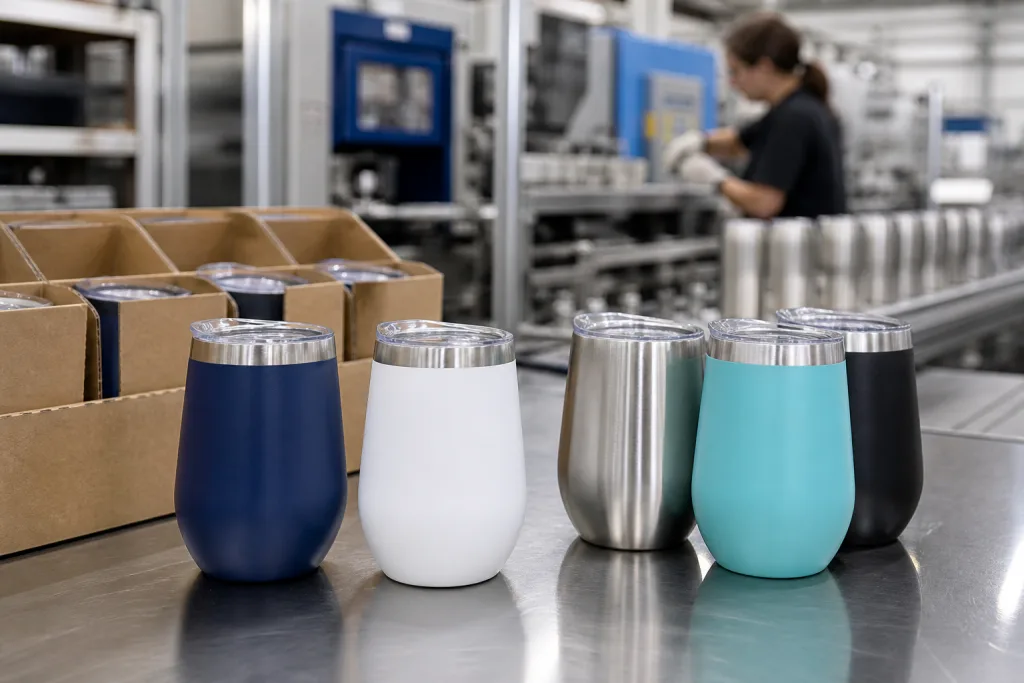
Key Takeaways
- A 12 oz distributor wine tumbler often lands at USD 1.80-3.60 FOB China depending on coating, lid, and logo method.
- Typical MOQ is 500-1,000 pcs per color; custom lid or shape changes can push MOQ to 3,000 pcs.
- Sample lead time is usually 5-10 days, while mass production runs 25-35 days at a Zhejiang canteen factory.
- AQL 2.5 major / 4.0 minor is normal for export inspection, and REACH-compliant coatings matter for Europe.
If you buy distributor wine tumbler programs for retail, promotions, or e-commerce, this is the wrong question to ask: not “can you make it?” Ask what the landed cost is at 500, 2,000, or 10,000 units, and whether stock reaches your warehouse in 12 days or 18 days after shipment. A sample quote looks cheap on page 1, then the buyer flags the add-ons: lid upgrade, laser logo, color powder coating, cartons, and sea freight. We’ve seen this go sideways over a 0.3 mm logo line change and a PO typo on carton marks.
In Zhejiang and across China, honest manufacturers break the quote into shell, lid, finish, decoration, and pack-out, so you can compare suppliers line by line instead of guessing. That is how we run quotes on the line. For standard 12 oz and 16 oz double-wall stainless wine tumblers, the workable export range usually starts at 500 MOQ and 25-35 days for production after approval, assuming artwork is ready and you are not changing molds. QC pulled the sample, checked coating adhesion with a cross-hatch cutter, and this is where weak quotes usually fall apart: the math doesn’t work if pack-out and freight are buried.
What Drives the Unit Price
For a distributor wine tumbler, the unit price usually breaks into five cost blocks: stainless shell, lid, surface finish, decoration, and secondary packaging. If two quotes are more than 20% apart, one factory is usually missing a line item or quoting a lighter spec. We see this every month. The buyer sends two photos and one rough PO, then later QC pulled the sample and found the lid, coating, or box was never included. A canteen factory does this a lot to get in low, then starts adding cost after artwork approval. We've seen this go sideways.
Here is the range we see on the line for common export specs: a plain 304 stainless 12 oz tumbler with a standard push-on lid usually lands at USD 1.20-1.60 FOB China at 5,000 pcs. Add powder coating and a one-color silkscreen logo, and the price usually moves to USD 1.70-2.40. Add laser engraving, matte finish, and a gift box, and you are closer to USD 2.30-3.20. If you ask for 18/8 stainless, a thicker 0.5 mm shell wall, or a better Tritan lid, cost climbs again. We run into buyer pushback on gift boxes all the time, but the math doesn't work once you add hand packing, barcode stickers, and drop-test requirements. Zhejiang factories stay sharp on base manufacturing; custom packaging and low-volume decoration are where budgets usually get stretched.
Cost drivers you should ask about:
- Steel grade: 201 vs 304 vs 316
- Wall thickness: 0.4 mm, 0.5 mm, or 0.6 mm
- Lid type: PP, Tritan, sliding, sip-through
- Decoration: one-color print, wrap print, laser, UV print
- Packing: bulk pack, color box, mailer, retail set
MOQ Tiers That Actually Matter
MOQ is not one number. On a real canteen distributor quote, we break it by color, logo process, and carton pack. If a factory says 500 pcs MOQ, ask one blunt question: 500 total, or 500 pcs per color? This is the right question to ask, because we’ve seen buyers miss that line on the PO and end up carrying 1,000 pcs instead of 500.
For standard customized drinkware, the structure we see every week in China is simpler than people think. Stock-color tumblers with a simple laser logo usually run at 300-500 pcs; the laser jig is fast to set and the line does not need a full print setup. Powder-coated custom drinkware with a printed logo is usually 1,000 pcs per color, because QC pulled the sample after screen alignment and color matching, and that setup cost has to land somewhere. At 3,000 pcs and up, you can start talking about special molded lids, custom shapes, or a fully customized growler-style body; once new tooling is involved, the math changes fast. If you want a canteen customizable program with mixed SKUs, some canteen suppliers will allow 2-3 colors in one order, but they often charge a color split fee of USD 80-150 per extra color.
Do not let a low MOQ hide the real cost. A 500-piece order at USD 2.90 can land higher than a 3,000-piece order at USD 1.95 once freight and packing are added, and we ship cartons by CBM, not by wishful thinking. For distributor canteen and distributor growler programs, the savings come from scale. Pushing the factory too hard on the first repeatable order usually backfires, and we’ve seen this go sideways when the buyer flagged price but ignored the carton count.
Lead Time From Artwork to Vessel
Lead time is where a lot of B2B buyers miss the shelf date. We’ve seen this go sideways. A serious canteen factory should break the schedule into artwork, sample, approval, production, inspection, and vessel booking. If the sales rep only says “30 days,” that is the wrong question to ask. On our side, we run the plan by day count and checkpoint, not one round number, because a 1 mm logo shift on the pre-production sample can cost 4 more days fast.
For a standard distributor wine tumbler, sample production usually takes 5-10 days if the mold already exists. If you need a new lid or custom outer finish, allow 15-25 days. Mass production in Zhejiang or other export-focused parts of China generally runs 25-35 days after pre-production sample approval. Add 3-5 days for third-party inspection and another 18-32 days for ocean freight to the U.S. or Europe, depending on port and season. On the line, custom powder coat is usually the part that drifts, and QC pulled samples before because the color delta was off against the approved swatch.
A realistic launch plan for custom drinkware looks like this: 7 days for artwork and quote finalization, 7-10 days for sample, 2-3 days for approval, 25-35 days production, 5 days for QC and booking, then shipping. For Amazon, retail chain resets, or seasonal promotion, add 10 extra days. The math works better that way. Before Q2 and Q4 peaks, the buyer flagged booking delays more than once, and one PO typo on carton marks held a shipment for 2 days while the forwarder waited for confirmation.
Choosing the Right Spec
Not every wine tumbler should run on the same spec. A 3,000-piece hotel promo order does not need the same wall thickness, insert card, or drop-test target as a retail SKU for North America. Pick the wrong build and you pay twice: once on unit cost, then again when returns hit because the buyer flagged dents or weak heat retention. We’ve seen this go sideways.
For most distributor wine tumbler projects, 12 oz and 16 oz are the safe bets. A 12 oz unit usually weighs 180-220 g with a 304 stainless inner and outer wall; a 16 oz unit is often 220-280 g. The common wall thickness is 0.4-0.5 mm. On our line, QC pulled the sample and squeezed sidewall feel by hand before caliper check—below 0.4 mm feels flimsy fast, and going past 0.5 mm usually adds freight, not sell-through. If you need insulation performance, ask for vacuum level and temperature retention data, not just “double wall.” This is the right question to ask. A solid supplier should show a 6-hour or 12-hour test sheet under standard lab conditions.
For wine-related retail programs, powder coat with a laser logo usually moves better because it looks clean and does not chip like low-grade print. We ship a lot of 2-piece set programs where a matched tumbler plus custom canteen or customizable canteen bundle lifts basket value, usually starting at 1,000 sets per color box. If you also sell outdoor categories, a custom growler or customizable growler line can share the same decoration setup and carton strategy, which helps when you negotiate freight rates with your canteen supplier or canteen vendors. One buyer pushback we hear all the time is, “Can you make the gift box smaller by 8 mm?” Sometimes yes. Sometimes the math doesn’t work.
Ask the factory for the exact steel grade, lid material, and coating thickness. “Food grade” is not enough for Europe or North America.
Where Hidden Costs Show Up
The first quote almost never holds. Hidden cost usually shows up in packaging, compliance paperwork, and mid-order changes. We see this every week on the line: a factory quotes a clean unit price, then adds USD 0.10-0.35 for inner trays, USD 0.08-0.20 for barcode labels, and USD 0.15-0.50 for retail cartons after artwork approval. If your carton dieline is off by 2 mm, the supplier will reproof and bill it. FNSKU labels, Amazon prep, or polybags with warning text add another charge. This is the wrong question to ask: do not ask only for unit price; ask for the packed, labeled, shipment-ready cost.
Compliance changes the landed number fast. For Europe, REACH documentation and a proper material declaration are mandatory. For North America, buyers usually ask for FDA-related food contact declarations, even when the final requirement depends on the sales channel. We had one buyer flag a PO because the material sheet said "stainless steel" but did not state 304 stainless. That delay cost 6 days. If you ask for BSCI, ISO 9001, or audit records from a Zhejiang canteen factory, you are not cutting unit cost, but you are cutting shipment risk. QC pulled the sample, paperwork matched, shipment moved. Weak factories stall, send partial files, or mix old audit dates into the pack. We have seen this go sideways.
Shipping catches buyers all the time. A 1,000-piece order of distributor wine tumbler products can look cheap FOB and turn expensive by air the moment a promotion date slips. Sea freight for 1,000-3,000 pcs usually makes sense unless your retail window is fixed and you already lost 12 days on artwork approval. We ship orders like this by sea every month; the math does not work if you compare only FOB and ignore duties, destination handling, and local delivery. Break it out line by line before you compare offers.
How to Vet a Factory Quote
You do not need ten supplier calls; you need five hard questions. A real canteen factory in Zhejiang should answer them cleanly. Ask for the spec sheet, a photo from the line, one inspection report, and the exact MOQ by color and logo method. If they cannot tell you whether the lid is PP or Tritan, stop there.
Use this checklist when reviewing a custom drinkware quote:
- Does the price include one logo position?
- Is the coating tested for abrasion and dishwasher resistance?
- What is the defect target under AQL 2.5?
- Can they support mixed cartons or master carton pack-out?
- What is the repeat order lead time after tooling is done?
If you are building a distributor canteen program, ask for a real capacity number. We run 80,000-150,000 units per month across multiple lines, and that is the gap between a 21-day repeat order and a 45-day one. QC pulled the sample on one run and found a 1.2 mm lid mismatch; the buyer flagged it, and the shipment held. This is where the math matters.
Send your spec for a real factory quote
Get MOQ, FOB price, and lead time in one clear sheet from a Zhejiang canteen factory that ships custom drinkware to Europe and North America.
Frequently asked questions
What is a normal MOQ for distributor wine tumbler orders?
For standard stock tooling, 500-1,000 pcs per color is normal. If you want custom packaging, special lid parts, or a new mold, expect 3,000 pcs or more. Some Zhejiang canteen suppliers will accept 300 pcs for sample-market runs, but the unit cost rises fast.
How much does a custom wine tumbler cost FOB China?
A plain 12 oz double-wall tumbler with standard lid often starts around USD 1.20-1.60 FOB China. With powder coating and one-color logo, plan on USD 1.70-2.40. Premium finish, laser engraving, or gift box packaging usually pushes it to USD 2.30-3.20.
How long does production take in a canteen factory?
For a standard distributor wine tumbler, sample time is usually 5-10 days and mass production is 25-35 days after sample approval. If you add a new lid mold, custom gift box, or special color, add 10-20 more days. Ocean freight from China adds 18-32 days depending on route.
What quality standards should I request?
Ask for AQL 2.5 major and 4.0 minor inspection, material declarations, and REACH compliance for Europe. For North America, request food-contact documentation and confirm the stainless grade, usually 304 or 18/8. If the supplier is a real canteen manufacturer, they should share test records, not just a brochure.
Can I combine wine tumblers with other drinkware in one order?
Yes. Many buyers combine distributor wine tumbler stock with custom canteen, custom growler, or other customizable drinkware to spread freight and packaging costs. The catch is that mixed SKUs may raise MOQs by color or decoration, so ask the canteen supplier to quote each line separately and then the combined carton plan.