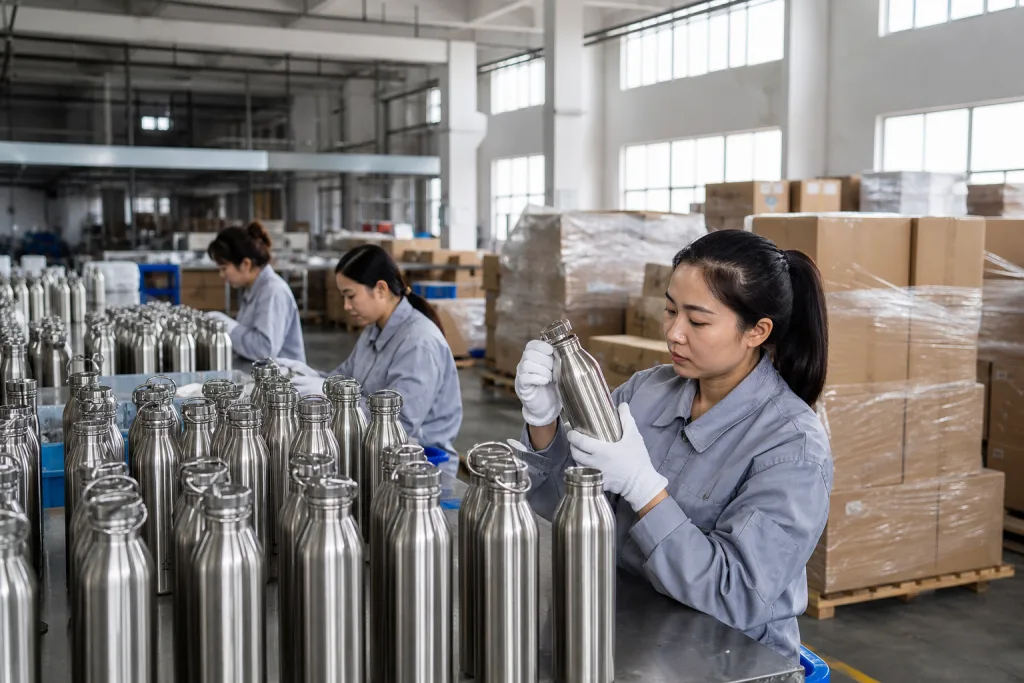
Key Takeaways
- Most leakage claims start at the lid set: define torque, gasket material, and a 2-hour inverted test at AQL 2.5 before shipment.
- For painted stainless bottles, require color tolerance and adhesion testing; a 1.0-1.2 mm body wall with cross-hatch pass standard is a safer baseline.
- Custom logo methods are not interchangeable: silkscreen is lower cost from about USD 0.05-0.12, laser engraving is slower but more durable.
- Typical MOQ in Zhejiang, China is 1,000-3,000 units per SKU, with 30-45 days lead time after sample approval and deposit.
You do not usually lose money on distributor water bottles because the sample looked ugly. You lose money because the approved sample hid a production flaw: logos that rub off after 50 dishwasher cycles, lids that seep in transit, color drift across 8,000 units, or cartons that fail an Amazon drop test. We have seen a 0.3 mm lid gap pass on the sample bench and fail on the line. By the time your customer sees it, your margin is already gone.
That is why buyers in Europe and North America do not stop at a quote from a canteen manufacturer in China. They ask where the product fails, how it gets tested, and which tolerances are locked before mass production. In Zhejiang, a decent canteen factory can run 400,000 units per month, but capacity alone does not protect you. A buyer once flagged a PO typo on the carton count, and the math did not work. Clear specifications do.
Where projects usually break first
Buying distributor water bottles does not usually fail at the concept stage. It breaks at the handoff from one approved pre-production sample to 1,000 or 3,000 pieces on the line. We see the same four failure points: sealing, surface finish, dimensional fit, and packaging. A bottle that looks good on your desk can still leak at 0.03 MPa on the air-pressure tester, show dust nibs after powder coat, miss a retail insert by 3 mm, or arrive in a weak 5-layer carton with crushed corners. If you source custom drinkware from a canteen supplier or canteen vendor in Zhejiang, China, ask for the control points on those four items before you push on price. That is the right order.
Here is where the math often stops working. A lot of canteen manufacturers quote from a generic drawing and a logo file, sometimes just a PDF plus an AI file with no lid section view. Good enough for a quotation. Not enough to stop claims. You need a spec sheet with material grade, wall thickness, finish code, print method, lid structure, gasket hardness, carton standard, and inspection plan. We usually add torque range for the cap and a carton drop note at 76 cm because buyers ask after the first complaint, not before. If you leave gaps, the factory fills them with its house standard, and those standards are not the same across canteen factories in China.
For a distributor or importer, the bottleneck is consistency. This is the wrong question to ask: “Can you match the sample?” The better question is, “Can you match it again six months later?” Your customer may reorder the same custom canteen next season. If the powder coat texture changes from 60 gloss to 75 gloss, the cap shade drifts from the approved Pantone, or the bottle height moves by 3 mm and no longer fits a retail insert, you own the claim. We have seen this go sideways over small things, even a barcode box shifted 8 mm because the PO had an old drawing revision. Serious distributor drinkware programs run with a sealed golden sample, approved Pantone target, barcode placement drawing, and written AQL standard. QC pulled the sample, and everyone works from the same reference.
- Baseline AQL: 2.5 for major defects, 4.0 for minor defects
- Common MOQ: 1,000 pcs per color for stock molds, 3,000+ pcs for new molds
- Normal lead time: 30-45 days after deposit and artwork approval
- Typical terms: FOB Ningbo or FOB Shanghai from Zhejiang, China
If your canteen distributors or retail clients care about repeat business, start here. Price talks later. On our side, we would rather spend 20 minutes checking the gasket durometer and master carton spec now than argue over a debit note after the goods ship.
Lids leak long before bodies fail
The bottle body gets the attention on shelf, but the lid set drives most claims. On our line, a 304 stainless body with a stable weld seam usually passes without drama; leaks start at the cap. The failure points are thread engagement, gasket compression, spout assembly, straw fit, and vent design. If you buy from a canteen factory or canteen supplier and treat the lid like a side accessory, expect returns. We’ve seen this go sideways after one carton drop test.
For a standard screw-cap customizable canteen, ask for the resin grade, gasket material, and torque range in N·m. PP is common for caps, Tritan is common for clear lids, and food-contact silicone is common for gaskets. Material name alone is the wrong question to ask. What decides leakage is the match between the cap and the neck finish, often within a 0.15 mm to 0.25 mm tolerance window. Too loose, and it leaks after 2 hours of vibration. Too tight, and operators on the capping bench over-torque the part, which warps inserts or cracks clear lids in winter transit.
Specs that reduce leakage risk
- Leak test: 100% air-pressure or vacuum test for assembled units, plus random 2-hour inverted water test
- Drop test: 3 drops from 80 cm with packed sample, then lid function recheck
- Gasket: food-grade silicone, Shore A hardness defined in your spec
- Thread tolerance: neck and cap matched to approved drawing revision
For sports lids, straws, and flip tops, insist on lifecycle testing. Smooth on the approval sample means nothing if the hinge pin loosens after 500 cycles. A practical benchmark for customized drinkware is 1,000 opening cycles with no crack, no hinge failure, and no seal loss. QC pulled one sample last month with a weak snap tab at cycle 620, so we held the lot. If you are buying a distributor canteen for school, gym, or outdoor channels, that matters more than saving USD 0.08 per unit. The math doesn’t work on claims.
A cheap cap can erase the margin on an otherwise good bottle. If the lid cost is only 18% of unit value but causes 80% of claims, that is the part to over-spec.
Reliable canteen vendors in Zhejiang keep lid incoming QC records, torque checks, and sealed reference samples. Ask to see the torque sheet, the go/no-go gauge record, and the retained sample dated by carton lot. We ship against those records. A polished sample photo tells you nothing if the buyer flagged seepage on PO line 3 after transit.
Decoration failure is usually preventable
Most buyers look at logo position first. Fair enough. The harder question is how long the decoration still looks acceptable after 30 days of actual use. On customized canteen and canteen promotional orders, we usually see the same complaint list: scratching on the shoulder, edge lift, ghosting, poor registration over 1.5 mm, and color drift against the approved chip. This is the wrong question to skip. The fix is usually process control and the right print method for the sales channel.
Silkscreen is still the workhorse for 5,000 pcs and up because the math works, usually around USD 0.05-0.12 per one-color print depending on size and quantity. We run heat transfer for full-color art, but QC pulled samples before with film lift at the rim because cure time was short by 2 minutes. Laser engraving is slower and costs more, but it holds up well on stainless programs, especially 304 stainless. UV print can look sharp on the approval sample, then fail on the line if the coating stack is off or surface energy is not checked with a dyne pen first.
For a painted custom drinkware program, write down both the finish and the test. Matte powder coat, glossy spray paint, rubberized finish, and ceramic-like coating do not wear the same way. If your distributor customer wants a premium hand feel, ask for coating thickness in μm and adhesion result, not only a color swatch. We have had buyers flag a perfect-looking sample because the PO only said “soft touch black” with no thickness range. A workable requirement is cross-hatch adhesion pass with no significant peeling, plus 3M tape test and rubbing test after cure.
What to lock in before production
- Color target: Pantone reference with acceptable ΔE tolerance or approved signed sample
- Print position: dimension from seam, base, or handle centerline
- Print size: width x height in mm, with tolerance
- Durability: dishwasher statement, hand-wash statement, or abrasion standard in writing
If you are buying canteen custom or canteen customizable product for corporate gifting, hand wash may be fine. Retail chain supply is different. You need tighter claims and cleaner paperwork. We have seen this go sideways when a buyer asked for “dishwasher safe” on a painted bottle without defining cycles, temperature, or detergent type. Better to label honestly than absorb replacements 90 days later.
A lot of canteen manufacturers in China can match the sample appearance. Far fewer hold the same result from lot 1 to lot 5. Ask for first article photos from mass production, not only the pre-production sample, and ask QC to include one image with a ruler at the print area in mm. That extra check catches drift early.
Steel grade and structure get misunderstood
Buyers ask for 18/8 stainless as if that settles it. It doesn’t. For distributor water bottles, steel grade is one line on the spec sheet, not the whole build. You still need to lock the structure: single-wall or double-wall vacuum, inner and outer wall thickness, base construction, and whether the vacuum chamber has copper coating. We’ve seen two bottles both marked 304 stainless land on the bench, and QC pulled the sample showing a 38°C gap in heat retention because one used a thinner inner wall and a weaker base.
A common vacuum-bottle build is SUS 304 inside and outside, with body thickness around 0.4-0.5 mm per wall depending on model, and a formed structure that feels roughly 1.0-1.2 mm in key load points. That is normal. On lighter promo units, some factories cut 20-40 g to hit a price break or carton weight target. The math doesn’t work if the bottle dents in first drop testing. We’ve had buyers flag loose-feel threads after a 1.2 m drop, and on the line we check that with thread gauges and a simple torque cap test. Lower weight trims freight and unit cost, but dents go up, threads get soft, and vacuum loss after impact shows up faster. If your canteen distributor sells to outdoor, worksite, or campus channels, ultralight construction is usually the wrong spec.
For thermal performance, define the test, not the slogan. “12 hours hot” is too loose. Write the fill temperature, ambient temperature, bottle position, and pass criterion. Example: hot water 95°C, room 20°C, test after 6 hours and 12 hours. For cold retention, state the starting water temperature or ice ratio; 30% ice and 70% water reads differently from chilled water only. We’ve seen this go sideways in RFQs where one PO even typed “hold 12 hrs” with no method, then 3 suppliers quoted the same claim using 3 different lab setups.
- Material compliance: REACH and LFGB where required, plus food-contact declarations
- Construction check: weld integrity, vacuum retention, base concentricity; we usually check base runout in mm on the table fixture
- Performance check: hot/cold retention under written lab conditions, with actual start and end temperatures logged
- Use case fit: office, school, outdoor, promo giveaway, or retail shelf; MOQ and drop-risk are different for each channel
This matters more on a customized growler or distributor growler. Carbonation changes the risk, and larger volume plus side-handle load changes it again. A custom growler or customizable growler needs lid sealing and handle pull testing that you would not always run on a 500 ml bottle. In our factory, handle pull tests at 15 kg expose weak screw seats fast, and that is usually where the buyer pushback starts after the first pilot batch.
Packaging damages more orders than buyers expect
Bottles arriving intact is not enough. If cartons crush, labels scuff, or the FNSKU is 4 mm off position, the order still fails. In our line, packaging is part of product quality for distributor drinkware, not an afterthought. Amazon FBA, club retail, and mail-order customers check outer carton strength and barcode accuracy on day one, and we have seen good bottle programs rejected over one wrong carton mark.
The usual mistake is approving a clean-looking unit box and skipping the transit pack-out. Ask your canteen vendor for the full spec sheet: polybag or no polybag, divider material, units per inner, master carton size, gross weight, and drop-test requirement. This is the right question. For Zhejiang export, we run master cartons at a practical handling weight because the math doesn't work once gross weight climbs past about 15-18 kg on bottle programs; warehouse teams stack harder, corner crush goes up, and loading complaints start.
Unit protection matters too. Powder-coated bottles packed too tight will rub during 28-35 days at sea, and QC pulled samples before with ring marks on the shoulder and base edge. The bottle passed leak test, but the buyer flagged it as damage. A cheap fix usually solves it: base pad, neck protector, or an individual sleeve matched to the finish.
Minimum packaging controls to request
- Barcode control: outer carton mark, unit barcode placement drawing, scan check before sealing
- Carton spec: 5-ply or stronger export carton, burst or edge crush standard defined
- Transit test: carton drop test and vibration simulation for selected packed samples
- Pack photos: mass production packing images before container loading
For customizable drinkware sold at retail, set a packaging approval gate separate from bottle approval. We ship preproduction pack photos for this because artwork approval alone misses too much. With customized growler and larger sizes, partition strength matters more since one 64 oz body can crack or dent the next unit if the cell width is loose by even 3-5 mm. Good canteen manufacturers treat packaging as an engineering item. Not just artwork.
Your QC plan should be written, not implied
A big share of sourcing friction starts with one basic gap: the buyer thinks the factory’s “standard QC” matches the buyer’s standard. It doesn’t. We see this on the line all the time. If you want stable distributor water bottles, put the inspection criteria into the order file in black and white. One file. Approved drawing, material list, decoration file, packaging spec, defect classification, and test plan. QC pulled the sample from a job last month where the PO said “matte black lid,” but the artwork file still showed Pantone Black 6 C. That is how rework starts.
For B2B orders, a practical setup is pre-production sample approval, inline inspection during first 10-20% of output, and final random inspection at AQL 2.5/4.0. Simple. If the order is 5,000 units, do not wait until all 5,000 are packed to find the logo is 6 mm too low or the cap color is wrong. We’ve seen this go sideways. An inline gate usually saves 12 days versus 18 days if you catch the issue only after full packing, because the line can stop before all cartons are sealed. A capable canteen manufacturer in Zhejiang should send date-stamped line photos, vacuum test records from the gauge, and packaging checks while production is running.
If social compliance matters to your customer, ask early for BSCI or equivalent audit status. If chemical compliance matters, ask whether the program supports REACH, LFGB, FDA-related food-contact documentation, or ASTM/CPSIA for kids items where relevant. Do not ask for every certificate out of habit. This is the wrong question to ask. Ask for the ones your market needs, because the math doesn’t work if the factory pays for tests that never matter to your channel. One buyer flagged a missing LFGB report on a U.S.-only bottle program; that added 4 days and solved nothing.
Also decide the claim process before shipping. Write it into the PO. If there is a defect rate above agreed AQL, will the factory sort, rework, replace on next order, or issue credit? We ship cleaner programs when this is settled early. On one 8,000-unit order, the buyer typed “1pc/white box, 24pcs/ctn” on the PO, but the approved pack-out was 20pcs/ctn. That typo alone can turn a claim into an argument after arrival.
Good factories are not factories with zero defects. They are factories that expose defects early enough that you do not ship them.
If you are working with canteen distributors, private-label buyers, or a canteen manufacturer in China for the first time, ask for one thing above all: the exact inspection checklist they will use on your order. Ask for the actual form. We run into suppliers who talk about “full QC” but cannot show a checklist with print position tolerance, drop-test standard, or carton burst requirement. If they cannot show it, they are not ready for serious OEM work.
How to brief a canteen factory properly
If you want a usable quote from a canteen factory, do not send “Need 750 ml bottle with logo, please quote.” We see that mail every week. It produces rough pricing, then rough problems. A proper RFQ for customized drinkware should let the factory cost the right structure, check the right process, and quote on the same basis so you can compare 3 suppliers without guessing what each one left out.
Start with the commercial basics: target quantity, destination market, incoterm, target ship date, and whether the item is stock mold or new mold. Then give the engineering basics: capacity, material, insulation type, finish, logo method, packaging format, compliance needs, and test expectations. Put the bottle drawing or even a hand sketch in the mail if you have one; on our line, a 0.5 mm change at the neck can decide whether a stock lid fits or we need a new tool. If you expect a custom canteen, customizable canteen, or customized canteen line extension later, say it now. Neck finish and lid platform choices affect future SKU flexibility. Buyers often ask about price first. That is the wrong question to ask if the lid platform is still undecided.
- Product: 500 ml, 750 ml, or 1,000 ml; single-wall or vacuum, and confirm body diameter if it must fit a cup holder
- Material: SUS 304/316 where required, PP/Tritan/silicone for lid parts, plus any no-BPA wording needed on the retail pack
- Decoration: Pantone, laser, silkscreen, wrap print, embossing if available; send logo size in mm because “medium logo” means nothing on the floor
- Packaging: plain box, color box, PDQ, mailer, or FBA-ready pack, with barcode position and carton drop requirement if you have it
- Compliance: REACH, LFGB, ASTM/CPSIA where applicable, tied to the actual sales market
- Inspection: AQL level, leak test, thermal test, drop test, barcode check, and whether QC should pull the sample before mass packing
On pricing, be realistic. A decent stock-mold stainless promotional bottle may start around USD 2.20-4.80 FOB depending on size, finish, and lid. A more complex canteen customized vacuum item with premium coating and gift box can move far above that. If one quote from a canteen supplier is 20% below the Zhejiang cluster, ask what got cut: steel weight, coating passes, carton spec, or inspection time. We have seen this go sideways. One buyer flagged denting after arrival, and the root cause was simple: export carton changed from 5-layer to 3-layer to hit target price. Cheap quotes are usually not magic. They are omissions.
Brief it well and most failure points die before production starts. We ship smoother that way. It is still the cheapest cost control in the job.
Send your bottle spec, not just a logo
We will review failure points, suggest workable specs, and quote MOQ, lead time, and FOB pricing from our Zhejiang production team.
Frequently asked questions
What MOQ should I expect for distributor water bottles?
For stock molds from a Zhejiang, China factory, MOQ is commonly 1,000 units per model and color, sometimes 500 units for plain stock without custom packaging. If you need a custom lid color, gift box, or mixed print positions, expect 1,000-3,000 units. A new mold usually starts higher, often 3,000-5,000 units depending on tooling complexity. For laser engraving on a standard bottle, some canteen suppliers can keep MOQ at 500-1,000 units because there is no print screen setup. Always ask whether MOQ is per SKU, per color, or per logo. Those are not the same, and they affect your landed cost and inventory risk.
How long does custom drinkware production normally take?
For a repeat stock model with confirmed artwork, normal lead time is about 30-35 days after deposit and pre-production sample approval. If you need new packaging, multiple logo methods, or a busy season booking, 40-45 days is more realistic. New molds can add 20-35 days for tool making and validation. Sample lead time is usually 5-10 days for logo samples and 15-20 days for structural changes. In Zhejiang, China, the fastest schedules usually fail at packaging or decoration, not bottle forming. Build at least 7 extra days for inspection, booking, and document corrections if the shipment is time-sensitive.
Which tests matter most before I approve a bulk order?
For most distributor water bottles, the essential tests are leak test, drop test, thermal retention test for insulated models, coating adhesion test, and barcode/packaging verification. A practical minimum is 100% leak test during production, then random 2-hour inverted water test on final inspection samples. For coated stainless, ask for cross-hatch adhesion and rub test. For vacuum bottles, define hot and cold retention conditions in writing, for example 95°C fill at 20°C ambient. If the item is for kids, ask about ASTM or CPSIA-related requirements where applicable. For Europe, check REACH and food-contact declarations. Test the version with final logo and packaging, not only the plain bottle.
Is laser engraving better than silkscreen for a custom canteen program?
Better depends on your channel. Silkscreen is lower cost and faster for volume, often around USD 0.05-0.12 per color on simple layouts, so it suits promotional and price-sensitive orders. Laser engraving is more durable on stainless because it removes coating or marks the metal directly, but cycle time is slower and unit cost is higher, often by USD 0.08-0.30 depending on size and fill area. If your buyer expects dishwasher resistance or long service life, laser is safer. If your program is a seasonal giveaway and hand-wash care is acceptable, silkscreen can be perfectly reasonable. Ask your canteen manufacturer to quote both methods on the same bottle so you can compare cost against failure risk.
How do I compare canteen manufacturers in China without getting fooled by low quotes?
Compare them on a matched specification, not on headline price. Send the same RFQ with exact capacity, steel grade, wall construction, lid material, logo method, packaging, compliance documents, and inspection standard. Then ask each canteen factory for unit weight, carton size, gross weight, MOQ, lead time, and included tests. A quote that is 15-20% lower often hides something: thinner steel, weaker packaging, fewer QC steps, or no barcode handling. Ask for BSCI status if social compliance matters, and ask to see their actual AQL checklist. A strong supplier in Zhejiang should be able to explain where defects usually happen and how they control them. That answer tells you more than the first price.