Key Takeaways
- For a standard 500-750 ml stainless distributor water bottle, practical MOQ is usually 1,000-3,000 pcs per SKU, with logo setup from USD 40-120
- FOB China pricing for double-wall 18/8 bottles commonly lands at USD 2.80-5.90 depending on capacity, coating, lid style, and packaging
- Normal bulk lead time is 25-45 days after sample approval and deposit; repeat orders can drop to 20-30 days when stock components are used
- Use AQL 2.5/4.0, request REACH and LFGB or FDA contact compliance, and confirm carton drop testing before booking ocean freight
You are not just buying a bottle. You are booking shelf space, tying up freight budget, taking on compliance risk, and handing your customer service team a product that looks simple on the screen but fails expensively on the line if one 0.3 mm tolerance or lid fit check gets missed. A distributor water bottle program can work for promo, retail, gyms, and corporate accounts, but this is the wrong question to ask if you start with price only. The numbers and specs need to be locked before sampling turns into a PO.
We see buyers from Europe and North America come to Zhejiang—and across China—asking for a custom canteen, customized drinkware, or a distributor growler line, then getting a quote in 24 hours and real qualification 10 days later. That is where deals go sideways. You need a practical checklist: material grade, MOQ, decoration method, testing standard, carton count, lead time, and who runs production inside the canteen factory. QC pulled one sample last month where the PO said “silicon ring” instead of “silicone ring”; small typo, big argument later.
What are you really buying?
When you source a distributor water bottle, you are buying a repeatable supply program, not a one-off sample. That is the job. The first question is not color; it is whether the canteen manufacturer can hold the same spec across 3 shipments, 5 shipments, or 10. We have seen a pre-production sample pass, then the bulk lot drift on body weight by 12 g, vacuum hold by 2 hours, powder coat adhesion on the cross-cut test, or lid torque after 10,000 units. QC pulled that sample and the buyer flagged it fast.
Start with construction. For insulated stainless SKUs, the common base is 18/8 stainless steel, also called SUS304, on the inner and outer wall. Typical outer wall thickness is 0.4 mm to 0.5 mm, and inner wall 0.3 mm to 0.4 mm. For entry-level single-wall customized canteen models, 0.4 mm body thickness is common. If your customer is a sports chain or outdoor distributor, ask for the target carry weight early: under 260 g for a lighter 500 ml bottle, or around 320-420 g for a heavier premium feel. We check this on the line with a digital scale before packing. This is not a small detail; buyers will argue about “feel” after the PO lands, and the math does not work if the target weight was never locked.
A serious canteen supplier should also define vacuum retention targets. A practical benchmark for a double-wall bottle is hot retention above 45°C after 12 hours and cold retention below 10°C after 12 hours, tested at room temperature around 20-25°C. We run random hold tests with a thermometer probe and log the result by batch. If you are buying a custom growler or distributor growler, lid seal and carbonation resistance matter more than headline temperature claims. This is the wrong question to ask if the product will carry sparkling drinks.
- Retail channel: usually wants stronger packaging, barcode control, and lower defect tolerance; one wrong EAN sticker on a master carton will stop a shipment.
- Promotional channel: often accepts simpler boxes and focuses on logo cost and delivery speed; MOQ and print setup charge get pushed harder here.
- Outdoor channel: cares about coating durability, carry handle strength, and leakproof performance; we have had buyers ask for a 1 m drop check before approval.
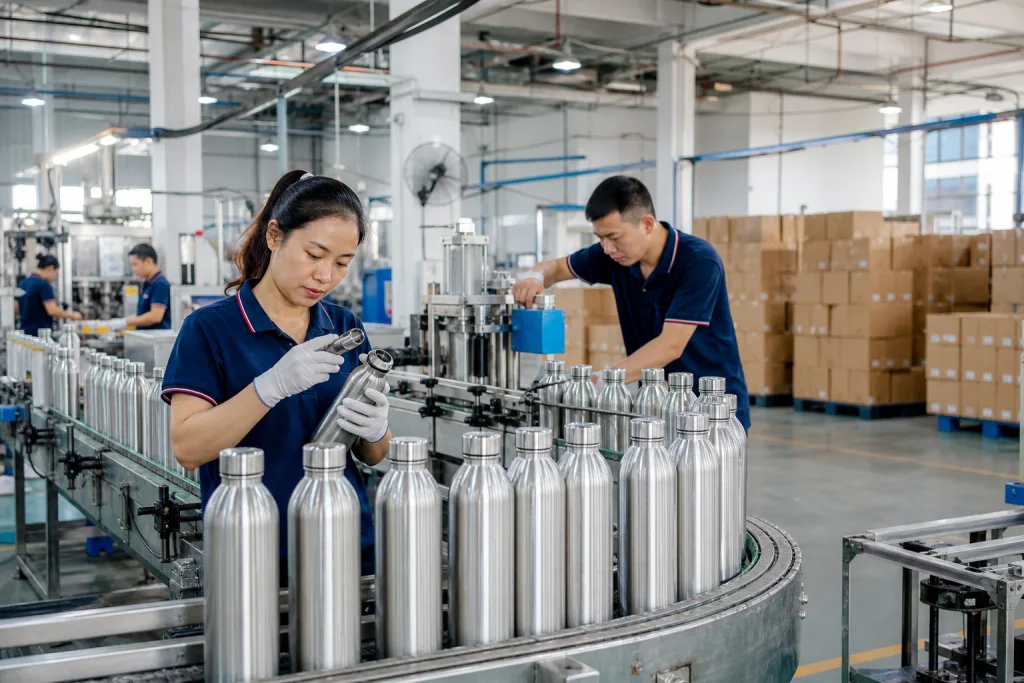
At BottleForge Industrial in Zhejiang, a normal production plan can handle 300,000 units per month across core stainless categories, but capacity only matters if your specification sheet is tight enough to stop substitutions. We ship volume every month. Still, if the PO says “black lid” and the approved sample says matte Pantone-coated lid with a 3.0 mm silicone ring, the line needs that written clearly or this will go sideways.
How do MOQ and price move?
Buyers usually ask for the customizable canteen range first, then the price. That is the wrong question to ask. On our side, MOQ and unit price move first, based on how much of the bottle is already running on the line. If you pick an existing 500 ml or 750 ml body, a standard PP or stainless lid, a one-color logo, and a plain white box, MOQ may start at 1,000 pcs per color. If you ask for a fully customized canteen with a new lid mold, custom Pantone powder coat, a printed retail box, and a matching silicone boot, the commercial MOQ can jump to 3,000-5,000 pcs. We see this at sampling stage all the time: the buyer wants “full custom” but not the mold charge, and the math doesn’t work.
For a standard distributor drinkware quote from Zhejiang, these are realistic FOB China ranges:
- Single-wall stainless bottle, 500-600 ml: USD 1.60-2.60
- Double-wall vacuum bottle, 500 ml: USD 2.80-4.20
- Double-wall vacuum bottle, 750-1,000 ml: USD 3.90-5.90
- Insulated custom growler, 1.2-1.9 L: USD 6.80-11.50
Decoration shifts price fast. Basic silk screen may add USD 0.08-0.18 per unit. Laser engraving is often USD 0.12-0.25. Full-wrap digital print or hydrographic patterns can add USD 0.40-1.20, depending on coverage and reject rate. QC pulled the sample on one 750 ml order because the wrap registration was off by 1.5 mm, and that kind of defect eats margin fast. If your client needs a canteen promotional item for a campaign, ask if they actually need individual boxes. Dropping the gift box can save USD 0.20-0.60 per piece and fit more units per export carton.
Ask for three versions of the quote: stock model, semi-custom, and fully custom. That shows where the real cost sits.
Good canteen vendors will break out one-time tooling, logo setup, sample fee, and testing cost. If those charges are buried inside the unit price, reorders get messy and price comparisons turn soft. We ship plenty of repeat programs, and this is where buyers get burned: PO line 4 says “mat black lid,” the approved sample was satin black, and now nobody can tell what changed.
Which customization choices matter most?
Not every customization pays back. New buyers in custom drinkware often spend weeks on color chips and lid accents, then miss the parts end users touch every day. For a distributor canteen range, start with body finish, lid performance, and logo durability. That is where claims, returns, and repeat orders usually land. We’ve seen this go sideways: one buyer argued over a Pantone match for 9 days, then QC pulled the sample and found the seal ring was 0.6 mm out of spec.
Body finish
Powder coating is still the safest bet for most customizable drinkware lines. It hides fingerprints, gives better grip, and holds up in transit better than glossy spray paint on the line. Ask for coating adhesion and cross-hatch test results. We usually run a tape pull after the cross-hatch cut, because nice-looking finish means nothing if it flakes at carton rub points. On dark matte colors, scratches show less. On white or pastel shades, carton abrasion shows fast, so divider quality and pack-out matter more than buyers expect.
Lid and seal
Bottles get returned for leaks. Nobody sends back 5,000 pcs because the logo is 2 mm off center. Confirm whether the lid uses PP, Tritan, stainless, or a hybrid assembly, and ask what the gasket material is. For leakproof claims, ask for upside-down testing for 2 hours and the cap torque range. A practical cap torque target is around 8-12 kgf.cm depending on thread design and gasket hardness. We check this with a torque meter, and the buyer flagged one PO last season because the sample passed at 10 kgf.cm but production drifted lower after a mold polish change.
Logo method
For canteen custom or customized drinkware projects, match the logo process to the sales channel. This is the right question to ask.
- Silk screen: low cost, clean spot colors, best for promo volume and MOQ-driven distributor orders.
- Laser engraving: premium look, no ink migration, strong on stainless and powder coat, with fewer abrasion complaints after shipment.
- Heat transfer or digital print: works for gradients and multi-color branding, but ask for abrasion resistance and rub-test results before you ship 3,000 pcs.
If you need a customized growler for brewery or event use, larger imprint areas make artwork distortion easier to spot. Request a wrapped artwork proof at actual circumference, not a flat file only. We have had buyers approve the flat PDF, then reject the first sample because the seam-side text looked stretched by 1.5 mm.
A lot of canteen suppliers in China will quote endless accessories, but smart buyers cut variables early. Two lid styles, three body sizes, and six core colors usually sell better than a 40-SKU range that breaks forecasting and slows replenishment. The math doesn’t work once dead stock starts sitting in the warehouse.
What should you verify before PO?
The fastest way to lose margin on distributor drinkware is approving a sample without freezing the production standard behind it. Before you issue the PO, make a short approval checklist and treat it as fixed. We’ve seen this go sideways when the sample looked fine, then the line switched from 0.5 mm to 0.4 mm wall thickness and nobody caught it until final inspection. This step shows whether you are dealing with a real canteen factory or a trading office passing messages back and forth.
- Specification sheet: lock capacity, net weight, dimensions, steel grade, finish, lid material, gasket material, packing method, and barcode placement. Put tolerances on the sheet where needed, such as bottle height ±2 mm.
- Compliance: confirm REACH for Europe, LFGB when requested, FDA food-contact expectations for the US, and Proposition 65 awareness for California programs. Ask to see the latest lab report, not an old PDF with another SKU number.
- Factory audits: verify BSCI or equivalent social compliance if your customers require it. We ship to buyers who ask for the audit expiry month on the PO.
- Inspection standard: set AQL 2.5 for major defects and 4.0 for minor defects if that is your normal drinkware standard. QC pulled the sample once on logo misalignment at 3 mm, and the buyer flagged it as a major appearance issue.
- Performance tests: confirm leak test, vacuum retention, coating adhesion, dishwasher statement if claimed, and carton drop test. If the claim is “12 hours hot,” write the test condition into the PO.
Ask who owns incoming material control. This is the right question to ask. A solid Zhejiang canteen factory checks steel thickness with a micrometer, matches coating batch numbers, and tests lid fit before mass assembly starts. Ask how vacuum bottles are screened for insulation loss too. On our side, the line uses in-line temperature or pressure checks before packing, because one bad vacuum weld in 10,000 pieces is still a claim waiting to happen.
For ecommerce or Amazon distribution, confirm the master carton weight stays below your warehouse limit, usually under 15 kg or 18 kg depending on the program. Approve FNSKU labels, suffocation warnings, and outer carton marks before production; we have seen a single PO typo on carton mark text hold shipment for 4 days. If this bottle is a simple customizable canteen model now but might move to online retail later, build the carton for both channels from day one. The math doesn’t work on repacking in Europe or North America.
How long does supply actually take?
Lead time gets oversold all the time. Split it into five checkpoints: sample stage, material prep, production, inspection, and vessel booking. That is how we run it on the line. For a stock-body distributor water bottle with standard decoration, a realistic schedule from approved artwork is 25-35 days. For a canteen customized project with new molds or custom packaging, 35-50 days is the honest number. We have seen purchase orders delayed over a 0.5 mm logo position change, so this is the wrong question to ask if the spec is still moving.
A workable sourcing timeline looks like this:
- 2-5 days: quote revision, artwork check, and final specification sheet; the buyer flagged Pantone mismatch on one PO, and that alone cost 2 days
- 5-10 days: pre-production sample or logo sample; QC pulled the sample after pad print adhesion check
- 7-12 days: packaging sample if retail box is custom; carton drop-test feedback often changes the insert die-line
- 20-30 days: bulk production for repeatable stock-body programs; on stainless items we usually hold weld and vacuum checks before full run
- 3-7 days: final inspection and booking release; AQL tables are fast, but getting booking confirmation is not always fast
If your canteen distributor program has seasonal demand, build in at least 10 extra days before Chinese New Year and 7 extra days in peak shipping months. Buyers blame the canteen supplier for delays that are actually vessel space problems out of China. We ship against that risk by locking the booking window early and approving cartons before cargo-ready date. Last season one buyer approved the master carton after booking cutoff, and the cargo sat 6 days.
Payment terms also change speed. Many canteen factories start with 30% deposit and 70% before shipment. After 3 clean orders, some factories will discuss better terms, but do not expect that on PO one. If you need lab testing, add 5-10 working days depending on protocol. SGS or LFGB queues do not care about your launch date. The math does not work if the promotion is fixed and testing starts after bulk production.
The practical lesson is simple: if a quote promises 15 days for a fully customized canteen order in peak season, read it as a sales answer, not an operations answer.
Where do quality failures usually happen?
Most defects in custom drinkware are boring, predictable, and preventable. They usually come from process drift, not bad luck. If you know the failure points, you can ask sharper questions of canteen distributors, canteen manufacturers, or the factory directly.
The common issues are:
- Leakage: usually from silicone gasket dimensions going out of spec, thread mismatch, or a lid that was only hand-snugged instead of torqued to 8-10 N·m.
- Paint defects: pinholes, thin coating at the shoulder, or carton rub marks on matte finishes. We see this when the spray line is rushed.
- Logo variation: weak adhesion, wrong Pantone match, or placement off center by more than the agreed tolerance.
- Vacuum loss: a small share of bottles fail insulation after processing or a drop test at 1.2 m.
- Dent damage: poor inner packing, weak cartons, or pallet overhang during export handling.
Set tolerances before production. Example: logo position within plus or minus 2 mm, color against the signed sample, and no leakage after a 2-hour upside-down test. Ask for photos from the line, not just the packed cartons. QC pulled the sample, checked the cap seal, and found a 0.8 mm gap once on a 5,000 pcs order; that saved a lot of argument later. A solid canteen factory will usually run first-article approval, in-process patrol inspection, and final random inspection before cartons are sealed.
For higher-volume distributor growler or customizable growler orders, weld consistency and handle assembly need extra attention because the unit weight is higher and transport stress is worse. If the buyer says “all parts look the same,” that is the wrong question to ask. We ship plenty of mixed-lot work, and we have seen fit issues go sideways when lids and bodies come from different subcontractors. Ask straight out whether body forming, vacuuming, powder coating, and printing stay in-house or get outsourced.
Complaint handling matters almost as much as defect rate. You want a supplier in Zhejiang or elsewhere in China that can trace the lot number, review inspection data, and make a credit or remake decision in 3 days, not 3 weeks. One PO typo on a 20,000 pcs order once turned the carton mark into the wrong SKU; the factory caught it at packing, and that was the difference between a clean shipment and a mess.
A shortlist that saves you trouble
If you are comparing canteen distributors, canteen suppliers, or a direct canteen manufacturer, keep the shortlist brutal and practical. Pretty decks do not save a late truck. We have seen a buyer approve a supplier on samples, then lose 11 days because the carton spec was never fixed. Use this checklist when you qualify a distributor water bottle source:
- Can they quote FOB and EXW clearly, with packaging broken out?
- Is MOQ stated by SKU, color, and logo, not one vague total?
- Can they provide REACH or LFGB test reports for comparable models?
- Do they accept AQL inspection by your third party?
- Can they hold lead time at 25-45 days in writing?
- Do they show carton dimensions, GW/NW, and pallet loading?
- Can they support barcode, FNSKU, or retail labeling requirements?
- Is there a clear claim policy for leakage, coating failure, or transit damage?
You can buy through canteen vendors or go factory direct. Neither path wins by default. A trading company can keep communication clean and bundle products. A real canteen factory gives faster technical answers, and on a 304 stainless bottle we can often lock the lid fit faster because the line already runs that tooling. The right choice depends on order size, SKU count, and how much sourcing work you want to push onto the supplier.
If you are new to sourcing in China, keep the first order tight: one body style, one lid, two colors, one packaging format. QC pulled the sample at 5 g leakage on a basic cap test before. Fix the simple stuff first. Once the supplier proves consistency, move into custom growler, customizable canteen, or full customized drinkware families. Chasing the lowest opening quote is the wrong question to ask.
Get a workable distributor water bottle quote
Send your target capacity, quantity, logo method, and delivery date. We will reply with MOQ, FOB pricing, lead time, and a realistic production route.
Frequently asked questions
What MOQ should I expect for a distributor water bottle order?
For a standard stainless model using existing tooling, expect 1,000 pcs per SKU or color as a practical starting point. Some canteen suppliers in China will quote 500 pcs, but that usually means higher unit cost, fewer color options, or mixed leftover components. For a new lid mold or fully customized canteen package, 3,000-5,000 pcs is more realistic. If you need multiple logos on one bottle shape, ask whether MOQ is by body color or by artwork. That changes inventory risk. Also confirm carton quantity, because a 1,000-piece MOQ packed 24 pcs per carton behaves differently in warehousing than 12 pcs per carton.
How do I compare quotes from canteen manufacturers fairly?
Ask every supplier to quote the same Incoterm, usually FOB Ningbo or FOB Shanghai, and the same specification sheet. The quote should separate body construction, lid material, decoration method, packaging, sample fee, and any tooling charge. For example, a bottle at USD 3.20 FOB with a plain white box may become USD 3.85 once you add laser logo, color box, barcode label, and silicone base. Also compare net weight and carton dimensions. A cheaper bottle that packs inefficiently can cost more after ocean freight. For repeat orders, ask if the same price holds at 3,000 pcs, 5,000 pcs, and 10,000 pcs.
What tests matter most for customized drinkware sold in Europe and North America?
Start with food-contact compliance and then move to functional performance. For Europe, buyers commonly request REACH screening and sometimes LFGB depending on the program. For North America, FDA-contact expectations are common, and some customers ask about Proposition 65. Functionally, request leak testing, vacuum retention testing for insulated bottles, coating adhesion, and carton drop testing. If the product is intended for children, ASTM-related requirements may also apply depending on the full product design and accessories. A useful rule is to budget 5-10 working days and several hundred USD for third-party testing if your exact final configuration has not been previously validated.
Should I source from a canteen factory or from canteen vendors and distributors?
If your annual volume is above 20,000-30,000 units on a few core SKUs, factory-direct usually gives you better specification control and faster decisions on tooling, decoration, and claims. If your order is mixed across many categories or you need heavier sourcing support, experienced canteen vendors can still be efficient. The key is transparency. Ask who owns the production schedule, who manages QC, and where the bottle is actually made. A trading company that can show factory audit records, inspection photos, and clear claim handling may be safer than a factory with weak export communication. Judge the process, not just the business card.
What is a safe first order structure for a new custom canteen supplier?
Keep the first PO narrow. Choose one proven bottle body, one lid style, one decoration method, and two colors at most. A first order of 1,000-3,000 pcs total is enough to test quality consistency, packaging performance, and communication discipline without overcommitting. Use a pre-production sample, confirm the master carton layout, and set AQL 2.5/4.0 for inspection. If the order is for ecommerce, approve barcode placement and FNSKU details before mass production. After one clean shipment with acceptable defect rate, on-time dispatch, and responsive after-sales handling, then add more capacities, a customized growler line, or broader customizable drinkware options.