Key Takeaways
- For most distributor vacuum insulated bottle programs, 18/8 stainless with 0.5 mm inner and outer walls is the safest retail spec.
- MOQ is usually 500-1,000 pcs for custom logo work; full custom canteen projects often need 3,000 pcs or more.
- A good vacuum bottle should hold 6-12 hours hot and 18-24 hours cold in real-world use, not lab-only claims.
- FOB China pricing for a standard insulated bottle usually starts around USD 3.20-6.80 depending on lid, coating, and print method.
If you buy drinkware for retail, corporate gifts, or online distribution, the wrong vacuum bottle cuts margin fast. A distributor vacuum insulated bottle is a spec call. You are locking in wall structure, lid fit, coating, carton count, and the finish your customer will accept after the first return claim. We’ve seen this go sideways: a buyer asked for the lowest price, then flagged 0.8 mm dents on arrival because the master carton was packed too tight.
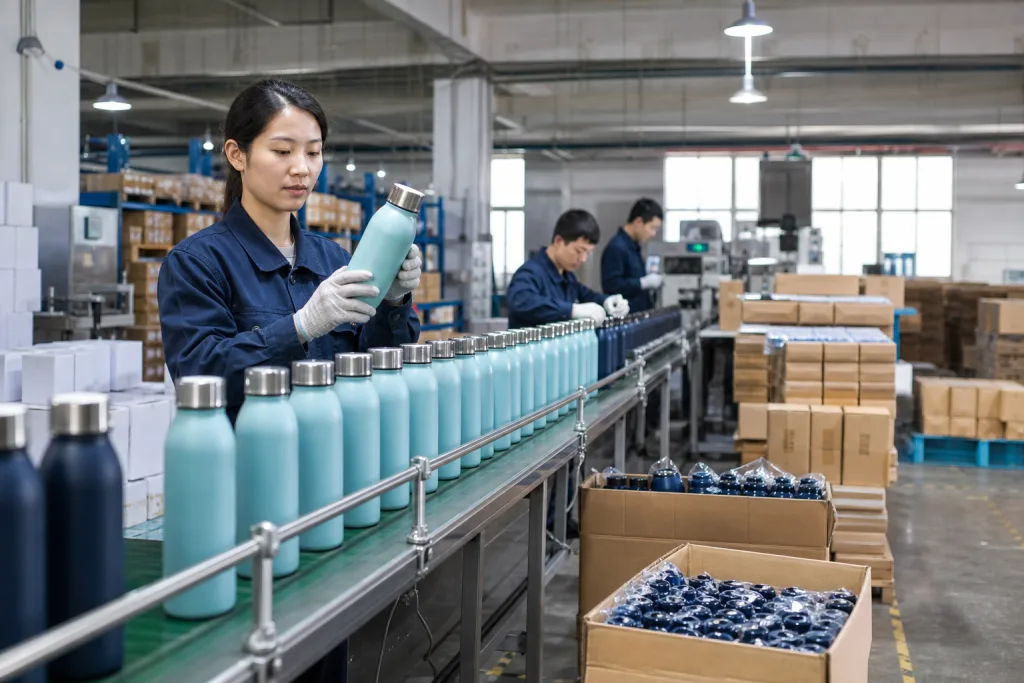
In Zhejiang, good factories quote by model and spec, not guesswork. At BottleForge Industrial in Hangzhou, our monthly output is 600,000 units, MOQ starts at 500 pcs for stock-based customization, and normal lead time is 18-25 days after sample approval. Those numbers matter on the line. QC pulled the sample, checked vacuum retention and carton drop performance, because distributor drinkware lives or dies on consistency: AQL 2.5, REACH compliance, and packaging that keeps a 20 oz tumbler from arriving dented. This is the wrong question to ask if you only want the cheapest unit price; the freight math and return rate usually hit harder.
What distributors really compare
When you compare a distributor vacuum insulated bottle, do not start with color. Start with spec. This is the wrong question to ask: “What is your best seller?” We see that request on POs every month, and it usually points the buyer to the wrong channel product. A retail chain needs cleaner packaging, barcode accuracy, and tighter cosmetic control; last month QC pulled the sample over a 1.2 mm paint skip near the base. A distributor canteen for schools or promotions usually wants lower unit cost and fewer SKUs, often 2 lid options instead of 6 colors. A premium distributor growler for outdoor channels needs thicker steel, a better lid seal, and stronger carton protection because a 12-bottle drop test will expose weak packing fast.
Use a simple head-to-head table before you request samples:
| Spec | Entry distributor bottle | Mid-tier retail bottle | Premium custom growler |
|---|---|---|---|
| Steel | 201/304 mix | 304 interior/exterior | 304/316 options |
| Wall thickness | 0.35-0.40 mm | 0.45-0.50 mm | 0.50-0.60 mm |
| Capacity | 350-500 ml | 500-750 ml | 750-1500 ml |
| FOB price | USD 3.20-4.20 | USD 4.50-6.80 | USD 7.20-11.50 |
| MOQ | 500-1000 pcs | 1000 pcs | 3000 pcs |
If your channel is distributor drinkware, price pressure is real, but a weak bottle creates more cost later. We run into the same pushback all the time: buyers try to save USD 0.28 per piece, then the line shows lid fit drift at 0.6 mm and claims start after shipment. I would rather see a slightly higher unit price and fewer leakage claims than chase the lowest quote from a canteen supplier that cannot hold dimensional tolerance. The math doesn't work once you add replacement stock, complaint handling, and one rework batch of 500 pcs.
Insulation performance vs channel price
Vacuum performance is where 7 out of 10 canteen suppliers oversell, and we’ve seen this go sideways fast. A lab sheet might show 24 hours cold, but buyers ask what happens after 30 dishwasher runs, a tired silicone ring, and cartons taking a 1-meter knock at transit transfer. For a distributor vacuum insulated bottle, the working target is usually 6-12 hours hot and 18-24 hours cold at ambient conditions around 20-25°C. This is the right question to ask. On our line, QC pulled a sample last month with a clean vacuum seam but a lid vent that lost temp 3 hours early.
Here is the practical comparison. A straight-wall bottle with a basic PP lid is fine for a canteen promo order at 3,000 pcs MOQ, but it is not the same product as a retail-grade custom drinkware SKU. A flip lid adds convenience and raises cost by about USD 0.35-0.90, and buyers often flag the hinge pin after abuse testing. A straw lid means more parts, more assembly time, and more leak points at the mouthpiece and tube joint. A screw cap is still the simplest option for a customized canteen used in school, fitness, or outdoor channels. Simple sells.
My rule: if the bottle has to ship to a distributor in Europe or North America, pay attention to the lid seal, not just the vacuum seam. Most claims come from the cap, not the steel.
Ask your canteen factory for drop-test data, lid cycle data, and thermal test conditions. A serious canteen manufacturer should be able to show a 1-meter drop on carton and product, plus 3,000-5,000 open-close cycles depending on the lid. We also expect the test sheet to show fill temperature and water volume, because the math doesn’t work if one factory tests at 95°C fill and another at 85°C. If they cannot give numbers, treat the insulation claim as marketing, not engineering. We ship plenty of bottles with good steel; the buyer complaint still comes back to a 2 mm seal issue in the cap.
Customization choices that move margin
Custom logo work is where margin gets protected or burned. This is the wrong question to ask if you only compare add-on cost. On the line, decoration choice changes sell-through, reject rate, and how the bottle looks after 6 months in use. Silk screen is fast and cheap, but we see ink adhesion issues on curved shoulders if the jig is off by 1-2 mm. Laser engraving gives a cleaner mark and holds up under abrasion. UV print carries more color, though QC pulled samples before for poor surface energy after pretreatment. Powder coating can cover small body marks and makes a customized canteen look more premium at first touch.
For distributors, I usually rank customization this way:
- Silk screen: best for 1-color logos, MOQ 500 pcs, low cost; we run this most on straight-wall bodies where the mesh sits stable.
- Laser engraving: best for long-life branding, usually USD 0.15-0.40 add-on; good choice when the buyer flagged scratch resistance on a prior PO.
- Heat transfer: good for full-color art, but requires tighter control; the bake time and placement jig need to stay consistent or edges lift.
- Embossed/debossed: stronger retail feel, often higher mold or setup cost; the math doesn't work for a 500 pcs trial order.
If you need a canteen custom for a distributor campaign, look at unit economics over the full program. A USD 0.25 logo saving means little if the print fails after 200 washes. We have seen this go sideways: a buyer saved on decoration, then paid back more in replacements and claim emails. For a canteen distributor serving corporate clients, a clean laser mark usually wins because complaint rates stay lower and the bottle remains usable as customized drinkware longer. In Zhejiang, 20 factories can claim all four methods. On one 64 mm body with a tapered shoulder, maybe 5 run them well.
Ask for a sample with your exact Pantone and exact bottle finish. We have had POs marked “black” with no Pantone code, then the buyer rejected the lot under D65 light because the logo shifted warm. “Close enough” gets custom canteen orders rejected by brand owners.
The spec table that should decide
Before you approve a PO, line the bottle up against a usable spec table. This is where weak traders get exposed. A factory that handles export work should send the same table format on every quote, down to thread spec and carton size, so you are comparing like for like instead of guessing off two WhatsApp photos and a 1-page PDF.
| Spec | Why it matters | Recommended range |
|---|---|---|
| Material | Safety and odor control | 304 stainless, optional 316 for acidic use |
| Vacuum gap | Insulation stability | Less than 0.01 mbar leakage standard |
| Capacity | Channel fit | 500 ml, 750 ml, 1000 ml |
| Finish | Retail value | Matte powder coat, glossy spray, or bare steel |
| Lid type | Leak risk | Screw, flip, or sport lid depending on use |
| Packaging | Damage rate | 1 pc/box, 24 pcs/carton, drop-tested master carton |
For distributor canteen programs, 500 ml is the safest-moving SKU. We ship more 500 ml than anything else because it fits mass retail and gift sets without blowing up carton count. A 750 ml body works better for sport and travel. A 1,000 ml body sits closer to a custom growler or premium outdoor bottle, and the freight math changes fast; on one buyer PO, the carton was 12 mm too tall and landed in oversized handling, which pushed shipped cost up 8-15%.
Canteen distributor networks usually want fewer SKUs, not more. This is the wrong question to ask if the buyer is chasing “maximum choice.” We have seen this go sideways: 7 models, MOQ split too thin, the line keeps changing caps, and QC pulled the sample because the wrong logo file was matched to the wrong lid color. Three good models beat seven average ones.
Factory checks before you place order
You do not need to visit every factory. You do need to ask the questions that show whether the line is under control. A Zhejiang canteen factory should explain weld quality, vacuum pumping time, coating cure temperature, and where QC pulled the sample. Ask for the vacuum hold standard, the laser weld inspection method, and how they balance output between body forming and final assembly. If they cannot explain line balance in plain numbers, this is the wrong question to skip for repeat distributor orders.
Request these checks:
- AQL standard: use AQL 2.5 for major defects and 4.0 for minor defects on export orders.
- Material report: stainless steel grade, BPA-free lid confirmation, and REACH declaration if you sell in Europe.
- Leak test: 100% leak check on finished lids or assembled units.
- Color tolerance: Delta E target below 2.0 for branded runs.
- Carton test: ISTA-style drop or equivalent shipment simulation.
At BottleForge Industrial in Hangzhou, we run export work with sample confirmation, pre-production approval, and inline QC before packing. On the line, QC uses a gloss meter and color card before mass coating, and the buyer usually flags lid shade shift first. That process is standard for serious custom drinkware orders in China, not a luxury add-on. A canteen promotional order can accept more variation than a premium retail bottle, but random gloss differences and lid mismatch should stop shipment. If a factory quotes without a clear QC plan, the math doesn't work, and we've seen this go sideways after the PO typo changes a matte black lid to black paint.
Best fit by distributor use case
The right distributor vacuum insulated bottle depends on where you sell it. School buyers want a lid that comes apart in 30 seconds and a body that survives a 1.2 m drop. Fitness accounts push for a grip that does not slip with sweaty hands, plus a cap that stayed dry in our 24-hour upside-down leak test. Corporate gift orders want a cleaner finish and carton art that does not make the bottle look cheap. Marketplace sellers care about return rate and reorder stability. That is the whole game.
Use this practical matching guide:
- Promotional campaigns: 350-500 ml, basic screw cap, 1-color print, lowest landed cost.
- Retail chains: 500-750 ml, powder coat, laser logo, tighter cosmetic QC.
- Outdoor or premium: 750-1000 ml, thicker body, better gasket, stronger carton.
- Custom growler programs: 1000 ml and above, wider mouth, reinforced handle if needed.
If you are buying as a canteen distributor or distributor canteen wholesaler, watch reorder speed first. We run a Zhejiang line that holds 18-25 day lead time on stable colors, while the buyer flagged one PO last spring for a simple typo on the carton count that would have blown the ship date. For repeat orders, ask for reserved mold or color records so your customized drinkware stays consistent across seasons. The math does not work if every batch turns slightly different.
The best canteen distributors are not the ones with the most samples. They are the ones with the fewest surprises after order two.
Send your spec sheet for a fast quote
We’ll match your channel, MOQ, and decoration method with a usable China export spec, not a guess.
Frequently asked questions
What MOQ should I expect for a distributor vacuum insulated bottle?
For stock-body customization, expect 500-1,000 pcs MOQ. If you want a new mold, special lid, or unique handle, 3,000 pcs is more realistic. In Zhejiang, some canteen suppliers will quote lower, but the price usually rises after sample approval. For repeat distributor drinkware orders, the better move is 1,000 pcs per color with one carton spec. That keeps your inventory clean and avoids dead stock.
How much does a custom insulated bottle cost FOB China?
A standard 500-750 ml bottle with 304 stainless, one-color logo, and basic box usually lands around USD 3.20-6.80 FOB China. Add USD 0.35-0.90 for a better lid, USD 0.15-0.40 for laser marking, and more if you need gift packaging. A premium customized growler can reach USD 7.20-11.50 depending on wall thickness and finish.
Can you make canteen customized for European compliance?
Yes, but you need the right documents. For Europe, ask for REACH declarations, food-contact material statements, and if needed LFGB-related test support through your lab path. For the U.S. and Canada, buyers often want BPA-free lid confirmation and material traceability. A good canteen manufacturer in China should provide these before mass production, not after shipment.
What is the safest decoration method for repeated washing?
Laser engraving is usually the safest for long-term use because it does not peel. Silk screen is fine for short-cycle canteen promotional projects, but it can wear after heavy washing or abrasion. If you want a premium custom canteen for retail, laser is the cleanest choice. If you need full-color branding, UV print works, but sample testing is essential.
How do I reduce leakage claims on distributor drinkware?
Focus on the lid and gasket, not just the bottle body. Ask for 100% leak testing, a cycle test of at least 3,000 openings for the closure, and carton drop testing. Specify the gasket material, usually silicone, and confirm torque standards during assembly. Many leakage claims in distributor canteen programs come from loose cap assembly or shipping damage, not vacuum failure.