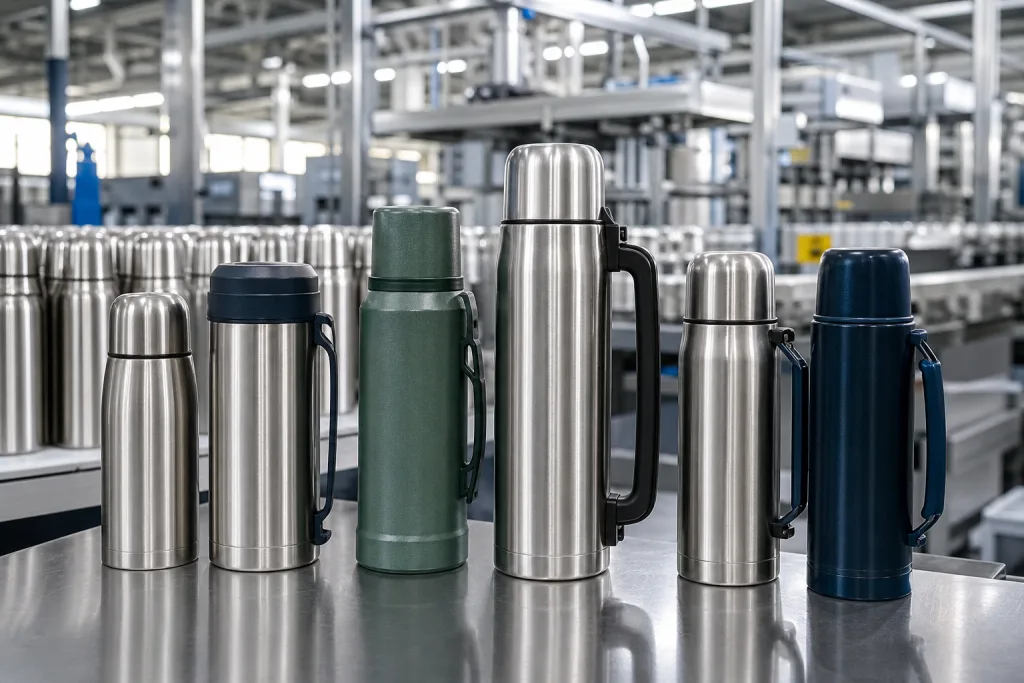
Key Takeaways
- Decide construction first: 18/8 stainless, 0.4-0.5 mm inner wall, copper-coated vacuum, and a 12-24 hour heat target change cost by 8-18%
- Typical MOQ for a customized thermos is 1,000-3,000 pcs per color, with 35-50 day lead time from sample approval in Zhejiang, China
- Silkscreen is usually USD 0.08-0.20 cheaper per unit than laser, but powder coat plus laser gives better outdoor retail durability
- Use AQL 2.5/4.0, 24-hour leak testing, and REACH/LFGB or FDA documentation before booking thermos bulk shipments
You can buy a stainless bottle from almost any catalog. That part is easy. The hard part is buying a distributor vacuum flask that stays out of retail returns, avoids logo claims, and still lands in time for a late-season top-up. We see this on the line every month: outdoor buyers ask for heat retention, leak rate, coating rub test results, and carton cube; promo buyers push harder on logo edge sharpness, landed cost, and repeat consistency from PO to PO. Those targets overlap, but they do not point to the same flask, and this is the wrong question to ask if the brief is only “send your best seller.”
If you are sourcing from Zhejiang or elsewhere in China, make 4 decisions early: bottle construction, decoration method, compliance package, and order structure. Do it before sampling drags on. A 0.2 mm wall change, a screen print instead of laser, or a mixed-size MOQ of 3,000 pcs can shift cost, yield, and lead time fast. Get those four right, and the custom thermos program runs clean. Get them wrong, and even a good factory thermos turns into an 18-day rework cycle instead of a 12-day shipment.
Start with four buying decisions
Most buyers ask for a quote too early. Wrong start. Before you compare supplier thermos pricing, lock down four buying decisions first. On our line, the same 500 ml body can run through different tools and pack-outs, and that is where the quote moves.
- Use case: outdoor retail, corporate gifting, or event giveaway.
- Thermal target: 6, 12, or 24 hours practical retention.
- Branding method: silkscreen, laser engraving, heat transfer, or full-wrap digital print.
- Order structure: one SKU in volume, or multiple colors and capacities split across a container.
These four choices drive almost every cost line in a distributor thermos project. A 500 ml double-wall stainless unit for promotions can run with standard polished steel, a PP lid, one-color print, and individual polybag packing. A retailer's thermos program for hiking stores usually asks for powder coating at 60-80 μm, a thicker lid seal, a stronger carry loop, and ISTA-minded master cartons. We have seen buyers skip this discussion, then flag the carton drop result after sampling. That rework costs time.
Here is a real pricing swing. A common custom thermos quote from Zhejiang can move from USD 3.10 to USD 4.25 FOB by changing three items: powder coat finish, copper-plated vacuum layer, and laser logo on two sides. The bottle still looks similar in a product photo, but the routing on the factory floor changes: extra coating pass, added vacuum step, then logo positioning twice on the laser jig. QC pulled the sample once because the second-side logo sat 2 mm high. Small detail, real cost.
If you are buying thermos bulk for distribution, ask your thermos manufacturer to quote three tiers instead of one. Tier A is price-driven for promotions. Tier B is balanced for most distributors thermos programs. Tier C is retail-grade with stronger finish and testing. This is the right comparison. One single quote is the wrong question to ask, because the math doesn't work until you see the trade-off between unit price, finish risk, and reorder speed. We ship cleaner projects when buyers review all three tiers side by side before sampling.
You do not need the best bottle. You need the bottle that matches your channel, return tolerance, and reorder speed.
Match construction to the sales channel
Construction is where new buyers lose margin. We see both mistakes: overbuilt bottles that price out, and under-spec bottles that come back dented. A vacuum flask is more than “double wall stainless.” Check the steel grade, wall thickness, neck design, vacuum draw, and lid build. This is the right place to get picky. On the line, QC usually checks wall thickness with a micrometer, and 0.03 mm off spec is enough to change the feel in hand.
For most manufacturer thermos projects, the practical baseline is 18/8 stainless steel body, with inner and outer walls around 0.4 mm. If the bottle is large, such as 750 ml or 1,000 ml, outer wall thickness may move to 0.45-0.5 mm to reduce denting during transport. Better heat retention usually comes from a stable vacuum draw and a copper-coated inner wall, not thicker steel. Buyers ask for 0.5 mm on both walls thinking it will hold heat longer; the math doesn’t work, and it adds weight and freight.
What to specify
- Capacity: 350 ml, 500 ml, 750 ml, 1,000 ml are the standard distributor vacuum flask sizes.
- Mouth style: narrow mouth holds heat better; wide mouth fits ice cubes and is easier to clean. A common neck size we run is 44 mm.
- Lid material: PP, Tritan, or stainless cap with PP inner structure. If the buyer flagged smell on a past order, ask what resin grade was used.
- Seal: food-grade silicone, usually 1 or 2 gasket points. QC pulled the sample last month because one gasket was twisted after torque testing.
- Thermal claim: ask for a test condition, such as 95°C fill, room temperature 20°C, checked at 6 and 12 hours. One single “12-hour hot” claim is too loose.
Outdoor retail usually sells better with powder-coated 500 ml and 750 ml models with a carry loop. The finish hides light scratches, and the grip feels better with wet hands. Promotional thermos programs usually go to 350 ml or 500 ml straight-body shapes because decoration is cleaner and packing is tighter. We ship more straight bodies for one reason: carton efficiency. In a standard export carton, sculpted bodies leave dead space and raise drop risk; the buyer only notices after the first 1.2 m drop test fails.
A thermos factory in China with automated vacuum lines usually gives you tighter retention consistency than a workshop still doing more manual welding. At BottleForge Industrial in Zhejiang, standard stainless thermos output can reach 300,000 units per month, but headline capacity is the wrong question to ask. Ask for retention test records from three production dates, not one good-looking sample. We’ve seen this go sideways. One PO even had “5000 pcs” typed instead of “50,000 pcs,” and no one caught it until the booking plan was short.
Price the real cost, not sample cost
A clean pre-production sample can fool you. Sample cost is not production cost. We see this every week on the line. When you compare thermos suppliers, split the quote into at least seven buckets.
- Body and lid
- Surface finish
- Logo process
- Packaging
- Testing and compliance
- Tooling or setup
- Freight basis such as EXW or FOB Ningbo/Shanghai
A standard 500 ml bulk thermos with spray paint and one-color silkscreen usually lands around USD 2.80-3.40 FOB at 3,000 pcs. Add powder coat, laser engraving, a color box, and a drop-tested export carton, and the number moves to USD 3.60-4.60 FOB. We had a buyer flag a PO once because the lid drawing had a 2 mm mismatch. If you need a custom lid mold, plan on USD 1,500-4,000 in tooling, depending on the part count.
Low MOQ looks cheap on paper. The math does not work. A quote at 500 pcs can jump 12-25% on unit price, and your color choices shrink because coating and printing setup get spread over fewer units. For most thermos custom projects, the efficient MOQ is 1,000 pcs per model per color. If you need three colors, ask the supplier if they can split 3,000 pcs across them without a surcharge. We run into this with 304 stainless cups all the time.
Promotional brands need to price packaging as a real line item. A white box may cost only USD 0.10-0.16, while a printed gift box may cost USD 0.28-0.55. If your end customer wants a label or insert card, ask the vendor to quote kitting labor separately, usually USD 0.03-0.12 per unit in China depending on the task. QC pulled the sample twice on one job because the card slot was 1 mm off.
If you sell into Amazon or retail distribution, carton size matters almost as much as bottle cost. One design that saves 8 cents on the unit can still lose money if it pushes carton weight over a freight bracket or wastes pallet space. We’ve seen that go sideways on a 24-piece master carton. Check the carton spec before you chase the cheapest flask price.
Choose decoration for durability and margin
Logo method is not cosmetic. It changes scrap rate, lead time, and the number of after-sale emails we get. A distributor vacuum flask for outdoor shelves needs a different decoration plan than a 5,000-piece promo run. We learned that after one buyer flagged 120 peeled logos from a carton drop test.
Silkscreen printing is still the cheapest choice for a 1-color logo on a smooth body. It is usually USD 0.08-0.20 lower per unit than laser engraving, based on size and quantity. That makes sense on thermos bulk orders when the margin is thin. The weak point is abrasion, especially on painted cups that rub in transit. QC pulled three samples after a 1.2 m drop, and the edge wear showed up fast.
Laser engraving runs slower and costs a bit more, but it holds up better for premium positioning. On powder-coated bottles, the laser burns through the top layer and leaves a clean metal mark. We ship this for outdoor retail because the logo does not peel. One buyer pushed back on the extra cost until we showed the cross-section from a test cup, 0.35 mm coating and all.
Heat transfer and digital print handle multicolor graphics, gradients, and wraparound art. They fit promo brands better than rugged outdoor channels. The trade-off is tighter proofing for registration, curve distortion, and artwork setup. Ask your thermos factory for an artwork safe-area drawing with exact millimeters, not a verbal promise. We had one PO typo where the buyer wrote 185 mm wrap length, then the carton label still used 188 mm.
Practical logo rules
- Keep silkscreen logos at least 15 mm from vertical seams or hard body curves.
- For laser logos, confirm coating thickness and contrast on dark colors.
- Request a cross-hatch adhesion check on painted bodies.
- For gift programs, ask for Pantone tolerance guidance before mass production.
If you are buying a customized thermos for repeat annual programs, standardize one logo process and one position. That cuts setup mistakes between seasons and across factories in Zhejiang or other parts of China. The math does not work when you keep changing decoration, because we see shade variation, offset print position, and carton mix-ups. One logo, one slot. Cleaner line, fewer claims.
Do not skip compliance and QC
If you import into Europe or North America, your custom thermos needs a clean paperwork trail. The bottle looks simple. The legal risk is not. Ask your manufacturer thermos partner for material compliance files and process-control records, down to the PO lot and steel mill cert if needed. We’ve seen a buyer flag one missing signature on a Declaration of Compliance and hold a 2,400 pc shipment for 12 days.
For Europe, common requests include REACH and, for some retail programs, LFGB food-contact testing. For the US and Canada, buyers usually ask for food-contact declarations aligned with FDA expectations, plus testing tied to coatings, decals, or packaging inks. If the flask is sold for children, the test scope changes fast, and this is where old paperwork fails. Last year’s supplier thermos documents are often useless for this year’s customer, especially after a lid material change from PP to Tritan or a silicone ring hardness shift from 50 to 60 Shore A.
On factory control, ask for:
- AQL standard: usually Major 2.5 / Minor 4.0 for finished goods inspection.
- Leak test: 100% air-pressure or inverted water test for assembled lids.
- Vacuum retention check: sample-based verification per batch.
- Coating adhesion: cross-hatch or tape test.
- Drop test: packaged unit check if you sell e-commerce or mail order.
A serious thermos manufacturer in China should be comfortable with third-party inspection before shipment. That is standard practice on the line. You are protecting margin, not offending anyone. QC pulled the sample, and the defects we see most in Zhejiang are usually cosmetic, not catastrophic leaks: logo off by 1.5 mm, dust under powder coat, color shift between batch A and batch B, or lid mismatch after final assembly. We ship plenty of orders where the vacuum is fine but the buyer rejects appearance.
If your brand sells into outdoor retail chains, ask for a pilot run inspection at 300-500 pcs before full production continues. The math doesn’t work any other way. A mid-run check on the first decorated cartons costs far less than reworking 5,000 units after printing, coating, and carton packing are done, especially once the buyer has already flagged Pantone drift or a typo on the PO artwork.
Plan MOQ, lead time, and replenishment
Lead time is where thermos distributors usually get squeezed. On a standard custom order from China, we often run 3-7 days for quote revisions and artwork checks, 7-12 days for the pre-production sample, 25-35 days on the line for bulk production, then 5-10 days for booking and export paperwork after final inspection. QC pulled one sample last month because the logo sat 2 mm off-center on the silk screen. That reset approval by 2 days. For normal-season orders, budget 35-50 days from sample sign-off to FOB shipment.
Peak season is a different game. Orders locked before August for Q4 gifting move smoother than orders dropped in October, when carton booking gets tight and buyers start chasing the same vessel shape. We have seen a PO come in with the gift box size typed wrong by 10 mm, and that alone held sampling for 3 days. If you need a suppliers thermos program for year-end promotions, reserve capacity early and freeze packaging artwork before the first sample goes out. Waiting to fix the insert card later is the wrong move.
MOQ should match your replenishment math, not just your opening spend. A common MOQ for a distributor vacuum flask is 1,000 pcs per size per color. Some stock-shape models can run at 500 pcs if decoration stays limited, such as one-color printing on an existing powder coat. Ask a harder question: do the 500 ml and 750 ml bodies share the same lid, gasket, and carton spec? We ship those mixed programs every month. Shared parts cut spare inventory and make reorders less messy. If each size uses its own cap set, the math doesn't work as cleanly.
For distributors thermos business, it often makes sense to split your buy into two layers:
- Core SKU: 60-70% of volume in black, white, or navy, the colors that usually move first and let you replenish with less guesswork.
- Program colors: 30-40% in seasonal shades or customer-specific logos, where the buyer flagged Pantone matching and pack-out details more often.
This split gives you a base you can ship again and again, with room left for promo business. If your chosen thermos supplier keeps blank stock and adds decoration later, repeat orders can move faster. We have blank bottle stock in Zhejiang for some shapes, and that can bring replenishment down to 15-25 days on repeat logo jobs. Only do this if the finish, lid, and packaging are already locked. Change one of those three, and we've seen the schedule go sideways.
Use a shortlist scorecard before ordering
When you compare thermos manufacturers, price alone is the wrong question to ask. Run a scorecard instead. We’ve seen first POs go smoother when the buyer scores the factory before deposit, especially on programs with 3 lid options or a 5,000 pcs MOQ.
A practical scorecard for a distributor vacuum flask program can weight the factors like this:
- 25% product consistency: weld finish, retention stability, lid fit.
- 20% compliance: REACH/FDA/LFGB support, traceable material declarations.
- 20% commercial terms: MOQ, tooling terms, payment, FOB clarity.
- 15% decoration capability: logo quality on your chosen finish.
- 10% packaging execution: barcode, carton marks, FNSKU if needed.
- 10% communication speed: engineering answers, revision control, sample follow-up.
Ask each thermos factory the same ten questions and get written answers. No phone-call promises. Ask if they run 24-hour leak testing, what their standard AQL is, and the maximum logo size for laser on a tapered body. Ask if they can hold Pantone close on powder coat, what the MOQ is for split colors, and the repeat-order lead time. Ask for BSCI or ISO records if your customer asks for them. QC pulled one sample last month with a lid torque reading 0.4 N·m below spec; that kind of detail tells you who is managing the line and who is guessing.
The best thermos distributor relationships are boring, and that is a compliment. Specs stay stable. Drawings are version-controlled. Carton marks do not change because someone typed “SS304 botle” on the PO and nobody caught it. If a manufacturer thermos partner cannot answer direct technical questions before deposit, they will not get sharper after deposit. We’ve seen this go sideways.
Here is the working method: define the channel, lock the construction, price the real production route, verify compliance, then stress-test MOQ and replenishment. Check actual numbers, like 12 days for a repeat color box run versus 18 days if the insert card changes too. Once those points are fixed, choosing between thermos suppliers gets simpler and the math works.
Get a clear thermos quote before you commit
Send your target capacity, logo method, quantity, and market. We will reply with a practical MOQ, FOB price range, and production route.
Frequently asked questions
What MOQ should I expect for a custom stainless distributor vacuum flask?
For a standard stock-shape stainless flask, the normal MOQ is 1,000 pcs per size per color with one logo position. Some thermos suppliers in China will accept 500 pcs for trial orders, but expect a 12-25% higher unit price and fewer coating choices. If you need a fully customized thermos with a new lid or base mold, practical MOQ often starts at 3,000-5,000 pcs because tooling and setup need to be amortized. For distributors, a smart starting structure is 3,000 pcs total split into three colors of one core size, usually 500 ml. That is usually enough volume to get workable FOB pricing without overloading your warehouse.
How long does production usually take after sample approval?
For most stainless thermos orders from Zhejiang, China, plan 35-50 days from final sample approval to FOB shipment. A normal timeline is 7-12 days for a pre-production sample, 25-35 days for mass production, and another 5-10 days for inspection, packing confirmation, and vessel booking. Repeat orders can be faster if the thermos factory already has blank stock, approved artwork, and standard packaging; then 15-25 days is possible. Peak gifting season is slower, especially from September to November, so book capacity early. If your project includes a new mold, add 20-30 days for tooling and validation before the sample stage.
Which logo method is best for outdoor retail versus promotional use?
For outdoor retail, powder coat plus laser engraving is usually the safest option. It costs more than silkscreen, often by USD 0.08-0.20 per unit, but the logo resists scratching and looks premium on shelf. For promotional thermos campaigns where unit cost matters more and the product has a shorter service life, one-color silkscreen on a smooth painted body is often enough. If you need multicolor artwork, digital print or heat transfer can work, but they need tighter proofing and can be less durable under abrasion. Ask for a decorated sample and a simple rub test result before you approve mass production.
What compliance documents should I request from a thermos manufacturer?
For Europe, ask for REACH-related material declarations and, when needed, LFGB food-contact testing. For North America, ask for food-contact declarations aligned to FDA expectations, plus any coating or packaging test reports your customer requires. Beyond documents, request a QC plan covering 100% leak test, batch retention check, and finished inspection to AQL 2.5/4.0. If your customer has social compliance requirements, ask whether the factory can provide BSCI or similar audit records. The key is consistency: documents should match the exact bottle, lid, seal, coating, and packaging configuration you are buying, not a generic report from another model.
How can I reduce risk on my first thermos bulk order?
Start with one proven body shape, one lid, and no more than two or three colors. Avoid a new mold on the first order unless your brand truly needs it. Ask for a full pre-production sample with final logo, packaging, and carton marks, not just a blank bottle. Use a third-party inspection before shipment and set the standard in writing: AQL 2.5/4.0, 24-hour leak testing, logo position tolerance, and carton drop expectations. If possible, approve a pilot run of 300-500 pcs before full decoration continues. This costs a little time, but it is much cheaper than discovering coating shade variation or lid issues after 5,000 units are packed.