Key Takeaways
- For a distributor thermal bottle, practical MOQ is usually 1,000-3,000 pcs per SKU, not 200 pcs, if you want stable unit cost and packaging options.
- 304 stainless inner plus 201 or 304 outer is common; expect 6-12 hour hot retention claims to vary by lid structure and fill volume.
- AQL 2.5/4.0 final inspection, carton drop testing, and coating adhesion checks cut rework risk on custom drinkware orders.
- From Zhejiang, China, normal production lead time is 25-40 days after sample approval and 30% deposit, longer for molded lids or gift boxes.
You are not buying a bottle. You are buying margin, repeat orders, and fewer complaints 6 months after launch. A distributor thermal bottle looks simple on the screen, then the buyer flagged heat-retention claims, coating rub on the handle, carton drop failure at 76 cm, or Pantone drift across 20,000 units. We have seen this go sideways on the line, and that is where B2B buyers lose money.
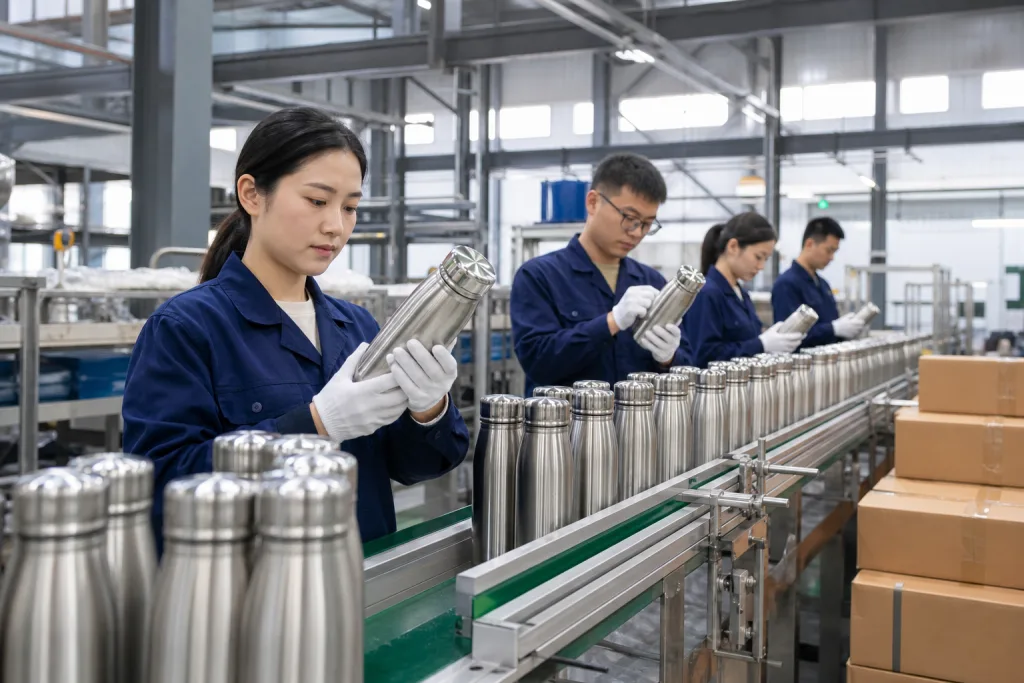
If you source from Zhejiang or other parts of China, get the numbers before you sign off tooling or artwork. This is the right question to ask. A solid canteen manufacturer or canteen supplier should give you MOQ, AQL, lead time, steel grade, and test standards without fluff. At BottleForge Industrial in Hangzhou, Zhejiang, we run about 600,000 units per month, with typical MOQs from 1,000 to 3,000 pieces and mass production in 25 to 40 days depending on decoration and packaging. QC pulled the sample, checked color at the spray line, and measured key fit points in mm before approval.
What should you ask first?
Start with the question most first-time buyers skip: where will you sell this bottle, and what failure is unacceptable? A distributor thermal bottle for promo giveaways is built on different math than a retail custom canteen or a corporate gifting customizable drinkware project. If your target landed cost is under USD 6, the options tighten fast. We’ve seen buyers ask for powder coat, retail box, and two print positions at that level, and the math doesn’t work.
Your first RFQ should ask for five things only: capacity, structure, decoration, packaging, and compliance market. For example: 500 ml double-wall vacuum bottle, 304 inner/201 outer, powder coat plus 1-color silkscreen, white box, EU market. That is enough for a canteen factory in China to quote with fewer gaps inside 24 to 48 hours. On our side, sales will usually check bottle weight and lid type first, then the line confirms carton size before we send pricing.
- Capacity: 350 ml, 500 ml, 750 ml, 1,000 ml all change carton count and freight. A 1,000 ml bottle can push outer carton weight close to the limit, so shipping cost moves fast.
- Structure: straight wall, cola shape, wide mouth, loop lid, handle lid. Even a 3 mm wider mouth changes tooling and sometimes the cap fit sample.
- Decoration: spray paint, powder coat, silk print, laser, UV print, wrap transfer. QC pulled the sample once because a matte powder coat surface was too rough for clean small-text silkscreen.
- Packaging: bulk pack, egg-crate, white box, color box, PDQ, gift set. MOQ often shifts here, and the buyer usually flags it late.
- Compliance: REACH, LFGB, FDA contact safety, CPSIA or ASTM for kids items if relevant. This is where you should name the market early, not after sampling.
If a canteen vendor replies with one headline price and no quote basis, be careful. Serious canteen manufacturers will state steel grade, thickness, lid material, test basis, and FOB port. We run into claims from missing quote details more than from production defects. In Zhejiang and nearby export clusters in China, experienced factories know one skipped item at RFQ stage becomes a problem later—sometimes over something as small as a PO typo on lid color.
How do you judge bottle construction?
Bottle construction comes down to three checks on our side: steel spec, vacuum performance, and how the lid seats. For B2B orders, the standard build is food-contact 18/8 stainless steel, listed as SS304, on the inner wall. The outer wall is often SS201 or SS304. SS201 outside is not a defect by itself; it is a price choice. We quote both. For coastal or humid markets, and for distributor programs selling into gift retail, buyers usually ask for 304 outside too because rust complaints start at the bottom seam first.
A normal vacuum bottle body runs about 0.4 mm inner and 0.45 to 0.5 mm outer. Those numbers matter on the line. Drop below that and dents show up faster in carton drop tests; we have seen 12 pcs out of 1,000 get ring dents after transit with thinner outer walls. Go heavier and the math doesn't work for freight or hand-feel. Vacuum retention is not just steel grade, and this is the wrong question to ask if a supplier only talks about 304. Neck forming, copper coating inside the vacuum gap, stopper compression, and the actual fill temperature during testing all change the result.
Useful numbers to request
- Hot retention: for a 500 ml bottle, 12 hours above 42°C from 95°C fill is a realistic benchmark.
- Cold retention: 24 hours below 10°C with ice water is common for standard vacuum models.
- Leak test: 100% air pressure or inverted leak check before packing.
- Salt spray: 24 to 48 hours for painted parts if you need better coating performance.
You do not need the strongest retention on every order. You need retention claims your distributor customers can repeat without returns.
This is where adjacent terms start causing PO mistakes. A custom growler or customizable growler usually needs a wider mouth and a heavier lid set, often with a thicker silicone seal that QC pulled to 2.5 mm on one recent sample. A customized canteen for outdoor distribution may need a carry loop and a scratch-resistant powder coat instead. If you buy canteen custom programs under the same contract, keep each construction spec on its own sheet. We have seen this go sideways when a buyer flagged one shared drawing and the wrong lid was approved for both models.
What MOQ actually makes sense?
MOQ is not a factory rule on paper. It is the point where your spec stops wasting money on the line. For a distributor thermal bottle, 1,000 pcs per color per size is a solid start on standard molds, especially if we run the same lid, same carton, and one logo position. Once you ask for custom Pantone coating, printed box, barcode labeling, and mixed lids, 2,000 to 3,000 pcs per SKU usually prices out cleaner with fewer handwork exceptions. We have seen buyers push for 800 pcs with 4 lid colors and 3 box versions; the math doesn't work.
Buyers ask this every week: can a canteen customizable order be split across colors? Yes, usually. The split still needs control. A common setup is 3,000 pcs total with a minimum 500 pcs per color if the bottle body, lid, inner tray, and carton marks stay the same. Once you start changing box designs, inserts, or logo positions, labor jumps fast because the line keeps stopping for pack-out checks. QC pulled a sample last month where the PO barcode font was wrong by 1 mm, and that small miss held packing for half a day.
- Standard bottle + 1-color logo: MOQ 1,000 pcs, roughly USD 3.20 to 5.80 FOB depending on size and finish.
- Powder coat + color box: MOQ 2,000 pcs, usually USD 0.25 to 0.60 more per unit.
- New lid mold: tooling often USD 2,500 to 8,000, plus 20 to 30 extra days.
- FNSKU sticker or Amazon prep: add USD 0.03 to 0.12 per unit depending on pack-out.
If you are managing a wider distributor canteen or distributor growler range, consolidate the parts. Using one cap across two body sizes cuts spare-part trouble and trims packaging SKUs at the same time. We ship repeat orders faster when the cap, gasket, and master carton stay unchanged; 12 days vs 18 days is normal once artwork is locked. This is the right question to ask your canteen vendor: how do you handle repeat orders of 1,000 to 2,000 pcs after the first 5,000 pcs run is done? A good canteen distributor or canteen suppliers network should answer with stock parts, lead time, and what they kept on file—not just the first-order price.
Which decoration survives real use?
Decoration is where custom drinkware projects often fall apart. The sample room piece looks clean, then after 12 days of carton rubbing and daily carry, the body shows wear. For thermal bottles, powder coating is the safe starting point for scratch resistance and grip. We run dry-film checks on the line at 60–80 μm, and that thickness usually gives the best balance. Standard spray paint works on lower-cost canteen promotional projects, but the math doesn't work if the item will get tossed into backpacks, cup holders, and export cartons.
For logos, silkscreen is the budget pick for 1-color or 2-color artwork on smooth panels, especially when the print area stays within 50 x 80 mm. Laser engraving removes ink-risk completely and fits stainless or painted surfaces where a metallic reveal is acceptable. UV print looks sharp on shelf, but curved bottles are where we've seen this go sideways. QC pulled the sample once because the logo shifted 1.5 mm off center after curing, and the buyer flagged it right away.
Ask these checklist questions
- Is the logo area flat enough for clean registration?
- Will the bottle go into retail, gym, school, or outdoor use?
- Do you need dishwasher resistance, or only hand-wash guidance?
- Is the project a custom drinkware reorder where the previous color must match within a small tolerance?
For most canteen customized, customized growler, or customizable canteen programs, I would choose a decoration that survives claims, not one that just wins the first sample review. This is the wrong question to ask if the team is only comparing unit price. A powder-coated body with laser mark usually beats a glossy spray body with oversized multicolor print once the product hits real use. If your canteen suppliers in China cannot share adhesion, abrasion, or tape-test results, ask for a pre-production sample made on the real line, not a hand-made sample. We ship both, and the hand-made one can hide problems the cross-hatch cutter finds in 5 minutes.
What compliance and QC matter most?
B2B buyers do not need every certificate on earth. This is the wrong question to ask. You need the documents that match your sales market and bottle spec, then a QC routine the factory runs on the line. For a distributor thermal bottle sold into Europe, REACH and LFGB-related food-contact expectations come up on almost every RFQ. For North America, FDA food-contact alignment is the normal baseline. If the item is for children, ASTM or CPSIA-related requirements should be cleared before sampling starts, not after the first 500 pcs are packed.
On the factory side, do not stop at the certificate wall in the meeting room. We have seen buyers get a clean PDF set, then find no real checkpoint records at all. Ask whether the supplier has BSCI or equivalent social audit if your retail account requires it. Ask for ISO 9001 if your vendor approval team checks process control. Then ask how incoming, in-process, and final inspection are done, and who signs the records when QC pulled the sample at 10:00 a.m. from line 2.
- Incoming checks: confirm steel grade, lid resin, gasket hardness, and paint batch against the PO and material card. We usually check gasket hardness with a Shore A durometer and buyer teams often ask for the reading, not just “OK.”
- In-process checks: check vacuum performance, logo position, thread fit, and color consistency during production. A 1.5 mm logo shift will get flagged fast, and cross-threading on the lid is one of the most common complaints we see.
- Final inspection: AQL 2.5 for major defects and 4.0 for minor defects is a common practical level. The math doesn’t work if a factory promises zero defects on a 10,000 pc order but will not define defect standards first.
- Pack-out checks: verify barcode scan, carton marks, drop test, and assortment count before loading. We have seen a single PO typo on carton mark color code hold a shipment for 2 days.
At shipment stage, do one more random leak test and vacuum retention spot check, even if the line already checked them. QC pulled the sample, filled it, and set it aside for retention testing is still a better habit than trusting yesterday’s report. Reliable canteen manufacturers and canteen factory teams in Zhejiang, China usually accept third-party inspection because it protects both sides. If a canteen supplier pushes back on basic AQL or refuses carton drop testing from 76 cm, treat that as a warning sign. We have seen this go sideways.
How do lead times really move?
Lead time moves less with the bottle body and more with the work around it. For standard models, sample lead time is often 5 to 7 days for a plain sample and 7 to 12 days for logo samples. Mass production usually runs 25 to 40 days after deposit and sample approval. In peak season from August to November, add 7 to 15 days if your China supplier is heavily booked. On our line, the logo sample often waits on screen setup or Pantone sign-off, not on the 304 stainless shell.
The biggest delays are rarely in stainless forming. They show up in artwork approval, custom packaging, or accessory sourcing. A simple white box can be ready in a few days. A gift box with EVA insert, spot UV, and drop-test requirement may add 10 to 15 days by itself. We have seen a buyer flag a 2 mm logo shift on the insert card, and that small issue burned 4 extra days. This is the wrong question to ask: “How fast can you make the bottle?” Ask what item has the longest path.
- Plain stock sample: 2 to 5 days
- Pre-production sample: 7 to 12 days
- Bulk production: 25 to 40 days
- Sea freight to EU/US: roughly 20 to 40 days depending on route and booking
If you are coordinating a canteen distributor launch, build your timeline backward from the in-warehouse date, not the ship date. Leave days for inspection, booking, customs clearance, and warehouse intake. QC pulled the sample on one order because the PO listed “matte black” but the carton mark said “matt balck,” and the buyer held release until that typo was fixed. The same rule applies if your range includes custom growler, distributor growler, or distributor drinkware bundles. One delayed straw lid, carry strap, or gift box can hold the whole shipment if the schedule is tight. We have seen this go sideways.
How do you compare suppliers fairly?
The only fair way to compare suppliers is a normalized quote sheet. Send the same spec pack to every canteen manufacturer, canteen vendors group, or canteen distributors contact on your list—same FOB China term, same packaging, same test scope, same carton pack. We see buyers skip this and the math doesn't work. If one quote is USD 0.80 lower, check the details line by line: did they switch the outer wall to 201, drop the strainer, or change the master carton from 24 pcs to 50 pcs? On our line, even a 5 mm shorter inner straw or a 10 gsm lighter box board will move cost.
A usable shortlist scorecard should cover price, response speed, technical clarity, sample quality, QC transparency, and repeat-order discipline. Put numbers on it. For example: reply in 24 hours vs 5 days, sample remake in 7 days vs 15 days, PP sample approval in one round vs three. A supplier who answers a gasket question in one day is often the safer pick than a factory that is cheaper by USD 0.12 and needs a week to confirm silicone grade. QC pulled a sample last month because the barcode on the color box was 2 mm off center; this is where good follow-up shows up fast.
Supplier comparison checklist
- Quote includes steel grade, capacity tolerance, and lid material.
- MOQ and color split rules are written clearly.
- Lead time states whether packaging is included.
- Testing scope and AQL standard are confirmed.
- Logo method and expected durability are explained.
- Spare parts and reorder support are available.
If this is a customized canteen, customized growler, or customizable growler program you plan to run for 2 or 3 seasons, ask who owns the tooling, how color standards are archived, and whether the supplier keeps retained samples for each PO. Ask to see the sample retention shelf photo if you want a straight answer. We ship repeat programs by matching to signed masters, Pantone callouts, and retained units tagged with the PO number—one tag we caught last quarter even had a typo in the buyer PO, which saved a claim later. The wrong question to ask is only "what is your best price?" The better factories run your program like a repeat industrial job, not a one-off trading exercise. That is the gap between a smooth distributor thermal bottle line and 6 small claims that should never have happened.
Get a practical quote for your distributor thermal bottle
Send capacity, target price, logo file, packaging, and market. We will reply with MOQ, FOB pricing, lead time, and compliance options from Zhejiang, China.
Frequently asked questions
What is a realistic landed-cost target for a distributor thermal bottle?
For a 500 ml double-wall vacuum bottle, a realistic FOB China range is usually USD 3.20 to 5.80 at 1,000 to 3,000 pcs, depending on steel grade, finish, lid style, and packaging. Sea freight, duty, local delivery, and warehouse handling can add another 20% to 45% depending on destination and shipment size. If you add a color box, expect roughly USD 0.25 to 0.60 extra. If your target landed cost is under USD 4.50, keep the spec simple: standard mold, 304 inner, 201 outer, powder coat or spray finish, one logo position, and no gift packaging. Most cost overruns come from packaging and decoration changes, not the bottle body itself.
Should I choose 201 or 304 stainless steel for the outer wall?
For the inner wall, use 304 stainless for food contact as the default. For the outer wall, 201 is common and acceptable for many mid-market custom drinkware programs because it lowers cost without affecting the beverage contact surface. If your product is positioned as premium, sold in damp climates, or needs a stronger corrosion story, choose 304 outer as well. The price gap varies by market, but on a 500 ml vacuum bottle it may add around USD 0.15 to 0.40 per unit at normal MOQs. Ask the canteen manufacturer to state both grades on the quote and sample approval form so there is no confusion later.
How many samples do I need before mass production starts?
Usually three sample stages are enough. First, a stock sample to confirm shape and hand feel; that often takes 2 to 5 days. Second, a logo sample to confirm color, print position, and finish; budget 7 to 12 days. Third, if the order is large or packaging is complex, approve a pre-production sample made with final materials before the main run. For orders above 10,000 pcs, many buyers also request a sealed golden sample retained by both sides. That extra step is useful when you have multiple repeats across China sourcing cycles because it reduces arguments over color shift, logo size, or lid detail on later shipments.
What defects should a final inspection focus on?
For a distributor thermal bottle, final inspection should focus on leaks, poor vacuum performance, dented bodies, unstable bases, coating defects, incorrect logo position, mixed components, and barcode or carton mark errors. A practical standard is AQL 2.5 for major defects and 4.0 for minor defects, with functional tests included. I would ask the inspector to test at least lid fit, inverted leak performance, random hot-water retention samples, carton drop resistance, and assortment count. If the order includes Amazon FBA prep, also confirm FNSKU placement and scan readability. Many shipment problems are packing errors, not manufacturing failures, so the inspection should cover both product and pack-out.
Can one supplier handle thermal bottles, custom canteens, and growlers together?
Yes, if the supplier is a real canteen factory or canteen manufacturer with broad drinkware capability, not just a narrow assembler. Many factories in Zhejiang, China can produce thermal bottles, custom canteen lines, and some custom growler formats under one account, but you should still confirm which items are made in-house and which are outsourced. Ask for MOQ by category, typical lead times, and whether the same QC standard applies across all SKUs. For example, a factory may run vacuum bottles in-house at 600,000 units per month but source certain lids or larger growler parts outside. That is not a deal-breaker if the supply chain control is clear and the inspection points are written into the order.