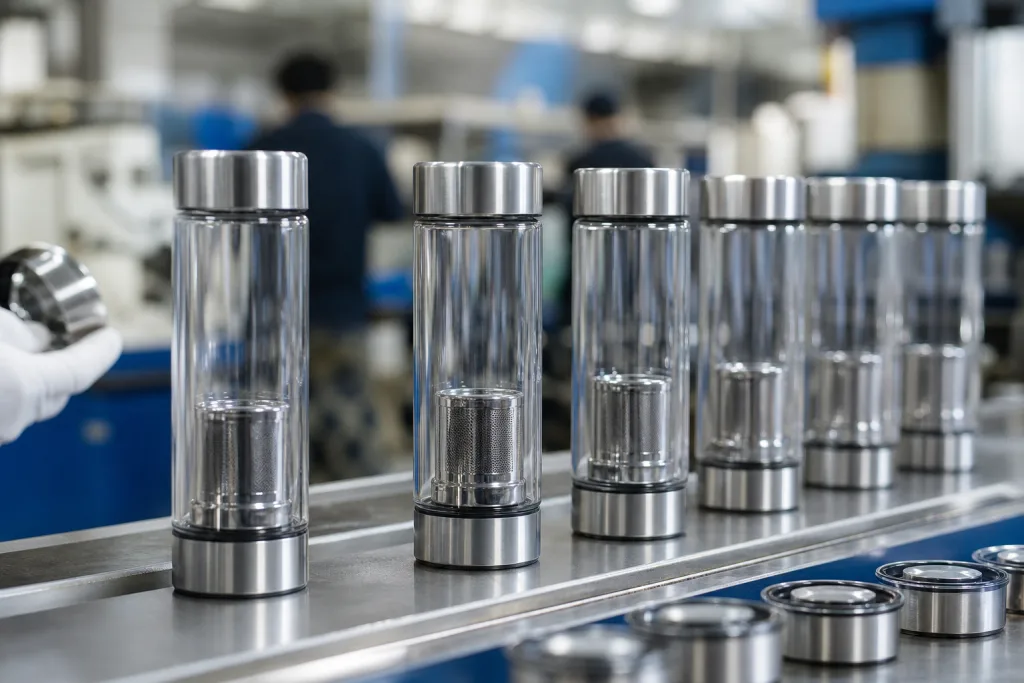
Key Takeaways
- A stock-mold bulk infuser bottle usually lands at 1,000-3,000 pcs MOQ, while fully custom molds often start at 5,000-10,000 pcs.
- Typical FOB China pricing runs from about USD 1.85 to USD 4.90 per unit depending on Tritan or glass, infuser design, decoration, and packaging.
- Sampling usually takes 5-10 days, mass production 25-40 days, and a new custom mold can add 18-35 days before production starts.
- AQL 2.5 inspection, REACH checks, and drop-leak testing add cost upfront but reduce chargebacks and rework risk by measurable percentages.
If you are buying a distributor tea infuser bottle for a wellness brand or hydration startup, the hard part is usually not the bottle shape. It is getting solid numbers early enough to protect margin, lock the launch date, and map the reorder. We see buyers ask for a quote on a custom infuser bottle, then the buyer flags the total after the first breakdown: basket material, logo method, packaging spec, and compliance testing shift cost more than the lid profile does. On our line, a screen print change and a carton upgrade can move the unit price faster than most first POs expect.
From Zhejiang, China, we run into the same split all the time: one buyer needs a factory direct infuser bottle at 2,000 units for a campaign, another needs 20,000 units across three colors for retail distribution. The right sourcing decision comes from cost tiers and calendar math. This is the wrong question to ask if the only question is ex-works price. A 2,000-piece run with one-color print and a plain white box behaves nothing like a 20,000-piece order with three PMS-matched lids, and QC pulled the sample once over a 1.5 mm logo offset that would have been missed on a quick quote. If you understand where the dollars and days go, you can buy a bulk tea infuser bottle with fewer surprises.
What your bottle really costs
For a distributor tea infuser bottle, unit price comes from a lot of small factory choices. New buyers often stare at 700 ml and stop there. That is the wrong question to ask. On our line in Zhejiang, the bigger cost moves usually come from resin or glass grade, infuser build, logo method, and pack-out. A 700 ml single-wall Tritan body with a simple PP lid and removable infuser usually lands lower than a double-wall glass design with a stainless steel basket and gift box. We see it on costing sheets every week, and sometimes the buyer flagged the volume first while the gift box alone added more than the lid upgrade.
Here is the practical FOB range you can use when planning:
- Basic stock Tritan infuser bottle, 650-750 ml: USD 1.85-2.60 at 3,000 pcs
- Mid-grade custom tea infuser bottle with better lid finish and color matching: USD 2.40-3.30 at 3,000-5,000 pcs
- Borosilicate glass bottle with stainless tea basket: USD 3.20-4.90 at 2,000-5,000 pcs
- Gift box upgrade: add USD 0.28-0.85 per set
- Silkscreen logo: add USD 0.04-0.09 per color per side
- Laser marking on metal cap part: add USD 0.08-0.18 per unit
If you compare a custom fruit infuser bottle against a custom tea infuser bottle, the fruit version often comes in a bit higher once the inner rod, fruit chamber, or filter assembly adds extra plastic parts and tighter fit tolerance. On one 750 ml project, QC pulled the sample because the core-to-body gap was off by 0.6 mm, and that turned into slower assembly and more rework. A customizable fruit infuser bottle with a long infusion core also takes more hand assembly time than a simple tea basket design. The math does not work if a supplier prices both structures almost the same.
Ask your supplier to break out bottle body cost, infuser cost, decoration cost, and packaging cost. Do it from the first quote. That makes it easier to compare a bulk fruit infuser bottle, a bulk tea infuser bottle, and a general bulk infuser bottle without mixing costs that do not belong together. We ship cleaner quotes this way, and it avoids the usual pushback later when a buyer sees that a logo print or gift box changed the FOB by USD 0.12 or USD 0.48. A factory direct infuser bottle quote should never be one lump sum with no explanation.
MOQ tiers change your margin fast
MOQ is where startup buyers lose margin first. On a stock model from a China factory, MOQ is usually set by color resin batching, logo screen setup, and master carton packout, not by the bottle body itself. At BottleForge Industrial, monthly output can reach 400,000 units across drinkware lines, but on the line we still quote MOQ by SKU, lid match, and pack spec—sometimes a 2 mm logo position change is enough to shift the setup math.
Typical ranges look like this:
- 1,000 pcs: works on some stock-color models with one simple logo, usually one print position and standard export carton
- 2,000-3,000 pcs: common for a custom logo infuser bottle using existing molds; this is where most distributor orders land
- 5,000 pcs: a common break point for better pricing on a customized infuser bottle in custom colors, because resin batching and color matching start to make sense
- 8,000-10,000 pcs: more realistic for a fully custom made infuser bottle with new tooling; we have seen buyers miss this and then push back after the mold quote lands
The price drop from 1,000 to 3,000 units is usually more meaningful than from 10,000 to 12,000. For example, a distributor infuser bottle quoted at USD 2.78 for 1,000 pcs may move to USD 2.32 at 3,000 pcs, then only down to USD 2.18 at 10,000 pcs. This is the wrong question to ask: “What is your lowest MOQ?” Better ask where the first efficient tier sits. We have seen this go sideways when a buyer forces 1,000 pcs, then loses margin on freight, setup, and repack costs.
When mixed colors help
If the factory allows one model with 3 colors under one order, you can test market demand without sitting on dead stock for 6 months. A common formula is 3,000 pcs total with 1,000 pcs per color. We ship this split often. QC pulled the sample on one order last month because the sage green lid was 1 shade off the approved chip, but the mixed-color structure itself worked well for a customizable tea infuser bottle line aimed at yoga studios, supplement brands, or hydration subscriptions.
You do not need a fully customized fruit infuser bottle on your first PO if an existing mold with custom color, logo, and packaging gets you to market 45 days sooner.
This matters for distributor fruit infuser bottle and distributors tea infuser bottle programs alike. The best MOQ is not the lowest one offered. It is the quantity that protects your margin and still moves through your channel within 60-90 days. If your channel sells 1,200 units a month, the math does not work on a 10,000 pc first run unless the buyer already locked the rollout plan.
Lead time starts before production
Lead time for a distributor tea infuser bottle needs to be broken into stages. If a supplier says only “30 days,” ask what sits inside that number. This is the wrong question to skip. In China, the delay usually starts before the line runs: artwork confirmation, Pantone approval, pre-production sample sign-off, and packaging proofing. We’ve seen a PO held 6 days because the buyer approved the bottle logo but missed a 3 mm barcode shift on the gift box.
A realistic timeline for a stock-mold custom infuser bottle is:
- Quotation and specification confirmation: 1-3 days
- Sample update with logo or color: 5-10 days
- Packaging artwork check: 2-4 days
- Mass production: 25-35 days
- Final inspection and booking: 3-7 days
Your ready-to-ship window is often 36-59 days after deposit and approvals, not counting ocean transit. QC pulled the sample, the buyer signed the PPS, then we ship on schedule. Miss one approval, and 36 days turns into 43 fast.
For a custom made infuser bottle with a new cap, new infuser basket, or new body mold, add:
- Tooling design and DFM review: 3-7 days
- Mold making: 18-35 days
- T1-T3 sampling and corrections: 10-20 days
That means a customized tea infuser bottle can take 67-121 days before shipment. A new cap looks simple on the screen, but on the factory floor we still need to check thread fit, leak test torque, and basket seating after T1. The math doesn’t work if you try to save USD 0.12 per unit and lose a retail launch window in Europe or North America.
For Amazon or DTC projects, also ask whether the supplier can apply barcode labels, FNSKU stickers, and carton marks before loading. Those extras usually add 2-4 days if confirmed late. We run these add-ons at packing, not after the cartons are stacked, and the buyer flagged this more than once after sending the FNSKU file with the wrong carton mark typo. A factory tea infuser bottle program runs smoother when carton dimensions, label positions, and pallet rules are fixed before production begins.
The parts that push price up
Not all custom work costs the same. Buyers often think the logo is what makes a tea infuser bottle expensive. On our line, that is usually the small part. The price moves more from mold complexity, material upgrades, and hand assembly. We have seen POs with a one-color logo add under 5%, then a cap change pushes the whole quote off target.
The main cost drivers usually look like this:
- Material: Tritan is normally higher than standard AS or PET, and you pay for that extra clarity and impact resistance. Borosilicate glass is higher again, with more care needed in packing because QC pulled more break-risk samples on thin-wall glass bodies.
- Infuser construction: A 304 stainless basket with fine mesh costs more than a molded plastic strainer. If the mesh is 0.25 mm and the basket is two parts instead of one, assembly time goes up fast and the line slows down.
- Cap design: Leakproof lids with silicone seals, carry loops, and locking parts raise piece cost and defect risk. This is where buyers get pushback from QC, because one bad seal groove by 0.3 mm can turn into leakage complaints.
- Decoration: Multi-color print, wrap print, or special coating adds setup cost and scrap risk. We run trial prints first, and soft-touch coating is one of the first places where the buyer flagged rub marks.
- Packaging: Mailer-safe boxes, EVA inserts, or retail windows can add 15%-35% to total set cost. The math does not work if the bottle is basic but the box spec looks like a gift set.
A custom logo infuser bottle with one-color print on a stock cap may add less than 5% to cost. A custom fruit infuser bottle with a new infusion rod, soft-touch coating, and window gift box can add 25%-45%.
Wall thickness and hardware matter
On plastic bodies, small wall-thickness changes affect hand feel and production yield. For many Tritan bottles, a body wall around 2.2-2.8 mm is typical. Move from 2.4 mm to 2.8 mm and resin use rises directly per piece. For metal filter parts, 304 stainless in roughly 0.25-0.40 mm thickness is common depending on basket design. We check this with a micrometer on incoming parts. If a supplier cannot explain these numbers clearly, the quote is not stable. This is the wrong question to ask: “Why is your unit price higher?” Ask what thickness and hardware the price is built on.
For distributor fruit infuser bottle or distributors infuser bottle projects, ask for a costed option sheet. You want to see what happens if you switch from printed box to plain white box, from stainless filter to PP filter, or from custom Pantone body to stock transparent body. We ship cleaner quotes when this sheet is done up front, sometimes 12 days instead of 18 days on sampling because the buyer is not changing specs midstream. That is how you protect margin, not by asking for a last-minute discount after the sample is approved.
Quality checks that save rework
The cheapest bulk infuser bottle stops being cheap once it leaks on shelf or lands with scratches on the first carton layer. On tea and fruit infusion bottles, we usually see rework from five points: lid sealing, thread mismatch, basket fit, print abrasion, and glass breakage during transit. This should be written into the PO before deposit. We have seen one typo on a PO turn a 58 mm lid thread into the wrong cap match, and the line had to stop.
Minimum checks you should ask for:
- Leak test: 100% for assembled bottles, often vacuum or inverted hold test
- Drop test: commonly 1.0-1.2 m with packaging, depending on product type
- Dishwasher or wash-cycle check: if dishwasher-safe claim is used
- Print adhesion: tape or rub test for silkscreen and coating
- Material compliance: REACH, LFGB, FDA-contact as applicable
- Inspection standard: AQL 2.5 major / 4.0 minor is a common export baseline
If you are buying a customizable infuser bottle for the EU, ask for REACH confirmation by item and by packaging, not just the bottle body. The buyer flagged this on one order after finding the inner polybag ink was missing a declaration. For North America, ASTM claims can matter more on some programs, especially gift sets and youth-facing packs. If kids are anywhere near the target use, this is the wrong question to ask: “Is it sold as a kids item?” Review it more cautiously either way.
Factories in Zhejiang that ship export orders every month should also know how to handle BSCI or social compliance audits if your retail account asks for them. That does not improve the bottle seal by itself. It does make onboarding smoother with larger chains because the paperwork is ready, the audit trail is cleaner, and the factory is less likely to stall at the last minute over a missing payroll record.
The practical point is simple: a customized fruit infuser bottle or customized tea infuser bottle should have an approved golden sample and inspection checklist before production starts. QC pulled the sample, signed against the print color and basket fit, then we run mass production to that standard. The math doesn't work any other way. Buyers will spend USD 180-300 on a pre-shipment inspection in China to avoid a 6% return rate after arrival.
How distributors should stage the first order
If you are a wellness brand or hydration startup, stage the first order to learn fast. Don’t treat PO#001 like a design contest. We usually push buyers toward an existing mold, a workable MOQ, 2 proven colors, and a clean custom logo infuser bottle setup. Last month one buyer tried 7 lid colors on a 3,000 pcs trial order; the math didn’t work, and the line lost time just on color changeover.
A practical first-order structure looks like this:
- SKU count: 1 body style, 2-3 colors
- Order quantity: 2,000-5,000 pcs total
- Decoration: 1-color silkscreen or laser logo
- Packaging: standard color sleeve or simple retail box
- Quality target: AQL 2.5 with leak and drop testing
This structure fits a distributor tea infuser bottle program, a distributor infuser bottle for mass hydration retail, or a factory fruit infuser bottle for a seasonal push. It keeps landed cost easier to control and lead time inside one buying cycle—more like 18 days sampling plus bulk prep, not 30 days of back-and-forth on artwork and box inserts. We ship plenty of first orders like this, and QC usually pulls the sample set faster when there are fewer moving parts.
When to move to full customization
Move to a custom made infuser bottle after you have proof of repeat demand, not before. The signals we look for are monthly sell-through above 70%, reorder visibility from two or more channels, and a target margin that covers tooling without squeezing the next PO. New tooling can cost anywhere from USD 1,500 for a simple insert revision to USD 6,000-12,000 for a more complete bottle and cap program. We’ve seen this go sideways when a buyer approves tooling before confirming carton count or neck fit tolerance.
That is the point where a fruit infuser bottle custom program starts to make sense. If your brand needs a distinctive silhouette, an infuser core that looks proprietary, or a better unboxing setup, then a customized infuser bottle can create separation on shelf. Until then, speed usually beats originality. On our side in China export, the buyers who do well are the ones who launch on time, reorder without PO errors, and customize only what the customer will pay for. One small example: the buyer flagged a logo position once, and the issue was only a 3 mm shift on the screen print jig.
Get a clear infuser bottle quote fast
Send your target quantity, bottle size, logo method, and deadline. We will reply with MOQ, FOB pricing, and a realistic Zhejiang, China production schedule.
Frequently asked questions
What is a realistic MOQ for a distributor tea infuser bottle order?
For an existing mold, a realistic MOQ is usually 1,000-3,000 pieces, depending on color and decoration. If you need a custom logo infuser bottle in one stock body color, 2,000 pcs is a common working level. If you want custom Pantone matching, multiple components, or a customized tea infuser bottle with new tooling, 5,000-10,000 pcs is more realistic. In China, factories often quote a low MOQ first, but the price at that level may be 12%-20% higher than the efficient production tier. Ask for pricing at 1,000, 3,000, and 5,000 pcs side by side. That will show you where the real cost break happens and help you avoid ordering a quantity that looks flexible but kills your margin.
How long does a custom infuser bottle order usually take from approval to shipment?
If you use an existing mold, expect about 36-59 days from deposit and approval to ready shipment. That usually includes 5-10 days for sample confirmation, 25-35 days for production, and 3-7 days for final inspection and booking. A custom made infuser bottle with a new lid, basket, or body mold can take 67-121 days because mold development alone may add 18-35 days, plus another 10-20 days for trial samples and corrections. If you also need custom packaging, barcode labels, or retailer-specific carton marks, build in another 2-4 days. Buyers in Europe and North America should add ocean transit separately when planning launch dates.
What is the normal FOB price range for a bulk tea infuser bottle?
For a stock Tritan model, FOB China pricing is often around USD 1.85-2.60 per unit at 3,000 pcs. A better-finished customizable tea infuser bottle with upgraded lid details or more decoration usually lands around USD 2.40-3.30. A borosilicate glass design with a stainless steel basket can run about USD 3.20-4.90 depending on packaging. Simple silkscreen logos may add USD 0.04-0.09 per color, while a retail gift box can add USD 0.28-0.85 per set. The best way to control cost is to separate bottle, infuser, logo, and packaging charges. That makes it easier to compare a bulk fruit infuser bottle, a bulk infuser bottle, and a premium tea version fairly.
Should a startup choose a stock model or a fully customized infuser bottle first?
For most wellness brands, start with a stock model and customize only the visible parts: color, logo, and packaging. That approach usually cuts development time by 30-60 days and avoids tooling costs that can range from USD 1,500 to more than USD 10,000. A custom infuser bottle makes sense only when you already have stable demand, decent forecast accuracy, and a clear reason for changing the shape or infuser structure. If your first order is under 5,000 pcs, an existing mold usually gives you better speed and less risk. In Zhejiang, China, many buyers over-customize too early. The result is a slower launch, more revisions, and weaker cash flow on the first purchase order.
What quality standards should I ask for on a distributor infuser bottle project?
At minimum, ask for 100% leak testing, a packaged drop test at 1.0-1.2 meters, print adhesion checks, and a defined inspection level such as AQL 2.5 for major defects and 4.0 for minor defects. For Europe, request REACH-related compliance support and make sure food-contact materials are documented properly. For North America, confirm the applicable food-contact and packaging requirements before production. If your bottle has stainless filter parts, specify 304 stainless and ask for thickness details, often around 0.25-0.40 mm depending on design. A pre-shipment inspection in China typically costs far less than handling retail claims later. On a 5,000-piece order, one missed leak issue can cost more than the inspection itself.