Key Takeaways
- A 0.5 mm 304 body is common; 0.6 mm improves dent resistance and adds about 8-12% weight
- MOQ for a custom canteen usually starts at 3,000 units; plain stock can be 500-1,000 units
- Typical lead time is 25-35 days after sample approval, plus 3-7 days for packing and booking
- Leak testing, vacuum retention, and coating adhesion matter more than the logo method
If you source a distributor stainless steel flask for retail, corporate gifting, or e-commerce, the spec sheet matters more than the pitch. We’ve seen two 500 ml bottles with the same drawing perform nothing alike on the drop bench: one started leaking after 30 drops, another cleared a 1.2 m fall test and still held temperature for 12 hours. Same capacity. Different build.
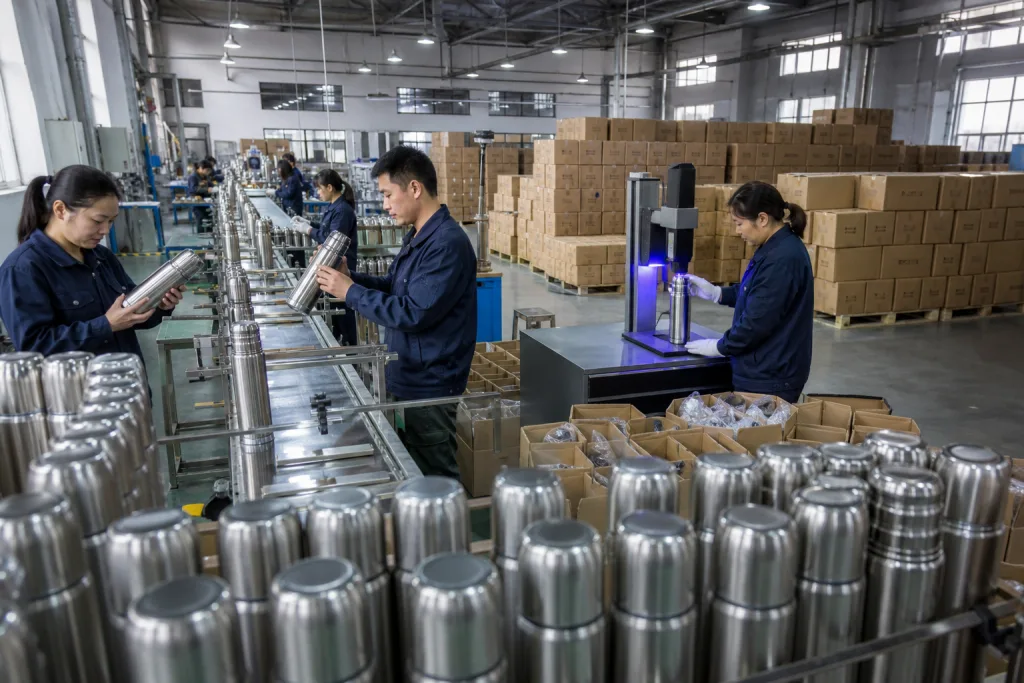
The gap usually comes from wall structure, steel grade, lid fit, and how the canteen manufacturer runs welding and vacuum sealing on the line. In Zhejiang, a lot of China’s drinkware output sits within a 2-hour truck radius of Hangzhou, and some factories ship 50,000 units per month. That number sounds good on a call. The wrong question is output alone. What matters is whether they hold AQL 2.5, buy REACH-ready materials, and keep your customized drinkware consistent on repeat POs—especially after QC pulled the sample and the buyer flagged a 0.3 mm logo shift.
Start With Steel Grade
For a distributor stainless steel flask, steel grade comes first. Most canteen suppliers quote 18/8, which is 304 stainless steel. That is the safe baseline for food contact in Europe and North America. If the factory tries to push a cheaper grade to shave cost, you get rust marks, weak odor control, and buyer complaints after 3 months on the shelf.
For the inner wall, 304 is the standard on a customized canteen. For the outer shell, 201 shows up in budget runs, but it is a tradeoff, not a free upgrade. We have had buyers push for a canteen custom order at USD 1.85 to 2.40 per unit FOB China; that only works with a stripped spec and a low MOQ. If you want a brushed body, powder coat, laser logo, and individual box, the math moves to USD 2.80 to 4.20 depending on size and volume. QC pulled the sample, checked the wall at 0.5 mm, and the buyer flagged the PO typo on finish color before we ran the line.
- 304 inner wall: better corrosion resistance and odor control
- 201 outer wall: lower cost, less durable finish
- Wall thickness: 0.5 mm standard, 0.6 mm for tougher distributor drinkware programs
Ask the canteen factory for material certificates and a food-contact declaration. Serious canteen manufacturers in China can send mill certs the same day; weak suppliers stall or send a blurry scan. This is the wrong question to ask if someone says "trust us"—ask for the heat number and the cert match, then check the sample. That is the difference between a clean distributor canteen line and a return claim.
Vacuum Gap And Heat Hold
The vacuum gap is where a flask passes or fails. A proper double-wall stainless steel flask uses that space to slow heat transfer. We run a 500 ml sample on the line and QC pulled the lid twice; the buyer still asked why the first cup cooled faster. Ask how the claim was tested, not just the number on the box. For most 500 ml and 750 ml flasks, hot hold usually lands at 6 to 12 hours, depending on lid construction and fill level. Cold retention sits around 18 to 24 hours.
Do not treat marketing numbers as standard. A customized growler with a wide mouth and swing top will not hold temperature like a narrow-mouth sports bottle. Same story for a canteen customizable for coffee versus water. A screw cap with a silicone sealing ring seals better than a decorative lid with weak compression. We had a PO typo once: “sleek cap” became “silk cap,” and the buyer flagged it before production. If your channel sells custom drinkware to outdoor or travel buyers, 12-hour heat retention sells better than a bigger logo area. That is the wrong question to ask.
Buyer impact: a 10% gain in vacuum retention often cuts returns more than a 20% lower unit price saves you.
Ask for a thermal report with starting water temperature, ambient temperature, fill ratio, and lid type. If the canteen distributor cannot show that sheet, the numbers are useless for catalog copy. We check the test cup at 95°C and the room at 23°C; that is the kind of detail buyers trust.
Lid Design Drives Returns
Most leak claims start at the lid, not the bottle body. We see this on the line all the time: the weld passes, the vacuum holds, then QC pulled the sample and found seepage at the cap after hand tightening. For a distributor growler or stainless flask, the wrong question is not “Is the body 304 stainless?” but “Does the cap seal square under normal hand torque?” Check the sealing ring material, thread depth, and whether the cap seats evenly after 2 or 3 turns. Silicone is the standard sealing material; cheap rubber hardens faster, picks up odor, and starts coming back as a return.
In canteen distributors’ catalogs, you usually see 3 lid styles: screw cap, push-button lid, and flip top. Screw caps are the safest bet and the math works on claim rate. Push-button lids fit office and travel use, but they add springs, pins, and 1 more assembly station, so QA has more places to catch trouble. Flip tops look good for custom canteen promotions, but we’ve seen this go sideways when the hinge pin is loose or the spring force drops after a few hundred cycles. One buyer flagged this on a PO typo that called for a “flip lip,” and the sample still leaked. For distributor stainless steel flask programs, I usually push buyers toward a screw cap unless retail placement gives them a clear reason to take the risk.
- Silicone ring thickness: 1.5-2.0 mm is common; below 1.5 mm, the seal often loses compression after repeated use
- Thread engagement: deeper threads reduce cross-threading; we usually check cap start and full seat by hand on 5 samples per lot
- Leak test: 24-hour inversion test is the minimum, not a bonus; if a factory treats this like an upgrade item, walk away
A good canteen supplier should also show closure cycle testing, often 3,000 to 5,000 open-close cycles. Ask what failed in the test, not just the headline number. We ship programs where the cap passes 5,000 cycles, but the hinge cover starts loosening at 3,200, and that matters. If they cannot quote a number, they are guessing.
Decoration Changes Unit Economics
Logo method changes cost, not just looks. We see it on the line in yield, scrap, and repeat orders. For a canteen promo run, silkscreen is still the low-cost pick for one-color branding, often USD 0.08 to 0.20 per location at volume, but QC pulled samples before where a 0.3 mm fine line filled in after curing. Laser engraving costs more at setup, then runs steady on stainless and does not chip off in handling.
Heat transfer and UV print can carry detailed artwork, but this is where jobs go sideways if process control is loose. The buyer usually asks which logo looks best. That is the wrong question. Ask which method survives abrasion tests, dishwashing, and cartons stacked in a warehouse for 30 days. For Amazon sellers and retail-chain programs, a customized canteen with engraving usually brings fewer return claims than a painted logo; we have had buyers flag edge wear on printed marks after a basic tape test. If you want a premium gift look, powder coating with a laser logo is the strongest mid-tier option.
Watch MOQ by decoration. A canteen manufacturer may quote 1,000 units for blank stock, then 3,000 units for a printed version, then 5,000 units for a special color. That is standard. What matters more is whether the factory can hold Pantone matching within ΔE 2.0 across repeat production in Zhejiang or elsewhere in China. We check this with a spectrophotometer, and if the PO says “mat black” on page 1 and “Pantone Black 7C” on page 2, expect trouble.
Practical pricing view
At 5,000 units, a plain brushed flask may land around USD 2.10 FOB China, while a powder-coated customized drinkware version can move to USD 2.70-3.60. That spread is enough to kill margin fast. If decoration pushes the item above your target retail margin, cut the spec back and put the money into packaging. In distributor programs, we have seen a stronger gift box lift sell-through more than a second print location.
Packaging Is Part Of The Spec
Buyers split packaging from product all the time. That is a mistake. We’ve seen a solid flask pass final QC, then land with shoulder dents because the inner box wall was under 1.5 mm and the dividers collapsed in transit. For export, 5-ply or 7-ply board is the normal starting point, and the carton spec belongs on the PO with the flask spec. Inner boxes need to stop metal-on-metal contact and keep printed surfaces from scuffing on the line and in the container.
If you sell through retailers, the pack has to work at the shelf and at receiving. We usually print barcode, country of origin, and batch code on the gift box or label, and QC pulled one sample last month because the buyer’s PO typo swapped the batch code format. For Amazon FBA, you also need FNSKU labels and a carton pack list. That is where orders get stuck. A canteen supplier who already runs this process can cut rework to 12 days vs 18 days, and that gap matters.
- Drop protection: 1 m to 1.2 m carton drop is a fair export target
- Master carton load: 20 to 50 units depending on size
- Labeling: SKU, barcode, batch number, and origin country should be clear
Ask whether the canteen distributor can do polybags, molded pulp trays, or individual boxes. This is the wrong question to ask by itself. Ask which pack style matches your sales channel, MOQ, and claim risk. We ship warehouse club programs in stronger individual boxes with tighter carton fit; promo orders often go simpler because the math doesn’t work on heavy retail packaging. The buyer flagged this on a 3,000-piece run last season, and they were right.
Compliance And Test Reports
If you sell into Europe or North America, compliance is a gate, not a bonus. For stainless steel flasks and custom canteen programs, ask for REACH, LFGB where the EU program needs it, and a food-contact declaration. For the US market, buyers usually ask for testing aligned to FDA food-contact expectations plus QA files tied to the PO. We also see Prop 65 reviews come up fast when the item has spray coating, a logo print, or a silicone part over 5 g.
Do not assume every canteen manufacturer in China runs paperwork the same way. A solid canteen factory in Zhejiang will pull test reports, batch traceability, and incoming QC records from the file cabinet or ERP in 10 minutes; QC pulled the sample, matched the lid lot, and checked the 304 stainless coil record. A weaker vendor often sends one generic PDF with no SKU, no date, and no lab scope. That is the wrong answer when your retailer asks for proof after a complaint or the buyer flagged a coating smell on 2 out of 500 units.
Minimum file set: material declaration, third-party test report, production inspection record, and carton test if you are shipping e-commerce.
For BSCI or social compliance, ask for current audit status if your account requires it. Large buyers do not approve a factory from one sample photo. They want a supplier that can repeat the same customized canteen spec for 12 months without drift on coating thickness, weld quality, or lid fit; on the line we check coating at 18-25 μm and run a lid torque check at 1.2 N·m. If a factory cannot show that control, the math does not work.
How To Read A Factory Quote
A quote for a distributor stainless steel flask should show more than unit price. Check steel grade, thickness, capacity, finish, logo method, packing, MOQ, sample lead time, and mass-production lead time. If one line is missing, the quote is incomplete. We see this a lot when buyers line up canteen manufacturers in China and only stare at the FOB number. Last month QC pulled a 0.4 mm wall sample because the quote said 0.5 mm.
Read it like this: a lower unit price with a 10,000-unit MOQ can lose to a slightly higher price with 3,000-unit MOQ if your yearly demand is not locked in. A canteen customizable line that ships samples in 7 days and mass production in 30 days beats a cheaper canteen supplier that needs 60 days and blows the season. The buyer flagged a PO typo once—“3000 pcs” became “30000 pcs”—and the line had to stop.
- Sample lead time: 5-10 days for standard tooling and decoration
- Mass lead time: 25-35 days after approval
- Factory capacity: 50,000 units/month is a useful benchmark for stable supply
Compare a custom canteen quote with a custom growler quote and the geometry tells the story. Wider mouths, heavier lids, and complex coatings add process time, and the math does not work any other way. A good canteen distributor will say that straight, not hide it in the ship date. On our line, a 58 mm mouth needs a different jig than a 43 mm one.
Get a flask spec quote that holds up
Send your target capacity, decoration method, and annual volume. We’ll map the right stainless steel spec, MOQ, and lead time fast.
Frequently asked questions
What MOQ should I expect for a distributor stainless steel flask?
For blank stock, 500 to 1,000 units is possible. For a custom canteen with logo and color work, 3,000 units is a common MOQ in China. Special lids or retail packaging can push it to 5,000 units. If a canteen manufacturer offers 300 units with full customization, check whether they are using existing stock only. Low MOQ often means less control over color matching and longer reorder risk.
How much does a custom stainless steel flask cost FOB China?
A basic 500 ml flask in 304 stainless steel may start around USD 1.85 to 2.40 FOB China for large runs. Add powder coating, laser logo, and gift box, and you may land at USD 2.70 to 4.20. A customized drinkware order with premium lid hardware or double packaging can be higher. Pricing in Zhejiang is usually better at volume, but freight and carton size still affect your landed cost.
What test report should I ask a canteen supplier for?
Ask for food-contact material declarations, REACH if you sell into Europe, and a third-party leak and thermal report. For the US, many buyers also request FDA-related food-contact support documents. If the product has coating or printed parts, ask about abrasion and migration testing. A reliable canteen factory should also share batch traceability and QC records tied to your PO.
Is laser engraving better than printing for custom drinkware?
For stainless steel, laser engraving is usually more durable because it does not chip or fade. Silkscreen is cheaper and fine for simple logos, often under USD 0.20 per location at scale, but it is less resistant to wear. If your customers will wash the flask often or carry it in bags, laser is the safer choice. For a canteen promotional program, print may look better on day one, but engraving usually holds value longer.
How do I avoid leak complaints on a customized canteen?
Focus on the lid, not just the body. Request a 24-hour inversion leak test, silicone seal spec, and closure cycle testing of at least 3,000 uses. Ask for photos of the thread profile and sealing face before mass production. A good canteen vendor will also send pre-production samples and pilot-run units. If you source from China or Zhejiang, insist on AQL 2.5 inspection at minimum for critical defects.