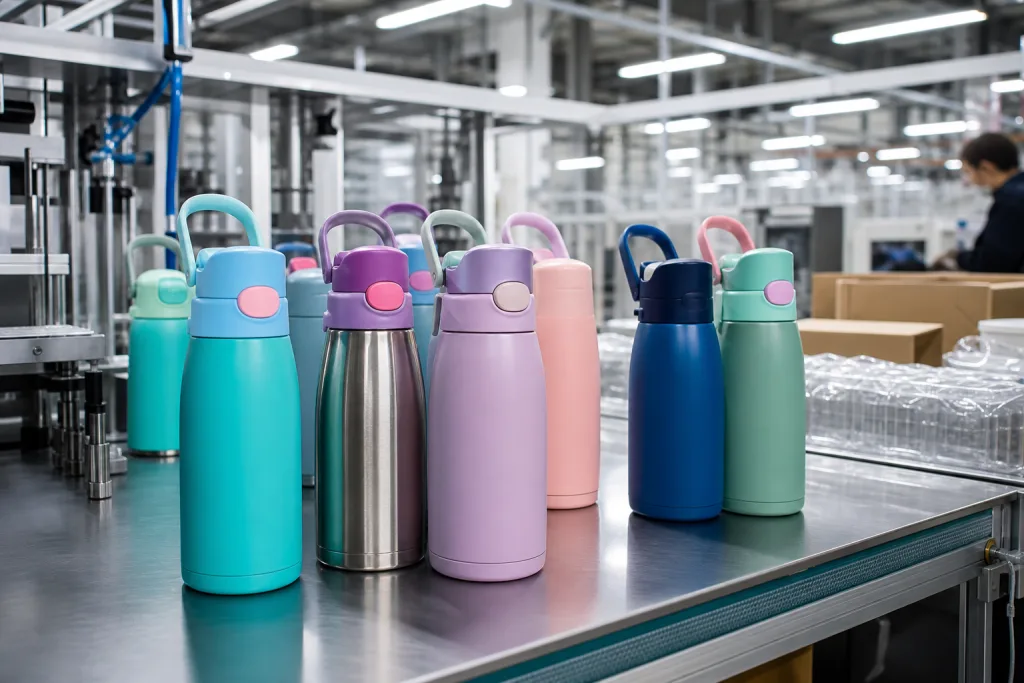
Key Takeaways
- Typical MOQ for a custom school water bottle is 1,000-3,000 pcs per SKU, while stock-color items with one-color logo can start around 500 pcs
- FOB China pricing for PP or Tritan bulk kids water bottle programs usually lands around USD 1.20-3.80 per unit depending on size, lid, print, and packaging
- Normal lead time is 25-45 days after sample approval and deposit, plus 3-7 days for pre-production samples and 25-40 days ocean transit to Europe or North America
- Compliance and quality steps for kids products should include LFGB or FDA material review, CPSIA or REACH checks where needed, and AQL 2.5 final inspection before shipment
If you buy for a school district, fundraiser program, or children’s retail line, the hard part is rarely the bottle shape. The hard part is getting a distributor school water bottle program priced right, tested right, and shipped before the school calendar closes the window. We see buyers fixate on FOB first. This is the wrong question to ask. A quote that looks cheap can climb fast once you add mold cost, print setup, drop testing, compliance files, and split shipments; on one 8,000-piece PO, the buyer flagged a missing straw-cleaning brush and the landed math changed the same day.
From Zhejiang, China, we see the same pattern each season: buyers ask for a custom kids water bottle in April and need stock in U.S. or EU warehouses by July. That timing works, but only if you lock MOQ tiers early, confirm decoration limits on the line, and count where the production days actually go—12 days for sampling and artwork sign-off versus 18 days lost after a logo position change. For school use, durability, compliance, and refill convenience matter more than trendy shapes. QC pulled the sample last week and found a lid thread off by 0.3 mm; that small miss is exactly how school orders go sideways.
Start with the actual school use case
When you source a distributor school water bottle, the first pricing mistake is lumping all kids bottles into one bucket. That is the wrong question to ask. A 350 ml flip-straw bottle for kindergarten, a 500 ml one-hand bottle for primary school, and a 650 ml sports bottle for older students behave like three separate SKUs on the line, with different cap structures, pack-out methods, and return rates. We have seen a buyer flag this after one mixed PO because the 650 ml model took more carton space and pushed freight up by 8%.
School district buyers usually focus on four points: leak resistance in backpacks, easy cleaning, safe contact materials, and enough decoration space for school branding. Distributors add one more: repeatability on the next order. If the first shipment works, they want the same Pantone match, the same cap torque, and the same print sharpness six months later. QC pulled a sample last season because one repeat order had a logo shifted 1.5 mm, and that small miss caused a full carton recheck.
For most bulk school water bottle projects, the working range is a 400-600 ml body in PP, Tritan, or 18/8 stainless steel with a carry loop and a simple flip lid. Simple sells. The fancier the lid, the more defect points you add and the slower we run the assembly line. A basic one-piece straw lid may cost USD 0.18-0.35 less than a push-button auto-open lid, and in our drop test station it usually holds up better after 10 drops from desk height.
At BottleForge Industrial in Zhejiang, China, we usually tell new buyers to cut moving parts before they cut bottle wall thickness. The math does not work if you save USD 0.05 on resin and then pay for crack claims. For school use, a Tritan body around 2.0-2.5 mm wall thickness or stainless outer wall around 0.4-0.5 mm is a safer base. We measure this with an ultrasonic thickness gauge on first articles. You get fewer dents, fewer cracks, and fewer parent complaints.
If you are comparing children water bottle manufacturers, ask for one realistic school spec instead of a wide catalog quote. For example: 500 ml Tritan, flip straw, carry loop, 1-color logo, MOQ 3000 pcs, AQL 2.5. You will get cleaner cost data and a lead-time plan that means something. We have seen this go sideways when a PO just said “kids bottle assortment,” and then the tool list, print method, and packing standard all changed after sampling.
What the unit price is made of
The unit cost of a custom children water bottle usually comes from six cost buckets: material, lid complexity, decoration, packaging, compliance testing, and order volume. Buyers often stare at the bottle body and miss the real driver. On a lot of kids bottle programs we run, the lid and decoration add more cost than the body itself. Last month a buyer flagged a quote gap on a 500 ml Tritan bottle, and the gap came from a push-button straw lid with 3 silicone parts, not the bottle wall.
- Material: PP is usually the lowest-cost option. Tritan runs higher, with better clarity and a more premium shelf look. Single-wall stainless steel sits above plastic. Vacuum stainless is often the wrong spec for school programs unless you are aiming at a higher retail tier. We’ve seen this go sideways when the PO said “insulated” but the school budget was under USD 3.00 FOB.
- Lid system: A screw cap with carry loop is the cheapest build. Flip straw and push-button lids add silicone parts, springs, and more hand assembly on the line. QC pulled one sample this spring where the spring force was off by 0.3 kg, and that alone changed the open-close feel enough for the buyer to reject it.
- Decoration: One-color silk screen is the clean budget choice. Wrap print, heat transfer, or multi-color UV print costs more and pushes up reject risk. On curved bottles, we check logo position with a simple 2 mm tolerance gauge because artwork drift is one of the first things buyers complain about.
- Packaging: Bulk pack with dividers is much cheaper than an individual color box, hang tag, and barcode label set. The math doesn’t work if you try to hit a school distributor target price with full retail packaging from day one. A common pack we ship is 24 pcs per carton with cardboard dividers and PE bags.
- Testing: Lab tests are not expensive per unit on volume orders, but they hit harder at lower MOQs. At 1,000 pcs, a USD 450 test report moves the unit cost in a way buyers feel. At 10,000 pcs, it is a small line item. This is where FDA or LFGB planning should be done early, not after sample approval.
- Volume: The drop from 1,000 pcs to 3,000 pcs is usually meaningful because molding setup, color matching, and print setup spread better. The drop from 10,000 pcs to 20,000 pcs is smaller per unit. One buyer asked us for the same price at 800 pcs as 3,000 pcs; that is the wrong question to ask.
Typical FOB Zhejiang, China pricing for children water bottle wholesale orders looks like this:
- 350-500 ml PP bottle, stock color, one-color logo: USD 1.20-1.80
- 450-600 ml Tritan bottle, custom color, flip straw lid: USD 1.80-2.90
- 500-650 ml single-wall stainless bottle, powder coat, one-color logo: USD 2.40-3.80
Then add the common extras. Custom Pantone color matching usually carries USD 80-200 per color batch risk allowance. Logo screen charge is around USD 30-60 per color per position. New mold work starts from USD 3,000 for a simple cap component and goes to USD 8,000 or more for a full custom body and lid set. Compliance testing runs roughly USD 250 to USD 900 depending on market and scope. We still see small PO errors here; one order sheet even said “Pantong 299C,” and the line had to stop for color confirmation before masterbatch mixing.
If a children water bottle supplier gives you a low quote, check what is missing first. Most of the time it is not fraud. It is just that the quote excludes barcode labels, spare straws, inner bags, or testing. We also see omitted items like 1 extra straw per bottle, 5-layer mailer drop requirement, or an individual polybag with suffocation warning.
MOQ tiers that change your math
MOQ is where school buyers burn time. We see the same RFQ every week: 300 pcs, custom color, custom lid, printed box, retail labels. Five factories get it, three decline, two quote a number the buyer flags as crazy. The setup is still there on a small run—screen charge, color masterbatch, carton mark, and first-piece approval all hit before the line starts.
For a bulk children water bottle program, use these working tiers:
- 500 pcs: Usually works only on a stock mold, 2-3 stock colors, and a simple one-color logo. Good for a pilot or a school fundraiser. If the PO also asks for a custom box insert, the math often doesn't work.
- 1,000 pcs: Practical entry MOQ for a custom logo kids bottle with one body color and one lid color, especially in PP or Tritan. On our line, this is where pad printing and basic assembly stay manageable.
- 2,000-3,000 pcs: Better cost efficiency for custom school water bottle projects. You get more room for decoration, barcode labels, and cleaner packaging options without forcing the factory to spread setup cost over too few units.
- 5,000 pcs and above: Best level for children water bottle customized programs with dedicated packaging, spare part sets, and tighter delivered cost. This is also where a 5-layer export carton and drop-test prep start to make sense.
As a children water bottle factory, we commonly run MOQ at 1,000 pcs per size per color for standard custom kids water bottle production, with monthly capacity around 300,000 units across kids and sports bottle lines. Ask one direct question: is MOQ per SKU or per production batch? QC pulled a sample last month on a mixed-color order, and the only issue was a PO typo that turned one SKU into two.
Example: 3,000 pcs split into three colors can price well if the bottle body stays the same and we only change masterbatch at the hopper. That is one job with one mold set. But 3,000 pcs split into three different lid structures is close to three jobs, because we change assembly fixtures, check fit, and re-run leak test at 0.2 MPa.
For school district buyers, there is another angle: replacement demand. Order 5-8% over your exact student count. Small replenishment orders hurt on freight and setup, and we've seen color drift after six months when resin lots change. The buyer usually asks if 200 pcs can be added later at the same price; this is the wrong question to ask.
If you are buying children water bottle bulk for multiple schools, ask your supplier to quote both one-logo and multi-logo scenarios. Five district logos on one base bottle sounds simple, but each screen setup, packing sort, and carton mark adds handling on the line. We ship these jobs every month, and this is where landed cost often moves more than bottle cost.
Lead times by stage, not by guess
Lead time for a distributor school water bottle needs to be split by stage. If a factory only says “30 days,” that number is incomplete. You need to pin down whether it covers samples, testing, packaging sign-off, and vessel booking out of China. We’ve seen this go sideways when a buyer reads “30 days” on the PI, then learns the barcode file approval was never counted.
Typical timeline for stock mold custom orders
- Day 1-3: Final spec confirmation, artwork check, quotation sign-off
- Day 3-7: Pre-production sample or digital mockup
- Day 7-10: Sample approval and deposit payment
- Day 10-35: Mass production for 1,000-5,000 pcs
- Day 30-38: Final inspection, packing list, booking prep
- Day 38-45: Container loading or LCL dispatch
Then add transit:
- To U.S. West Coast: about 18-28 days port to port; if rail or inland delivery is included, we often see 24 days vs 32 days
- To Europe: about 25-40 days depending on route and customs handling; Rotterdam moves differently from inland truck delivery to Germany
- Air freight: about 5-10 days door to door, but the math doesn’t work for low-cost school bottles once chargeable weight is checked
For a custom made kids bottle using a new mold, add 20-35 days for tooling and first sample validation. A new lid tool is not just “open mold and go” — we still need first shots, trim checks, and fit testing, and QC pulled the sample more than once after finding a 0.3 mm mismatch at the thread. If the project also needs children water bottle promotional packaging with custom insert cards, carton drop testing, or retailer-specific barcode files, add another 5-10 days.
Amazon FBA projects need FNSKU labeling and carton rules checked before packing, not after. This is the wrong question to ask: “Can you pack first and label later?” No. Once the line seals a master carton, rework burns time and money fast, and we’ve had buyers flag a single PO typo in the carton mark after 60% of packing was finished.
One practical warning from Zhejiang: school season creates bottlenecks. From May to August, line loading rises fast across China because promotional drinkware and back-to-school programs overlap. A lead time quoted at 28 days in February can become 40 days in June. We run into this every year. If you need August shelf readiness, approve samples by May, not after Dragon Boat Festival.
Good buyers do not ask for the fastest possible lead time. They ask which step is on the critical path and what can be approved in parallel.
Testing, compliance, and quality checkpoints
Kids products get checked harder, and they should. If you buy from children water bottle manufacturers in China or elsewhere, compliance is not an add-on line on the PI. The test list depends on your market, but for a school-use bottle we usually start with a material declaration, then basic migration and chemical review. On the line, QC pulled one sample last month because the silicone straw spec on the supplier COA did not match the approved Shore A 50 sheet.
For Europe, buyers usually ask for REACH screening and LFGB-related food contact review on the materials that touch liquid or mouth. For the U.S., FDA food-contact compliance is standard, and if the product is sold for children, importers often add CPSIA-related checks for lead and phthalates in accessible parts and decoration. This part gets missed too often. If the bottle has a silicone bite valve, PP straw, or painted logo, each one needs to sit inside the test scope. We have seen a lab quote cover the body and cap, then skip the printed band because the PO note was vague.
Quality control should be plain, written, and easy to audit. We run:
- Incoming material check: resin grade, stainless spec, color masterbatch, silicone hardness, with color checked against the approved chip under a light box
- In-line checks: thread fit, leak test, straw insertion depth, print adhesion, with go/no-go gauges at the capping station
- Final inspection: AQL 2.5 for major defects, AQL 4.0 for minor defects on standard export orders
- Functional tests: 100% leak test where possible, plus random drop test and dishwasher warning verification on packing and manual copy
A basic leak test is not enough for a bulk kids bottle program. Ask for a backpack-use simulation or at least a side-lay leak test on filled samples for 24 hours. Push-button lids should also be cycle tested; 500 cycles is a common starting point, and 1,000 is safer for school programs. A cap that works 10 times in the sample room but fails after 300 openings at school is not a good product. The buyer flagged this on one 5,000-piece order after spring force dropped below spec.
If your brand sells to schools, also ask whether the children water bottle manufacturer has BSCI or similar social audit status and whether the factory runs under ISO-based procedures. These do not guarantee quality, but procurement teams ask for them, and we ship faster when the paperwork stack is ready. This is the wrong question to ask if you use it instead of product testing. Audit status does not replace leak data, migration reports, or inspection records. Solid children water bottle vendors in China will show the valid reports they have and say clearly what they do not.
Where buyers overspend or get delayed
Most delays on a custom children water bottle order are self-inflicted. Not because the buyer is careless. The problem starts at RFQ stage, where 6 or 7 key points are left open and the line has nothing firm to run against.
The biggest cost trap is over-customization on a low-volume order. If you need 1,000 pcs, stay with a proven stock mold. A fully custom school water bottle shape almost never pays back unless you are ordering 10,000 pcs or building a long-term school or retail program. We have seen buyers push for a new silhouette, then pull back after the first mold quote and 3D drawing revision. Spend that budget on lid quality and decoration durability. That is where claims usually start.
The second trap is defaulting to retail packaging. For district distribution, an individual white box is often enough. Moving from plain box to full-color window box can add USD 0.18-0.45 per unit, and it increases carton size, which raises sea freight cost. On one 500 ml project, the master carton jumped by 38 mm in height just from the insert and window structure. For children water bottle wholesale school projects, simple usually wins. The fancy box gets thrown away on day one.
The next delay is late artwork approval. Multi-color wrap art on curved bottles often needs a print area adjustment, and QC pulled the sample more than once because the logo landed too close to the bottle shoulder. If your team takes 7-10 days to approve revised artwork, that alone can wipe out the time you saved by choosing a faster factory. We have seen this go sideways over a small barcode shift and one Pantone callout missing on the PO.
Carton planning gets underestimated all the time. A 500 ml bottle with straw lid may pack 48 pcs per carton in one design and only 36 pcs in another because of handle shape. That changes freight, warehouse handling, and school-level distribution. On the floor, this is not abstract math: if the handle sticks out 12 mm more, the pack-out changes and pallet count moves with it. Buyers often ask about bottle weight first. This is the wrong question to ask.
Do not ignore spare parts. If the bottle has a straw or bite valve, buying 2-3% extra components is usually wise. Adding spare parts during production is cheap because we run the same silicone and PP parts on the line at the same time. Asking for them after shipment is slow, and the math does not work once you add courier cost for a few cartons.
Good children water bottle distributors and importers treat the PO as a system: bottle, lid, print, carton, test report, barcode, and shipping plan. If one piece is vague, the whole schedule turns vague. We have had a buyer flag a shipment because the outer carton mark used "School Bottel" from the PO typo, and that single misspelling held approval for 2 days.
A realistic sourcing plan for your next PO
If you are buying a bulk kids water bottle or children water bottle custom line for schools, work backward from the delivery date. Start with the warehouse receipt date, subtract ocean transit, customs clearance, and final truck delivery, then subtract production time and sample approval. What is left is your decision window. On school programs, we often see 12 days left where the buyer assumed they had 3 weeks. On the line, that gap shows up fast once the PMS color chip or carton barcode is still not signed off.
A practical buying sequence looks like this:
- Choose 2-3 stock molds only, not 20 catalog items the sales team sent over
- Request FOB pricing at 1,000, 3,000, and 5,000 pcs so the price break is clear before you mix SKUs
- Confirm whether the quote includes logo, packaging, spare parts, and testing scope; we have seen PO files miss one straw brush and the buyer flagged the whole set
- Approve one physical pre-production sample, not just photos from a phone
- Lock artwork, carton marks, and barcode files before deposit; a 2 mm logo shift is enough for QC to pull the sample
- Book inspection at least 5 days before estimated finish date
For school district buyers who need a children water bottle customized with district branding, ask for two quote versions: one standardized bottle for all schools, and one with school-specific logos. The standardized version often saves 8-15% in setup and handling. If separate logos are mandatory, keep the body color and packaging the same across all schools. This is the right question to ask early, because mixed color cartons and logo swaps are where we have seen this go sideways at packing.
For importers working with a children water bottle factory in Zhejiang or wider China, be direct about your target landed cost. A factory cannot engineer to your number unless you share it. If your target is USD 2.20 FOB, say so. Then the supplier can suggest PP instead of Tritan, a screw lid instead of push-button, or bulk carton pack instead of retail box. We run this exercise every week, and the math does not work if the target stays hidden until after sample approval.
The fastest route to a school-ready program is plain: fewer variables, cleaner costing, and a bottle children can use every day without breaking it in week one. We ship smoother when the PO, barcode sheet, and carton mark file all match on day one.
Get a real kids bottle quote with timelines
Send your target size, quantity, logo, and delivery date. We will reply with MOQ tiers, FOB pricing, sample timing, and compliance options from Zhejiang, China.
Frequently asked questions
What is a realistic MOQ for a custom distributor school water bottle?
For most stock-mold programs, 1,000 pcs per size or SKU is the realistic starting point. Some children water bottle suppliers in China will accept 500 pcs if you use stock colors, one-color logo print, and simple bulk packing. Once you ask for custom Pantone colors, individual color boxes, or a special lid assembly, MOQ usually moves to 2,000-3,000 pcs. If you need a new mold, the practical launch volume is often 5,000 pcs or more to spread tooling cost. For school district projects, also plan 5-8% extra units for replacements and late enrollments. That is usually cheaper than placing a small repeat order later.
How much does a bulk kids water bottle usually cost from China?
For FOB China pricing, a simple PP school bottle can start around USD 1.20-1.80 each at 1,000-3,000 pcs. A Tritan custom kids water bottle with flip straw lid is more commonly USD 1.80-2.90. A single-wall stainless model may run USD 2.40-3.80 depending on finish and print. Add-ons matter: a color box can add USD 0.12-0.45, multi-color printing can add USD 0.08-0.35, and third-party testing can add USD 250-900 per project. Sea freight, duty, and inland delivery are separate. If a quote looks unusually low, check whether it excludes printing setup, spare straws, barcode labels, or compliance documents.
How long does a custom school water bottle order take?
For a stock mold with custom logo and color, normal factory lead time is about 25-45 days after sample approval and deposit. Pre-production samples usually take 3-7 days. If you need a new mold, add 20-35 days for tooling and first article approval. Ocean transit from China to Europe often takes 25-40 days, while U.S. port transit is commonly 18-28 days, plus customs and final delivery. During peak season from May to August, production queues in Zhejiang and other parts of China get tighter, so add a buffer of 7-10 days. If your warehouse must receive goods by early August, try to approve samples no later than May.
What compliance documents should I request for children water bottle wholesale orders?
Ask first for a material declaration covering bottle body, lid, straw, seal, and decoration. For Europe, many buyers request REACH review and food-contact compliance evidence such as LFGB-related testing where applicable. For the U.S., FDA food-contact compliance is standard, and children’s programs may also need CPSIA-related checks for lead and phthalates in accessible components or coatings. If the bottle is sold to schools, request test scope confirmation before mass production, not after. Also ask for final inspection records using AQL, usually AQL 2.5 for major defects. Good children water bottle manufacturers in China can show previous report formats, but reports must match your exact SKU and materials.
Is it better to choose plastic or stainless steel for school programs?
For cost-sensitive school distribution, PP and Tritan are usually the practical choices. They are lighter, cheaper to ship, and less likely to dent than stainless. A 450-600 ml Tritan bottle is often the best middle ground for a custom children water bottle because it looks premium but stays within a manageable FOB price band. Stainless steel makes sense if your program targets higher durability or retail margins, but it typically adds USD 0.60-1.50 per unit over plastic and increases freight weight. For younger children, lighter weight matters. For older students or premium district programs, single-wall stainless can work well if you keep the lid design simple.