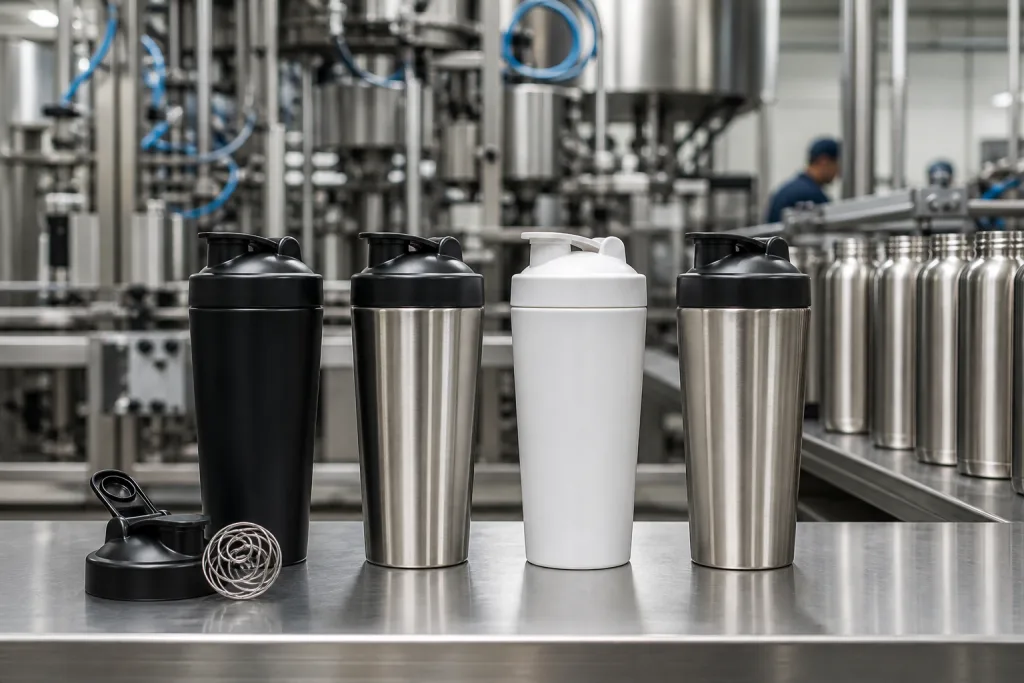
Key Takeaways
- A workable opening MOQ for a distributor protein shaker is usually 3,000-5,000 pcs per color, with sample lead time 7-12 days and bulk lead time 25-40 days
- Put shaker volume, resin grade, leak standard, decoration method, carton pack, and AQL 2.5 into the RFQ before quoting FOB China pricing
- For PP or Tritan shakers, unit price often moves by USD 0.12-0.45 just from wall thickness, whisk type, and print method changes
- Your PO should list testing scope such as REACH, LFGB or FDA contact compliance, plus barcode, carton marks, and spare lid allowance by percentage
If you buy for distribution, a protein shaker looks easy—until the first sample leaks at the thread, the logo flakes after 50 dishwasher cycles, or the lid pitch shifts by 0.3 mm in bulk production. That is not a design issue. It is a sourcing issue. You need a clean path from RFQ to approved sample to bulk PO, with every critical spec written on the PO before tooling, screen printing, and carton packing start. We have seen this go sideways because one buyer typed “black lid” on the PO and forgot “matte,” then QC pulled the sample and the finish was wrong on 6,000 pcs.
For buyers in Europe and North America, the hard part is margin, compliance, and lead time, and this is where the math often breaks. A distributor protein shaker often sits next to a custom canteen, customizable drinkware, or even a customized growler in the same catalog, so the finish, carton style, and logo position need to match. On our line in Zhejiang, we see the same pattern over and over: buyers who lock the line items early ship in 12 days vs 18 days on repeat orders, take fewer claims, and spend less on rework. This is the wrong question to ask: “What is your best price?” Ask instead how the factory controls thread fit, print adhesion, and AQL pull standard before mass production.
Start with the right RFQ
Most sourcing trouble starts before the first quote. If you send three suppliers “protein shaker, custom logo, 700 ml,” you may get three prices for three different products. One quotes a PP body with PE lid, one quotes AS, one quotes Tritan. One includes a plastic whisk ball, another a fixed mixing grid. You cannot compare them honestly.
For a distributor protein shaker, the RFQ should read like a purchase spec, not a promo brief. At minimum, write these line items:
- Capacity: 600 ml, 700 ml, or 28 oz with actual brimful and usable fill volume
- Material: PP, Tritan, or stainless outer with plastic inner parts
- Wall thickness: for example PP body 0.9-1.1 mm, lid 1.8-2.2 mm
- Mixing part: wire whisk ball, injection-molded whisk, or snap-in grid
- Leak requirement: no leakage after 30 minutes upside down when filled to 90%
- Decoration: 1-color silkscreen, heat transfer, in-mold label, or wrap print
- Packing: polybag + egg crate, color box, PDQ, or master carton only
- Target compliance: FDA, LFGB, REACH SVHC, BPA free declaration
If you are also buying custom drinkware lines such as a custom canteen or customizable growler, ask each canteen factory to quote on the same Incoterm, usually FOB Ningbo or FOB Shanghai. We run through this on the line all the time: EXW from one plant and FOB from another will wreck the math. Ask for price breaks at 3,000, 5,000, and 10,000 pcs. A factory with 600,000 units per month total drinkware capacity may still want a higher MOQ on a new shaker mold, while standard items often start at 3,000 pcs. QC pulled the sample at 90% fill and found the lid weeped after 22 minutes, so this is not a place to guess.
The RFQ stage is also where you ask whether the supplier is acting as a canteen vendor or the actual producer. Trading company is not a dirty word, but you need to know who owns molding, printing, and final inspection before samples go out. We once saw a PO typo change “700 ml” to “70 ml”; the buyer flagged it after the first draft, and that saved a costly mess.
Read the quote like an engineer
A low quote means nothing if it skips the parts that trigger claims later. Read every line. A protein shaker at USD 1.18 FOB China can land at USD 1.49 once you add the whisk ball, second print color, color box, and lid gasket upgrade. We had a buyer flag a PO typo on “gasket” once, and the line still caught it before packing.
Typical price ranges for a standard distributor protein shaker from Zhejiang, China look like this:
- PP shaker, 600-700 ml: USD 0.85-1.35 FOB at 5,000 pcs
- Tritan shaker, 700 ml: USD 1.45-2.20 FOB at 5,000 pcs
- Stainless insulated shaker: USD 3.80-6.50 FOB at 3,000 pcs
Those numbers shift fast with tooling status, resin grade, and decoration. If you are a distributor drinkware buyer building a range that also includes canteen custom and canteen promotional products, keep one sheet with item code, cavity count, mold ownership, sample charge, unit price by quantity, print cost, carton details, and testing cost. We run that sheet on the office side in Hangzhou, and it saves arguments when the buyer asks why a 2-cavity mold changes the math.
Quote checkpoints that matter
- Mold status: existing mold or new tooling; if new, who owns it and where it is stored
- Logo method: silkscreen is cheaper; wrap print gives more coverage; laser works only on suitable surfaces
- Tolerance: capacity tolerance, weight tolerance, and color tolerance
- Spare parts: extra lids or seals at 1%-2% for after-sales support
- Testing: one-time cost or included; lab name if available
Ask straight questions. Is the quoted lid the same one used in the test report? Is the whisk stainless 304 or plated wire? Is the color matched to Pantone under natural daylight or D65 light box? We had one sample pass QC, then the buyer noticed the cap height was 1.5 mm off from the PO drawing. That is the wrong question to dodge. The same discipline you use with canteen distributors, canteen manufacturers, or a distributor growler program applies here.
Good sourcing is not about getting the cheapest shaker. It is about making sure the item you approve is the item the factory can repeat at 5,000 or 50,000 pcs.
Sample stage decides your claim rate
After you shortlist suppliers, move to samples fast and do it with a written checklist. Sample lead time for a standard distributor protein shaker is usually 7-12 days for a pre-production mockup and 12-18 days for a fully customized sample with exact logo and Pantone match. Put the checklist on the PO or email thread, not in a WeChat voice note. We have seen buyers approve a cap by photo, then reject the logo size later because the artwork note said 28 mm and the PO showed 26 mm. If the supplier also runs custom canteen or customized drinkware lines, ask them to keep the same artwork scaling rules across SKUs so your shelf presentation stays consistent.
Your sample approval should cover four things: function, appearance, pack-out, and paperwork. Miss one, and the claim shows up after shipment.
- Function: leak test, drop test from 80-100 cm with empty bottle, lid open-close cycle, whisk fit
- Appearance: molding gate finish, seam line, haze level, color variance, logo adhesion
- Pack-out: barcode position, carton dimensions, units per carton, inner pack count
- Paperwork: declaration of material, test plan, sample sign-off sheet, artwork file confirmation
For practical testing, fill the sample to 90% with water and protein powder. Shake hard for 60 seconds, then leave it horizontally for 30 minutes. QC pulled samples this way on our line and found weak lid threads that passed a 10-second upside-down check. Also check the vent cap with a 2 kg hand-pressure squeeze after shaking. If you sell through gyms or supplement chains, test odor retention after 24 hours, because low-grade PP can hold smell and trigger complaints. This is where buyers push back after launch, not before.
If you are dealing with canteen vendors or canteen suppliers with a broad customizable canteen range, do not assume they know shakers well. This is the wrong question to ask: “Do you make bottles?” Ask how they control thread design, hinge performance, and mixing insert fit on shaker orders. These fail in different ways. We have seen a canteen factory run clean body molding, then miss whisk tolerance by 1.5 mm and the insert rattled in transit. Ask for old bulk photos or in-line inspection records of similar shakers. A serious canteen factory or canteen supplier should send them without drama.
Last step: lock the approved sample with a sample code, approval date, and signed comments. Keep one sample with you and one sealed at the factory. Put the factory set in a PE bag with the code label outside, then store it near the line office or sample room. That becomes the reference during production and final inspection. Without that physical standard, every argument later turns subjective, and the math does not work on claim cost.
Write the PO line by line
A purchase order for bulk custom drinkware should read like a control document, not a simple qty-price sheet. This is where new B2B buyers lose margin. If the PO is missing line items, the factory will run its standard process, and that standard often does not match your market, your warehouse rules, or the sample you approved on the table.
For a distributor protein shaker, your PO should include at least these fields:
- Item description: 700 ml PP protein shaker with snap lid and mixing grid
- Color: body Pantone 427C translucent, lid Pantone Black C solid
- Material: food-contact PP body, PP lid, TPE seal if used, 304 whisk if wire ball included
- Net weight: for example 138 g plus or minus 5 g
- Logo: 1-color silkscreen, 35 mm x 60 mm, adhesion standard 3M tape test pass
- Packing: 1 pc/polybag, 50 pcs/master carton, carton size and max gross weight
- Shipping marks: PO number, item code, country of origin, carton sequence
- Barcode: EAN or FNSKU location and scan grade requirement
- Inspection: AQL 2.5 major / 4.0 minor unless otherwise agreed
- Documents: test report copy, packing list, commercial invoice, COO if needed
If you are buying a wider line from canteen distributors, including customized canteen, custom growler, or distributor canteen items, make a separate annex for packaging rules. Do not bury this inside email comments. Carton consistency matters if you are cross-docking, and we have seen this go sideways when one SKU packs 24 pcs per carton and the next packs 30 with no pallet note. North American buyers often cap cartons at 12 kg for easier warehouse handling. Some European buyers push pallet fill first and accept 14-15 kg. The buyer flagged this on one PO last month because the outer carton width was off by 8 mm and broke the pallet pattern.
Also specify overrun and underrun tolerance. For printed plastic shakers, plus or minus 5% is common unless the order is large enough to hold exact count. If your promotion is fixed-quantity retail, tighten that to plus or minus 2% and expect some price impact. This is the right place to be strict. The math does not work if your sales team promised 10,000 pcs and we ship 9,500. In Zhejiang factories shipping mixed drinkware programs, these small PO details keep your custom canteen and shaker items aligned when they leave China together, especially when QC pulled the sample and found the PO number typed wrong on the shipping mark.
Control production before cartons close
Once the PO is confirmed and deposit paid, stay on the order until ex-factory date. For 5,000-10,000 pcs, a normal run is 25-35 days after sample approval; peak season often pushes that to 40-50 days. We’ve seen this go sideways when the line is running 4 canteen customizable and customized growler projects at the same time: molding hits plan, then logo printing and carton packing fall behind. One missed approval on a 0.5 mm logo shift can burn 3 days.
Ask for three checkpoints during production:
- Pre-production meeting record: confirms material, color, logo orientation, and approved sample reference
- In-line photos: first molded parts, first printed parts, first packed carton
- Pre-shipment inspection: based on your AQL and functional checklist
For shakers, the repeat defects are lid flash, hinge stress whitening, off-center print, weak seals, and dust or black specks inside the cup. QC pulled the sample on one run because the lid gate trim left a sharp edge at 1.2 mm, and the buyer flagged it right away. Final inspection should cover dimensions, color, logo adhesion, leakage, odor, and carton count. We usually suggest 32-80 pcs for functional checks under AQL sampling, depending on lot size. If you buy from a canteen vendor that mainly runs stainless custom canteen products, check the plastic assembly area yourself. This is the right question to ask. It should be separated from heavier metal work, with dust control in place, not next to grinding or brushing machines.
Compliance is part of production control, not a document chase at the end. For the US, you may need FDA food-contact declarations; for Germany-focused business, LFGB; for the EU, REACH SVHC statements; and CPSIA/ASTM details if the same supplier also makes kids items. If the shaker sells as gym merchandise rather than a toy, ASTM toy testing is usually irrelevant, but the paperwork still needs the correct product category wording. We’ve had a PO typo where “protein mixer bottle” was listed under a children’s line item, and the importer had to reissue documents before shipment.
If claims cost more than inspection, book a third-party PSI in China. The math doesn’t work any other way. A standard PSI fee is small next to a rejected container or a promotion missed by 12 days. Good canteen manufacturers expect this. We ship smoother when the buyer sets the checklist early and the inspector checks cartons before they close.
Land cost and after-sales math
The FOB quote is just the start. We care about landed cost and how fast we can refill stock. A distributor protein shaker with a sharp price can still be the wrong buy if it cubes out badly, lands with a 3% leak claim rate, or forces hand relabeling at your warehouse. We had a buyer flag a 1 mm carton overhang on a 40HQ. That one changed the math.
Build landed cost from FOB price, testing, inland freight in China, ocean or air freight, duty, customs clearance, local delivery, and warehouse handling. Then set an after-sales reserve. For a basic shaker program, we usually see 1%-2% spare lids or full units set aside. If you also carry customizable drinkware, customizable canteen, and distributor growler items, keep the spare-parts rule aligned across the range so your service team is not making it up order by order. The wrong question is whether the lid looks cheap; the right one is whether the claim reserve survives a bad batch.
Carton efficiency matters. A 700 ml shaker in a bulky retail color box can cost less at source and more on the truck. Plain polybag pack often wins for distributor resale. If your channel needs canteen promotional gift-box presentation, model that as a separate pack-out. We run this check with a tape measure and cube sheet before the line starts packing; a 5 mm carton change can wipe out the margin.
Reorder planning matters too. If the first PO is 5,000 pcs and sell-through looks strong, ask the supplier to hold matching resin or masterbatch for 30-45 days. Color drift between lots is a common complaint in customized drinkware programs from China. QC pulled the sample once and the buyer spotted a shade shift under daylight, not under factory LEDs. Serious canteen suppliers and canteen manufacturers know why this control matters, especially when the shaker sits next to a customized canteen or custom growler in one branded collection.
After the first order, log every issue in a running spec sheet: loose vent cap on lot A, print rub on dark colors, carton crush on the bottom layer, barcode placement error. That sheet is where the real savings live on PO number two. We ship better when the notes are tight. One typo on a PO, one missing lid color code, and the claim file gets ugly fast. Buyers who keep that sheet usually see claim rates drop below 0.5% by the second or third production run.
Send your shaker RFQ with real specs
We will review your line items, flag missing details, and quote practical MOQ, FOB China pricing, sample timing, and compliance options within 24 hours.
Frequently asked questions
What MOQ should I expect for a distributor protein shaker?
For a standard existing-mold shaker, a realistic MOQ is 3,000-5,000 pcs per color per item. If you need exact Pantone matching, special inserts, or retail color boxes, some factories in Zhejiang, China will push for 5,000 pcs to keep setup waste under control. Stainless insulated shaker models often start at 3,000 pcs because the unit value is higher. If you are combining the order with custom canteen or other custom drinkware SKUs, ask whether the supplier can split the total MOQ across 2-3 colors. Do not only ask for the minimum. Ask for the price ladder at 3,000, 5,000, and 10,000 pcs, because the cost drop can be USD 0.08-0.20 per unit depending on print and packing.
Which material is better for shaker bottles: PP or Tritan?
PP is usually the practical choice for promotional and distributor programs. It is lower cost, lighter, and commonly lands around USD 0.85-1.35 FOB for standard 600-700 ml sizes at 5,000 pcs. Tritan costs more, often USD 1.45-2.20 FOB, but gives better clarity, a more premium feel, and lower odor retention. If your buyers are gyms, supplement chains, or corporate gift customers, PP is often enough. If you sell into specialty retail and want a cleaner visual match with customizable drinkware or a customized canteen line, Tritan can justify the extra cost. In both cases, specify BPA-free material declarations and ask for leak testing, logo adhesion testing, and food-contact compliance before bulk approval.
How long does custom sampling and bulk production usually take?
A pre-production sample from an existing mold usually takes 7-12 days after artwork and color are confirmed. A fully customized sample with exact Pantone matching, new packaging, and final logo print often takes 12-18 days. Bulk production for 5,000-10,000 pcs normally takes 25-35 days after sample approval and deposit, but peak season can stretch that to 40-50 days. If you add lab testing, allow another 5-10 working days depending on the test scope. China scheduling gets tight before major shipping peaks, so build in buffer if your shaker launch is tied to a fixed campaign date. The same timing discipline applies if your PO also includes a custom growler, custom canteen, or other distributor drinkware items.
What compliance documents should I ask for when importing shaker bottles?
At a minimum, ask for food-contact compliance matching your market. For the US, that usually means FDA food-contact declarations. For Europe, buyers often request REACH SVHC statements and, depending on the customer, LFGB testing for extra confidence. Also ask for a BPA-free declaration if the material claim is part of your sales language. Beyond compliance, request material descriptions, packing list, commercial invoice, and country of origin details. If the same canteen supplier also makes kids products, do not assume those test reports apply to your shaker. Testing should match the exact material and component set of the approved item. Good documentation from China should reference the actual sample or production item code, not a vague generic bottle description.
How do I reduce leakage and print claims on the first bulk order?
First, approve a real production-style sample, not just a plain stock sample. Second, write leak performance into the PO, such as no leakage after 30 minutes upside down at 90% fill. Third, define the print method and adhesion standard, for example 1-color silkscreen with 3M tape test pass. Fourth, require AQL 2.5 major and 4.0 minor inspection with functional sampling before shipment. Fifth, ask for 1%-2% spare lids or extra units for service claims. Most leakage issues come from lid fit, vent cap design, or seal variation, while print issues come from poor ink selection or insufficient curing time. Those are manageable if the factory and buyer lock the specification early and inspect against the same approved reference sample.