Key Takeaways
- A real distributor military canteen order usually starts at 1,000-3,000 units MOQ and 30-45 days lead time
- 304 stainless at 0.4-0.6 mm wall thickness is safer for branded field use than thin promotional stock
- Ask for AQL 2.5 general and 4.0 critical inspection, plus REACH and food-contact documents
- For custom logo work, laser engraving adds about USD 0.20-0.60 per unit; print is usually faster but less durable
You are not buying a souvenir bottle. A distributor military canteen order sits between field gear and promo stock, and buyers get burned right there. We’ve seen POs that said only “metal canteen,” nothing else. No wall gauge. No coating spec. No drop test plan. Then the line runs, QC pulled the sample, and the problems show up fast: dented bodies at 0.4 mm, odor from the liner, paint chipping after one shipment.
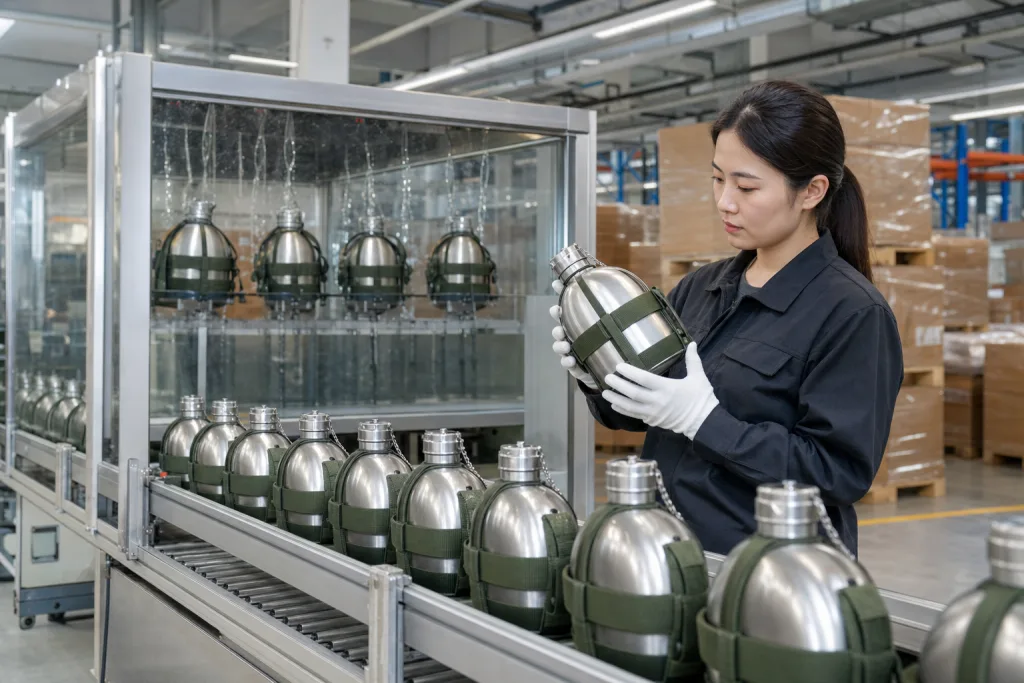
At BottleForge in Zhejiang, we see this often: a distributor wants 5,000 to 20,000 units, needs logo placement, and wants the first sample in 7 to 10 days. That is workable, but only if the canteen custom details are locked before sampling. This is the wrong question to ask: “Can you make a metal canteen?” China has plenty of canteen manufacturer options. Only a small group of canteen factories run repeatable QC, REACH-aware finishes, and export packaging that survives FOB shipping into Europe or North America. We ship test cartons with a 5-layer outer box and 10 mm EPE when the buyer flagged transit damage before, because we’ve seen this go sideways.
Start with the end use
The fastest way to waste money is sourcing before you define use. A distributor military canteen for outdoor retail, tactical shops, or a corporate promo program should not share the same build. A gift-grade canteen promotional item might only face a few office handoffs. A field-use canteen needs tighter cap retention, leak testing at the line, and coating resistance after drop checks. Sounds obvious. We still see buyers ask for price first, then change the spec after the first sample.
Write the job in plain words: capacity, user, and abuse level. A 750 ml or 1,000 ml custom canteen in 304 stainless with a 0.5 mm body is a common commercial spec, and we usually confirm wall thickness with an ultrasonic gauge before mass production. If you need a military-style shape, confirm whether the buyer wants a single-wall canteen, double-wall insulated version, or a nested cup set. This is the wrong question to skip. For distributor drinkware programs, the best option is usually the simple one that passes drop, vibration, and odor checks without adding custom parts that slow the quote.
- Capacity: 500 ml, 750 ml, 1,000 ml
- Material: 304 stainless or BPA-free PP cap components
- Finish: matte powder coat, brushed, or plain polished
- Use: retail, promo, outdoor, survival, institutional
If your customer wants a customizable canteen for brand campaigns, hold the geometry steady and change only color, logo, and packaging. We run this setup all the time at 1,000 pcs MOQ because it keeps tooling risk low, and the factory can quote from day one without guessing around a new neck size or cap thread. The math doesn't work if every campaign asks for a new mold.
Lock the spec sheet first
Good buyers do not send “customized drinkware” and wait for the factory to guess. They send a spec sheet. For a distributor military canteen, that sheet needs material grade, wall thickness, cap type, gasket material, logo method, packaging format, and testing standard. If those points are missing, 5 factories will quote 5 different bottles, and the comparison is useless. We see this on the line all the time: one buyer means a 0.5 mm single-wall body, another expects a heavier shell and never wrote it down.
Use numbers. A workable spec reads like this: 304 stainless steel body, 0.5 mm wall, 18/8 composition, silicone gasket, PP lid, laser logo 30 x 20 mm, individual kraft box, drop test from 1 meter, leak test 24 hours inverted. Clear enough. If you want a customized canteen with a premium finish, ask for powder coating thickness around 60-80 microns, and make the factory check it with a coating thickness gauge, not by eye. If the order is for promotional resale, a printed logo is often enough, but the abrasion math does not work the same as engraving. QC pulled samples last month where the buyer flagged rub-off after 300 wipes because the PO only said “logo black.”
For a canteen custom project heading to Europe, ask the canteen manufacturer for REACH declaration and food-contact conformity. For North America, ask for California Prop 65 awareness if coatings or inks are involved. This is the right question to ask early, not after sampling. A serious canteen factory in Zhejiang should provide sample photos, dimensional drawings, and a pre-production approval sheet before mass production starts. We ship smoother when the drawing shows neck diameter in mm and the approval sheet matches the carton mark exactly—last season one PO even had the logo position typoed by 2 mm.
Price the order like a buyer
Bad deals usually start with the wrong question: “What’s your unit price?” A distributor military canteen from China may quote at USD 2.10 EXW and still land at USD 3.60 to 5.20 after logo work, inner boxes, master cartons, freight, and duty. We’ve seen this go sideways. One buyer pushed hard on 10 cents, then got hit later by a 5-ply carton upgrade and a barcode label added at packing. Price it in layers instead: blank unit price, decorated price, packaging price, and MOQ breaks.
For standard stainless custom drinkware, factory pricing usually moves at 1,000, 3,000, and 5,000 units because the line setup and packing labor change there, not because someone felt like changing the quote. A laser logo may add USD 0.20-0.60 per unit. Full-color print can add USD 0.15-0.40. If you want a custom growler with the canteen program, bundle it only when the lid system and surface finish can run on the same line; if one item needs powder coat and the other needs brushed finish, the math doesn’t work and you pay setup twice. A Zhejiang canteen manufacturer with stable output can usually produce 80,000 to 120,000 units per month across mixed drinkware lines, but QC pulled the sample on more than one project where decoration capacity, not bottle forming, held the ship date.
Ask for a quotation that separates tooling, sample fees, decoration, cartons, and freight assumptions. If the supplier will not do that, they are not ready for distributor work.
For canteen vendors, transparency is not optional. It protects your margin when the buyer flags an artwork change in week three, or when a PO typo changes a 24-unit carton pack to 20 and the whole packing cost has to be recalculated.
QC the sample before mass production
Your sample is not a freebie. It is the production standard for the whole PO. Check the distributor military canteen sample by hand: fit, finish, odor, logo position, and leak performance. We run the cap open-close test 50 times on the bench, then invert the bottle for 30 minutes on kraft paper to catch slow leaks. Fill it with hot water if the product will ever take warm liquids. If the gasket still smells after one rinse, this is the wrong question to ignore; we have seen that issue turn into return claims fast.
At sample stage, ask the canteen manufacturer to confirm these points in writing: dimension tolerance within ±1.5 mm on body length, logo position within ±1 mm if it is laser or print, and no visible burrs at the rim or thread. QC pulled samples before where the thread crest had a small burr you could feel with a fingertip, and the buyer flagged it at once. If you are buying customized canteen products for retail, request a carton drop test and transit vibration simulation. For export, an AQL plan of 2.5 for major defects and 4.0 for minor defects is normal. Critical defects should be zero: leaks, sharp edges, contaminated interiors, wrong logo. The math does not work if you waive these now and sort complaints later.
Do not approve a sample from photos alone. A canteen supplier in China can shoot a clean picture and still fail sealing on the third cap rotation. We have also seen a signed PO with one logo position typo carry all the way to the line. Ask for a retained golden sample, signed and dated, before the production run begins.
Choose the right decoration method
Decoration is where a custom piece either holds up or starts to look like giveaway stock after 30 days in the field. For a distributor military canteen, laser engraving is usually the safe call on products that get knocked around in trucks, racks, and range bags. It does not peel. On brushed stainless, it reads clean; on our line, QC pulled samples after a 50-cycle rub test and the mark still held. Silk print costs less for big logos and color branding, but cure control has to be right, and we have seen scuffing show up after hard abrasion. Powder-coated shells also take laser marking well, giving a sharp contrast effect if the coating thickness stays around 60-80 μm.
If the program needs a canteen customized with unit names, event years, or serial numbers, laser is usually the better route. If the order is a canteen promotional bundle with matching colors across 10,000 units, screen print or heat transfer is often the practical answer because the line runs faster and color matching is easier to hold lot to lot. A good canteen vendor should tell you directly when strokes are under 0.2 mm, artwork is too detailed, or the logo sits too close to the side seam. This is the wrong question to ask: “Which method is cheapest?” Ask which method survives shipment, handling, and end use without rework. We ship plenty of repeat orders where the buyer flagged tiny text on the PO, and moving it 3 mm saved the run.
- Laser engraving: durable, low risk, usually USD 0.20-0.60/unit
- Silkscreen: cost-effective for 1-2 colors, faster setup
- Pad print: useful for curved zones and smaller marks
- Powder coat: adds value, but confirm adhesion and chip resistance
For a canteen distributor selling into outdoor and tactical channels, durable decoration usually matters more than flashy artwork. We have seen the opposite choice go sideways—great-looking graphics at first, then edge wear after cartons shift in transit.
Protect the shipment and paperwork
Export trouble usually starts after the bottle passes inspection. We’ve seen clean goods arrive with dents because the packout was wrong, not the product. For distributor canteen programs, we run inner polybags or tissue wrap, then a fitted box, then a master carton with corner protection. A carton spec of 5-ply is common for lighter orders; heavy stainless sets may need 7-ply or extra dividers. On the line, QC will often do a 76 cm drop check on the packed sample before we ship. If you are shipping FOB from Zhejiang, make sure the outer carton mark is legible and the carton count matches the packing list exactly. This is where one typo on a PO can turn 1,200 pcs into a claim.
Paperwork should be boring. That is a compliment. Ask for the commercial invoice, packing list, HS code suggestion, country of origin, and test reports if your channel partner requires them. For Europe, keep REACH and food-contact files ready to send the same day. For North America, make sure your cartons and labels can carry SKU, barcode, and FNSKU if the order later moves into marketplace fulfillment. We’ve had buyers flag label layouts over a 2 mm barcode quiet-zone issue, so this is not admin fluff. A distributor military canteen line often becomes a distributor growler or sports bottle line later, so keep labeling standards consistent across SKUs. The wrong question to ask is “Can you add the label later?” If 18 SKUs are already in the system, the math doesn’t work.
Buy from China and make export boring. That’s the job. The best canteen manufacturers in Zhejiang know a clean pallet, correct carton count, and stable packing process matter as much as the bottle itself. We ship plenty of orders where QC pulled the sample, found one mixed carton, and stopped loading until the count matched. That extra 20 minutes at the warehouse saves weeks of back-and-forth later.
Set the reorder plan early
One-off orders kill margin. If the first run moves, set the reorder plan before the season closes. For a distributor military canteen program, we usually tell buyers to freeze 1 approved sample, 1 packaging master, and 1 color standard at the factory; on our line that means the sealed sample stays tagged at the spray booth and the carton master sits with the die-cut file. The second PO goes faster, and the extra setup math doesn’t work if you rebuild the same item every time. If the first SKU stays clean, you can roll into a customized growler or other customized drinkware with the same decoration workflow and avoid rechecking every print position from zero.
Ask the canteen factory for repeat-order lead time, not just first-order lead time. A good Zhejiang canteen manufacturer can often repeat a confirmed stainless order in 25 to 35 days after artwork approval, compared with 35 to 45 days for a fresh run. We’ve seen buyers push back here and ask for 20 days on 304 stainless with a new gift box; this is the wrong question to ask. First check what is actually frozen: artwork, Pantone, inner tray, barcode, carton mark. If you need seasonal stock, place the reorder before the first PO sells through. Do not wait for zero inventory—then you ship expedited freight to save a month you already lost.
The practical rule is simple: keep the product stable and change the branding only where needed. QC pulled a repeat sample last month and the only drift was a 1.5 mm logo shift because the buyer flagged a revised PO file with the old mockup attached. That is how second and third shipments go sideways. Let the factory run the repeatable work, and canteen distributors protect margin without inviting quality drift.
Send your spec and get a real quote
If you need a distributor military canteen from China or Zhejiang, send capacity, material, logo, and target MOQ. We will quote the order the way buyers actually use it.
Frequently asked questions
What MOQ should I expect for a distributor military canteen order?
For a stainless distributor military canteen, MOQ is usually 1,000 to 3,000 units per design and color. If you add custom logo work or a special lid, some canteen manufacturers will ask for 3,000 units to keep setup costs sane. In Zhejiang, a capable canteen factory may support mixed SKUs if the body is shared and only decoration changes. Sample orders are often 1-2 pcs, sometimes 5 pcs if there is tooling risk. If the supplier quotes 300 units with a full custom shape, check the hidden costs carefully.
How do I know if the quality is good enough for export?
Ask for three things: material proof, test standards, and inspection plan. For export-grade custom drinkware, 304 stainless, silicone gasket, and food-contact declarations are normal. QC should include leak testing, cap cycle testing, and AQL inspection, typically 2.5 major and 4.0 minor. A reliable canteen supplier in China should also show REACH-related documentation for Europe and clear carton labels for North America. If the factory refuses to share a control plan, that is a red flag regardless of the unit price.
Is laser engraving better than printing for a custom canteen?
For a distributor military canteen, laser engraving is usually the safer choice because it does not peel or fade. It works especially well on brushed stainless and powder-coated surfaces. Printing is cheaper and faster for large logos or full-color branding, but it can scuff under abrasion. Expect laser to add around USD 0.20-0.60 per unit, while print may add USD 0.15-0.40 depending on color count and setup. If the product will be used outdoors or handled by end users every day, engraving is the cleaner long-term answer.
What lead time is realistic from a canteen factory in China?
For a standard order from a Zhejiang canteen factory, sample lead time is often 7 to 10 days. Mass production usually runs 30 to 45 days after sample approval and deposit, depending on decoration and packaging. Reorders can drop to 25 to 35 days if nothing changes. Freight is separate, so do not confuse production time with total landed time. If you need peak-season stock, add at least 2 extra weeks for booking, inspection, and export paperwork. China can move fast, but only if your artwork and spec are final.
Can I bundle canteen, growler, and bottle programs together?
Yes, but only when the manufacturing workflow matches. A distributor canteen order can sometimes share decoration, cartons, and QA with a custom growler or sports bottle line, which helps your margin. The key is to avoid forcing unrelated molds or lid systems into one PO. If the products all use stainless bodies and similar laser or print methods, bundling is efficient. If one item needs insulation and another does not, the factory may split the line anyway. A good canteen distributor strategy is to bundle the artwork, not the tooling, unless the factory confirms compatibility.