Key Takeaways
- Most distributor kids water bottle orders work best at 250-500 ml, with 350 ml the safest school size
- A flip-top PP cap with silicone seal usually passes leak checks better than basic screw lids in backpack use
- For custom children water bottle projects, MOQ is often 1,000-3,000 pcs and decoration adds 3-10 days
- Ask for AQL 2.5/4.0 inspection, REACH-compliant materials, and drop-test results before you place a bulk kids bottle order
If you’re buying for a distributor kids water bottle program, the wrong spec costs more than the unit price. We’ve seen a 280 ml bottle leak in school backpacks, a cap fail after 3,000 cycles on the torque tester, and print peel after 20 washes. That turns a routine reorder into claims, returns, and lost margin.
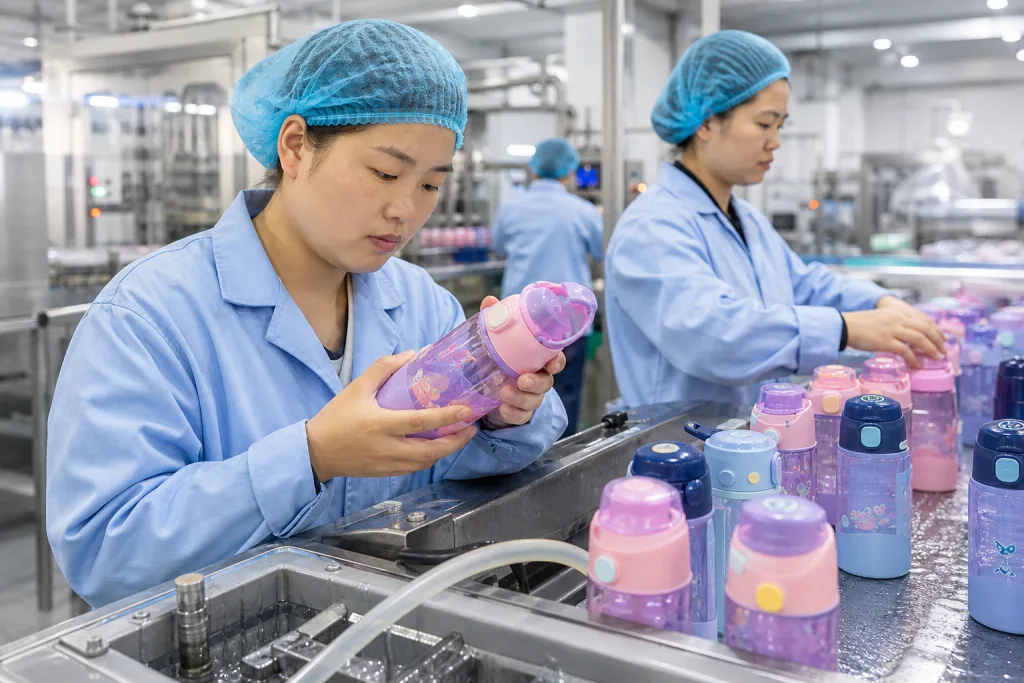
The right way to source in Zhejiang or wider China is to start with the use case, then fix the material, cap, and decoration. This is the first thing to sort out. For school districts, you may need a bulk school water bottle with a one-handed lid, low odor, and a spout sized right for smaller hands. For retail, you may want a custom kids bottle with a logo, carton-ready packing, and a 45-day lead time. At BottleForge Industrial in Hangzhou, our kids bottle lines run 120,000 units per month, with MOQ from 1,000 pcs on standard molds and 30-45 days for most custom orders. Last month, a buyer flagged a PO typo on carton marks 24 hours before mass packing, and we still shipped on plan because the line had not sealed the outer cases yet.
Start with the use case, not the catalog
Buyers searching distributor kids water bottle often ask for price first. Wrong question. We start with end use and how the bottle will be carried, dropped, washed, and packed out. A bulk children water bottle for kindergarten does not need the same build as a custom school water bottle for primary students or a promotional kids bottle for a retail chain. Mix those together and the math doesn't work: you pay for features the channel will not use, or you cut spec now and pay later in claims. On our line, QC pulled a sample last month with a strap anchor shifted 1.8 mm, and that kind of miss matters fast on a kids item.
Use-case fit is simple and practical:
- School district: 350-500 ml, one-hand lid, name label area, dishwasher-safe parts.
- Retail/distributor: 300-400 ml, strong visual design, custom logo kids bottle packaging, barcode-ready carton.
- Promotion: lower cost, simple decoration, children water bottle promotional pack, short lead time.
For a children water bottle distributor, the fastest supplier check is to request the same 3 data points from each children water bottle supplier: exact capacity, tested leak method, and unit carton spec. We ship quotes every week from Zhejiang where 6 factories may offer “similar” bottles off the same photo, but one uses a 0.35 mm straw, another packs 48 pcs per carton, and another has no real leak test record. What matters is fit for the sales channel. A school district buyer will push on safety, drop resistance, and spare parts. A gift distributor will flag shelf appeal, color match, and print edge sharpness. The best children water bottle wholesaler is not the cheapest one; it is the one that fits the use without hidden failures. We've seen this go sideways over a PO typo on carton size alone.
Compare the main materials head to head
For a bulk kids water bottle program, material choice hits the numbers fast: unit cost, carton weight, odor complaints, and how often the buyer flags leakage after drop test. We run into this at RFQ stage all the time. PP, Tritan, and stainless steel do different jobs, and this is the wrong question to ask if a buyer only says “which one is best.” For school tenders and giveaway programs, PP is usually the low-cost route. For retail shelves where clarity sells the bottle in 3 seconds, Tritan looks better. If the market expects insulation or a heavier hand feel, stainless is the fit, but the math changes on freight and target price.
| Material | Typical capacity | FOB China price | Best fit |
|---|---|---|---|
| PP | 300-500 ml | USD 1.20-2.10 | Bulk children water bottle, school programs |
| Tritan | 350-650 ml | USD 2.10-4.20 | Retail, premium custom kids water bottle |
| 304 stainless | 350-500 ml | USD 3.50-7.80 | Higher-value custom made kids bottle |
PP usually comes in at 45-70 g for a 350 ml body, so we ship more pieces per carton and freight stays under control. Tritan is often 80-120 g, with better transparency and cleaner color matching; on the line, buyers like it when Pantone-matched lids sit next to a crystal-clear body. Stainless is heavier at 140-220 g, depending on wall thickness, bottom shape, and lid set, and QC pulled samples before where a 0.4 mm body dented after repeated drops. A solid children water bottle manufacturer in China should tell you the resin grade or steel spec straight, not just say “food grade.” If they cannot confirm BPA-free status, REACH file support, and standard wall thickness like 1.2 mm or 0.5 mm, keep looking. We’ve seen this go sideways when a PO says Triton instead of Tritan and nobody catches it until pre-production.
Lid design decides the complaint rate
Most returns on a custom kids bottle start at the lid, not the body. We see this on the line all the time: QC pulled 12 complaint samples last quarter, and 9 were leak issues from caps, hinge parts, or gasket fit. If a bottle leaks inside a school bag, nobody asks who molded the silicone ring. They blame your brand. So skip the catalog language and check lid design like a production engineer. For distributor kids water bottle orders, a flip-top lid with a silicone gasket and lock button is usually the safer bet. Unit cost runs a bit higher than a plain screw cap, but the math works if it cuts claims and re-shipments.
What usually works
- Flip-top with lock: best fit for bulk school water bottle programs. Kids can open it one-handed, and the lock helps after a 1 meter desk drop. MOQ is often 3,000 pcs per color.
- Screw cap with loop: lower cost, but we’ve seen this go sideways. Buyers like the simple tooling, then later flag cross-threading, over-tightening, or lost caps during term use.
- Straw lid: good option for younger kids, especially 350 ml to 500 ml sizes. The weak point is cleaning. If the straw brush is missing from the set, complaints usually follow.
Ask your children water bottle suppliers for a leak test at 1 meter drop, 30 minutes inverted, and 3,000 open-close cycles. Those are baseline numbers, not premium ones. We run a torque check on the cap and a Shore A hardness check on the gasket because this is where trouble starts. A factory with a BSCI audit and clear production control in Zhejiang or another export hub in China is fine to have, but this is the wrong question to ask first. Real proof is lid fit with no rocking, gasket hardness that stays stable lot to lot, and no flash left on the sealing edge under inspection. For school district buyers, also ask whether the lid parts are separately replaceable. One buyer flagged a PO typo on spare seals after shipment, and it still saved the order— a 3-cent seal beats a 100% bottle replacement.
Decoration choices change selling price
For a custom children water bottle, decoration does more than add a logo. It changes shelf feel, MOQ, and lead time on the line. For a chain-store children water bottle custom program, the wrong print method can make a good bottle look like a low-end item in 3 seconds flat. For seasonal retail under a children water bottle distributor program, speed matters more than fancy graphics sometimes; we’ve seen a PO miss back-to-school because the buyer pushed for a full-wrap effect on a tight 18-day ship window.
The basic options are silkscreen, heat transfer, pad print, UV print, and laser engraving on metal parts. Silkscreen is still the workhorse for a bulk kids bottle order because we run it fast, the math works, and QC knows where failures show up first. Expect roughly USD 0.08-0.25 per color per unit, with 5-7 days extra for setup and curing. On our side, screen mesh choice and jig fit matter more than buyers expect; if the bottle body shifts even 1.5 mm, the logo looks off-center. UV print gives stronger visuals on some plastics, but surface prep has to be clean or adhesion fails in tape test. Laser engraving is usually reserved for stainless lids or metal surfaces and fits premium custom logo kids bottle projects better.
“If your channel is school procurement, keep the artwork simple. One logo, one Pantone match, one carton label. Complexity raises scrap rate and adds 7-10 days.”
When buyers ask for children water bottle customized artwork, I usually lock the print area and line thickness first. This is the right place to push back. Fine text under 1.2 mm often breaks in production, and character graphics with small outlines are where QC pulled the sample and flagged ink fill more than once. If your brand uses a lot of illustration detail, ask for a physical sample, not only a PDF. We’ve seen this go sideways when a buyer approved artwork on screen, then rejected the first 500 pcs because the eyes on a cartoon bear closed up after curing. A children water bottle vendor who sends a real sample with an ink adhesion test is usually easier to work with than one promising perfect renderings only.
Safety paperwork is not optional
Any children water bottle manufacturer worth buying from should price compliance into the quote from day one. This is not extra paperwork. For Europe and North America, we usually send three basics first: a food-contact declaration, REACH support for resin and coating, and BPA-free test reports where that claim appears on the artwork. School buyers often push one step further. We have seen compliance teams ask for ASTM-related references, phthalate screening, or migration testing based on the lid structure and the market.
Do not accept “safe material” or “eco-friendly” on a datasheet. The buyer should ask for the exact resin grade, ink type, and seal material, down to the silicone hardness if the spout or gasket uses silicone; 60 shore A is common, but QC needs the actual spec and food-contact confirmation. On mixed-color children water bottle wholesale orders, ask whether the masterbatch pigments are covered under the same standard. This is where deals go sideways. For a distributor kids water bottle line, each colorway should run the same BOM, not one lid seal in clear silicone and another in recycled blend because the line was short on stock. A Zhejiang factory can control this cleanly if you lock it before sampling. After approval, the math doesn't work.
- Request test reports dated within 12 months.
- Match the factory name on the report to the shipping entity.
- Ask for carton labels and HS code support before booking freight.
If the order is shipping to a school district, file records by PO number and production lot. We had one buyer flag a PO typo 8 weeks after shipment and ask for full traceability by carton mark. Boring work, yes. You still need it.
MOQ, lead time, and freight math
Buyers fixate on unit price and miss the freight math. That is the wrong question to ask. On kids bottle orders, MOQ and carton loading decide margin just as much as ex-works cost. A standard children water bottle supplier in China may quote 1,000 pcs MOQ for stock molds, 3,000 pcs for custom colors, and 5,000 pcs if you want a new mold or special lid. That is normal on the line. What matters is whether those quantities match your monthly sell-through, not whether the first quote looks cheap. We have seen POs delayed because the buyer pushed for 2,000 pcs on a color run that needed a full pigment batch.
Typical lead times from a children water bottle factory in Zhejiang are 15-20 days for stock items, 25-35 days for color or print customizations, and 35-50 days for new mold work. Then add 7-12 days for ocean freight to the US West Coast, plus inland delivery. We usually tell buyers to plan 12 days port to port and 18 days if the container gets rolled once. If you are a children water bottle distributor serving multiple channels, build your forecast around carton quantity, not bottle quantity. A 350 ml bottle packed 24 pcs per carton may save warehouse space against a 12 pcs display pack, but shelf impact changes and the math does not always work. QC pulled one sample last month where the display tray looked good, but the carton cube jumped enough to wipe out the promo margin.
Shipping weight moves fast with lid style and carton size. A 350 ml PP bottle at 60 g plus packaging may land around 10-12 kg per carton. Scale that across 10,000 pcs and freight turns into a line item you cannot ignore. The best children water bottle vendor will quote FOB, carton dimensions, gross weight, and sample turnaround in one sheet. We run a quick carton check with a tape measure and floor scale before we release the PI, because buyers flag missing CBM data all the time. If the supplier leaves this out, you end up rebuilding the quote by hand.
Build the spec sheet before you ask for price
If you want quotes you can compare, send a spec sheet instead of a two-line email. We see this every week: buyer asks for “kids bottle, good price,” then the line loses 2 days chasing basics. A clean spec sheet cuts revision rounds and keeps factories on the same target. For distributor kids water bottle sourcing, lock six points before RFQ: capacity, material, lid style, decoration method, packaging, and compliance target. That is enough to screen out traders fast. We’ve seen this go sideways when one supplier quoted 350 ml net fill and another quoted 350 ml brimful.
Here is the minimum you should lock:
- Capacity: 300, 350, 450, or 500 ml.
- Material: PP, Tritan, or 304 stainless.
- Lid: flip-top, straw, or screw cap.
- Decoration: silkscreen, UV print, pad print, or engraving.
- Packing: polybag, color box, or retail carton with barcode.
- Compliance: REACH, BPA-free, food-contact declaration, or market-specific tests.
For a custom school water bottle order, keep the artwork to one logo and one dominant color unless the retailer is paying for shelf impact. That is the wrong place to get fancy if your MOQ is 3,000 pcs. For a children water bottle customized for promotions, the fastest route is usually a stock mold, one-color print, and standard export carton. We ship those jobs faster because QC pulled the sample once, approved the print position, and the line just runs. That is how you stay near USD 1.50-2.50 instead of sliding into premium cost. In China, a lot of factories can produce a bottle; far fewer can hold the same spec six months later on a repeat PO without cap shade drift or a barcode typo. That is the gap between a one-off buy and a real children water bottle wholesale program.
Request a kids bottle spec and FOB quote
Send your capacity, lid, and artwork. We will match the right mold, price, and lead time for your channel.
Frequently asked questions
What MOQ should I expect for a custom kids water bottle order?
For standard stock molds, MOQ is usually 1,000 pcs. If you want custom color, print, or packaging, plan for 3,000 pcs. New mold or special lid projects often need 5,000 pcs or more. A children water bottle factory in Zhejiang may accept mixed colors, but the unit price rises fast if you split too many SKUs. For school district buyers, one 350 ml model with 2-3 colors is easier to manage than five small variants.
Which bottle size sells best for school buyers?
For school district use, 350 ml and 450 ml are the safest sizes. 250-300 ml is too small for older kids, and 500 ml can feel bulky in a backpack. A bulk school water bottle around 350 ml gives a good balance of weight and hydration. In practice, that size also packs well, usually 24-48 pcs per carton depending on packaging. If you need a custom school water bottle with a name label, keep the body diameter comfortable for small hands.
How do I check if a supplier is reliable?
Ask for factory audit status, test reports, and a production video showing molding, assembly, and packing. A real children water bottle supplier should quote lead time in days, not vague weeks, and should give you FOB terms, carton dimensions, and defect handling terms. If they can show AQL 2.5/4.0 inspection records and a monthly output figure, that is a good sign. In China, especially Zhejiang, the good factories are usually specific about process because they actually control it.
What decoration method is best for retail orders?
For most retail bulk kids bottle projects, silkscreen is the best mix of cost and durability. It is usually the cheapest at volume and works well for 1-2 colors. If your design is detailed, UV print gives better visual impact, but it needs a cleaner surface and adds cost. Laser engraving is best on stainless parts, especially for a premium custom logo kids bottle. For school or promotional programs, keep the print simple to reduce scrap and rework.
Can I get compliance documents for Europe and North America?
Yes, if you work with a proper children water bottle manufacturer. Ask for food-contact declaration, REACH-related support, BPA-free confirmation where relevant, and migration or material test reports. For some North American buyers, ASTM-related references or additional chemical screening may be required by your compliance team. Make sure the paperwork matches the exact product code, lid material, and decoration method. If you change a seal or print ink, request updated documents before shipment.