Key Takeaways
- Typical MOQ for a distributor kids drink bottle starts at 3,000 pcs, with 25-35 day production after approval.
- Tritan, food-grade PP, and 304 stainless each solve different use cases; pick by age, weight, and leak risk.
- A proper QC plan should include AQL 2.5 visual inspection, leak testing, and cap cycle testing at 3,000 opens.
- For branded orders, print durability matters more than artwork complexity; one-color silkscreen is often the safest option.
You are not buying a cute bottle. You are buying a repeatable, low-complaint SKU that survives school bags, dishwasher cycles, and a few thousand drops. For a distributor kids drink bottle program, the real risk is not the unit price. It is cap leakage, weak print, off-spec capacity, and missing compliance papers when your retail customer asks for them on Friday. We have seen a 5 mm gasket issue turn into a full carton hold, and the buyer flagged it only after the first drop test.
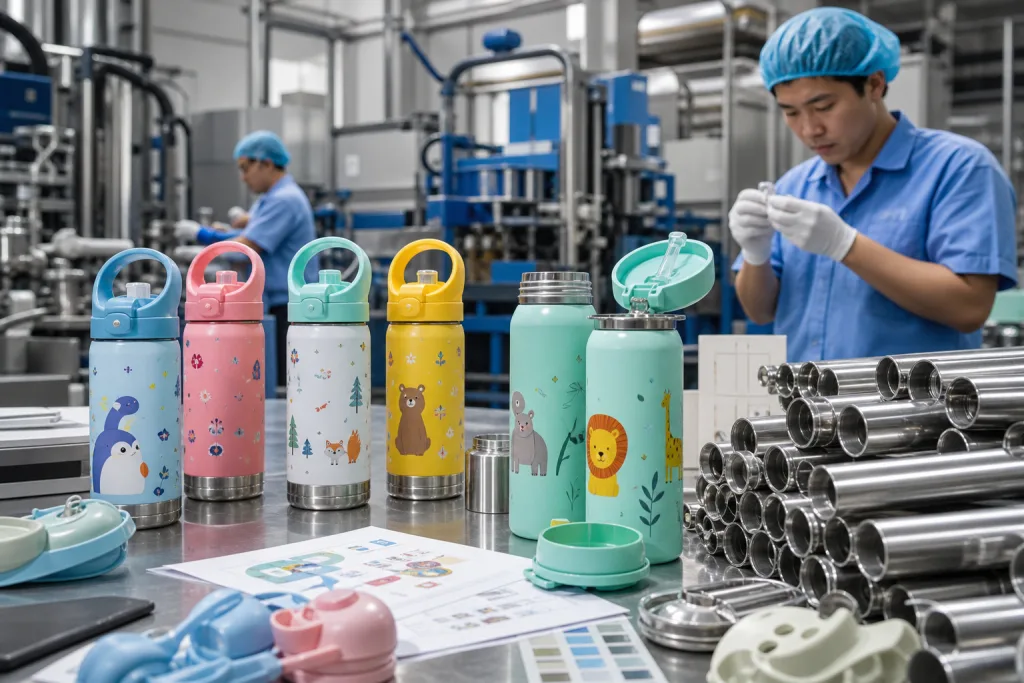
At BottleForge in Zhejiang, we run these orders the same way every day: define the use case, lock the material, confirm decoration, then QC the shipment against AQL. This is the right order. If you start with artwork and ignore the lid structure, the math doesn't work. A solid kids bottle program can start at 3,000 units, run with a 25-35 day lead time after sample approval, and stay profitable if you treat it like a supply chain project, not a gift item. On the line, QC pulled the sample and checked fill volume against the PO before packing. China can do this well, but only if you specify it well.
Start with the child, not the artwork
When a distributor asks for a kids bottle, the first mistake is going straight to logo position. Start with the child. Age band, drinking style, and daily use decide the bottle first. A 400 ml bottle for preschool is not the same item as a 600 ml school bottle, and on our line the weight gap alone is often 35 g to 60 g once you change body diameter and lid structure. For younger kids, low weight and easy grip matter more than a fancy finish. For older children, you need a stronger lock, a faster flow rate, and a cap that still closes after getting slammed into a backpack 200 times. We have seen buyers ask for soft-touch paint on a kindergarten SKU; this is the wrong question to ask.
For a typical distributor kids drink bottle program, we cut the spec with three direct checks. First, does the child need a straw, a spout, or a chug mouth. Second, is it for cold water only or for warm drinks up to 45°C. Third, must it fit a school cup holder or a lunch bag pocket—on one PO last season, the buyer flagged a 72 mm base because their pocket opening was only 70 mm. Skip these checks and the order goes sideways. You end up with a canteen custom order that looks good in photos but fails in real use. QC pulled samples like this before: nice print, clean color, then seepage at the hinge after the inverted test. A canteen distributor knows the problem well. The market asks for attractive custom drinkware, but parents check cleaning and leakage first.
Practical starting specs
- Capacity: 350 ml, 400 ml, 500 ml, or 600 ml
- Weight target: under 180 g for plastic models
- Leak target: 0 leaks in 24-hour inverted test
- Drop target: 1.2 m onto plywood, 3 cycles
If you want a canteen promotional item, fine, but for retail and school channels you need a real distributor canteen spec sheet, not a pretty render. We usually start with a lid made from fewer parts, then check seal compression with a go/no-go gauge before mass production. Zhejiang buyers push for simple structure first because it scales faster and gives fewer QC problems in China production. The math does not work if the bottle looks sharp on screen but fails after 12 drops in a school week.
Pick the material that fits the channel
Material choice shows up later as return rate, not just FOB. For kids’ bottles, we usually run three body materials on the line: Tritan, food-grade PP, and stainless steel. Tritan gives you shelf clarity and a cleaner premium look, but the resin cost is higher. Food-grade PP is lighter and cheaper, which matters when the target is under USD 1.80 FOB on larger runs and the MOQ is 5,000 pcs. Stainless steel fits programs that need temperature retention or a tougher premium SKU, but then weight, rolled edges, and drop safety need closer control.
For a distributor kids drink bottle program, I usually put Tritan into mid-market retail, PP into promotional and school campaigns, and 304 stainless into lines where the buyer can carry a higher MSRP. If you need a custom canteen or customizable canteen with a handle and leakproof lid, PP is usually the easier tooling path; we can cut revisions faster on the mold and keep the handle boss area around 2.0 mm. If the customer asks for a customized canteen with double-wall insulation, the math changes fast. At that point you are closer to a custom growler build than a basic school bottle, and we have seen buyers flag the first quote after comparing it to a single-wall PP bottle.
Do not ignore wall thickness. For PP bodies, 1.8-2.2 mm is normal for good rigidity. For Tritan, keep the base thicker if the bottle sits in lockers or gets knocked around in backpacks; QC pulled one sample last season with whitening at the base radius after a drop test. In Zhejiang, a canteen manufacturer will often suggest a slightly thicker wall than the sample photo shows because a factory in China sees what cracks during carton drop, mass packing, and transport. This is the wrong question to ask if the buyer only focuses on empty weight. That extra 0.2 mm is often the difference between a clean shipment and a claim.
“If the bottle feels good in hand but cracks at the hinge after 500 cycles, it is not a kids bottle. It is a warranty problem.”
Lock the cap before you print
Decoration is second. Cap engineering is first. On kids bottles, most claims start at the closure: leaks, cracked push buttons, tight hinges, missing seals. Before you sign off artwork, lock the cap spec and test it on the actual sample. We’ve had buyers approve a nice render, then QC pulled the sample and found the button travel was off by 0.6 mm. A solid canteen customizable design should shut with one hand, open without catching small fingers, and keep the silicone gasket seated after repeated washing.
For most distributor drinkware programs, we run cap checks before print approval: 3,000 open-close cycles on the line, a 24-hour inverted leak test, and a hot-fill deformation check if the bottle will see warm water. If there is a straw, measure the straw ID and check the internal channel for flash or black specks; a 6 mm straw that looks clean outside can still trap debris inside. If it uses a sports cap, smell-test the bite valve after contact with warm water for odor transfer. This is the wrong question to ask: “Can we skip testing to save a few cents?” The math doesn’t work. A canteen supplier who skips these checks is not cutting cost; he is pushing risk to your warehouse.
Decoration still matters, but keep it under control. One-color silkscreen, laser engraving on steel, or a small wrap label usually holds up better than full-surface print on a moving cap. For a canteen customized order, keep artwork off hinge lines and grip zones. We’ve seen this go sideways fast: the buyer flagged logo stretch on a curved body after carton drop and rub, even though the preproduction PDF looked fine. On shaped bottles, distortion shows early, and abrasion from carton partitions will kill weak print first. The better choice is a clean layout that survives packing and handling, not a busy canteen promotional design that wins approval on screen and fails after shipment.
- Keep print 8-12 mm away from seams and ribs
- Use Pantone references, not vague color names; we still see POs marked “sky blue” with no chip
- Ask for tape rub test at 50-100 cycles
- Confirm dishwasher resistance if your market expects it
Build the spec sheet like a buyer
Good sourcing starts with a spec sheet that your canteen vendor, factory, and QA team read the same way. A picture plus a logo file is not a spec. We ask for capacity tolerance, full dimensions in mm, raw materials, accessory list, pack-out, carton loading, and compliance points on page one. On our line, QC pulled a pre-production sample last month where the straw length was 6 mm short because the PO only showed a rendering. That is how production drift starts.
For a standard kids bottle, I would write the spec this way: body material, lid material, silicone grade, Pantone color codes, capacity tolerance within +/- 5%, leak requirement, fall test height, print location with size in mm, individual packaging, master carton count, and label format. A common MOQ note is 3,000 pcs per color per size, so put that in too if the buyer flagged split-color packing. If you sell into the US or Canada, ask for REACH and LFGB if your channel needs them, and keep the file set ready for retailer review. For Europe, material declarations matter. For North America, ASTM-related test support may sit on the table depending on age grading and product claims. Buyers ask for everything up front sometimes. This is the wrong question to ask. Ask what the retailer or channel actually requires.
Here is what new buyers miss: packaging is part of the product. A 400 ml customized drinkware piece in a plain polybag may pass for a B2B giveaway, but it usually fails for ecommerce or club retail once the carton takes a 76 cm drop. If the item is a distributor kids drink bottle for mixed-channel distribution, specify barcode placement, master carton strength, inner pack count, and drop protection. We have seen this go sideways when a buyer sent the FNSKU file after the outer cartons were sealed, and then 1,200 cartons had to be reopened for relabeling. That rework cost hurts.
In Zhejiang, the better canteen manufacturers give you a factory drawing with actual dimensions, wall thickness, and assembly notes, not just a sales sheet. We run drawings with neck finish size, handle clearance, and logo area marked in mm, then match them against the sealing jig before approval. That is the difference between a canteen distributor order that lands cleanly and one that makes your warehouse team relabel half the shipment because the buyer flagged a carton mark typo on the PO.
Sample approval is where you save money
Sampling is not a formality. This is where we save buyers from paying ocean freight on preventable mistakes. For a distributor kids drink bottle run, ask for a pre-production sample built with the final mold, final logo, and final accessories. If your PO calls for Pantone color matching or a custom flip lid, a generic sample is the wrong reference. We have seen a buyer approve from a stock bottle, then flag a 1.5 mm lid gap and logo position shift on the line. A custom drinkware program is only custom when the sample matches the production BOM line by line.
We usually run one revision for structure and one for decoration. More than that, the math doesn't work. If the buyer keeps changing the cap or body height after sample approval, lead time slips fast. In China, each tooling or insert change can add 5-10 days, and we've seen it turn a 12-day sample cycle into 18 days once mold inserts need re-cutting. A serious canteen manufacturer will label sample photos with mold numbers, revision dates, and even the cavity ID; QC pulled the sample last month and found the PO typo matched the old lid spec. Ask for those marks. They protect you later when you compare the pre-production sample with the mass run.
For buyers comparing a custom canteen, custom growler, or a kids bottle line, the economics are different, and this is where people ask the wrong question. A customizable growler can carry more weight and has fewer moving parts. A kids bottle needs stricter safety engineering, bite-valve checks, and more QA points. On our side, we run leak tests with a 0.2 MPa air-pressure rig and check strap pull force before sign-off. So test the sample like a real consumer product, not a promo item. If it passes, keep one signed reference sample sealed in your office and one at the factory in Zhejiang. That step avoids arguments once production starts in China.
QC the batch like a distributor
Once production starts, check consistency with a sampling plan, not by opening all 3,000 pieces. This is the wrong question buyers ask first. A canteen distributor cannot afford full inspection, so run a proper AQL plan. For cosmetic defects, AQL 2.5 is common. For critical defects like leakage, keep zero tolerance on the agreed test sample. On our floor, QC pulled the sample and checked molding flash at the parting line, color variation against the signed chip, print alignment within 1.5 mm, gasket fit, lid function, and carton labeling before release.
A practical QC flow for a 3,000-unit order looks like this: first article approval on the line, mid-production check at 30%, then final random inspection before packing. If the bottle has a straw or flip top, count each component and verify assembly torque with a digital torque meter. If the customer wants a customized growler style cap for an older-kid line, test torque and seal compression more strictly than on a standard bottle; we have seen 12 kgf·cm pass on one cap and fail on another with the same drawing. Small issues stack fast in mass production. One buyer flagged a loose straw retainer after 600 pcs, and the line had to stop.
Do not skip carton testing. A good bottle in a weak carton still arrives as a claim. Check inner box strength, drop resistance, and shipping marks with the same discipline you use on the product. We ship master cartons only after barcode scan, seal tape check, and a drop test from 76 cm. A broken master carton can ruin an otherwise good distributor drinkware shipment. For a canteen suppliers relationship that lasts, ask for production photos, carton loading count, and one final leak-test video before departure. In Zhejiang, that is normal factory control, not an extra favor, and it saves surprise claims after arrival.
- Visual inspection: scratches, sink marks, print shift, and flash at the gate
- Functional test: lid open/close cycle, leak check, straw pull force
- Packaging test: barcode scan, carton drop, seal tape adhesion
- Document set: invoice, packing list, CO, test reports, and the final PO revision with no carton-mark typo
Price, freight, and lead time reality
Most buyers ask for unit price first. Wrong question. The number that decides your margin is landed cost. A distributor kids drink bottle usually starts at USD 1.10-1.60 FOB for a simple PP body on volume runs, then moves to USD 1.80-3.20 for Tritan with a better lid build and cleaner fit on the spout parts. Stainless steel and heavy decoration push it higher fast; we have seen silk print plus a two-color pad print add enough labor on the line to change the quote more than the buyer expected. Tooling is separate if the structure is new. If you need a canteen customized shape, budget for mold cost and 25-45 days of tooling work before mass production, and ask for a 3D drawing check before steel cut, because one PO typo on bottle height can burn a week.
Lead time depends on season and line loading. In Zhejiang, we run fast, but Q4 and back-to-school fill the line hard. For a normal repeat order, 25-35 days after sample approval is realistic. For a new mold project, plan 45-60 days before shipping. If you are a distributor canteen buyer, protect your margin by asking for a production calendar, not just a promise. We ship quicker only when artwork, packaging, and payment are locked on time; if the insert card size changes by 2 mm after approval, the packing line stops and the schedule slips.
Freight hits harder than first-time buyers expect. A lightweight plastic bottle may look cheap FOB, but bad carton density ruins container loading math. Ask the canteen supplier for carton dimensions and CBM before you confirm. We also suggest asking for packed carton weight in kg and a loading estimate by 40HQ, because the buyer flagged this on us once after seeing too much air in a master carton. If you are shipping mixed SKUs, this is where a canteen vendor earns his keep with tighter carton planning and cleaner palletization. QC pulled the sample once on a mixed-pack order because the divider board was too soft and caps were scuffing in transit. That is basic factory discipline, not marketing.
For long-term programs, the best setup is a stable base model with minor seasonal custom drinkware changes. You keep tooling stable and cut risk. You still give the retail customer a fresh lineup with new colorways, a lid update, or a small graphic change instead of reopening the whole mold; the math does not work if every season becomes a full redevelopment. That is how a distributor growler or kids bottle program stays profitable over multiple reorder cycles.
Send your spec, get a real quote
We can review your kids bottle target, confirm MOQ, and give you a production plan with test requirements and landed-cost drivers.
Frequently asked questions
What MOQ should I expect for a distributor kids drink bottle order?
For a standard order, 3,000 pcs is a realistic MOQ at a China factory in Zhejiang. If you need a new mold, printed logo, and custom packaging, some canteen manufacturers will ask for 5,000 pcs. For repeat orders with the same tooling, 1,000-2,000 pcs may be possible, but pricing will be higher. Always confirm if the MOQ applies per color, per design, or per SKU. That detail changes your buying plan more than the headline number.
Which material is safest for kids bottles?
For a kids bottle, safety depends on material plus cap design. Tritan is popular for clear bottles because it is tough and BPA-free. Food-grade PP is lighter and lower cost, and it works well for school use. 304 stainless is strong, but it adds weight and cost. For Europe and North America, ask for REACH support, food contact declarations, and test reports. A good canteen supplier will also confirm silicone grade for seals and straws, because that is where odor and leakage issues usually start.
How do you test for leaks on a bulk order?
We use a 24-hour inverted leak test on production samples, plus repeated opening and closing on the cap. For a kids bottle with a straw or flip lid, I would also test after 3,000 cycles if the customer wants a durable retail SKU. At final inspection, a canteen factory should test random cartons before packing release. For critical accounts, you can require zero leakage on the agreed AQL sample set, not just visual inspection.
Can I customize packaging for retail or Amazon?
Yes, and you should. For retail, you may need printed color boxes, hang tags, and barcode labels. For Amazon, confirm FNSKU placement, carton barcode, and suffocation warning if applicable. A customizable drinkware order often succeeds or fails on packaging accuracy, not the bottle itself. Ask the factory for box dimensions and master carton counts early, because freight cost and shelf presentation both depend on them. Packaging changes late in the project can add 5-7 days easily.
What is a fair lead time for production and shipping?
For a repeat distributor kids drink bottle order, 25-35 days production after sample approval is normal. If you need a new mold or structural changes, add 20-30 days. Ocean freight from China to North America or Europe can add 18-35 days depending on port and season. If you buy from a Zhejiang factory, build in buffer time before back-to-school or holiday resets. A good canteen distributor will give you a schedule with sample approval, production, inspection, and ETD dates, not just one vague delivery promise.