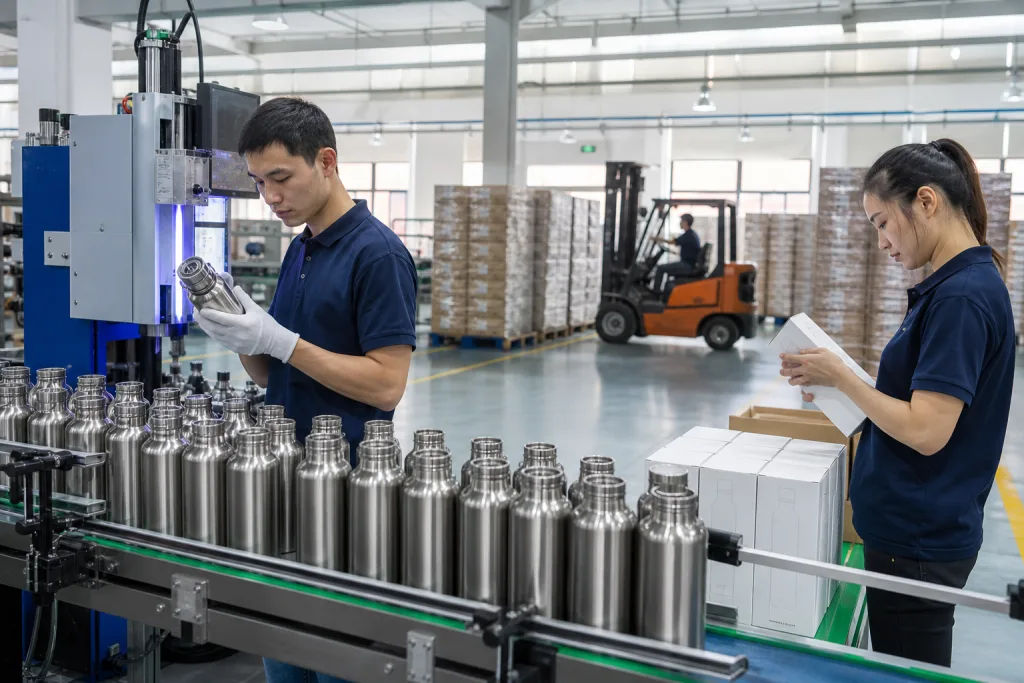
Key Takeaways
- For most distributor programs, 18/8 stainless steel with 0.4-0.5 mm outer wall and MOQ 1,000-3,000 pcs is the safest starting point
- Vacuum flasks advertised at 24 hours cold should be checked at real fill conditions, usually 95°C hot and 4°C cold, not marketing claims alone
- Decoration choice changes both cost and risk: single-color silkscreen may add USD 0.08-0.18, laser engraving USD 0.12-0.25, powder coat USD 0.35-0.80
- AQL 2.5 inspection, REACH testing, and a defined lead time of 25-45 days matter more than a quote that is USD 0.20 cheaper
You are not buying a bottle. You are buying margin, repeat orders, fewer claims, and a landed-cost sheet that still makes sense after freight, testing, and repacking. That is why a distributor hydration flask should be judged as a commercial product first and a lifestyle item second. We have seen the wrong 750 ml flask pass a sample review, then fail once the line runs 5,000 units with barcode labels, drop-test cartons, and vessel booking locked at 35 days. QC pulled the sample, and the wall thickness was 0.1 mm under the approved spec.
Most failures start with four decisions: body material, insulation performance, decoration method, and supplier control. This is the right place to press. If you are comparing a canteen custom project in Zhejiang, China with offers from several canteen suppliers, those four points tell you fast which quote is usable and which one is cheap only on paper. We have had buyers flag a price gap of $0.28 per unit, then find the cheaper factory skipped vacuum rate checks and packed 24 pcs per carton with no divider. The math doesn't work.
Start with your channel math
If you sell through retail chains, promotional distributors, e-commerce resellers, or corporate programs, one distributor hydration flask will not fit all four channels. Buyers ask for a universal SKU all the time. The math says no.
Start with four numbers: target landed cost, target wholesale price, expected annual volume, and acceptable claim rate. If your landed cost target is USD 3.80 and your wholesale target is USD 6.50, there is no room for heavy custom packaging, premium coatings, or a complex lid. If your channel can take a wholesale price above USD 9.00, a more differentiated custom drinkware program starts to work. Last week, QC pulled a sample with a 0.6 mm lid gap, and that kind of issue burns margin fast.
For a distributor canteen or distributor growler range, decide whether the product is margin-led or brand-led. Margin-led products need efficient tooling, standard diameters, and low carton waste. Brand-led products can justify custom molds, branded lids, and gift-ready packaging, but only if yearly volume supports the tooling payback. This is the wrong question to ask if the buyer has not given you a MOQ yet.
- Promotional channel: prioritize fast repeatability, logo clarity, MOQ flexibility, and safe pricing under 1,000-3,000 pcs.
- Retail channel: prioritize shelf presence, leakage control, barcode placement, transit durability, and compliance paperwork.
- Online channel: prioritize damage rate, pack dimensions, FNSKU or outer label requirements, and review-sensitive quality issues such as dents and odor.
At BottleForge Industrial in Zhejiang, China, we usually tell new buyers to lock the commercial structure before they talk cap colors. A PO typo on a 12,000 pcs order once moved the carton pack from 24 to 20, and the buyer flagged it after sampling, not before. It sounds basic, but we see projects go sideways when someone picks finishes before deciding whether the SKU is for branded retail, canteen promotional campaigns, or a price-driven distributor drinkware line.
You can recover from a plain design. You usually cannot recover from the wrong cost structure once the market price is set.
Pick the body construction wisely
This choice looks simple on a spec sheet and gets expensive fast on the PO: single wall or double wall, stainless or plastic, standard flask or wide-mouth growler. For most Europe and North America B2B programs, 18/8 stainless steel is still the safe base. We run it every week. It holds up on the line, buyers accept it without much debate, and it takes powder coating, screen print, laser, and wrap decals without drama.
For a mainstream distributor hydration flask, the spec we ship most is double-wall vacuum stainless steel, inner 304 and outer 304, with a 0.4-0.5 mm outer wall and a 0.3-0.4 mm inner wall. That balance works. It gives decent dent resistance without wrecking the unit cost. If a quote comes in far below market, ask one direct question: did they cut wall thickness, or is the vacuum yield weak? QC pulled a sample last month from a low-cost trial and the base gauge was 0.28 mm instead of 0.4 mm. The math doesn't work.
Where each format fits
- 500-750 ml flask: the core SKU for distributor drinkware programs. Easier repeat orders, easier carton planning, and fewer complaints about shelf fit.
- 1,000 ml hydration bottle: stronger perceived value on first look, but freight climbs fast and carton weight gets buyer pushback once a master carton passes 12 kg.
- Custom growler 1.2-1.9 L: a fit for outdoor, brewery, or premium gifting programs. Slower sell-through for some canteen distributors, and the wider neck usually needs its own cap tooling.
- Single-wall customizable canteen: lower cost and lighter freight. No insulation story, weaker premium feel, and more condensation complaints in summer.
If you are sourcing from a canteen factory in China, ask straight out if the lid thread is shared across body sizes. This saves headaches later. Shared neck tooling cuts replacement-part mix-ups and makes repeat orders cleaner. We have seen buyers flag a 63 mm lid on a PO that should have been 58 mm, and that small typo delayed approval by 4 days. Check the lid material stack too: PP, Tritan, or stainless at the contact points, plus whether the silicone seals are LFGB or FDA-grade for your market.
Canteen manufacturers like to show 20 body shapes. This is the wrong question to ask. You do not need 20. You need 2 or 3 shapes that match how you sell: one narrow-mouth flask for core volume, one sports-bottle profile, and maybe one customized growler for higher-ticket accounts. We have seen wide catalogs go sideways because stock gets split across near-duplicates. A tight range is easier to test, stock, and reorder, and the line changes faster when the base diameters stay within 2-3 mm.
Insulation claims need proof
Vacuum performance is where first-time buyers get sold by brochure copy. That is the wrong question to ask. A distributor hydration flask should be sold on test data from the line, not “12 hours hot” printed on a sales sheet. Ask for the actual test condition: starting liquid temperature, ambient temperature, fill ratio, and elapsed time. We usually ask for records like 95°C fill, 20°C room, 90% fill, checked at 6 and 12 hours. Without that, “12 hours hot” and “24 hours cold” mean little.
For a 500-750 ml vacuum flask, a normal commercial target is about 8-12 hours of usable hot retention and 18-24 hours of cold retention, depending on the body shape and the cap build. Shape matters. A taller, narrower body usually holds temperature better than a short, wide one because the heat-loss area is lower. On our floor, a 500 ml straight bottle with a 68 mm diameter will usually test better than a squat 500 ml body at 78 mm, even with the same 304 stainless structure.
Check the cap system as hard as the body. Most field complaints come from seal failure, not the vacuum wall. A good customized canteen for distribution should pass leak tests after thermal cycling and after drop simulation in the packed state. QC pulled the sample. We still found cap seepage after a carton drop test from 76 cm because the silicone ring was sitting 0.5 mm proud in the groove. If the product includes a carry loop or handle, test that too. We have seen buyers flag a decorative lid strap that snapped at 8 kg pull force, and then the warranty math does not work.
- Ask for a retention test record with initial and final temperatures.
- Ask for leak testing method such as inverted hold, air pressure, or vacuum verification.
- Ask about vacuum inspection rate per batch, not just per model.
- Ask how dents are controlled in polishing, coating, and packing.
For a canteen customizable program sold into Europe, define the acceptable quality level before mass production. Put it on the PO. Many importers use AQL 2.5 for major defects and 4.0 for minor defects on finished packed goods. That is a professional standard, not perfection. We have seen this go sideways when a buyer wrote “no scratches accepted” on the PO but gave no sampling plan, then the inspection team rejected packed goods for hairline marks under 30 cm viewing distance. If your canteen vendor or canteen supplier avoids AQL talk, treat that as a warning.
China has capable stainless drinkware plants, especially around Zhejiang. The gap is not sample making. Any decent shop can ship 2 approval samples. The real test is whether the factory can hold vacuum yield, leak control, and cosmetic consistency across 10,000 units packed over several PO releases. On one 12,000-piece run, the buyer flagged color variation between cartons 1-200 and 201-400 because the powder coating line changed gun settings mid-batch. That is the factory issue that matters.
Decoration drives cost and complaints
Most buyers treat decoration as branding. On the line, it is also a yield and claims decision. If you need canteen customized or customized drinkware for distributors, choose the decoration by use case first. Looks come second. We have seen buyers approve a nice mockup, then reject 6 mm logo shift on mass production because the bottle shoulder was tighter than the sample.
Silkscreen is still the workhorse for simple logos. It is economical, usually around USD 0.08-0.18 for a one-color print depending on size and order quantity, and it runs best on smooth powder-coated bottles with a stable jig. The risk is scratch-off if the ink system is wrong or the oven cure is short; QC pulled the sample once after a 3M tape test and the edge lifted on 2 out of 10 pcs. Laser engraving is more permanent and premium-looking, typically USD 0.12-0.25, but it exposes bare stainless under a coated surface, so the visual tone changes. Some buyers flag that contrast after approval. Ask before you lock artwork.
Heat transfer wraps give wider color range. Digital printing fits smaller customized canteen batches and variable artwork, sometimes from MOQ 300. The trade-off is cost and abrasion resistance. If your buyer account is a sports event, employee gift program, or school order, this is the wrong question to ask: “Which print looks best on screen?” The better question is how the logo looks after 500 rubs in a carton with dividers.
Good questions to ask canteen vendors
- What abrasion or tape tests do you run on logo adhesion?
- Can you match Pantone colors on powder coat and print separately?
- Will the logo position shift between manual and automatic lines?
- What is the decoration reject rate on dark matte coatings?
For canteen promotional orders, a proven standard body with standard coating and standard print area is usually better than a heavily customized bottle shape with an untested finish. A custom drinkware distributor makes money on repeatability. We ship faster when the print area is already locked, the screen frame is on file, and the packing method is known. If each order turns into a new engineering exercise, the math does not work. Margin gets eaten by approvals, rework, and delayed shipment.
That is why a customizable growler or custom growler needs planning. Large curved surfaces look good for decoration, but they are harder to print with stable registration and usually need more protective packing, sometimes 5-layer mailer cartons instead of standard dividers. We have seen this go sideways on wide-body growlers where the buyer wanted a wrap print and then pushed back on carton size. For premium accounts, it still works. Just leave enough time for pre-production samples and carton drop review.
Judge the factory, not the sample
A polished sample proves almost nothing on its own. QC can hand-build 3 bottles and make them look perfect under a light box. The real check is whether the canteen manufacturer runs production, inspection, compliance, and shipping the same way on your order terms, not on sample-room terms.
Ask monthly capacity for the product you are buying, not total output mixed across mugs, tumblers, and plastic items. A serious canteen factory should give you straight numbers: 300,000-500,000 stainless vacuum units per month, MOQ 1,000 pcs for standard colors, and 35-45 days lead time for first bulk orders after sample approval. Ask how many vacuum lines they run and how many necking machines are on the floor. Those numbers tell you if your 8,000-unit program will get a stable slot or keep getting bumped by a 50,000-piece reorder. This is the wrong question to ask if you only want the lowest price.
Then check the paperwork against the actual process. For Europe, REACH and food-contact compliance may be required depending on product configuration and market entry route. For North America, you may need FDA-related material declarations, and for kids' items ASTM or CPSIA-linked requirements can apply. Social compliance such as BSCI matters for some retail channels. Quality systems such as ISO 9001 are useful only if the factory can show where they use them: incoming 304 stainless check, vacuum test records, coating cure temperature logs, and final inspection reports. We have seen factories show a clean certificate, then fail to match a lid silicone report to the PO revision because one color code changed.
- Pre-production sample: confirm color, logo, barcode, and packaging details. We usually mark this against the signed artwork file and outer carton layout before the line starts.
- In-line inspection: check welds, vacuum status, print registration, and lid fit. QC pulled the sample at the 200-piece point last week and caught a 0.8 mm logo shift.
- Final random inspection: use AQL and review packed goods by carton. Ask who sets the sampling plan and whether they inspect by model, color, and packing mix.
- Shipping control: confirm carton marks, pallet rules, and loading photos. The buyer flagged one PO last month because the carton mark dropped a single digit from the item code.
Many canteen manufacturers in Zhejiang and other parts of China are solid on production and weak on documents. We see this often. If you are a new canteen distributor, ask for a written specification sheet and make the factory sign off on it. Include dimensions, weight tolerance, material grade, coating standard, logo method, packaging details, and inspection criteria. Put real figures on it, such as height tolerance in mm and unit weight tolerance in g. That one sheet prevents more disputes than a stack of chat messages, and the math does not work if the spec lives only in WeChat screenshots.
Build a repeatable sourcing program
Once you lock the right distributor hydration flask, the next step is making repeat orders simpler, faster, and lower risk. We run this by freezing the parts that do not need debate and customizing only the pieces the end customer will actually notice. On the line, that usually starts with a signed spec sheet and a 0.5 mm tolerance callout on the lid fit.
For most distributor drinkware accounts, the clean model is a core platform with controlled options: two capacities, three standard lid types, six stock powder colors, and two decoration methods. Your canteen supplier can stock common components, and replenishment moves faster. We have seen open-ended programs go sideways; the buyer asked for one more color, one more lid, one more box, and suddenly lead time became 18 days instead of 12. Attractive on paper. Messy in production.
A practical setup looks like this:
- Core SKU: 500 or 750 ml standard flask, MOQ 1,000 pcs per color.
- Logo variant: silkscreen or laser, MOQ unchanged if artwork area is standard.
- Retail pack upgrade: color box or kraft box, add USD 0.18-0.60 and 5-7 days.
- Full custom mold: only after forecast exceeds roughly 20,000-30,000 pcs annually.
If you work with multiple canteen suppliers or canteen vendors, compare total operating friction, not just EXW or FOB price. This is the wrong question to ask if you only focus on unit cost. One factory might be USD 0.15 cheaper, then take three extra days to confirm artwork and another week to correct carton marks after QC pulled the sample and found the PO typo printed on 24 master cartons. The math does not work.
For importers shipping FOB Ningbo or Shanghai from Zhejiang, China, check carton efficiency and container loading before final approval. A bottle with poor nesting or too much headspace in the gift box can push freight up fast. Ask for carton size, pcs per carton, gross weight, and a 20GP or 40HQ load estimate. We ship programs where a 5 mm change in box height cuts several hundred sets from a container, and the buyer flagged it only after booking space.
The best customized drinkware programs are not the most complex. They are the easiest to reorder with the same quality six months later. If your canteen customizable range can be quoted, approved, produced, and inspected with little back-and-forth, you have something distributors can scale. That is what repeat business looks like in a factory, not a pitch deck.
Need a workable flask spec, not just a low quote?
Send your target price, volume, market, and artwork. We will suggest a realistic distributor hydration flask specification with MOQ, lead time, and FOB guidance.
Frequently asked questions
What MOQ should I expect for a distributor hydration flask?
For standard stainless vacuum bottles from a China factory, MOQ is usually 1,000 pcs per model per color for stock finishes. If you need a custom powder color, printed box, or non-standard lid, expect 2,000-3,000 pcs. Full custom mold projects often start closer to 5,000 pcs and only make commercial sense when annual volume reaches 20,000 pcs or more. If a canteen supplier offers 300 pcs on a fully customized flask, check carefully what is actually custom. Often it means a standard body with simple logo printing only. For first orders, many B2B buyers do best with one standard body, one stock coating, and one decoration method to keep MOQ and risk under control.
How do I compare quotes from different canteen manufacturers fairly?
Make every supplier quote against one written specification sheet. Include capacity, steel grade, wall thickness, vacuum or single-wall construction, lid material, seal type, coating, logo method, packaging, carton spec, and FOB port. Without that, one quote may use 201 stainless on non-contact parts, thinner walls, or a simpler inner polish. Ask each canteen manufacturer to state unit net weight, carton gross weight, lead time, sample time, and testing included. Also compare defect control terms such as AQL 2.5 and whether third-party inspection is accepted. A quote that is USD 0.18 lower can still be more expensive if the bottle is lighter, dents more easily, or needs rework on logo placement.
What compliance documents should a custom drinkware distributor ask for?
For Europe, ask for REACH-related declarations and food-contact test reports relevant to the materials that touch liquid or mouth. For North America, request material declarations for stainless steel, PP or Tritan lids, and silicone seals, plus any market-specific food-contact support your importer needs. If the product is for children, add the applicable requirements for that channel, such as CPSIA-related controls and testing where relevant. Social audits like BSCI may matter for retail buyers, while ISO 9001 helps show process discipline. The key point is to ask for reports tied to the actual configuration you buy. A generic test report from another model or from several years ago is not enough for a serious distributor canteen program.
How long does a typical customized canteen order take from approval to shipment?
For a standard model with stock coating and logo print, sample approval can take 5-10 days and bulk production usually 25-35 days. If you add custom color matching, special packaging, or several logo positions, 35-45 days is more realistic. A new mold or heavily customized growler project can extend to 50-70 days depending on tooling and validation. Always separate sample time from production time in the quotation. Also confirm whether the lead time starts from deposit, artwork approval, or final pre-production sample signoff. Buyers in Europe and North America should add booking and ocean transit time on top. If timing is tight, choose a standard body from Zhejiang, China and keep packaging simple.
Is stainless steel always better than plastic for distributor drinkware?
Not always. Stainless steel wins when you need a stronger premium position, better durability, and vacuum insulation. It also gives better perceived value for gifting and outdoor use. But plastic or Tritan bottles can be the better commercial choice when your target landed cost is low, weight matters, or the program is for sports events and high-volume promotions. A single-wall plastic bottle can cost well under a vacuum flask and reduce freight significantly. The trade-off is lower margin potential at retail and fewer premium branding cues. Many canteen distributors carry both: one stainless custom canteen line for core branded business and one lightweight bottle line for price-sensitive promotional orders.