Key Takeaways
- A basic distributor growler often starts around USD 1.80 to 3.20 FOB at 1,000 pcs; decoration and packaging can add 12% to 28%.
- Typical MOQ tiers are 500, 1,000, and 3,000 pcs; going from 500 to 3,000 pcs can cut unit cost by 8% to 22%.
- Standard lead time is 20 to 30 days after sample approval; complex canteen customized orders need 35 to 45 days.
- A factory in Zhejiang with 200,000 units/month capacity usually handles mixed custom drinkware better than a small trading setup.
If you are buying a distributor growler for retail, promotions, or channel sales, do not treat it like a generic bottle. A 32 oz or 64 oz growler looks simple, but landed cost moves fast once you add material grade, lid type, decoration, carton spec, and compliance work. In Zhejiang, we see the same thing every week: the buyer asks for a quote, then finds the gap between a plain stock unit and a custom growler can run 18% to 35% before freight. QC pulled one sample last month and the lid thread was off by 0.4 mm. That kind of miss changes the whole order.
Lead time is the other place people get burned. A canteen manufacturer may promise 15 days, but that usually means one color, one print method, and standard packaging. Once you need a canteen customized with a logo, retail label, and export cartons, the schedule changes. If you want margin that holds, read the quote like a procurement engineer, not a catalog shopper. We run this math on the line every day, and the wrong question to ask is, “Can you do it fast?” Ask what MOQ, pack-out, and carton test the factory is actually set up for. That is where most distributor drinkware programs win or fail, especially when you source from China or another Zhejiang factory with real monthly capacity and MOQ discipline.
What drives growler pricing
The price of a distributor growler usually comes down to five items: material, wall structure, lid system, decoration, and packing. For stainless steel, a 304 body with 0.5 mm wall thickness is standard for value programs. Move to 18/8 stainless, double-wall vacuum, or a thicker 0.6 mm shell and the quote climbs, but dent resistance and shelf appeal go up too. We run this every week on the line. A single-wall promotional canteen program can land below USD 2.00 FOB China at scale. A vacuum-sealed custom growler with powder coat is more like USD 3.80 to 6.50.
Decoration is where a lot of first quotes get fuzzy, and the buyer flags it fast. One-color silkscreen usually adds USD 0.08 to 0.18 per unit. Laser engraving takes more labor, yet it gives a cleaner premium look and holds up better after 50 wash cycles. Full-wrap printing needs setup fees of USD 60 to 150 per design, so it only makes sense after a few hundred pieces. We had one PO with the art code typed as “PR1NT” instead of “PRINT”; QC pulled the sample and caught it before we burned plates. That is the wrong question to ask if you are only chasing the lowest unit price.
Packaging is the quiet cost driver. A plain OPP bag is cheap. A color box with insert, barcode, and master carton test marks adds about USD 0.20 to 0.60 per unit, and that money often comes back at wholesale sell-through. On one export job, the buyer wanted a 12-day pack-out schedule on a 20,000-piece order, and the carton spec had to match 5-ply export standards or the math did not work. In Zhejiang, the factories with stronger packing lines usually quote more cleanly because they know the drop-test risk, carton compression, and warehouse labor behind each box.
MOQ tiers that actually matter
MOQ is the line where setup labor stops eating your margin. For a canteen factory, we run three tiers a lot: 500 pcs for samples or small distributor drinkware runs, 1,000 pcs for normal custom orders, and 3,000 pcs when the buyer wants the sharpest unit price. On a 500-piece order, the unit price is usually 15% to 25% higher than at 1,000 pieces because pad printing, carton layout, and pallet handling are spread over fewer units. At 3,000 pieces, you can still shave off 8% to 12% if the spec stays locked. QC pulled the sample on a 500 pcs run last month and found the same issue again: setup cost does not disappear because the PO is short.
Do not chase the biggest MOQ just because it looks cheaper on paper. If you are testing a new canteen customizable program in Europe or North America, 1,000 pcs is usually the better call. It gives you stock for sell-through and leaves cash on the table for the next reorder. A canteen manufacturer in Zhejiang will give more room on Pantone matching, lid changes, and printed gift boxes once the order clears 1,000 pcs, because the line can stay moving. Below that, the buyer gets steered toward stock colors or a plain carton. We have seen this go sideways when a distributor pushed for 300 pcs, then complained the lid swap added 9 days and the math stopped working.
Ask the canteen supplier for three quotes on one sheet: 500 pcs, 1,000 pcs, and 3,000 pcs. That shows the price curve fast. If the gap between 1,000 and 3,000 is only 4%, the factory is likely using stock shells or eating some risk. If the gap is 12% or more, you are paying for real setup savings. A clean PO typo can expose sloppy quoting too; we once got "3000pcs" and "3,000 pcs" on the same order, and the buyer flagged it before we cut film. Honest canteen vendors show the cost split clearly. Weak ones hide it in carton charges or freight padding.
Lead time from PO to shipment
For a distributor growler, the lead time clock starts after sample sign-off, not after the PO lands in our inbox. If the artwork is clean and we run a standard body, the pre-production sample is 5 to 7 days. Mass production for a simple custom canteen takes 15 to 20 days. Then add 3 to 5 days for AQL 2.5 inspection, carton drop checks from 80 cm, and export booking. So the real number is 20 to 30 days before vessel or air freight. Clean path. That is what a capable canteen factory with stable Zhejiang lines should hold, assuming the PO does not arrive with a wrong Pantone code or a missing lid SKU.
Customized growler work changes the clock. New lid tooling, multi-color wrapping, special packaging, or EU compliance documents add 7 to 15 days. If you need REACH-related statements, food-contact declarations, or an FSC carton spec, do not assume the factory has every file sitting ready. We have seen this go sideways when a buyer approved the bottle but forgot the kraft box insert; QC pulled the sample, and the line waited 2 days for revised dielines. A solid canteen manufacturer will ask for vector artwork, Pantone references, and packaging dimensions before they promise a ship date.
For planning, use this rule: stock body plus standard logo equals 20 to 25 days; full custom shape or special lid equals 35 to 45 days. Air freight cuts transit time, but it will not fix a late spray-paint batch or a delayed silicone gasket. The math does not work if you save USD 0.18 per unit and miss a retailer launch week. A distributor canteen program usually loses more in missed sell-through than it saves by chasing a cheaper price.
Material choices and unit economics
I’ll rewrite the three paragraphs in place, keeping every tag and the original structure intact while making the sales copy sound like a factory-side buyer note.Material choice is where you decide whether your canteen customized program feels premium or cheap on arrival. Stainless steel is still the safest call for a custom growler because it handles hot and cold fills, shrugs off dents better than thin aluminum, and gives us room for laser logo, silk print, or powder coat. A standard build we run is 304 stainless, 0.5 mm body, double-wall vacuum, with a PP or stainless lid. That spec holds retail margin and cuts complaint risk.
Aluminum works for lightweight promo drinkware, but on growler-style SKUs it often feels thin unless the finish is controlled tightly. Glass looks clean, yes, but the math does not work once you add carton breakage, re-pack labor, and the buyer’s claim rate. We once had a brewery buyer flag a 2.8% breakage target on a 10,000-piece shipment; QC pulled the sample carton and the carton drop test told the story. If you are building a canteen promotional pack for clubs, breweries, or corporate gifting, stainless is usually the practical choice. Plain and tough.
Do not skip the lid. A basic screw lid may cost under USD 0.20 in volume, while a bamboo-top or handle lid can add USD 0.35 to 0.90, and that delta shows up fast on a 5,000-piece PO. We ship enough of these to know the lid is where margin leaks. Also ask for gasket material. Silicone gaskets beat low-grade rubber on smell control and heat stability, and we have seen taste-transfer complaints come back on rubber after just 12 days of use. A good distributor canteen program should define body, lid, coating, and gasket, not just capacity.
How factories quote customization
A serious canteen vendor should not quote from memory. We quote from a spec sheet. Expect the factory to ask for capacity, material, coating, logo size, Pantone color code, lid type, carton count, and target market. For a canteen custom quote that buyers can actually use, state the sales channel upfront: Amazon FBA, wholesale shelf, or promo giveaway. That choice changes carton burst strength, barcode position, and whether the line packs each piece in a 0.03 mm polybag or a retail-ready color box. QC pulled one sample last month because the barcode was placed under the silicone grip, and the buyer flagged it before FBA booking.
Good quotation practice in China is to separate tooling, unit price, and packaging. For example, the tooling fee for a new cap or a branded insert may be USD 80 to 500 depending on complexity, while the unit price could be USD 2.40 FOB at 1,000 pcs. If a canteen distributor receives one blended number with no breakdown, the math doesn't work. In Zhejiang, the better canteen suppliers will list print setup, carton upgrade, and sampling cost separately, with details like “1C logo setup USD 35” or “5-layer K=A carton +USD 0.06/pc.” That is a sign they know how export buyers actually buy, not just how to send a fast PI.
Check whether the price is based on FOB Ningbo, FOB Shanghai, or EXW factory. A difference of USD 0.08 to 0.20 per unit may look small, but on 10,000 units it becomes real money. For distributor drinkware buyers, a clean quote beats a cheap quote. You need to know exactly what is included before you approve the PO, especially if the PO says “FOB China” and nobody typed the port. We have seen that go sideways: 12 days to rework a quote package instead of 2 days to confirm it correctly at the start.
Quality checks before you place PO
Price means little if the sample fails QC. For custom drinkware, ask for AQL 2.5 on major defects and 4.0 on minor defects unless your own QA spec is tighter. We run this on the line with a caliper and a torque tester, and the buyer should see the numbers before PO. Check that the canteen manufacturer can support food-contact declarations, ink safety for the decoration method, and vacuum retention performance if the product is double-wall insulated. A clean growler test is 24-hour hot/cold retention under controlled conditions, plus lid leak testing and carton drop testing at 76 cm or 100 cm, depending on your market.
Finish consistency needs the same hard check. Powder coat thickness usually sits around 60 to 80 microns. Too thin, and scratches show after one carton run. Too thick, and thread fit plus lid torque go out of spec. We had a buyer flag a 2 mm gap on a black powder coat sample, and QC pulled the gauge to confirm it. A responsible canteen factory will give you the coating standard, the polishing grade, and the acceptable color tolerance. For branded distributor canteen programs, that stops argument later.
If the supplier cannot explain AQL, coating thickness, and lid torque in plain numbers, keep looking.
From China, especially Zhejiang, the split between a real plant and a trading layer shows up in the QC file. A real factory sends process photos, inspection records, and packing confirmation without a three-day delay. We saw a PO with "growler" typed as "growlerr" once, and the carton mark was wrong by one line; that is the sort of miss a real line catches before shipment. If they cannot send that file fast, the math does not work.
Choosing the right supplier type
I’ll rewrite the three paragraphs to sound like a seasoned factory-side sales engineer, keep the HTML untouched, and tighten the supplier advice with concrete ops detail.Not every supplier is built for the same job. For a 500-piece promo run, a trader with stock shells can get you moving fast. For repeat pricing, compliance, and custom branding every quarter, you want a factory or manufacturer with stable line capacity. We’ve seen this go sideways when a buyer kept re-quoting the same bottle because the supplier had no real control on the line.
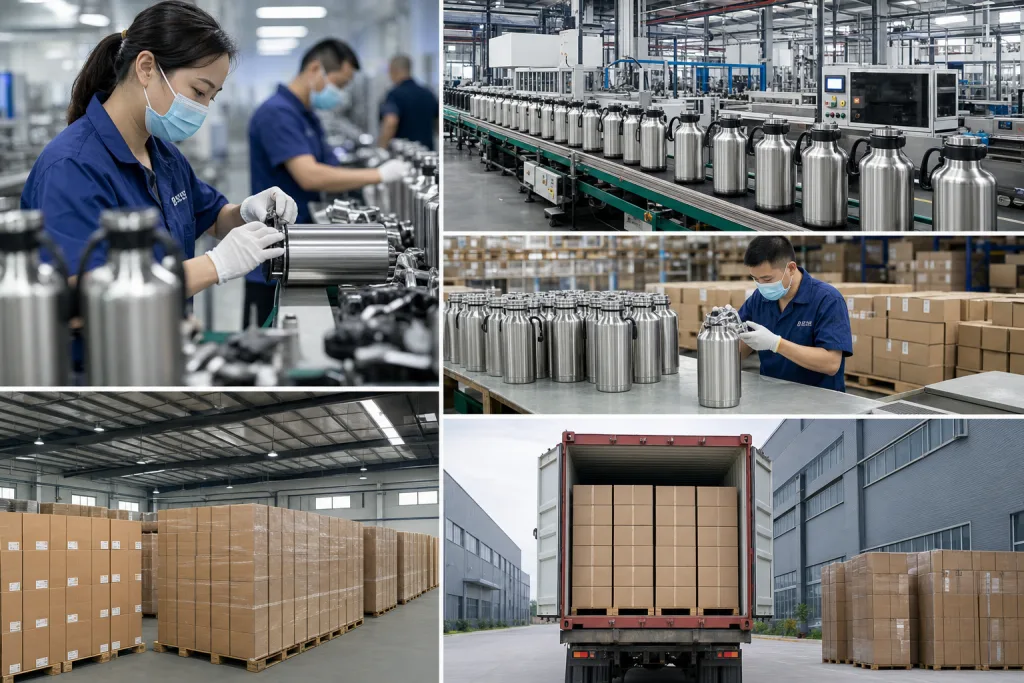
For distributor growler programs, ask for monthly output, not just a one-off quote. A plant running 200,000 units per month can usually handle color matching, staggered shipments, and 3 to 5 SKUs without blowing up the schedule. If your North America or Europe buyers need quick reorders, the supplier should hold buffer stock for lids, rings, and cartons. Otherwise the “fast mover” turns into a 12-day delay versus an 18-day delay, and the buyer flags it on the next PO.
Look for BSCI, ISO 9001, or similar audit support if you sell into large retail channels. Those papers do not guarantee product quality, but they make onboarding easier. QC pulled the sample with a caliper at 0.2 mm, and that kind of control tells you more than a low quote ever will. The better question is who owns production discipline, not who offers the cheapest number, especially when you compare manufacturers in China for your next customized drinkware line.
Get a precise growler quote today
Send your capacity, logo, lid, and target market. We will quote MOQ, FOB price, and lead time from our Zhejiang factory.
Frequently asked questions
What is a normal MOQ for a distributor growler?
For most custom drinkware programs, 500 pcs is the low test MOQ, 1,000 pcs is the practical standard, and 3,000 pcs usually gives the best unit price. A 500-piece order can cost 15% to 25% more per unit because setup and packing labor are spread across fewer bottles. If you need a canteen customizable design with special packaging, 1,000 pcs is usually the safest starting point. A Zhejiang factory with strong capacity can still manage smaller runs, but the price will not look like volume pricing.
How much should I budget per unit FOB China?
For a simple stainless distributor growler, budget roughly USD 1.80 to 3.20 FOB at 1,000 pcs. A double-wall vacuum custom growler with better coating and logo work is more likely USD 3.80 to 6.50 FOB. Add USD 0.08 to 0.18 for one-color print, USD 0.20 to 0.60 for upgraded packaging, and possible tooling fees of USD 80 to 500 for special lids or inserts. If someone quotes far below this range, check whether the spec has been downgraded.
How long does production usually take?
A standard customized drinkware order often takes 20 to 30 days from sample approval to shipment. If you need new tooling, special lid parts, or extra compliance files, plan for 35 to 45 days. Sample lead time is usually 5 to 7 days if the artwork is ready. Freight is separate: air can move fast, but it cannot rescue a late production slot. For distributor canteen planning, build at least one extra week into your internal schedule.
What compliance documents should I request?
Ask for food-contact declarations, material specs for 304 or 18/8 stainless, REACH-related declarations if you sell in Europe, and test reports if the product is insulated. If the item is going into retail or FBA, ask for carton dimensions, gross weight, barcode placement, and pack count. A good canteen supplier in China should also be able to explain the decoration ink type and provide AQL inspection terms. If they cannot produce documents quickly, treat that as a risk signal.
Is a custom growler better than a stock item?
If you need speed, a stock body with custom logo is cheaper and faster, usually by 20% to 30% versus a fully customized growler. If you need differentiation, higher retail margin, or distributor exclusivity, custom shape and packaging can be worth the extra cost. Many canteen distributors start with a stock shape, then move to a canteen customized version after market feedback. That approach reduces cash risk while still building a branded line.