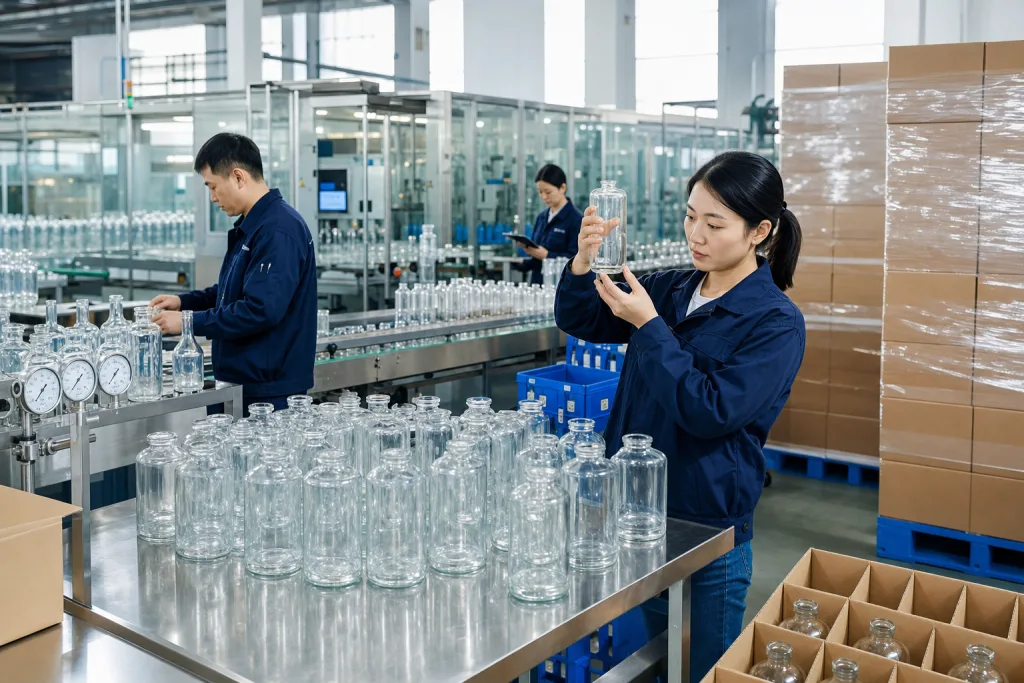
Key Takeaways
- MOQ for a custom glass water bottle usually starts at 3,000-5,000 pcs per SKU, with 35-45 days lead time after sample approval.
- Borosilicate glass bottles commonly use 1.2-1.8 mm wall thickness and pass thermal shock targets of 120°C in serious programs.
- A good RFQ should name glass volume, cap material, logo method, carton spec, and AQL target before you ask for FOB pricing.
- For distributor glass water bottle orders, packaging and leakage control matter more than the bottle image alone.
If you are buying a distributor glass water bottle program for a wellness brand or sustainable retail line, the hard part is not finding a factory. It is locking the bottle spec before you pay for samples, tooling, and freight. Glass looks simple. It is not. We have seen a 500 ml borosilicate glass bottle bulk order stall over a 38 mm neck finish, a cap leaking after a 30-minute inversion test, a logo drifting 2 mm off-center on the silk screen, or a shipper carton crushing at 18 kg stack load before the goods ever reached the buyer’s warehouse. The wrong question to ask first is price.
In Zhejiang and across China, the better borosilicate glass bottle manufacturer will ask for more detail than most first-time buyers expect. That is a good sign. A serious borosilicate glass bottle supplier wants your RFQ to cover glass grade, wall thickness, closure system, drop test target, and carton count. We run into this every month: the buyer sends a clean mood board, but QC pulls the sample and there is no cap torque range, no packed-drop standard, and even a PO typo on carton quantity. If you give clear inputs, you get cleaner samples, 7-day approvals instead of 15-day rework, and fewer chargebacks at the distributor level.
Start With the RFQ, Not the Sample
Start the custom glass water bottle program with a clean RFQ, not a sample request. We quote faster from one page with fixed specs than from “please quote” and two reference photos. On our side, the sales engineer will pass that sheet straight to the line leader and packing team; if the drawing is missing neck size or logo position in mm, the quote stalls. For distributor buyers, margin is set here. The factory must price the exact item you plan to sell, not the nearest bottle we already run.
Include these PO line items in the first request:
- Capacity: 350 ml, 500 ml, 750 ml, or 1,000 ml
- Glass type: soda-lime or borosilicate
- Wall thickness: 1.2 mm, 1.5 mm, or 1.8 mm
- Closure: bamboo lid, stainless steel cap, silicone sleeve, or tea infuser lid
- Decoration: silk screen, laser, decal, or frosted finish
- Packing: individual box, 24 pcs master carton, drop-test requirement
For a borosilicate glass bottle custom quote, ask for FOB Ningbo or FOB Shanghai, not just EXW. This is the wrong question to ask if you only compare the lowest factory unit price. We’ve seen a quote that was 0.10 USD cheaper on EXW turn into the higher landed cost after inland trucking, export documents, and carton reinforcement for a 24 pcs master carton. A solid Zhejiang supplier will send back a spec sheet, unit prices at 3,000 pcs and 10,000 pcs, and a sample fee that is often 50-120 USD per design. If they also flag one issue — for example, a bamboo lid and tea infuser lid on the same PO line — they’re paying attention.
Choose the Right Glass and Closure
Not every glass bottle should be borosilicate. That is the wrong question to ask. Start with how the bottle will be used on the shelf and after sale. If your channel is wellness retail or premium hydration, borosilicate glass bottle wholesale makes sense because it handles heat better and gives a cleaner, brighter wall finish; on our line, buyers usually compare 3.2 mm borosilicate against standard soda-lime side by side and pick the clearer sample. For cold-fill only products, soda-lime may work, but the risk profile goes up fast if end users pour in hot tea, add citrus daily, or run dishwasher cycles. We have seen this go sideways. A serious borosilicate glass bottle distributor should explain that in plain terms, not just quote a lower unit price.
For a custom borosilicate glass bottle, the glass itself is only half the product. The cap and liner decide if the order turns into returns. QC pulled the sample on one PO last month because the gasket sat 0.4 mm proud and the cap torqued unevenly. Ask for:
- PP or Tritan lid for lightweight programs with lower freight weight
- 304 stainless steel cap for premium positioning and a heavier hand feel
- Food-grade silicone gasket, 1.5-2.0 mm thick
- Leak test target: no drip at 180° inversion for 30 seconds
We see 7 out of 10 distributors order a customized glass water bottle and then lose margin because the closure was sourced too cheaply. The math does not work. In China, the bottle may pass visual inspection, but the liner fails after 20-30 wash cycles, or the buyer flagged a cap smell issue after the first dishwasher run. If you are building a borosilicate glass bottle promotional program, insist on closure samples alongside bottle samples. We ship both for approval. A good borosilicate glass bottle manufacturer can supply both from the same Zhejiang production cluster or coordinate vendors within the region, which usually cuts sampling time to 12 days vs 18 days.
Sample Like a Buyer, Not a Browser
Sampling is where a distributor glass water bottle order turns from talk into a buy order. Do not sign off because the bottle looks good in photos. Put it on a flat bench, check fill line height with a vernier caliper, inspect the mouth finish, and weigh it on a 0.1 g scale. A 500 ml custom glass water bottle usually lands around 280-420 g, depending on wall thickness and shape. If it comes in far under that, the bottle is too thin for export retail, and the math does not work.
Ask for three samples: clear glass, decorated sample, packed sample. For borosilicate glass bottle customizable projects, have the factory ship one full carton set and one loose bottle for test. QC pulled the sample on our line before packing, and that step catches a lot of trouble. Then run these checks:
- Leak test after cap torque adjustment
- Dishwasher cycle test, 20 cycles
- Drop test from 80 cm to 100 cm for packed units
- Logo durability test with alcohol wipe
Sample fees are normal in China, especially for a borosilicate glass bottle supplier making a new mold or new lid. A mold-free simple sample may cost 30-60 USD; a new logo plate or special box can bring the total to 80-200 USD. We once had a buyer flag a PO typo on the carton count, then ask why the sample fee was not free. Wrong question. A borosilicate glass bottle factory in Zhejiang that cannot give a clear sample checklist is a risk.
“Approve the sample by measurement and test result, not by appearance alone.”
Ask for Pricing in Two Tiers
For distributor borosilicate glass bottle sourcing, never ask for one price. Ask for two tiers: sample-to-bulk pricing and bulk-to-reorder pricing. The first tier covers the launch PO. The second covers the 3-month replenishment order after sell-through. We run quotes this way because a lot of buyers get burned by a cheap sample price and a messy reorder. A clean quote sheet should show MOQ, unit price, and packout on one line.
For a 500 ml clear bottle with a simple lid, China pricing usually lands at 1.20-2.20 USD FOB at 3,000 pcs. Add 0.15-0.40 USD for silk screen logo, 0.20-0.60 USD for frosting, and 0.25-0.90 USD for premium packaging. On a sleeve plus gift box order, the landed cost can jump fast. We saw that on a 10,000 pcs PO where the buyer flagged a missing carton insert on the draft; the math does not work if you compare plain bottle pricing to retail-ready packout.
When you compare borosilicate glass bottle distributors, manufacturers, and suppliers, make them quote the same packout. Otherwise you are not comparing the same item. Your PO should include:
- Item code and approved drawing number
- FOB port and currency
- Qty by SKU and by color
- Packaging spec and carton qty
- Inspection standard: AQL 2.5 major, 4.0 minor
If you are working with a borosilicate glass bottle vendor for retail chains, ask for breakage allowance in the quote. 1-2% overage is normal for glass. For larger distributor glass water bottle orders, a Zhejiang borosilicate glass bottle manufacturer with stable output can usually support 50,000-80,000 units per month across multiple molds, but confirm capacity by SKU, not just total factory output. QC pulled the sample last week on a 72 mm neck bottle, and the line passed on capacity while failing on one carton mark typo; that is the kind of detail buyers miss.
Lock Quality Before Production
Glass sourcing is not just the bottle itself. It is how the factory runs the line. A solid borosilicate glass bottle manufacturer should show incoming material checks, in-process inspection records, and final AQL inspection reports. If you are placing a bulk glass water bottle order, ask for the QC plan before mass production approval, not after the first 5,000 pcs are packed. We have seen this go sideways when the buyer approved a nice pre-production sample, then QC pulled the sample on day 3 and found the print drifting 3 mm off center.
Useful control points include:
- Glass thickness tolerance: ±0.2 mm
- Neck finish dimension: match closure drawing within ±0.3 mm
- Logo position tolerance: ±2 mm
- Carton compression and drop test according to your retail channel needs
For Europe and North America, ask for REACH and food contact declarations, plus any state-level or retailer-specific compliance requests. Some buyers also ask for ASTM-related test references if they plan to make performance claims on the package. A Zhejiang factory that ships export orders every month should be able to send a document pack with commercial invoice, packing list, CO, and test reports where applicable. This is the wrong question to ask too late. Ask before deposit, not before balance. If the borosilicate glass bottle supplier cannot show past inspection photos, a basic quality workflow, or even a neck gauge check from the line, you are adding risk for no reason.
In practical terms, your approval sample should become the control standard. Keep one signed sample, one photo file, and one dimension sheet. Put the key sizes on paper in mm, stamp it, and tie it to the PO version, because we have seen one typo in a closure code hold a shipment for 12 days vs 18 days reworking caps. That is how you stop arguments later when the goods are already on the water.
Move Bulk Orders With Clear PO Terms
After sample approval, issue the PO with zero soft wording. This is where distributors lose or save 2 weeks. A clean PO for a custom glass water bottle should lock quantity, unit price, tolerance, lead time, payment terms, carton marks, and the claim window in one file. We have seen this go sideways when a buyer typed “print same as sample” on the PO and the line stopped over a 2 mm logo shift. Do not leave control points buried in email threads.
A practical PO structure for a borosilicate glass bottle bulk order looks like this:
- PO line 1: 500 ml clear bottle, 5,000 pcs
- PO line 2: bamboo lid with silicone gasket, 5,000 pcs
- PO line 3: custom print, 5,000 pcs
- PO line 4: inner box and master carton, 5,000 sets
For Zhejiang and wider China sourcing, standard production after sample approval is often 35-45 days for repeat molds, and 45-60 days if the decoration or packaging is new. Ask one more question: is that factory time or ship-ready time? This is the right question. We run into pushback here because some suppliers quote 35 days, then add 7 days for carton confirmation and 3 days for rework after QC pulled the sample. If your distributor program needs a fast launch, ask whether the borosilicate glass bottle factory can reserve line time before you place deposit. Serious factories give a real schedule, not a fantasy date.
Inspect the first batch with a pre-shipment check. AQL 2.5 for major defects and 4.0 for minor defects is common, but premium retail usually needs tighter control on leakage and print quality. On our side, inspectors often use a vacuum leak tester and pull 32 pcs per carton mix to confirm closure fit and logo rub resistance. For large distributor glass water bottle programs, the math does not work if you save 3% on unit price and then eat one full claim on cracked bottles or blurred print. The cheapest order is the one that ships once, sells through, and reorders without redesign.
Plan Inventory Around Reorder Speed
A distributor glass water bottle program should run like a repeat order business, not a one-off private label trial. The supplier needs to hit the same finish, the same cap fit, and the same carton spec on the next PO, not just the first one. We’ve seen buyers get pushed back by a 1.5 mm cap height shift that looked small on paper and turned into leaking complaints after arrival. If you sell through wellness chains, gift stores, or e-commerce subscriptions, repeatability is the job. A borosilicate glass bottle distributor with a solid factory partner in China should hold color and print consistency to a tight tolerance, and QC should pull the sample against the approved master before the line runs.
Plan reorder timing before launch, not after the first sell-through report lands. If your first shipment is 8,000 pcs and your weekly sell-through is 600 pcs, you have a little over 13 weeks of inventory. Ocean freight from China plus customs can eat 5-7 weeks fast, and we run into this every season. A reorder should be triggered when you still have 6-8 weeks of stock, which gives the borosilicate glass bottle supplier room to start another 35-45 day production cycle. This is the wrong question to ask after stock gets tight; by then, the math doesn’t work.
For sustainable retailers, the best borosilicate glass bottle promotional program is the one that scales without requalification on every repeat order. Keep the same supplier file, the same product drawing, and the same carton spec, down to details like a 24 pcs master carton and the print position on the shipper mark. Change one variable at a time. Then you can see if the margin issue came from decoration or freight, instead of guessing. We’ve seen this go sideways because a buyer flagged cost, changed packaging and print together, and then no one could trace the real problem.
Send your RFQ and get a factory quote
We’ll quote your distributor glass water bottle spec with MOQ, FOB price, sample cost, and lead time from Zhejiang, China.
Frequently asked questions
What MOQ should I expect for a custom glass water bottle?
For a custom glass water bottle, MOQ is usually 3,000-5,000 pcs per SKU in China, depending on mold status and decoration. If you add a new lid, color sleeve, or printed box, the factory may ask for 5,000-10,000 pcs. In Zhejiang, a stable borosilicate glass bottle factory often gives better pricing at 10,000 pcs than at 3,000 pcs, sometimes by 10-18%. Ask for one MOQ per bottle, not one MOQ for the whole project, so you can see the real threshold.
How much does borosilicate glass bottle bulk pricing usually cost?
For a plain 500 ml bulk borosilicate glass bottle, FOB China pricing often lands around 1.20-2.20 USD at 3,000 pcs. Add 0.15-0.40 USD for logo printing, 0.20-0.60 USD for frosting, and 0.25-0.90 USD for premium cartons. A premium customized glass water bottle with sleeve and gift box can move above 3.00 USD FOB. Freight, duty, and inland transport will push the landed cost higher, so compare total landed cost, not just factory price.
How do I check if a supplier is a real borosilicate glass bottle manufacturer?
Ask for business license, export records, factory photos, and a sample QC workflow. A real borosilicate glass bottle manufacturer should show production capacity, usually measured in units per month, plus a clear lead time such as 35-45 days after sample approval. Also request REACH or food-contact paperwork, inspection photos, and carton test details. If they only send lifestyle photos and no dimensions, they are likely acting as a trading middle layer, not a factory.
Can I customize the bottle and packaging together?
Yes, and for distributor glass water bottle programs you usually should. A borosilicate glass bottle customizable order can include logo print, frosted body, silicone sleeve, custom lid, insert card, and retail box. Just remember that every added detail affects lead time and defect risk. If you change both decoration and packaging at once, allow an extra 7-15 days. For launch orders, it is smarter to lock the bottle first, then finalize the box artwork.
What quality checks should I require before shipment?
Use a pre-shipment inspection with AQL 2.5 major and 4.0 minor as a starting point. Check leak performance, print alignment, bottle weight, mouth finish, carton strength, and quantity accuracy. For a borosilicate glass bottle wholesale order, I also recommend random thermal shock and drop testing on packed samples. If your product will sit in retail stores, ask for photos of packed cartons, pallet count, and outer marks before the container is sealed.