Key Takeaways
- A standard 500ml distributor double walled bottle usually starts at MOQ 1,000 pcs per color, with FOB China pricing around USD 3.20-5.80 depending on steel grade and decoration.
- Typical lead time is 7-10 days for pre-production sample and 30-45 days for mass production after deposit and artwork approval.
- For vacuum drinkware, define AQL 2.5/4.0, heat retention targets, logo adhesion, and carton drop requirements before paying the deposit.
- Factories in Zhejiang, China that run 300,000-500,000 units/month can usually support private label, BSCI audits, REACH testing, and mixed decoration options in one program.
You are not buying a bottle. You are buying landed cost, an ex-factory date that holds, a defect rate your customer will accept, and a logo finish that still looks clean after six months on shelf. We see this on the line all the time: a distributor double walled bottle order looks fine at sample stage, then the first 2,000 pcs show print shift of 0.8 mm or a carton drop issue, and the buyer flagged it fast.
A practical buyer in Europe or North America often starts with a short brief: 500ml, vacuum insulated, custom logo, retail box, shipped on time. Fine. Then the real work starts. Which steel grade? What wall structure? What test standard? What AQL? What is a realistic MOQ from a canteen factory in Zhejiang, China, and where does the hidden cost land—tooling, lid fit, thicker foam, or a reprint after the PO typo on barcode digits? This is the right place to get specific, because "best price" is the wrong question to ask. The safer method is simple: run one order step by step, from spec sheet to final inspection, with QC pulling the sample before shipment.
Start with the order brief
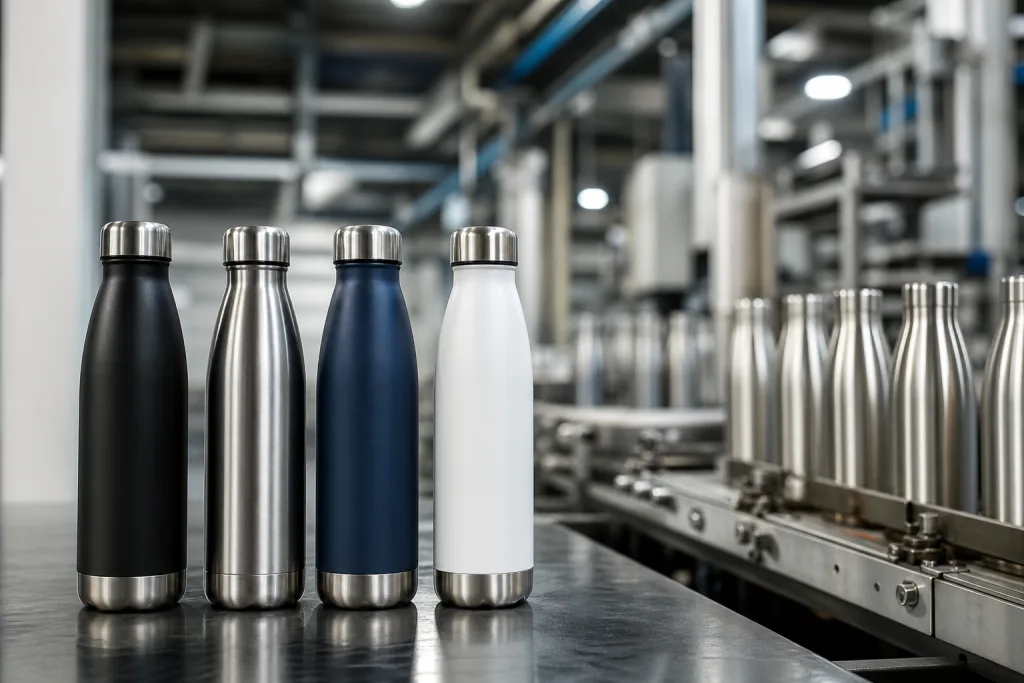
Let’s use a real buyer case. You’re a distributor drinkware buyer supplying two regional chains and one promotional reseller. You need a 500ml distributor double walled bottle for autumn delivery. Spec is tight: matte black body, one-color logo, screw lid with carry loop, individual kraft box, and a landed cost that still leaves room for wholesale margin. On our line, this usually starts from a 70mm mouth and a standard leak test at 0.03MPa.
The common mistake is asking a canteen manufacturer for a price before the core spec is locked. You will get a number. You will not get a quote you can place against another factory quote. This is the wrong question to ask. A proper RFQ for a custom canteen should include:
- Capacity: 500ml actual brimful, 470-480ml practical fill
- Body material: 18/8 stainless steel outer and inner, or 18/8 outer with 18/0 inner if budget is tight
- Construction: double wall vacuum insulated
- Wall thickness: common setup is 0.4mm outer + 0.4mm inner
- Finish: powder coating, usually 60-80 microns
- Logo: silk screen, laser, or heat transfer
- Packaging: white box, kraft box, or retail color box
- Compliance: REACH for EU, CPSIA or ASTM-related packaging checks if selling into North America, plus LFGB or FDA-contact testing as needed
Once those points are fixed, you can compare quotes from canteen suppliers on the same basis. In Zhejiang, China, 8 out of 10 factories will price the job differently after one small spec change. We see this every week. Changing from plain carton pack to retail gift box can add USD 0.28-0.75 per unit. A laser mark instead of screen print often lowers decoration complaints, but the shelf look changes, and the buyer flagged that on a 3,000-piece PO last season after QC pulled the sample.
If you are buying for a canteen promotional channel rather than retail, the brief changes again. You might want a simpler lid, 12 days production instead of 18 days, and a larger logo panel instead of premium packaging. We’ve seen this go sideways when the PO says “black box” and the buyer meant kraft with no insert. That is why experienced canteen distributors do not ask first, “What is your best price?” They ask, “What exact bottle are we talking about?”
Where the quote really moves
Once the brief is locked, the price starts to line up with the product. For a 500ml distributor double walled bottle from a canteen factory in Zhejiang, China, a normal FOB range at 1,000-3,000 pcs is about USD 3.20-5.80. That spread is real. We see it on the line every week, and it usually comes back to material, lid build, finish, pack-out, and whether the buyer changed the spec after the first sample.
Main cost levers
- Steel grade: 304/304 usually costs more than 304/201 or 304/430 combinations
- Lid structure: PP lid with silicone ring is cheaper than stainless cap with multiple parts
- Coating: standard matte powder is cheaper than gradient spray, rubber paint, or metallic finish
- Decoration: one-color silk screen is often USD 0.08-0.18; laser can be USD 0.12-0.25; full-wrap transfer is higher
- Packaging: kraft box is practical; color box with inserts increases both unit and carton size cost
Tooling is where some quotes jump fast. For a standard bottle body, there is usually no mold cost. For a fully customized canteen lid or unique shape, expect USD 1,500-6,000 depending on complexity. We have seen lid projects go sideways over a 0.3 mm fit issue between the inner stopper and thread. If you want a custom growler or customizable growler with a special handle or cap, the math changes fast because leakage testing gets tougher and tolerance control is tighter.
MOQ confuses buyers more than it should. Some canteen vendors advertise 300 pcs, but that usually means one stock color, one logo position, and no Pantone match. For a proper canteen customized order in your chosen Pantone body color, the real MOQ is usually 1,000 pcs per color and sometimes 3,000 pcs for unusual finishes. Ask one direct question: is MOQ by SKU or by total PO? This is the right question, because we still get POs with two colors mixed under one item line and the buyer flags the price later.
You do not control your cost by squeezing one more cent out of unit price. You control it by freezing the right specification early and avoiding rework, air freight, and reject stock.
If your channel is distributor canteen or distributor growler rather than e-commerce retail, watch carton efficiency. A bottle that looks premium but packs 24 pcs per carton instead of 36 can erase the unit-price win on freight alone. We ship both pack styles, and this is where buyers miss the full cost. The sample looks good on the table, but the master carton at 68 x 45 x 29 cm tells the real story.
Sampling before the deposit gets serious
You’ve shortlisted one canteen manufacturer. Now sampling starts. This is where custom drinkware orders either stay under control or get expensive fast. We treat samples as 3 separate checkpoints, not one catch-all step. On our line, QC pulled a sample last month because the base diameter was 0.8 mm over spec and it rocked on a flat table.
- Reference sample: existing item to confirm shape, lid style, hand feel, and base diameter
- Pre-production sample: your color, your logo, your packaging, final artwork position
- Sealed sample: approved golden sample kept by you and the canteen factory for QC reference
Typical sample charges for a distributor double walled bottle are USD 50-100 for a basic logo sample, often refundable against bulk order. Lead time is usually 3-7 days for a blank sample and 7-10 days for a decorated pre-production sample. If the body color is Pantone matched by powder coating, allow 2-4 extra days because the line has to spray, cure, then compare against the chip under standard light. Buyers ask for “faster color match” all the time, but this is the wrong question to ask if you want the batch to match the approved sample.
At this stage, ask direct questions. Is the powder coat smooth at the shoulder radius, or do you see orange peel after curing at around 180°C? Does the logo sit level relative to the seam, checked on a jig instead of by eye? Is the silicone ring food-grade and odor-free when the lid is opened from a sealed polybag? Does the bottle pass a 12-hour hot retention test target, such as keeping water above 42-45°C when filled with near-boiling water under defined conditions? Different canteen manufacturers use different test methods, so ask for the method, not just the claim. We’ve seen this go sideways when one factory tested half-filled bottles and the buyer assumed full-fill results.
If you are sourcing customizable drinkware for a promotional campaign, logo placement matters more than most buyers expect. A 5mm shift can make a straight bottle look crooked in photos. We ship plenty of promo orders where the buyer flagged a logo that was only 3 mm off the approved position. For a customized canteen or customized drinkware project, approve artwork with a measurable location from the base or seam, not “centered by eye.” Put the print height on the PO. Last week one PO even had “logo centered” typed twice and no mm reference at all.
Some buyers skip packaging review to save time. Don’t. The kraft box board weight, insert fit, barcode placement, and shipping mark layout all affect downstream cost. A carton with weak board can fail a drop test at 76 cm, and a loose insert lets the bottle scuff before it reaches the shelf. If you sell through a canteen distributor network or Amazon-style fulfillment, missing carton marks or wrong FNSKU label placement can trigger relabel fees and delays. The math doesn’t work when you save 2 days on sample approval and lose 12 days fixing outer carton marks after the goods are packed.
Production control on a live PO
After the sample is signed off, you place the PO and pay the deposit, often 30% with 70% against inspection or copy documents. A Zhejiang canteen factory might run 300,000 units a month, but that does not protect your order by itself. We’ve seen big plants miss a 2 mm logo position because the line worked from an old print card. Capacity is not control.
For 1,000-5,000 pcs, a workable lead time is 30-45 days after deposit, sample approval, and artwork confirmation. In China peak season, August to November, add 7-15 days if the bottle needs custom coating or gift boxes. The coating line is usually the choke point, not final packing, and the math does not work if a supplier promises 18 days on a painted vacuum bottle in October.
The buyer’s job at this stage is to freeze the production sheet. No loose ends. On our floor, the sheet sits with the digital scale, color swatch, and seal sample, and QC pulled the sample against that file before mass production. That sheet should cover:
- Material spec: stainless grade, PP grade, silicone hardness if relevant
- Construction: vacuum process, leak test requirement, net weight tolerance
- Decoration file: Pantone, size in mm, print method, position tolerance of +/-1.5mm or agreed standard
- Packaging spec: box dimensions, barcode type, carton quantity, drop test
- Inspection standard: AQL 2.5 major / 4.0 minor is common for drinkware
For canteen customizable programs with several SKUs, ask for an inline production photo set: raw body, coated body, printed body, assembled lid, packed carton. We usually send 5 photos per SKU. This will not replace inspection, and this is the wrong question to ask if the factory is weak on process, but it catches simple misses early. If one body color is too glossy or one logo is oversized, you want that on day 8, not day 38. We ship faster when the buyer flags it early.
A practical canteen vendor should also confirm vacuum yield and leak testing in numbers. Ask how many pieces passed the first vacuum hold test and what the leak test method was. On double wall bottles, we run pressure and hot-water checks, and hidden problems still show up: weak vacuum, lid thread mismatch, coating thin spots, welding marks under the base. One inspection finding we see too often is a lid that closes on the golden sample but binds after torque testing. Those are the returns that hit canteen distributors after launch.
If your program includes a custom growler or customizable growler alongside bottles, tell the factory if all SKUs must ship together. Growlers often run on a different test cycle and use different carton dimensions, so mixed loading can move the finish date by 3-5 days. We’ve seen this go sideways when the PO had 2 bottle SKUs ready but 1 growler carton mark was printed wrong, so the whole booking slipped.
Inspection that protects your margin
Pre-shipment inspection is where the buyer protects margin or gives it away. For a distributor double walled bottle, hope gets expensive fast. We tell buyers to put their own team on the floor in China or book a third-party inspector against a written checklist, not a WeChat message. On our line, QC pulled the sample after 80% packing because that is late enough to see real output and still early enough to stop a bad batch.
Your QC checklist should cover appearance and function in plain terms:
- Quantity count: packed quantity versus PO, carton count, and any short-pack by color or lid option
- Visual checks: dents, scratches, paint fish-eyes, print blur, color variance, base instability, with a clear limit like no visible defect at 300 mm
- Function checks: leak test, cap fit, strap pull, odor, vacuum retention spot check, and thread engagement that does not cross-thread in first closure
- Packaging checks: barcode scan, carton marks, inner box print, carton drop resistance, plus PO typos on label copy—we have seen one wrong item code hold shipment for 12 days
- Measurement checks: height, diameter, weight, fill volume, checked with calipers and a scale instead of eyeballing it
Most buyers use AQL. For drinkware, AQL 2.5 for major defects and 4.0 for minor defects is common. Define major defects before production starts. A leaking lid, failed vacuum, wrong logo color, or rust spot is major. A tiny underside scuff not visible at retail may be minor. This is the wrong question to ask after inspection, because by then the cartons are taped, the vessel booking is close, and the buyer flagged it when leverage was already weaker.
Ask the inspector to pull random units for a simple hot water retention comparison, such as 2 hours on 5 bottles from the packed lot. It is not a lab test. It will catch obvious vacuum failures. For a customized drinkware order, rub-test printed logos, especially silk screen, after coating cure. We have seen 20 rubs with a dry cloth pass, then 10 alcohol rubs expose weak adhesion on the logo edge.
For Europe, make sure any required REACH or LFGB documentation matches the actual SKU and material combination. For North America, align product contact testing and packaging claims with what you will sell. Check the lid, gasket, straw, and coating version against the report. The math doesn't work if the certificate shows one PP lid and the shipped SKU uses another. A certificate with the wrong lid material is not a real document; it is just paper.
This is where good canteen suppliers separate themselves from weak ones. A solid canteen manufacturer in China accepts inspection rules upfront, replaces rejects, and sends corrective-action photos from the line. A weak canteen supplier debates every scratch after goods are packed. We have seen this go sideways over a 1.5 mm paint chip that should have been classified on day 1, not argued at final inspection.
Freight, claims, and the second order
After inspection passes, the job is not done. You still need to lock shipment terms, keep claim evidence, and decide if this turns into a repeat program. For most buyers, FOB Ningbo or FOB Shanghai is the cleanest term out of Zhejiang. We ship both every week. If your canteen factory quotes EXW, check local trucking, export declaration, terminal handling, and document fees before you call it cheaper; we have seen EXW end up 6-9% higher once the forwarder invoice lands.
Carton dimensions hit freight almost as hard as unit cost. A bottle packed 24 pcs per master carton at 58 x 39 x 29 cm can ship better than a similar bottle stuffed into oversized gift boxes with 12 mm EPE and too much dead space. Ask for carton gross weight and CBM before you approve packaging. If a master carton goes past about 18kg, warehouse teams start complaining, and distributor canteen or distributor growler programs get beat up fast when they move through 3 hubs.
When the goods arrive, set a short claim window with your customer. Tell them to report leakage, denting, or print defects within 15-30 days of receipt, with photos tied to the carton number and outer mark. QC pulled the sample is not enough at this stage; field photos matter more. Then match the claims against your inspection report. If 2% of units show cap leakage but pre-shipment records showed none, you are likely looking at transit damage, cap over-torque drift from 1.8 N·m to 2.3 N·m, or carton compression, not random factory defects.
The second order is where the margin shows up. By then, you know whether the canteen distributors you supply want matte or semi-gloss, whether laser or screen holds up better, and whether the original MOQ still makes sense. This is the wrong question to ask if you only focus on unit price. A stable program can often improve by 3-8% in total cost through carton optimization, simpler print layouts, or running 2 SKUs in one production window on the same line.
If you are building a broader range beyond bottles, use the same control method for custom growler, customized growler, or customizable canteen lines. Good sourcing is not about finding a magic canteen vendor. It is about building a repeatable system with a canteen manufacturer that can hit the same quality level every time. We have seen this go sideways when a buyer changed the PO packing note from "1 pc/polybag" to "1 pc/white box" and did not recheck the drop test.
Send your bottle spec and get a real quote
Share capacity, target price, logo method, packaging, and delivery window. We will review feasibility, MOQ, lead time, and QC points before you place the order.
Frequently asked questions
What is a realistic MOQ for a distributor double walled bottle?
For a standard 500ml vacuum bottle with one logo and one stock-style lid, a realistic MOQ is usually 1,000 pcs per color. Some canteen suppliers in China may offer 500 pcs for existing stock color and simple logo, but that is not the same as a full custom program. If you want Pantone-matched coating, custom packaging, or multiple logo positions, expect 1,000-3,000 pcs per SKU. For a custom growler or a new lid structure, MOQ can rise to 3,000 pcs because setup loss and tooling recovery are higher. Always ask whether MOQ applies per color, per logo, or per shipment total.
How much should I budget per unit before freight and duty?
For a mainstream 500ml distributor double walled bottle, FOB China pricing usually falls between USD 3.20 and USD 5.80 at 1,000-3,000 pcs. Entry-level versions use simpler lids, standard powder coat, and basic silk screen. A better retail-ready bottle with 304 inside and outside, premium matte finish, laser mark, and individual color box can move above USD 5.00. Add roughly USD 0.08-0.25 for decoration changes and USD 0.28-0.75 for upgraded packaging. If a quote looks far below market, check steel grade, wall thickness, vacuum consistency, and whether testing or carton specs were quietly reduced.
What quality checks matter most for vacuum insulated bottles?
The big four are leak performance, vacuum retention, decoration adhesion, and packaging integrity. At pre-shipment stage, set AQL 2.5 for major defects and 4.0 for minor defects. Major defects should include leaking caps, failed vacuum, wrong logo color, unstable base, rust, and wrong barcode. Ask for spot checks on hot retention, simple rub tests on logos, and carton drop checks. Measurements should cover weight, height, diameter, and fill volume within agreed tolerance. If you buy from a canteen factory in Zhejiang or elsewhere in China, insist that the inspection standard is written into the PO, not discussed casually on chat after production is complete.
How long does a custom drinkware order usually take?
A normal schedule is 3-7 days for a reference sample, 7-10 days for a pre-production sample with your logo and finish, and 30-45 days for mass production after deposit and final approval. During peak months in China, especially before Q4 shipping rush, add 7-15 days. If your program includes custom boxes, multiple coating colors, or a customized growler with new tooling, lead time can extend to 45-60 days. Good buyers work backward from the delivery date and leave buffer for inspection, booking, and port congestion. Rushing production usually costs more in defects or air freight than it saves in calendar days.
What documents should I ask a canteen manufacturer to provide?
At minimum, ask for the PI, final packing list, commercial invoice, carton spec, barcode file confirmation, and any agreed product test reports. For Europe, buyers often request REACH and sometimes LFGB-related food-contact reports depending on the market. For North America, align requested reports with your channel and claims. If the factory has BSCI or ISO-related audit records, those help for retail compliance review, but they do not replace product testing. Also request a sealed sample record, inspection report, and material declaration for main components such as stainless steel, PP, and silicone. Those documents matter more than a generic certificate that does not match your exact SKU.