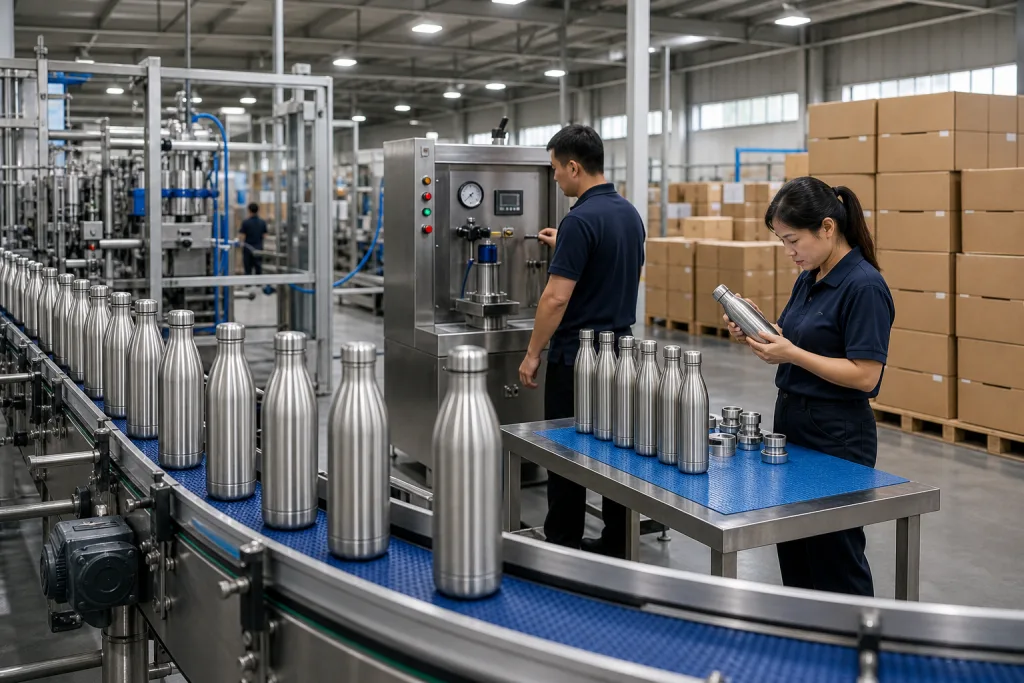
Key Takeaways
- 18/8 stainless inner and outer walls usually add $0.18-$0.45 per bottle versus mixed-grade steel, but reduce rust and complaint risk
- A practical MOQ for custom double wall bottles is often 1,000 pcs per color, with 35-45 day lead time from Zhejiang, China
- Heat retention claims need a method: 95°C fill, 20°C room, checked at 6, 12, and 24 hours is a usable benchmark
- AQL 2.5 for major defects and ISTA-style carton drop checks are more important for distributor drinkware than a perfect pre-production photo
You do not usually lose money on a distributor double wall bottle because the silhouette looks off. You lose it on the spec sheet: steel grade written as “stainless” instead of 304 stainless, vacuum performance promised without a test method, logo process approved before a 1.2 m drop test, or carton rules that do not match your distributor channel. We see this on the line. For a B2B buyer, the bottle is not one SKU; it is a stack of decisions that changes claim rate, landed cost, and reorder timing.
From Zhejiang, China, we see 30 to 40 RFQs a month asking for a custom canteen or customizable drinkware quote while skipping the lines that decide the order. A good canteen manufacturer should ask those questions early and put numbers on them. This is the wrong question to ask: “What is your best price?” The better question is which steel, which insulation test, which logo method, and what master carton limit your warehouse will accept. If you buy for Europe or North America, the details below decide whether a bottle moves cleanly through compliance, warehousing, and retail, or whether QC pulled the sample and the buyer flagged it for rework after the PO already had the wrong carton mark.
Start with material line items
The first line on the sheet should state the exact metal by part. For a distributor double wall bottle, the standard spec is SUS304 / 18-8 stainless steel on both inner and outer walls, plus a PP lid and food-contact silicone seal. If the quote says only “stainless steel,” ask again. That wording is too loose. On low-cost projects, some canteen suppliers switch the outer wall to 201 stainless and save roughly USD 0.12-0.25 per unit on a 500-750 ml bottle. We’ve quoted that split spec before. It can work for a pure price program, but for stock going into damp warehouses, gyms, schools, or winter retail, 304 on the outer wall cuts down corrosion claims. QC pulled one returned sample last year with rust spots starting near the base seam after warehouse storage, and the buyer flagged it fast.
For bottles meant to stay in service, ask for wall thickness on the sheet too. A common build is 0.4 mm inner + 0.5 mm outer. Entry price can drop to 0.35 / 0.4 mm, though dent resistance drops with it, especially on wide-body shapes. This is where the math doesn’t work for some buyers. They push for a few cents off, then the line packs a softer body into export cartons and the sidewall picks up damage under rough truck handling. If you are a canteen distributor or distributor growler buyer, that matters because B2B returns usually come from cosmetic dents, not leakage. One drop test with a loaded sample tells you more than a polished sales sheet.
The material declaration should list coatings, seals, and straws too, if included. For Europe, ask for REACH and LFGB-related food contact compliance support where relevant. For North America, ask your canteen factory for FDA food-contact declarations and California Proposition 65 screening if decoration inks or coatings are involved. A solid canteen manufacturer in Zhejiang, China should be able to trace each food-contact part back to the supplier and batch number. We run that check before mass production, down to the silicone ring and straw resin. If they cannot do that, you already have a traceability problem. We’ve seen this go sideways over one lid vendor change that never made it onto the PO.
Vacuum structure and insulation claims
“Double wall” tells you almost nothing. Ask if the body is double wall vacuum insulation, whether the outer wall gets a copper coat inside, and which test the factory actually ran. On our line, vacuum is standard for most sellable bottles in this class; QC checks the vacuum spot at the base before packing. Copper plating on the inner outer-wall surface can improve heat reflection and usually adds around USD 0.08-0.15 per bottle. On premium programs, that cost is fine. On budget distributor canteen projects focused on cold drinks, the math does not always work.
Ask your canteen vendors for a real test protocol, not “keeps hot and cold for hours” on a sales sheet. A workable benchmark is: bottle filled with 95°C water, room at 20°C, cap closed, temperature checked at 6, 12, and 24 hours. For cold testing, use 4°C water under the same room condition. A 500 ml vacuum bottle with decent construction may show roughly 65-75°C after 6 hours and stay below 10°C for 12-24 hours in cold testing, depending on mouth size and lid structure. We’ve seen this go sideways when the lid gasket is 1 mm thin or the thread fit is loose. Wide-mouth customizable canteen models usually lose heat faster than narrow-mouth commuter bottles. That is normal.
Buyer impact
- Wider mouth: easier filling and cleaning, weaker thermal retention. A 55 mm mouth usually drops heat faster than a 38 mm commuter neck.
- Thicker lid assembly: better insulation, higher mold complexity and replacement cost. Buyers push back on spare lid pricing here.
- Powder-coated body: better hand feel and scratch resistance, but do not confuse it with thermal performance. This is the wrong question to ask.
If you are sourcing a customizable growler or custom growler, check carbonation suitability separately. We ship plenty of insulated growlers for still beverages only. If your canteen vendor says yes to carbonated use, ask for pressure validation and lid vent design details, not just a verbal promise. We had one PO where the buyer flagged “carb safe” wording, but the sample lid had no pressure-release feature.
Capacity, weight, and mouth diameter
Buyers pick the shape, then freight hits them. We’ve seen this go sideways. Capacity and dimensions drive cost more than shelf appeal does. A 500 ml bottle might weigh 260-340 g depending on steel thickness and lid design. A 750 ml bottle can run 360-480 g. A 32 oz customizable growler may push well beyond 500 g. For e-commerce and distributor drinkware accounts, every 50 g matters once you spread it across inbound freight, pick-pack labor, and final-mile charges. On our line, one buyer flagged a 70 g jump after switching from a simple PP lid to a zinc-alloy handle lid, and the freight math stopped working fast.
Mouth diameter changes daily use and defect risk. Common openings are 32 mm, 45 mm, and 55 mm. A 32 mm mouth drinks cleaner and holds heat better. A 45-55 mm mouth fits ice and a brush, which sells well in North America for customized drinkware. The tradeoff is simple: wider threads and thicker gaskets give QC more places to catch leaks if tooling or cap torque is off. We run leak tests with a vacuum fixture, and QC pulled the sample last month on a 55 mm lid because the gasket was sitting 0.8 mm high. If your target channel is school, fitness, or outdoor, ask who opens the cap 10 times a day and who just throws in ice once. That is the right question.
Ask the canteen factory for three dimensions every time: body diameter, full height with lid, and base diameter. No shortcuts. These numbers affect cup-holder fit, secondary packaging, and pallet density. A body that grows from 72 mm to 78 mm may look minor on a drawing, but on a master carton it can reduce pack efficiency by 10-15%. That is direct cost. We ship mixed drinkware programs every month, and a 6 mm body increase has pushed a standard carton from 24 pcs down to 20 pcs before. BottleForge Industrial in Zhejiang plans this early because our output can reach 300,000 units per month across mixed drinkware lines; at that volume, poor carton efficiency gets expensive fast.
Good buyer practice: approve dimensions with tolerance, for example 72 ± 1.5 mm diameter and 265 ± 2 mm height. Without tolerance, inspection arguments start later. We’ve had POs list “72 mm” only, then the buyer rejected 73.2 mm at pre-shipment. That argument is easy to avoid.
Surface finish and logo process
This is where 7 out of 10 custom canteen programs start to drift: they look premium on a screen, then feel wrong in the hand once cartons land. The common body finishes are spray paint, powder coating, satin polish, mirror polish, and textured options. For distributor double wall bottle projects, powder coating is usually the safer pick. It hides fingerprints, adds grip, and takes minor scuffs better than glossy spray. On our line, the coat thickness usually runs 60-80μm. Expect a modest cost increase, often around USD 0.10-0.22 depending on color and quantity.
Decoration needs to fit the sales channel, not just the artwork file. For corporate gifting, a one-color silk screen is often enough and the math works. For retail reorder business, laser engraving avoids color variance, but only on the right coating build; we’ve seen buyers approve a matte black sample, then the logo came out weak because the underlayer was wrong. Heat transfer or full-wrap printing gives better shelf impact, but rub risk goes up fast if curing time and adhesion control are loose. QC pulled the sample last month with a 3M tape test fail after 20 rubs. Ask for adhesion and abrasion test standards, even if the factory uses internal methods.
Practical logo choices
- Silk screen: low setup cost, best for simple logos, usually 1-2 colors. Good for MOQ 1,000 where the buyer flagged budget first.
- Laser engraving: durable, premium look, slower cycle time. On 304 stainless bottles, the mark stays clean if the coating stack is matched.
- Heat transfer: better for gradients and multi-color art, needs stronger QC. This is where we check curing temperature and do abrasion pulls before packing.
- Embossed or debossed lid/band: higher tooling cost, useful for long-run programs. Tooling lead time is often 12 days vs 18 days if the mold shop is not overloaded.
If you are buying from canteen manufacturers in China for Amazon FBA or distributor channels, ask for logo position drawings in millimeters, not “centered visually.” This is the wrong question to ask, because “visual center” shifts once the seam, handle, or base pad is involved. Ask whether decoration happens before or after assembly. That changes scratch rate and inspection flow. We ship cleaner results when the sequence is locked on the PO; one buyer sent “logo heigth 32mm” on the artwork sheet, and the typo was small, but the size approval delay cost 4 days. A reliable canteen supplier should send a pre-production sample with actual logo size, Pantone reference, and finish code, not just a digital mockup.
Lids, seals, and leak risk
The lid is where margin disappears. On distributor double wall bottles, most claims come from four things: leaks, odor, broken handles, and thread mismatch. We’ve seen a cheaper body ship cleanly with a proven cap, while a better-looking body turned into rework because the new lid was rushed on the line. Typical lid materials are PP and Tritan, plus stainless-accent versions and carry-loop combos. Each choice changes cost, drop performance, and complaint rate. This is the wrong place to save $0.08.
Ask about gasket hardness, thread engagement, and assembly torque. Those points decide claim rate. Silicone seals in the 50-70 Shore A range are common. If the gasket is too soft, QC pulled samples with the seal rolled after repeated opening. If it is too hard, a 0.2 mm tolerance shift on the neck can break the seal. For straw lids and flip lids, ask for cycle testing. 500 openings is a low bar. 1,000-2,000 cycles is more believable for active-use product, especially if the buyer flagged loose buttons on a prior PO.
Leak testing should be routine. Not optional. A lot of canteen factories in Zhejiang run vacuum or air-pressure checks during production, then do a second inversion test after assembly. Ask what percentage gets tested, not whether they test. On standard screw-cap bottles, 100% leak testing is realistic. On lids with buttons, straws, or moving hinges, factories often run in-line checks and then final AQL inspection. That setup is acceptable if process control is tight and spare seals or replacement lids are already built into the after-sales plan. If not, we’ve seen this go sideways fast.
If you need a custom growler or distributor growler with carry handle, ask for handle load testing. A simple rule is to test at least 3 times the filled product weight for 1 hour. If the growler holds 1.9 L, the load is not small, and the math doesn’t work if the handle pin, strap, or anchor was picked only on target price. On one project, the buyer pushed for a thinner strap to hit MOQ pricing, and the pull test failed before packing. A canteen customizable project turns into a warranty project fast when accessories are specified too aggressively for the selling price.
Packaging, carton specs, and shipping math
B2B buyers lock in bottle cost first and leave packaging to the last week. That is where freight math breaks and damage claims start. For distributor drinkware, ask for the full packaging stack on day one: polybag or tissue, egg-crate or divider, inner box spec, master carton size, gross weight, and pallet plan. We run this check before mass production, usually with a tape measure and drop-test sample at the line. A standard single bottle color box can add USD 0.18-0.60 depending on print and insert design. If your channel is wholesale club, promo, or industrial distribution, a brown mailer or partition pack is often the better choice. A glossy gift box looks nice; the math does not always work.
Set carton limits early. This saves arguments later. A lot of importers cap master carton gross weight at 12-15 kg so warehouse staff can move cases without rework. If your canteen distributors use mixed-SKU picking, ask for carton labels with item code, color code, quantity, carton number, and barcode. We have seen buyers flag outer labels because the PO showed “charcoal” and the carton print said “dark gray.” For Amazon or major retail prep, you may also need FNSKU placement rules, suffocation warning wording, or country-of-origin marking on both item and carton. QC pulled one sample last month where the COO mark was on the bottle only, not the carton, and that would have failed retail prep.
Lead time needs to include packaging approval. A realistic schedule for a custom drinkware order from China is 7-10 days for sample approval, 30-35 days for production, and 3-5 extra days if custom boxes are printed at a separate plant. MOQ is commonly 1,000 pcs per color for existing bottle molds, though some canteen vendors can accept 500 pcs on simple logo runs with plain cartons. We usually confirm the dieline before the first 500 boxes go on press. Be careful with unusually low MOQ offers; we have seen this go sideways with split production, color inconsistency, or weak raw-material planning.
FOB Ningbo or FOB Shanghai is still common from Zhejiang. If you compare quotes, make sure all vendors use the same Incoterm and the same packaging assumption. Ask for the carton size in cm and the gross weight per carton, then check container loading on the same basis. We ship both ports, and the buyer pushback is usually not price — it is that one quote included a color box and another assumed a plain export carton. Otherwise you are comparing incomplete numbers.
Quality control that matters in practice
If a canteen supplier says “we do strict QC,” ask for the numbers. This is the right question. For a distributor double wall bottle, we expect incoming inspection on steel coils or tubes, in-line checks on vacuum weld integrity and coating adhesion, and final inspection to an agreed AQL. A common standard is AQL 2.5 for major defects, 4.0 for minor, though some buyers tighten this for premium customized drinkware. On the line, QC pulled the sample and checked seam finish by hand because leakage often starts from a rough weld lip, not from the steel grade on paper. Define critical defects clearly: leakage, sharp edges, odor, missing food-contact parts, and wrong barcode usually sit in critical or major, depending on your program.
Ask for the inspection checklist before deposit, not after production. We have seen this go sideways. The checklist should spell out dimensions, weight tolerance, color difference standard, logo position, leak test result, drop test, and packaging verification. If your bottle includes retail packaging, add barcode scan readability and carton drop checks. For export from China, a simple carton drop sequence from around 76 cm on edges, corners, and faces is a practical starting point for non-fragile drinkware packs. One buyer flagged a logo shift of 2 mm after mass production; that argument would have ended faster if logo position tolerance was written on the PO from day one.
Social and system audits matter too, especially for Europe and North America. If your brand or distributor account requires BSCI, Sedex, or ISO 9001 support, ask in the first 3 emails, not in week 5. Some canteen manufacturers are sound on production but not audit-ready for larger retail supply. The gap shows up when your customer asks for payroll records, calibration logs, or the last CAP report. We ship from Zhejiang every month, and third-party inspection before shipment should not make a serious factory nervous. If the factory pushes back on inspector access, the math does not work in your favor.
For custom drinkware, the best supplier is not the one answering fastest. It is the one that can tell you why a 0.1 mm tolerance, a gasket material, or a carton height changes your claim rate 6 months later. We run into this with lid fit: 0.3 mm at the silicone seat can be the difference between a pass and a leak after transport. That is how you buy repeatable product, not a sample that looked good once.
Send your bottle spec sheet for a real quote
Share capacity, steel grade, lid type, logo method, packaging, and target market. We will review the risks, MOQ, and workable FOB cost clearly.
Frequently asked questions
What is a normal MOQ for a distributor double wall bottle?
For an existing mold with standard lid options, a normal MOQ is 1,000 pcs per color and around 3,000 pcs for multiple mixed colors if you want the best unit cost. Some canteen suppliers in China will offer 500 pcs for a simple logo run, but that often comes with fewer color options or plain packaging only. If you need a new lid mold, special powder color, or custom gift box, MOQ usually rises because setup and material minimums increase. For distributor channels, ask for MOQ by color, by logo, and by packaging version separately. That avoids confusion when one vendor quotes 1,000 pcs but hides a 2,000-set box minimum.
How much should I budget for a custom double wall stainless bottle?
A practical FOB China range for a 500-750 ml vacuum insulated bottle is about USD 2.60-5.20 depending on steel grade, coating, lid complexity, and packaging. A plain 18/8 screw-cap bottle with one-color logo and export carton sits near the lower end. Add USD 0.10-0.22 for powder coating, USD 0.08-0.15 for copper lining, and USD 0.18-0.60 for an individual color box. Laser engraving may add more than silk screen because cycle time is slower. If you are buying a custom growler or a large-capacity distributor growler, expect a noticeably higher freight cost too. Always compare quotes on the same Incoterm, same packaging, and same leak-test requirement.
What compliance documents should I ask from a canteen manufacturer?
Start with material declarations for all food-contact parts: stainless steel, PP or Tritan lid components, silicone gaskets, straws, and coatings if they touch liquid. For Europe, many buyers request REACH support and food-contact compliance evidence relevant to the product structure. For North America, ask for FDA-related food-contact declarations and discuss Proposition 65 screening if inks, coatings, or colored plastics are involved. If your channel is children’s product related, ASTM or CPSIA-adjacent requirements may apply depending on the item type. Also ask whether the canteen factory can support BSCI, Sedex, or ISO 9001 documents if your customer needs them. Compliance should match the exact SKU, not just a generic company certificate.
How do I reduce leak complaints on customized drinkware orders?
First, keep the lid design simple unless your channel truly needs a straw, flip spout, or multi-part cap. Screw lids with one silicone gasket usually produce fewer claims than complex sport lids. Second, require 100% leak testing for standard screw-cap bottles and define the method in writing. Third, approve thread fit and gasket hardness on the pre-production sample, not only the decoration. Fourth, ask for torque control or assembly work instructions at the factory. Finally, include transit protection in packaging. A perfect lid can still leak if the thread gets deformed by rough packing. In practice, these steps matter more than chasing a very low unit price from unproven canteen vendors.
What lead time is realistic for custom drinkware from Zhejiang, China?
For a standard bottle shape with custom logo, expect about 7-10 days for samples and artwork confirmation, then 30-35 days for mass production after deposit and sample approval. If you add a new box design, accessory sourcing, or a new mold, total lead time can extend to 40-55 days. Peak season before Q4 promotions can push capacity further. Ask your canteen supplier whether coating, printing, and packaging are in-house or outsourced, because outsourced steps add queue time. Good factories in Zhejiang, China will also tell you their monthly capacity and current load. That matters more than a sales promise of “fast delivery” when you need stable reorders.