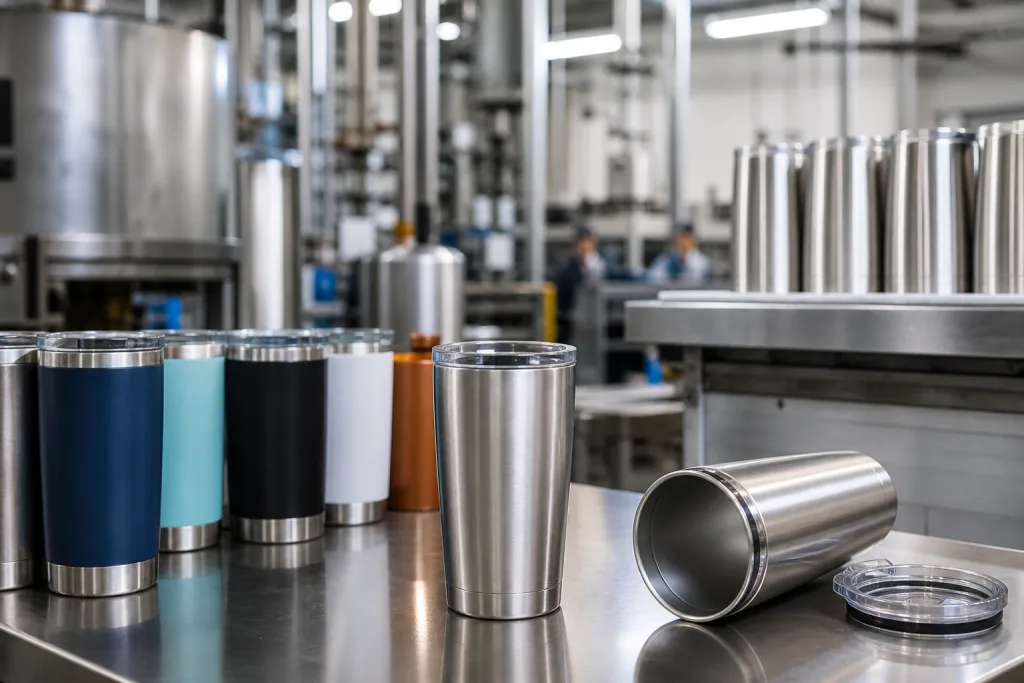
Key Takeaways
- Leak issues usually come from lid fit and silicone hardness; specify 100% vacuum and inverted leak testing on every batch over 1,000 pcs
- For 18/8 stainless travel tumblers, 0.4-0.5 mm inner wall and 0.5 mm outer wall are common; thinner steel cuts cost but raises dent risk in transit
- Powder coat and logo defects often create 2%-5% reject rates; define color tolerance, adhesion test, and print position tolerance before sampling
- A practical MOQ for custom travel tumblers in Zhejiang, China is often 1,000-3,000 pcs per color, with 25-35 day lead time after sample approval
A travel tumbler can look perfect in the photo, pass a quick pre-production sample, then fail as soon as it hits a distributor warehouse or a corporate-gift event. We see the same misses on the line: lids leak after a 1.2 m drop test, powder coat chips in 7 days, and logos drift by 2 mm so the buyer rejects 3,000 units. For a distributor coffee mug program, shape is not the main decision. Failure prevention is.
This shows up fast when you source from Zhejiang, China. Tooling choices are broad, prices are sharp, and spec gaps get exposed the moment you run volume. A good coffee mug manufacturer should lock tolerances, test points, and packaging standards before PO approval; last month QC pulled a sample because the inner tray opening was 4 mm too loose and cups knocked together in transit. If you are buying bulk travel tumbler or coffee mug custom made programs for coffee brands or promotional campaigns, this is the wrong question to ask: do I save $0.18 per unit now, or do I stop a full rework later? Weak specs cost more than a higher unit price ever will.
Most failures start in the lid
If you sell a bulk coffee travel mug program, customers judge the lid first. If it leaks on day one, the return starts there. They do not talk about vacuum retention or the Pantone match until later. For a coffee mug distributor handling corporate gifting, one bad lid can turn a 2,000-piece campaign into claims, replacements, and an ugly call from the buyer who flagged it.
The failure points are plain. We see thread pitch drift, a silicone ring undersized by 0.3 mm, or molding flash that stops the slider from closing all the way. QC pulled the sample once and found flash left at the gate on cavity 6. Buyers often ask for a coffee mug customizable lid with more features. This is the wrong question to ask. Every extra hinge, slider, or straw port adds another sealing point. A flip lid with two hinges and a straw port looks flexible on the sell sheet, but it gives you more leak risk than a simple screw lid with one gasket.
What you should specify
- Leak standard: 100% inverted test for 30 minutes on finished goods, not just pre-assembly parts.
- Silicone grade: food-contact silicone compliant with REACH and LFGB where required.
- Lid torque range: define a target closing torque so users can seal it without over-tightening.
- Spare gasket policy: for premium coffee mug private label orders, ask for 1% extra rings packed separately.
Ask your coffee mug factory direct supplier how they control lid variation between cavities. A 4-cavity lid mold can run fast on the line, but cavity match matters more than headline output. We run cavity checks with a go/no-go gauge and separate records by cavity number. At BottleForge Industrial in Zhejiang, we would rather lose 1 day on output than mix marginal lids into a full lot. The math doesn't work otherwise. Shipping 50,000 units/month on paper means nothing if 3% comes back as claims.
A sample that does not leak is not proof. A batch that passes documented leak testing is proof.
If you are reviewing a coffee mug supplier list or coffee mug supplier directory, ask for actual leak-test records, not only a general QA statement. Ask to see the form, the date, the lot number, and the pass rate. We have seen POs with a lid code typed wrong by one digit, and the wrong lid went into sampling. A serious coffee mug OEM manufacturer should already have the records ready.
Thin steel creates transit damage
Too many buyers look at FOB only. That is how a bulk coffee tumbler priced at USD 2.85 looks fine on the quote sheet, then lands with dented bases and oval rims after one container move and one courier handoff. Steel is not the expensive part. The cost sits in stable forming on the line, weld consistency, polishing yield, and vacuum hold, all of which depend on material consistency and wall thickness. We have seen QC pull a sample that passed visual check, then fail lid fit because the rim went out by 0.6 mm after transit.
For common 20 oz and 30 oz designs, you will often see 18/8 stainless steel with an inner wall around 0.4-0.5 mm and an outer wall around 0.45-0.5 mm. Some factories cut below that to chase low-price coffee mug in bulk deals. You save a few cents. Then the claim rate shows up later. On thin-body runs, the line packs a lighter unit, but carton stacking damage goes up fast, especially on 24 pcs master cartons if the outer wall drops under spec.
Spec around this by defining the material, not just "stainless steel tumbler." Put these points on the purchase order and approved sample sheet:
- 304 stainless steel, inside and outside, unless a lower-cost exterior grade is intentionally accepted
- Wall thickness tolerance, for example ±0.03 mm where practical
- Cup body weight range, because underweight product often signals thinner material
- Base impact requirement after drop test in shipper carton
For a premium café merchandise project, ask for a rim gauge check and a random section measurement from each lot. This is not overkill; this is basic control. We run digital calipers and a go/no-go rim gauge for this. The buyer flagged one order last year because the lid felt loose on 7 pcs out of 500 sampled, and the root cause was rim distortion, not the lid mold. For distributor coffee mug orders going to Europe or North America, a cleaner spec usually cuts total landed cost because damage claims and rework drop.
A reliable coffee mug factory in Zhejiang or elsewhere in China should tell you when your packaging spec does not make sense. This is the wrong question to ask: "Can you keep the mug safe with a thinner box?" A 30 oz bulk travel mug in a thin white box with no pulp insert will not survive parcel networks just because the tumbler itself is strong. We ship enough parcel-tested drinkware to know this goes sideways. On one PO, the buyer even typed "1 pc/white box, no insert" and later disputed corner crush on arrival. Material spec and packaging spec need to be written together.
Vacuum performance gets overstated
Insulation claims are one of the least standardized parts of this business. One coffee mug manufacturer prints “keeps hot 8 hours.” Another prints “12 hours.” Same product class, different test setup. We’ve seen 95°C fill water tested at 20°C ambient on one side, then 90°C fill water at 25°C ambient on the other, with the lid closed on one sample and half-open on the next. Even a 5 mm headspace difference changes the result. If you buy coffee mug promotional products off marketing copy alone, the end customer may call it defective when the factory and the buyer never agreed on the same test method.
The production failure here is not just bad vacuum. It is bad communication on what vacuum loss is acceptable. A tumbler can pass a basic vacuum check and still miss the field result if the vacuum degree swings from batch to batch or the copper coating on the inner wall is unstable. We run these as three separate checks on the line:
- 100% vacuum check: screen for obvious vacuum failure after production, usually with a hot-water or pressure-difference check on every unit
- Heat retention test: controlled lab or line test on sampled units, with fixed fill temperature, ambient temperature, and timing
- Aging verification: re-test after 24-48 hours to catch delayed vacuum loss that was not visible right after sealing
For a bulk travel tumbler order, ask the coffee mug supplier to define the method, not just the claim. This is the right question. Example: fill with 95°C water, hold at 20°C ambient, measure remaining temperature after 6 hours. Put lid status in writing too—fully closed, no sipping. We’ve had a buyer flag a “failed” sample that was tested with the slider open 2 mm. If you need cold retention for summer campaigns, specify ice-water testing as a separate standard.
Buyers working with coffee mug manufacturers in China often assume all double-wall vacuum tumblers are interchangeable. They are not. Bottom weld quality, chamber stability, and lid heat loss change real use fast. QC pulled samples last month where the body vacuum was fine but the lid leaked heat badly through the sip opening, cutting hot retention by about 1.5 hours. If your brand is selling a coffee mug custom made SKU at retail, advertise a conservative claim your QC can support every run. We’ve seen this go sideways when sales prints “12 hours hot” but the production sample averages 9 to 10.
If the order is for coffee mug private labeling into large distributor channels, ask for AQL levels on functional checks. AQL 2.5 for major defects and 4.0 for minor defects is common, but the math doesn’t work if leak and vacuum are buried inside general appearance standards. Most serious buyers tighten those functional limits because those are the defects customers notice first. On one 10,000-piece order, the PO even had a typo on the vacuum spec, so we forced a pre-production sign-off before mass production. Do that early.
Coating and logo defects multiply fast
A tumbler body can pass drop and leak checks and still be dead stock if the finish is off. We’ve seen this on the line. A powder coat that looked clean on the pre-production sample showed pinholes after the full bake, orange-peel texture on one cavity, and a visible color shift lot to lot. Printed logos scratched after carton rub, laser marks came out shallow on 304 stainless, and wrap graphics drifted on tapered walls by 2 mm, which the buyer flagged at first glance.
The issue for coffee brands and gift buyers is simple: decoration defects are judged by eye, and the standard falls apart fast if nobody writes it down. “Matte black” is not a spec. Pantone reference, gloss level, and viewing distance at 30 cm are closer to a real standard. This is the wrong question to ask: “Can you make it look nice?” Ask what counts as pass or fail under inspection light.
How to write a usable decoration spec
- State finish type: powder coat, spray paint, electroplating, laser engraving, silk screen, heat transfer, or UV print
- State color reference: Pantone code or approved physical swatch
- Set logo position tolerance: commonly ±1.5 mm to ±2.0 mm depending on shape
- Require adhesion and abrasion tests for the chosen decoration method
- Approve artwork with seam position clearly shown on tapered or handled designs
For coffee mug promotional runs, silk screen is cost-effective at volume, but it has limits. Fine lines fill in. Abrasion resistance is weaker over time, especially after 500 rubs on the tape test bench. Laser engraving is more stable for stainless exposure designs, though the look changes and some buyers push back once they see the exposed silver base. A capable coffee mug supplier should say this before you place MOQ 3,000.
We often see complaints that are actually spec gaps: no print orientation defined, no signed approval sample, no note on whether a 0.3 mm dust point is rejectable. QC pulled the sample and found the PO even had the logo facing left on one page and right on another. In Zhejiang, China, factories shipping 200,000 units/month can keep output moving, but if the spec sheet is loose, the inspection report turns into bargaining instead of control. We’ve seen this go sideways.
For coffee mug custom programs, use a golden sample with signed decoration placement and written defect limits. Mark the seam. Mark the viewing side. Note what is acceptable near the bottom radius. Without that, both sides end up arguing from photos on WeChat, and the math doesn’t work.
Compliance gaps appear after production
No buyer wants to hear about compliance after the cartons are sealed. It still happens on bulk coffee mug orders because the mug looks simple and the sourcing team chases price and print position. A stainless travel tumbler going to Europe or North America still touches food contact rules, lid plastics, and coating files, and the destination market decides what gets checked.
The failure is usually not a bad product. The papers do not match the line. We have seen a lid resin swap, a silicone supplier change, or a coating tweak wipe out the test report the buyer approved during sampling. One PO typo on the finish code was enough to start the mess.
If you work with a coffee mug supplier or coffee mug distributors serving two or three markets, ask for a materials control list tied to the BOM. For a 20 oz tumbler, we want the exact resin grade, gasket spec, and coating code on the same file. Typical checks include REACH for Europe, LFGB for Germany-focused projects, and FDA food-contact expectations for the US market. For children-oriented formats, ASTM-related requirements may also come into play depending on the product category and packaging claims.
- Ask for test reports linked to the same material family and finish used on your SKU
- Confirm whether the factory has BSCI or similar social compliance if your retail customers require it
- Lock the BOM after sample approval so the line does not swap parts
- Include a clause that major material changes need buyer approval before production
A coffee mug factory direct relationship helps because there are fewer hands touching the file. Still, even with a direct coffee mug manufacturer in China, check that the test report date, SKU description, and material references match the order. QC pulled the sample once and found a 3 mm lid change that never made it into the paperwork.
Good compliance control is dull work, but it costs less than rework, a customs hold, or a recall notice sent to your distributor list. The math does not work any other way.
Cartons fail before the product does
Buyers will argue over lid style for 2 weeks and mark up logo size by 2 mm, then sign off on stock packaging. We’ve seen this go sideways. A good coffee mug private label program gets damaged between Ningbo and a North American warehouse because the carton spec was treated like filler, not part of the order. For a distributor coffee mug shipment, outer carton strength and inner protection sit inside product quality, same as the tumbler body or lid fit.
Travel tumblers are dense. A 24-piece master carton gets heavy fast, and 30 oz formats push it over the line. On our floor, one packed carton can jump past 15 kg before the buyer notices the cube. If the board is weak or the dividers fold under load, units rub during truck transfer and container vibration. Then QC pulled the sample and found powder coat scuffing, dented rims, cracked lids.
Write packaging specs with numbers:
- Master carton limit: keep gross weight around 12-15 kg where possible for easier handling
- Carton strength: specify export-grade corrugate and compression expectations, not just “standard carton” on the PO
- Inner protection: individual polybag, tissue, or molded pulp depending on finish sensitivity; matte powder coat usually needs more separation
- Drop standard: define packed-drop test heights based on your channel, especially for e-commerce, such as 76 cm for parcel checks
If your coffee mug custom order is headed to Amazon FBA or parcel shipping, add FNSKU label placement, suffocation warning requirements where needed, and scan-test verification. We run a quick barcode check before sealing the lot because one bad label position can block receiving. If it is for corporate-gift handout programs, presentation boxes matter more. The shipper carton still has to survive ocean freight from China, and that is the wrong place to save 0.08 USD.
Some coffee mug manufacturers quote a low unit price, then quietly cut the carton spec from 5-layer to lighter board. The math doesn’t work. Ask for carton dimensions, board type, and pack-out photos before mass production. Ask for one compression test record too. Last month a buyer flagged corner crush on a sample shipper, and the issue traced back to undersized dividers by 3 mm. A strong coffee mug supplier will show pre-shipment packaging validation without getting defensive.
When buyers say they need coffee mug factory direct savings, keep the savings honest here: use the right carton once, not claims credit later. We ship replacement parts every season for programs that made the cheap carton call first.
Sampling mistakes become expensive at scale
The last big failure point is procedural. You signed off the wrong sample, or you signed off the right one with the wrong paperwork. We see this on custom coffee mug jobs all the time. A polished showroom sample, a fast Photoshop mockup, and a sales rep’s口头 promise are not production control.
For bulk coffee mug and bulk travel mug orders, split the process into three checkpoints: concept sample, pre-production sample, and production confirmation sample. The concept sample proves shape. The pre-production sample proves material, finish, and decoration. The production confirmation sample should match the final BOM, packaging, barcode, and carton marks. QC pulled the sample on our bench before release, and that 1 mm gap saved a buyer from a lid leak complaint.
Good buyers also ask for a short production file with:
- Approved dimensions and capacity tolerance
- Material list for body, lid, gasket, straw if any
- Decoration method and artwork revision code
- Packing method and carton marks
- Inspection standard with AQL and critical defects defined
If your coffee mug supplier list mixes factories and traders, this step tells you who controls the line. A real coffee mug factory will answer tooling, wall thickness, vacuum checks, and corrective action without dodging. A trader can still add value, but you need to know who is actually running production. The buyer flagged a PO typo once—“3040 stainless” instead of 304 stainless—and the whole file had to be fixed before we ship.
Typical MOQ for a custom color travel tumbler from Zhejiang is 1,000-3,000 pcs per SKU, with 7-10 days for sample revision and 25-35 days for production after approval. If a coffee mug OEM manufacturer promises 12 days on a new decoration setup with no trade-off, the math does not work. Ask what they are skipping on the line.
A disciplined sample process is not bureaucracy. It is how you stop one small miss from turning into 5,000 wrong tumblers.
Get a tumbler spec review before you place the PO
Send your artwork, target price, and channel requirements. We will flag likely production and QC failure points before sampling starts.
Frequently asked questions
What MOQ should I expect for a custom travel tumbler order?
For a standard custom-color vacuum tumbler, a realistic MOQ is usually 1,000 to 3,000 pcs per SKU in China. If you want a stock body with only one-color logo printing, some factories can start at 500 pcs, but your unit price will rise. New lid tooling, special coating, or gift box packaging can push MOQ higher, often 3,000 to 5,000 pcs. For distributor coffee mug programs, ask whether MOQ is per color, per size, or per artwork. Those are not the same thing. Also confirm whether overrun or underrun tolerance is allowed, typically around ±5% on mass production orders.
How do I compare coffee mug factory quotes fairly?
Do not compare only the FOB unit price. Put the quotes on one sheet and align at least eight points: stainless grade, wall thickness, lid type, gasket material, finish method, logo method, packing style, and test/compliance scope. A quote at USD 3.10 may be cheaper in practice than one at USD 2.85 if the lower quote uses thinner steel, weaker cartons, or no documented leak testing. Ask each coffee mug manufacturer for net weight, gross carton weight, lead time, MOQ, and defect policy. If a supplier cannot state those clearly, the quote is not complete enough to compare.
What quality checks matter most for bulk coffee tumblers?
For a bulk coffee tumbler order, focus first on functional defects: leaking lids, failed vacuum, unstable base, sharp rim, and broken handles or sliders. After that, check cosmetic items like coating consistency and logo placement. A practical inspection plan uses AQL with clearly defined critical, major, and minor defects. Many buyers use AQL 2.5 for major and 4.0 for minor defects, but they tighten leak standards beyond normal sampling and require 100% functional checks for sealing. Ask for records of vacuum screening, inverted leak tests, and drop testing of packed cartons. Those three checks eliminate many of the most expensive post-shipment claims.
How long does custom tumbler production usually take?
If the body shape already exists and you are applying a standard finish plus logo, plan around 7 to 10 days for sample approval and 25 to 35 days for bulk production. During peak season, especially before Q4 gifting, production can stretch to 40 days or more. New tooling or complex packaging can add another 15 to 25 days. Buyers in Europe and North America should also add inspection, booking, and ocean transit time on top. A good coffee mug supplier in Zhejiang, China will give you a schedule by milestone: sample, approval, production, inspection, and shipment, instead of one vague lead-time promise.
Should I buy from a coffee mug factory direct or through a trader?
Factory direct can give you better control over specs, faster technical answers, and cleaner corrective action when something goes wrong. That is useful for coffee mug customized projects with strict lid, coating, or packaging requirements. A trader can still help if you need mixed product categories, lower communication load, or warehouse consolidation. The key is transparency. Ask who owns the tooling, who issues the BOM, who performs in-line QC, and where the goods are actually produced. If the supplier says they are factory direct, they should be able to discuss wall thickness, mold cavity control, AQL, and production capacity in concrete terms.