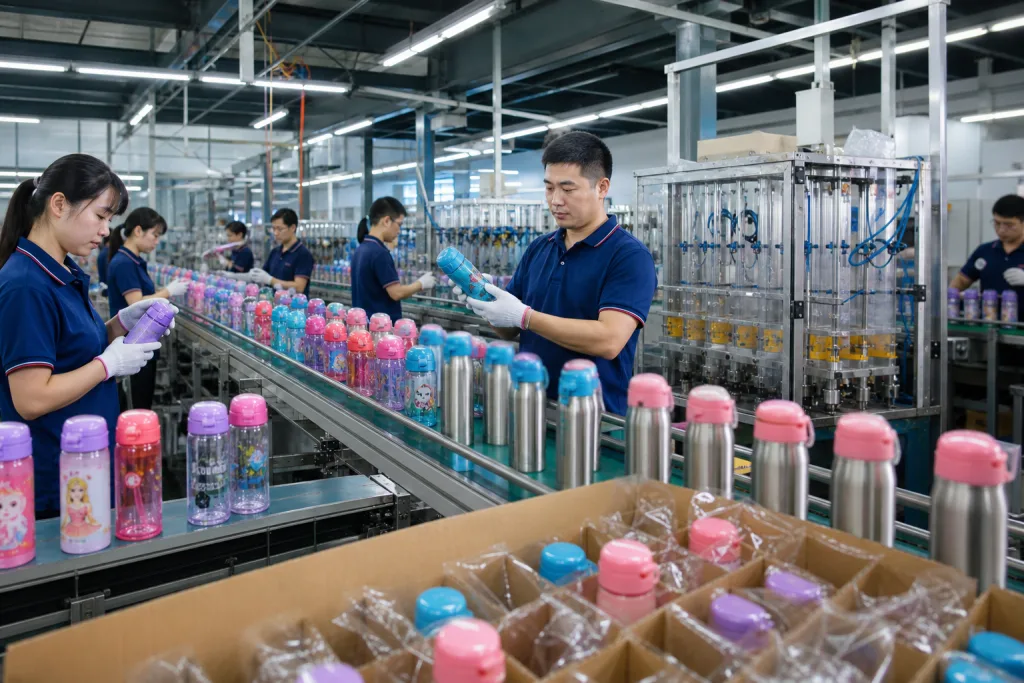
Key Takeaways
- For most school programs, 350-500ml bottles with 0.4-0.5mm stainless outer walls or 2.0-2.5mm Tritan bodies are the safest volume and durability range
- Typical MOQ for a custom kids water bottle is 3,000-5,000 pcs per color, while stock-color logo orders can start at 1,000 pcs
- Lab testing for REACH, LFGB, CPSIA, and California Proposition 65 can add 7-12 days and USD 600-1,800 depending on material and packaging scope
- For Zhejiang factory production, normal lead time is 25-35 days after sample approval, with output around 300,000-500,000 units per month
If you buy for school districts or import kids drinkware, the hard part is not finding a children water bottle supplier. Zhejiang alone has hundreds, and we see buyers compare 12 to 20 factories on one RFQ. The hard part is picking a distributor children water bottle program that survives real use, passes compliance, hits the target cost, and lands before back-to-school. We ship against school calendars, so 12 days vs 18 days on sample approval is not a small gap. It decides whether the line runs smoothly or the booking gets pushed.
You are balancing safety, leakage, age-fit, and branding at the same time. That is the real job. A bottle that looks clean in a catalog can fail after 3 weeks in a classroom; QC pulled a straw-lid sample last season after a 1.2 m drop test cracked the hinge on the fifth drop. A low quote also gets ugly fast once mold changes, test fees, and split shipments show up. We have seen buyers flag a PO typo on lid color, then pay for rework on 3,000 pcs. The right buying process starts with four decisions: material, lid system, compliance scope, and order structure. Ask those first. Price comes after.
Start with the four buying decisions
Bad buys usually start the same way: the team argues about price before the product brief is fixed. For a distributor children water bottle project, lock four decisions first. We’ve seen this go sideways on the line after a PO typo changed 500ml to 550ml and the carton spec no longer fit.
- Material: Tritan, single-wall stainless steel, or vacuum stainless steel.
- Lid system: straw, spout, flip top, or screw cap.
- Compliance scope: school use in Europe, retail in North America, or both.
- Order structure: stock tooling with custom logo, or fully custom made kids bottle with new parts.
Those four choices set most of the project: unit cost, MOQ, leakage rate, carton dimensions, and testing plan. This is the right question to ask first, not “what’s your best price?” For a children water bottle distributor, or for children water bottle vendors supplying school districts, the safer route is usually stock tooling with controlled customization. We run an existing body and lid platform, then change color, print, hangtag, and carton. QC pulled the sample last month on a stock 400ml body with a custom pantone match, and the project moved in 12 days vs 18 days for a new-part review.
A fully children water bottle customized program fits a national promotion only when the volume is there. New molds for a cap or silicone spout often cost USD 2,000-8,000. If the order is 5,000 pcs, the math doesn't work. If the order is 50,000 pcs across several school districts, it starts to make sense. On our side, a new cap mold also means first-shot checks, hinge life testing, and dimensional approval on parts down to 0.2 mm.
At BottleForge Industrial in Zhejiang, China, we usually tell new buyers to define use case before style. A glossy rendering is easy. Daily school use is harder. Kindergarten students need easier bite-valves and fewer detachable parts; our buyer flagged one design with a loose straw weight that failed the small-parts review. Middle-school programs often want a larger custom school water bottle with a carry loop and one-hand lid. Get the use case right, and the quote is cleaner, sampling is faster, and reorders are less painful.
Pick material by use, not trend
Material is the first trade-off, and this is where buyer math often goes wrong. We get asked for the cheapest bulk kids water bottle on POs as small as 3,000 pcs, then 60 days later the buyer flags scratches, leaks, or weight complaints from schools. There are 3 common choices, but trend should not decide this. Use should.
Tritan or other BPA-free copolyester
For a bulk school water bottle program, this is usually the cleanest fit. It is light, clear or tinted, and easy for kids to carry in a side pocket or lunch bag. A 450ml Tritan bottle normally lands in the USD 2.10-3.60 FOB China range at 3,000-5,000 pcs with standard print. Body thickness is typically 2.0-2.5mm, and on the line we check wall consistency with a caliper at the shoulder and base. The weak point is obvious: scratches show fast, and the handfeel is less premium than steel.
Single-wall stainless steel
This works well if you need better durability and a more premium look without paying for vacuum insulation. Common spec: 304 stainless steel body, 0.4-0.5mm wall thickness, 350-500ml. FOB pricing often sits around USD 2.80-4.80 for children water bottle wholesale orders. It handles daily abuse better than Tritan in most cases, though dents still happen if bottles are dropped on concrete. We have seen buyers ask for 500ml and then push back on weight after the pre-production sample; for younger kids, that pushback is fair.
Vacuum insulated stainless steel
This is a better match for retail-oriented custom children water bottle programs and colder climates. For school giveaway or district issue, it is often over-specified, and we have seen this go sideways once freight is calculated by carton weight. Typical FOB is USD 4.50-7.50 depending on lid and coating. Weight and freight cost are higher, plain and simple. QC pulled the sample on one insulated run last season at 420g with lid, and the buyer switched back to single-wall after seeing the shipping quote. For school district buyers, spill resistance and cleaning ease matter more than insulation in most tenders.
For most distributor children water bottle programs, 400-450ml Tritan or single-wall 304 stainless gives the best balance of cost, age-fit, and shipping efficiency.
Ask your children water bottle manufacturer to state the exact resin grade or steel grade, not just “food safe.” That wording is too loose. A solid China factory should provide material declarations and support REACH or LFGB testing. If the factory cannot tell you the body thickness, steel grade, and gasket material — or they dodge the silicone hardness on the lid seal — keep looking.
Lid design decides complaint rate
For kids drinkware, the lid drives more claims than the bottle body. We see it on the line. If you are buying children water bottle bulk for schools, camps, museums, or promotional channels, start with the closure, not the print color or bottle shape. That is the wrong question to ask first.
Straw lids sell well because kids can drink fast in class or on the field. The tradeoff is parts count: straw, bite valve, seal ring, hinge, locking tab. Every added part is one more leak point and one more cleaning complaint. QC pulled the sample on one school order last spring because the silicone straw wall measured 1.6mm instead of 1.8mm, and the buyer flagged tearing after one week of use. For younger users, test the soft silicone straw for tear resistance and odor, not just fit.
Spout lids sit in the middle. Cleaner design. Lower leak risk than pop-up straws in most runs, and parents find them easier to wash with a standard 8mm brush. For school district buyers, this is usually the safest choice. We ship more repeat orders on spout lids for that reason.
Screw caps hold up best in transit and warehouse stacking, but kids do not always manage them well during active use. Thread lead-in matters. We have seen cross-threading on caps with a shallow start angle, especially after mold wear passed 80,000 shots. A cap that an adult seals in one turn often needs two turns to give children enough sealing margin. The math doesn't work if you optimize only for adult handling.
Ask your children water bottle suppliers for a leakage protocol, not a sales promise. Put the test on the PO. A reasonable basic standard is:
- 100% vacuum or air-pressure spot check during assembly for sealed lids where applicable
- Filled bottle inverted for 30 minutes
- Drop test from 80-100cm, three orientations
- Carton drop test according to shipping method
Ask about spare parts too. On a custom logo kids bottle sold through distributors, replacement straws and seals can reduce returns by 20-30%. We have seen this go sideways when a buyer ordered 30,000 bottles and zero backup seals, then needed service stock six months into the school year. That matters if you are one of the children water bottle distributors servicing schools over a full academic year.
In Zhejiang and other China production hubs, a lot of factories can make a lid that looks good in a sample box. Fewer hold gasket tolerance stable across 3 production runs. Our QC team checks seal OD with a digital caliper to ±0.15mm because that is where leak complaints start. Sample approval should include a pre-production sample made from actual mass-production materials, not only a hand-made prototype. We have seen handmade lids pass, then mass goods fail because the gasket hardness shifted from 50 to 60 Shore A.
Compliance scope changes the quote fast
School district buyers and importers do not all need the same testing. This is where a children water bottle custom project gets derailed fast. One buyer writes “food grade” on the RFQ, another sends a CPSIA checklist, another asks for REACH and LFGB, and nobody locked the scope at quotation stage. We see this on the line all the time: the PO says “same as last order,” then the buyer flagged it because this time the cap logo uses a new ink.
For Europe, common requirements include REACH and food-contact compliance depending on the material and market. For North America, buyers often ask for CPSIA-related review for children’s products, California Proposition 65 screening, and ASTM-aligned checks where relevant to the product category and age grading. Do not check the bottle body only. QC pulled the sample once and found the risk was in the straw valve, a 2 mm silicone part, not the 304 stainless shell.
What you should ask a children water bottle supplier:
- Which tests were done on the same model, not “similar products”?
- Was testing on final decorated samples or plain material only?
- Do reports cover silicone parts, paint, printing ink, and straw material?
- Can the factory support AQL inspection and third-party pre-shipment checks?
A realistic plan for children water bottle customized orders is to budget USD 600-1,800 for lab work depending on material mix and market scope. Timing is usually 7-12 days. If packaging also needs compliance checks, add 3-5 days. This is the wrong question to ask: “What is the cheapest test package?” Ask what claim you need to support in each market, because the math does not work if you re-test after mass production starts.
Serious buyers also review factory systems. BSCI audits, ISO-style process control, and documented incoming material inspection do not guarantee a good bottle, but they cut risk. In our factory, incoming lids, straws, and seals are logged by lot number before they hit assembly. For a children water bottle manufacturer in China, the difference between a workshop and a real export factory is usually visible in traceability records, QC checkpoints, and willingness to define AQL limits such as Major 2.5 / Minor 4.0. We ship cleaner when those limits are agreed before tooling sign-off.
Know your customization boundaries
Not every children water bottle customizable option makes sense. Split it into two buckets: cosmetic changes and structural changes. This is the right first filter. On our line, buyers often ask for a “custom bottle” when they only need a lid color swap and a 1-color logo.
Cosmetic customization covers body color, lid color, logo, pattern, hangtag, barcode label, and carton artwork. Most bulk children water bottle orders should stay here because the cost stays controllable and the timeline stays normal. We run these changes without touching the core mold set. Typical decoration choices are:
- Silkscreen: low cost, good for 1-2 solid colors, usually USD 0.08-0.20 per color per position
- Heat transfer: better for full-color graphics, around USD 0.18-0.45
- Laser engraving on stainless: durable, premium look, often USD 0.10-0.25
- Embossed or debossed logo on mold parts: needs tooling change
Structural customization means a new cap shape, an integrated handle, a unique base, or special straw geometry. That changes the job from a standard children water bottle wholesale order into a development project. Expect a higher MOQ, 12 days vs 18 days to become 35-45 days, and extra testing on leak, drop, and bite resistance. We have seen this go sideways over a 0.8mm straw ID change that looked small on the drawing but failed flow testing.
For 7 out of 10 children water bottle promotional programs, an existing body with a clean logo and a Pantone-matched lid is the better buy. The math doesn't work on full custom unless volume is there. A stock-color custom kids bottle can often run at 1,000 pcs, while a custom school water bottle with exact Pantone body, custom package, and dedicated spare parts kit may need 3,000-5,000 pcs. We ship plenty of these with stock body colors because the buyer flagged cost first, not originality.
Artwork details matter. Fine lines under 0.2mm often fail on textured powder coating, and wrap graphics can shift on tapered bodies by 1-2mm if registration is not controlled. If your brand book is strict, ask for a print positioning tolerance in writing. QC pulled the sample more than once because the PO said “center logo” but gave no mm reference from the seam. Good children water bottle manufacturers in Zhejiang will raise this early instead of letting your QC team find it at inspection.
Build the order around logistics
If you import bulk kids bottle programs, build the brief around freight first. We’ve seen a 6mm wider body or a taller flip handle add more CBM cost than the logo print itself. On the line, the carton fit check usually tells the truth faster than the rendering.
For school district and importer projects, start with these numbers:
- Common carton quantity: 24 or 36 pcs
- Target bottle size: 350-500ml
- Ideal master carton gross weight: under 15kg for easier handling
- Sample time: 5-10 days for custom logo kids bottle on stock model
- Mass production: 25-35 days after sample approval
If you sell through retail or e-commerce, lock packaging details before production starts. FNSKU labels, suffocation warnings on polybags, and drop-tested retail packaging need sign-off before we run, not after QC pulled the sample and found the barcode facing the carton wall. If you supply schools direct, bulk pack with no individual gift box usually saves USD 0.20-0.60 per unit and cuts container volume fast. That is the wrong place to overspend.
Ask early if your children water bottle vendor can split shipments. A lot of buyers in Europe and North America want one order sent to 3 or 4 distribution points, and we’ve seen this go sideways when the PO typo puts teal caps into the UK stack instead of the NL stack. A factory that packs by PO line, color, or destination saves warehouse labor on your side. Our team in Zhejiang, China runs mixed-color production and carton marks by destination, with monthly capacity of 300,000-500,000 units depending on model complexity.
For Incoterms, first-time importers often choose FOB Ningbo or Shanghai to keep freight control in-house. If your children water bottle distributors network needs landed pricing, compare DDP line by line, including carton spec, HS code, and pallet rule. The math doesn’t work if the quote is low because the packaging was thinned down to pass price review. We ship both ways, but cheap DDP often hides weak packaging or vague customs classification.
How to qualify a supplier quickly
You do not need 20 factories. You need 3 qualified quotes and one disciplined sampling process. We usually cut the list to 3 in 48 hours. Whether you buy from children water bottle manufacturers or a trading company, screen them on facts, not sales slides. This is the right question to ask. Last month one PO even had the logo size typed as 35 cm instead of 35 mm, and nobody caught it until sampling.
Ask for these items in the first email round:
- MOQ by model, color, and logo process
- FOB China target prices at 1,000 / 3,000 / 5,000 pcs
- Latest audit status such as BSCI and production photos
- Existing test reports for the same kids bottle model
- Lead time for sample and bulk production
- AQL standard used for final inspection
Then request one sample set with your actual logo. This is where 7 out of 10 children water bottle suppliers show their real level. QC pulled the sample, checked print edge clarity under a 5x loupe, and measured logo position drift in mm. Check print sharpness, odor, thread feel, gasket fit, and whether the lid opens properly after repeated use. Run a simple in-house test: fill, shake, invert overnight, and drop on a rubber floor from desk height. We have seen lids pass the first open-close, then fail after 200 cycles on the line.
Price gaps usually have a reason. If one children water bottle factory is 18% lower than others, inspect the details: thinner steel wall, lower-grade copolyester, fewer QC checks at assembly, lighter cartons, or no spare seals in the master case. The math does not work if the quote is low and the spec stays the same. For children water bottle promotional tenders, these shortcuts may not show on day one, but they show after delivery. One common inspection finding is carton burst at 8 kg stacking load because the board grade was cut.
The best children water bottle distributor relationship is boring in a good way. Clear specs. Stable lead times. Low claim rate. Honest replies when something goes wrong. We ship repeat programs on that basis for years. A flashy pitch deck means little if the sample lead time is promised at 5 days and lands in 12 days vs 18 days for bulk with no warning. The buyer flagged that last season, and they were right.
Shortlist the right kids bottle program now
Send your target price, volume, market, and preferred lid style. We will recommend workable specs, MOQ, testing scope, and FOB options within one business day.
Frequently asked questions
What is a normal MOQ for a custom kids water bottle order?
For a stock model with one-color logo, MOQ is usually 1,000 pcs per design, especially for a custom logo kids bottle using standard body and lid colors. If you need Pantone-matched body and lid, custom packaging, or multiple print positions, expect 3,000-5,000 pcs. A fully custom made kids bottle with new mold parts can push MOQ to 10,000 pcs or more because tooling amortization and process setup need volume. Always ask whether MOQ is per SKU, per color, or per shipment total. Some China factories quote 3,000 pcs but mean one body color only, which matters if you need four school colors split 750 each.
Which material is best for school district bottle programs?
For most school district projects, 400-450ml Tritan or single-wall 304 stainless steel is the practical choice. Tritan is lighter and usually costs USD 2.10-3.60 FOB China at 3,000-5,000 pcs, so it works well for younger students and large-volume distribution. Single-wall stainless feels more durable and premium, typically USD 2.80-4.80 FOB, but it is heavier. Vacuum bottles are useful for retail, yet often unnecessary for classroom use. Focus less on trend and more on weight, leak resistance, and cleaning. Ask for exact body thickness, such as 2.0-2.5mm for Tritan or 0.4-0.5mm steel wall thickness, plus gasket and straw material details.
What compliance documents should I request for kids bottles?
Request documents based on your market, not generic “food safe” claims. For Europe, ask about REACH and relevant food-contact compliance for final materials. For North America, many buyers request CPSIA-related review, California Proposition 65 screening, and component-level declarations for silicone, paint, and inks. Also ask if reports are for the same model and decoration process, not a similar bottle. If your program targets children, packaging can matter too. Budget around USD 600-1,800 for fresh third-party testing depending on complexity. Good suppliers in Zhejiang or elsewhere in China should also support AQL inspection, often Major 2.5 / Minor 4.0, and provide traceability for raw materials.
How long does production usually take after sample approval?
For a stock-model children water bottle customized with logo and standard package, sample time is usually 5-10 days and mass production is 25-35 days after final sample approval and deposit. If you add Pantone matching, custom mold changes, or multi-country carton marking, add about 5-10 more days. Fresh lab testing can add 7-12 days in parallel if planned early. During the July-September peak for back-to-school and holiday programs, China factories can become tight, so place POs 60-75 days before required ship date. Ask whether lead time starts from deposit date or artwork approval date. Different factories define it differently.
Should I buy from a factory or a trading company?
Either can work if the process is controlled. A direct children water bottle manufacturer usually gives better technical answers, clearer tooling ownership, and lower pricing by 5-12% on stable volume. A capable trading company can help if you need mixed categories, lower communication burden, or consolidated shipments from several Zhejiang and China factories. The real question is transparency. Ask who owns production, who manages QC, and who handles corrective action if leakage or print defects appear. If a supplier cannot provide factory audit status, model-specific test reports, and a clear production timeline, the channel is not the issue; the management is.