Key Takeaways
- Typical MOQ for a distributor blender bottle is 1,000 units per color; custom lids often push it to 3,000.
- A normal production lead time is 25-35 days after sample approval; peak season in Zhejiang adds 7-10 days.
- Silkscreen is cheapest at about USD 0.08-0.20 per color, while laser engraving usually adds USD 0.25-0.60.
- For export QC, ask for AQL 2.5 on appearance and 100% leak testing on shaker lids.
If you are buying a distributor blender bottle order, the hard part is rarely the bottle itself. The trouble is the mix: MOQ, logo method, lid fit, leak test result, and whether the supplier ships on the promised date. We’ve seen a 500 mL shaker look fine on the sample table, then fail after a 3,000-unit run because QC pulled the sample and found the flip cap sitting 0.8 mm high on the line. This is the wrong question to ask if you only focus on bottle shape.
At BottleForge in Hangzhou, Zhejiang, we see this every week with buyers from Europe and North America. They want custom drinkware at a clean FOB price, passing REACH or ASTM checks, and holding up in real use after 12 days on water test, not just one quick bench check. If you are sourcing from China, you need a practical order path, not sales talk. The best canteen manufacturer is the one that flags the risk before you sign the PO—we’ve seen this go sideways over one typo in a lid code.
Start With the End User
Before you ask a canteen supplier for a quote, pin down who will use the bottle and how often. A distributor blender bottle for gym resale is a different item from a supplement promo shaker or a retail-chain bundle. Size is the first filter. 500 mL is common in Europe; 600-700 mL usually ships better in North America. If the buyer wants a custom growler-style body instead of a standard shaker, say it up front. We’ve seen this go sideways after sampling, because one body change can push mold cost from a shared tool to a new cavity set and change the cap fit by 0.3 mm.
Give your canteen factory a real brief, not a loose idea. The wrong question to ask is “what’s your best price?” Send target price, market, packout, and the carton marks you need. A workable brief looks like this: 1,200 units, 600 mL, PP body, stainless steel mixing ball, one-color logo, retail window box, ship FOB Ningbo. That is enough for the line to quote cleanly. If you need customizable canteen options for 3 or 4 retailers, ask for one shared base body with different caps or sleeves. We run projects like that often; it keeps MOQ manageable and cuts the chance of mixed inventory after carton drop test and final packout.
Do not skip compliance language. If the order goes to the EU, ask for REACH statement and food-contact declaration. For the US, ask for applicable FDA food-contact compliance and, if relevant, BPA-free resin confirmation. Any canteen manufacturer in Zhejiang that ships export orders should send these without drama; QC pulled this file set for one of our April orders in under 20 minutes. If the supplier stalls, sends an old test report, or the buyer flagged a resin grade typo on the PO and nobody can match it, move on.
Choose The Right Bottle Structure
For a distributor blender bottle, structure matters more than the logo. We see most claims at the lid, thread, or seal, not on the print. The usual builds are a single-wall PP shaker, a double-wall insulated canteen for premium channels, and a hybrid custom canteen with a mixing insert plus carry loop. Single-wall PP is the cheapest, usually USD 1.10-2.20 FOB depending on capacity and print. Double-wall versions start closer to USD 4.50 and can climb above USD 7.00 if you add vacuum insulation or stainless steel. On our line, QC pulled a leak sample last month and the issue was a loose thread start, not the body. That happens a lot.
If the bottle is for pre-workout powders, keep the mouth at 90-100 mm. Filling is faster. Cleaning is easier. A mixing ball in 304 stainless steel is still the safest default; some buyers ask for a plastic whisk to save a few cents, but the math doesn't work if the powder clumps and the end user complains. For distributors selling across retail, gym, and promo accounts, a customizable canteen base with interchangeable lids usually gives better repeat-order value than a one-off SKU. We’ve seen this go sideways when a chain buyer reorders 8,000 pcs and the first lid mold is already dropped. If you are a canteen distributor selling to chains that reorder in waves, standardizing the base is the right move.
What to lock before sampling
- Body material: PP, Tritan, or stainless steel
- Capacity: 500 mL, 600 mL, or 700 mL
- Lid type: screw cap, flip cap, or carry loop
- Seal: silicone gasket thickness 1.5-2.0 mm
- Print area: one side, wraparound, or debossed
Ask the canteen vendor to confirm tolerance on wall thickness and thread fit. A 1.8 mm PP wall is normal for a light shaker; anything much thinner starts to feel cheap and can deform in hot warehouses. This is the wrong question to ask: “Can you make it lighter?” Better ask how light it can go before the sidewall caves in after 30 days stacked in cartons. We check this with a thread gauge and torque test on the cap. In Zhejiang, a lot of canteen manufacturers can tool a new lid fast, sometimes in 12 days vs 18 days for a full new set, but every new lid adds risk. We ship plenty of repeat programs under 3,000 units, and for that volume you should stay with an existing mold whenever possible.
Branding Without Regret
For custom drinkware, treat logo choice as a margin decision. Not a branding debate. Silkscreen still gives the best cost on simple marks, especially for promotional canteen stock where the landed target is tight and the MOQ starts at 3,000 pcs. Laser engraving fits stainless steel or coated metal and looks sharper under showroom light, but the piece price goes up. UV print works on some plastics, though we’ve seen it chip after a week in a gym bag with keys and shaker balls. A distributor canteen order needs to survive the line, the carton drop, and daily use—not just look clean on a render.
Match decoration to the selling price. If you need an aggressive number for a distributor growler program, keep it to one color and one print position; on our semi-auto screen line, that usually cuts setup time by 18 minutes per batch. If the item is for brand owners selling at a higher retail, add wrap print or a matte coating. Metallic accent too, if the artwork supports it. The wrong question to ask is “what looks best?” Ask what still works after rework, carton packing, and AQL pull. Every added process raises rejection risk. A solid canteen factory in China will tell you if your PMS color can hold within a ΔE of 2.0 on the first run, or if you should sign off a closer stock color because the math doesn’t work.
“The cheapest logo is the one you don’t have to rework after the first shipment.”
If you’re building a custom canteen line for 4 or 5 distributors, ask for a print jig and a signed artwork proof. That’s basic control. We’ve seen this go sideways over small things: QC pulled the sample, the buyer flagged it, and the logo was sitting 5 mm low because the PO note had a typo on the print height. Then everyone points to a different file. Better Zhejiang canteen suppliers lock this down with jig photos, print-position measurements, and approval records, because export buyers do not accept gray areas.
Sampling And Spec Control
Do not approve a sample until you check it like a production part. Put a caliper on it. Measure overall height, cap diameter, thread engagement, and seal compression, then write the numbers down in mm on the sample card. If you ordered a customized canteen with a shaker insert, test it with real powder and water, then shake for 30 seconds and hold it upside down for 10 minutes. This catches most lid issues before mass production. We have seen QC pull a sample that looked fine dry, then leak from the sip cover hinge after 6 scoops of whey and one hard shake cycle.
Run sampling in two stages. First, ask for a plain engineering sample to confirm fit, hand feel, and basic assembly. Second, approve a pre-production sample with full artwork, packaging, and carton markings. For distributor blender bottle programs, that second sample should include the retail insert or barcode label if you plan to sell through Amazon, warehouse clubs, or pharmacies. If your product needs FNSKU or SKU labels, confirm label size early, like 50 x 30 mm, so the carton layout does not block the label panel. We have seen this go sideways because one PO had the barcode position typoed and the buyer flagged it only after the carton proof.
Ask for actual test reports, not photos. This is the wrong question to ask: “Can you make it pass?” Ask what already passed, on which lot, and to what limit. A serious canteen manufacturer should be able to provide:
- Drop test from 1.0 m or 1.2 m, depending on spec
- Leak test on 100% of lids during production
- Dishwasher resistance claim only if validated
- Food-contact and material declarations
For Europe, keep REACH and heavy metal questions on the table. For North America, ask whether inks and coatings have been tested for migration or compliant food-contact use, and ask for the lab date, not just a pass statement. We ship plenty of private-label bottles where the buyer first asks about color, but document control is what saves the order. If the canteen supplier hesitates, you have your answer. A good canteen distributor relationship is built on documents, not promises.
Factory Capacity And Lead Time
Capacity is the first check on a real distributor order. BottleForge runs about 800,000 units per month across several drinkware lines in Zhejiang. That scale matters when a distributor wants 8,000 shaker bottles split across 3 colors and 2 warehouses. If a factory only pushes a few thousand units a month, one late PO can move your ship date by 2 weeks or more.
For a standard distributor blender bottle order, plan on 25-35 days after sample approval and deposit. New tooling adds 10-20 days. Artwork changes do too. A custom growler-style lid usually needs another round of mold checks on the line. Peak season in China stretches the schedule before summer and again in Q4, so ask for the factory calendar before you send payment. We run into buyers who skip that step, then act surprised when the buyer flagged a 7-day slip.
Ask how the factory packs and stores cartons. In humid coastal Zhejiang, we ship with strong outer cartons, inner polybags where needed, and clear carton marks. If cartons sit 30 days in the warehouse before loading, moisture-safe packing is not optional. QC pulled the sample once and found corner crush on a 5-ply master carton after 12 days in storage. That is the wrong place to save money. Damaged cartons turn into chargebacks and warehouse rejections fast.
QC That Actually Prevents Claims
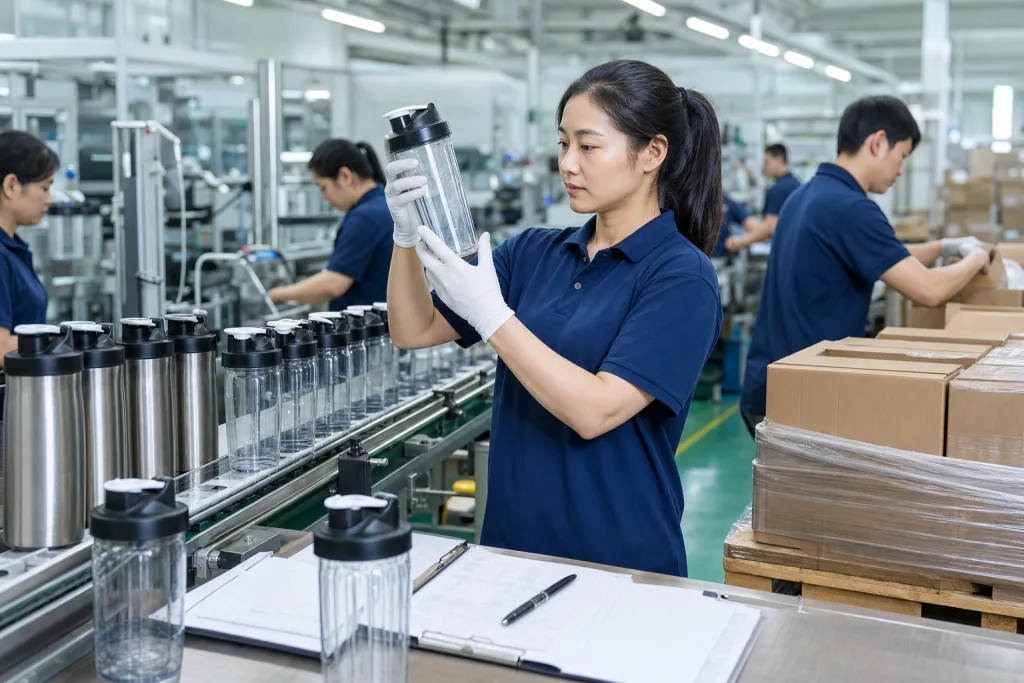
QC on a distributor blender bottle should target the defects that turn into claims. Leakage comes first. Cracked lids come next. Bad print is right behind them. Ask for AQL 2.5 on appearance and function, then set a zero-tolerance internal rule for critical defects like leaking, missing parts, or a whisk ball left out of the bottle. On our line, QC pulled the sample after lid assembly and ran a 100% lid check with a go/no-go fixture because one leaking bottle in a 5,000 pcs shipment costs more than the extra labor. This is the right question to ask.
Use a simple inspection list:
- Thread smoothness, no cross-threading after 3 open-close cycles
- Gasket seated flat, no pinch marks under a 3x lamp check
- Lid closes with consistent torque, usually checked against a set range in kgf·cm
- Print centered within ±2 mm
- Body free from sink marks, flash, or odor at final packing
If the order is a canteen customizable program with multiple graphics, pull one carton from each color and one from each packaging batch. We ship mixed lots on distributor canteen orders all the time, and that is where mistakes hide. Last month a buyer flagged a blue lid packed into the black SKU because the outer carton mark was right but the inner packout was wrong. Pull by batch. Then run carton drop testing at packing stage, not only at final inspection. We have seen clean-looking boxes fail after a 76 cm drop because the divider board was 2 mm short and the bottle shifted inside.
Buying from China, especially Zhejiang, your real protection is process control. The best canteen manufacturers keep incoming material records, first-article sign-off, and final inspection sheets with date, line, and inspector name. Ask to see those records before balance payment. If a canteen supplier acts surprised or sends only studio photos, they are not export-ready. We have seen this go sideways.
Commercial Terms Buyers Should Push
Pricing means nothing if the trade terms are fuzzy. Ask for unit price at 1,000, 3,000, and 5,000 units, with separate lines for tooling, sampling, and packaging. We see this every month: a distributor growler or shaker quote looks low, then the buyer flags that the master carton, paper insert, and freight were never included. FOB Ningbo or FOB Shanghai is usually the cleanest comparison point for China suppliers. The line is simple. If you want DDP, ask for duties, VAT, and broker fee as separate items, not one lump-sum line. We’ve seen a PO miss “inner box” by one line, and the cost gap showed up only after carton drop test prep.
Payment terms are usually 30% deposit and 70% before shipment. On larger repeat programs, some canteen distributors push to 20/80 or a short open-account window after 3 orders ship clean. On a first order, the math usually doesn’t work. Ask if the canteen vendor accepts split shipments, and ask the storage charge by day or by CBM if you delay pickup. QC pulled the sample on one program and the product was fine, but the buyer got hit with warehouse fees after holding 12 pallets for 9 days. Those charges matter more than a polished sample tray.
For buyers building a custom canteen program across stores or distributors, keep the SKU count tight. One base body, two lid colors, one print method, and one carton size is already enough for the line to manage if MOQ is 3,000 pcs per color. This is the wrong place to chase endless variation. Reorders run faster with fewer moving parts, and picking errors drop when the outer carton marks stay consistent. We’ve seen this go sideways: one extra lid color sounds small, then the buyer receives mixed caps in a 1.2 mm color shade difference batch and has to sort stock by hand. Even in a solid Zhejiang factory, every added option raises the miss rate.
Send your bottle spec for a factory quote
We can review MOQ, print method, packaging, and lead time before production, so your next Zhejiang order lands cleanly.
Frequently asked questions
What MOQ should I expect for a distributor blender bottle?
For a standard distributor blender bottle, a normal MOQ is 1,000 units per color if you use an existing mold and one-color print. If you want a new lid, a new mixing insert, or a fully customized canteen shape, MOQ often moves to 3,000 units. For mixed colors, many canteen suppliers ask for 500 units per color, but they will usually keep the total order at 2,000-3,000 units. On premium stainless programs, MOQ can be lower per SKU but the unit price rises fast.
How long does production usually take in China?
For a repeat custom drinkware order from Zhejiang or other parts of China, normal lead time is 25-35 days after sample approval and deposit. If you need new tooling, carton redesign, or a customized growler lid, add 10-20 days. In peak months before summer and Q4, add another 7-10 days if the canteen factory is busy. Freight booking can also add 3-7 days, so you should confirm your ship window before approving artwork.
Which decoration method is best for this product?
If your bottle is polypropylene or Tritan, silkscreen is the most cost-effective option for a canteen promotional order. Budget about USD 0.08-0.20 per color at volume. For stainless steel, laser engraving is cleaner and more durable, usually around USD 0.25-0.60 per unit depending on size and setup. UV print works for some customizable drinkware programs, but you should test abrasion if the product will be washed often. For distributor canteen orders, one-color print is usually the safest margin choice.
What QC tests should I demand before shipment?
At minimum, ask for 100% leak testing on lids, AQL 2.5 appearance inspection, carton drop checks, and confirmation of material compliance. For a distributor blender bottle, also request thread fit checks, gasket seating inspection, and shake testing with real liquid. If the order is going to the EU, ask for REACH documentation. If it is for North America, ask for food-contact declarations and any relevant migration test reports. A serious canteen manufacturer in Zhejiang should provide these without hesitation.
Can I mix canteen custom colors in one order?
Yes, but the factory will usually set a per-color MOQ. A common setup is 3 colors at 500 units each, or 5 colors at 300-500 units each, depending on the mold and print method. For a custom canteen or customizable canteen program, keep the base body the same and change only cap colors or silicone accents. That reduces risk and keeps pricing under control. If you want a distributor growler or shaker line with many colors, make sure the carton labels and inventory codes are set before production starts.