Key Takeaways
- For a 5,000-unit distributor beer tumbler order, realistic MOQ is often 500-1,000 pcs per color, with FOB China pricing around USD 3.20-5.80 depending on steel grade and print method.
- A normal custom sample cycle is 7-12 days, mass production 25-35 days after deposit and artwork approval, assuming no new mold is required.
- Use AQL 2.5 for major defects and 4.0 for minor defects, plus 2-hour heat retention and leak tests on retained samples before shipment.
- If you need Amazon or retail distribution, specify FNSKU, barcode position, carton gross weight under 15 kg, and 5-layer export cartons before PO approval.
You are not buying one beer tumbler. You are buying margin, an on-time ship date, and a SKU your distributor network can reorder without drama. That changes the spec from day one. A distributor beer tumbler project often starts as “custom drinkware, please quote,” then turns into hard questions on insulation hold time, logo finish after 200 dishwasher cycles, carton drop risk from 76 cm, and whether the factory can hit the same Pantone six months later on the line.
Here is the practical case. You need 5,000 stainless beer tumblers for a seasonal promotion in Europe, with two logo versions and a fixed ship date. The right canteen manufacturer or canteen factory in Zhejiang will ask for the print split, master carton size, and barcode placement before quoting; we have seen buyers type the wrong PO color code and QC pulled the sample just in time. The wrong supplier will push a low FOB price. This is the wrong question to ask if the first real problem shows up at packing inspection.
Start with the real sales channel
Take a common case from the line. You buy distributor drinkware for craft beer shops, event merch programs, and regional beverage brands. Your customer wants a 20 oz insulated beer tumbler with lid, powder coating, and a 1-color logo. They also say the range might extend later into a custom growler and a custom canteen program. At this stage, 7 out of 10 buyers ask only for a quote. That is the wrong question to ask. We’ve seen POs come in with the logo color listed but no retail channel, and then the carton spec gets revised twice.
Define the sales channel first, because the channel sets the spec. For brewery gift shops, shelf appearance usually beats shaving $0.08 off carton cost, and the buyer will flag powder-coat touch feel before they ask about pallet height. For a canteen promotional campaign, unit price and print speed usually matter more than premium powder texture; on our side, the line will often switch from a slower textured powder to a standard matte run to hold output. If the order will be sold by canteen distributors or canteen vendors into multiple regions, repeatability matters most. Same lid fit. Same print position. We check logo height with a 0.5 mm tolerance jig because once one region gets a different look, the complaints start.
- End use: beer tumbler for retail, promo, or hospitality, because each channel pushes a different print standard and carton target
- Volume: 16 oz, 20 oz, or 30 oz are the usual commercial sizes; 20 oz is still the safest middle volume for distributor programs
- Material: 18/8 stainless outer and inner is preferred for corrosion resistance, and buyers still ask us to confirm 304 stainless on the PO
- Construction: double wall vacuum, copper coating optional; we usually check vacuum hold after sealing and spot-check base temperature drop
- Decoration: silk screen, laser engraving, UV print, or emboss tool if volume justifies it, but the math doesn’t work on a new emboss tool for a small trial run
For this walkthrough, assume a 20 oz double wall vacuum distributor beer tumbler, clear AS lid, matte black powder coat, and one-side white logo. Quantity is 5,000 units split across two artworks. That is a standard China sourcing job, not a development project. A capable canteen supplier in Zhejiang should quote it fast and tell you where cost and risk actually sit: coating consistency, logo adhesion, and lid fit. QC pulled the sample on one run last month and found two lids rocking on the rim, which matters more than saving a few cents on steel.
Build the spec before price
Ask 3 canteen suppliers for a quote from one reference photo and you will get 3 numbers that do not match. One shop prices 201 stainless outside, another uses 304 inside and outside, another cuts body thickness by 0.05 mm. We see this every week. Build a purchase spec sheet first, even if it is only 1 page and the buyer flagged one typo on the PO.
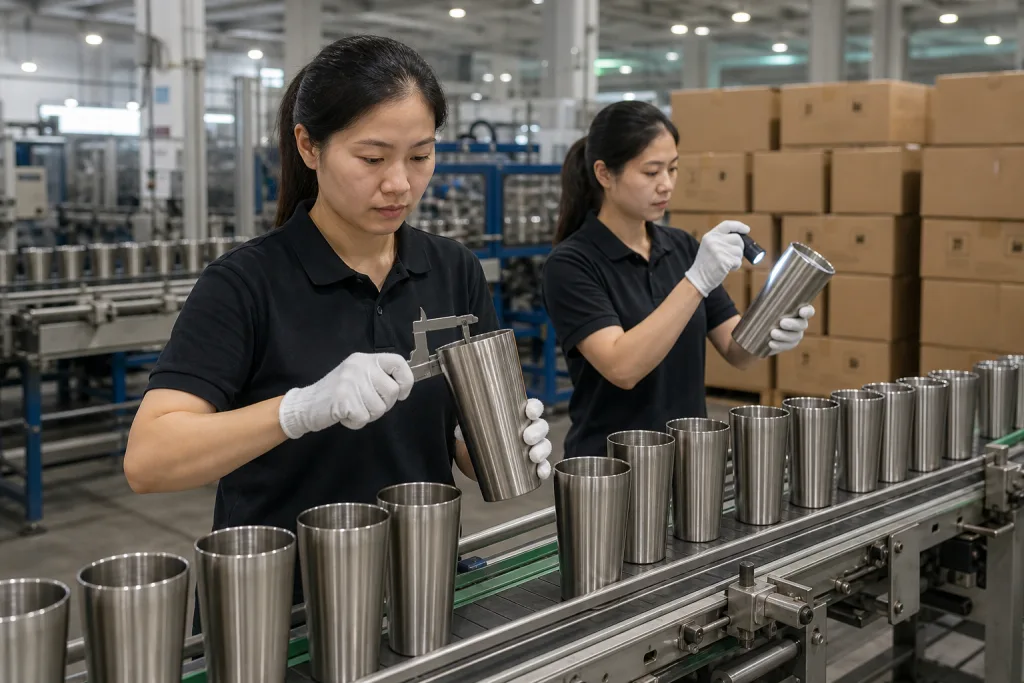
For this order, the spec should state: 20 oz capacity, 304 stainless steel inner and outer, wall thickness 0.4 mm inner and 0.45 mm outer, vacuum insulated, straight body, bottom diameter 72 mm, height 175 mm, clear push lid, Pantone Black C powder coat, logo width 55 mm, 1-color silk screen in white, individual polybag plus white box, 25 pcs per master carton. Add tolerance where it matters. Capacity tolerance can be plus or minus 3%. Height tolerance can be plus or minus 1.5 mm. Net weight tolerance should be within 8 g. On our line, QC pulled the first sample and checks height with a digital caliper before mass print approval.
Now the pricing is honest. At 5,000 units, FOB Ningbo or Shanghai, we usually quote in these bands:
- USD 3.20-3.90 for basic 201 outer / 304 inner construction
- USD 3.80-4.70 for full 304 inside and outside
- USD 0.08-0.18 for 1-color silk screen, depending on print size
- USD 0.20-0.45 for individual retail box with barcode label
If a canteen factory in China quotes USD 2.60 for this exact build, ask what changed. This is the right question. In most cases it is steel grade, thinner material, no powder topcoat, or weak vacuum yield; we have seen vacuum retention drop from 12 hours to 8 hours after a factory cut the weld and insulation standard. The same logic applies if you later buy a customizable growler, customized canteen, or customized drinkware range. Quote discipline protects you better than negotiation theatre. The math does not work if the build stays the same.
Low pricing is useful only when you know which specification has been removed to get it.
Sampling tells you what the PO missed
Once the price is acceptable, don't rush the deposit. Sampling is where the PO gaps show up. For a standard distributor beer tumbler with existing tooling, a plain sample is usually ready in 3-5 days. A pre-production sample with the exact coating, print position, and packaging usually needs 7-12 days from artwork confirmation. If you want a new lid color or a special base shape, add mold time and budget. A simple component mold can run USD 1,500-4,000 and add 20-30 days. We’ve seen buyers push for a 7-day launch while changing a lid Pantone on the same PO; the math doesn't work.
Sample review is not just looks. Check it like a buyer on the line, not someone opening one cup at retail. QC pulled the sample, then we check with a caliper and carton gauge:
- Lid fit across at least 10 random bodies, not one hand-matched sample from the bench
- Powder coat texture and edge coverage around rim and base, where thin spray often shows first
- Logo registration, opacity, and rub resistance after 50 dry wipes
- Thread or push-seal consistency if the item uses a special closure
- Master carton dimensions and box crush resistance
If your wider portfolio includes canteen custom projects or canteen customizable products, use the same approval routine across categories. It saves rework when you buy from 3 canteen manufacturers and 2 canteen vendors at the same time. Ask for sample test records too. A serious canteen manufacturer should be able to provide internal results for coating adhesion, salt spray if relevant, and basic thermal retention. We had one case where the buyer flagged a PO typo on the inner box mark, and the sample check caught it before 5,000 boxes were printed.
At BottleForge Industrial in Zhejiang, a typical monthly capacity for stainless vacuum drinkware can reach 300,000 units, but capacity does not prove sample accuracy. The right question is whether the sample followed the same process route as production. If the showroom sample was touched up by hand, then mass production runs on a different screen-printing jig or with outsourced lids, you are not approving the real item. We've seen this go sideways after first bulk inspection.
Plan production like a shipping calendar
After sample approval, count backward from the delivery date. If your warehouse receipt in Rotterdam is 15 August, we would book against that date, not the ex-factory date. Sea transit from East China usually runs 30-38 days port to port, then you still have customs clearance and local drayage. One lost week on the line is not small. We have seen a 7-day coating delay push cargo past vessel cutoff by 3 days, which is why this is the right question to ask early: what date must production finish, not what date can production start?
- Day 0: PO issued, 30% deposit paid, artwork approved
- Day 3-5: Pre-production sample signoff
- Day 7-20: Body forming, welding, vacuuming, polishing, coating
- Day 18-24: Printing and assembly
- Day 25-28: Inner box packing, outer carton packing
- Day 29-31: Final random inspection
- Day 32-35: Container loading and vessel cutoff
For a 5,000-unit order, 25-35 days is standard in Zhejiang, China, outside major holiday peaks. Before Chinese New Year, add 10-15 days. That is normal because plating slots, coating booths, and truck booking all tighten up at the same time. SKU count matters more than buyers expect. Two logo versions usually run fine. Ten logo versions at 500 pcs each slow packing, raise relabel work, and increase mix-up risk. QC pulled a sample last season where the PO had one character wrong in the color suffix, and 600 inner boxes ended up with the wrong sticker.
This is also where commercial terms need to be locked. FOB China is still the cleanest option for a lot of North American and European buyers because you control freight and can switch forwarders if booking goes sideways. If you buy DDP for convenience, insist the carton marks, HS code, and declared value match your compliance file exactly. We ship plenty of canteen and ecommerce programs, and the buyer often flags labels late: suffocation warning, country of origin mark, FNSKU, even a 3 mm barcode height change. These details are not glamorous. They decide whether your customized growler or distributor canteen shipment moves on time or sits in a forwarder warehouse waiting for relabeling.
QC that catches expensive defects
Most drinkware defects are not dramatic. They repeat. On beer tumbler orders, QC pulled the sample and found the same issues again and again: logo drift by 1.5 mm, weak vacuum on 3 pieces out of 200, powder pinholes near the base ring, lids packed too tight and cracking after transit vibration. This is what costs money. For a distributor beer tumbler order, I would not trust factory-floor photos as the main release basis. Use a written inspection standard, signed against the PO, and keep retained golden samples at both the factory and buyer side. We’ve seen this go sideways when the PO artwork file had one typo in the origin line.
A practical final inspection setup is AQL 2.5 for major defects and 4.0 for minor defects. Critical defects should be zero tolerance. That part is standard. The wrong question to ask is whether the line “looks good.” Ask what fails the lot. Major defects include loss of vacuum, wrong artwork, visible denting, sharp rim edge, missing origin mark, and leakage. Minor defects include slight print position deviation within agreed tolerance, small color shade variation, or light carton scuffing if the product is not retail boxed. On our side, the rim edge check is usually confirmed by hand feel and a simple edge compare sample, then QC logs the defect count by carton number.
Checks worth paying for
- Vacuum retention: hot water fill test on sampled units, compare temperature drop after 2 hours
- Leak test: inverted test for 30 minutes with assembled lid
- Coating adhesion: cross-hatch tape test on printed and coated areas
- Drop resistance: packed carton corner drop and edge drop from 76 cm for export cartons
- Barcode scan: verify retail or FNSKU labels on 100% of cartons if required
If your buyer program later expands into customizable canteen, canteen customized sets, or custom growler assortments, do not let each product line use different QC language. Standardize the checklist across SKUs, defect names, and pass/fail photos. We run into pushback here: one buyer calls it “light scratch,” another calls the same issue “abrasion,” and the factory ends up arguing over words instead of sorting stock. Ask for test reports relevant to your market, such as REACH for EU chemical compliance and food-contact declarations. If selling into the US, ASTM or California Proposition 65 questions may come up depending on materials and packaging components. A 100-carton order and a 10,000-piece program should still use the same defect definitions.
The point is simple: quality problems in China are usually specification problems first, production problems second. The factory cannot hit an undefined target. If the logo tolerance is not written as ±1 mm, if the master carton drop spec is not listed, if the lid torque range is missing, the math doesn’t work.
Packaging, compliance, and reorder logic
The first order is only half the job. Reorders pay the bills, and they break for boring reasons: missing carton specs, unclear labels, or a packing note that says “same as last time” with no file attached. For this 5,000-piece tumbler order, lock the pack-out in writing: one piece per polybag and white box, 25 pcs per carton, carton gross weight below 14.5 kg, carton size around 48 x 48 x 39 cm, shipping mark on two sides, barcode on one side, and palletization method if needed. We run into this on the line all the time. QC pulled the sample once because a PO typo showed 24 pcs per carton while the master case fit 25, and the buyer flagged the freight math right away. If you need shelf-ready packaging for a canteen promotional retail launch, specify box board grade and print file ownership on day one. This is the wrong question to ask late.
Compliance files should move with the order, not one week after the vessel sails. Ask your canteen factory for material declarations, factory audit status such as BSCI or ISO 9001 if relevant to your account, and any existing test reports for the lid resin and coating system. If you buy from canteen suppliers in Zhejiang 3 or 4 times a year, build a supplier file with expiry dates for reports and the last approved version number. We ship faster when that file is clean. A missing LFGB update or an old lid resin report can hold a repeat order for 2 days, sometimes 5, while the sales side chases papers that should already be in the folder.
Now the reorder logic. A lot of buyers over-customize the first project, then the second PO turns into a mess. If your artwork changes every season, keep the body color and lid common. If you need two markets, standardize the carton and change only the unit label. If MOQ is 1,000 pcs per color, build the program in reorder blocks that actually fit demand—1,000, 2,000, 3,000—not six slow colors at 300 each, because the math doesn't work. We have seen this go sideways when a buyer wanted four lid colors on one 20 oz beer tumbler and then could not rebuy the slow mover for another 90 days.
The best China sourcing relationship is not the one with the cheapest first order. It is the one where your second PO can be placed in 15 minutes because the spec, QC points, and packaging file already exist, the carton mark has already been checked against the barcode label, and the factory can repeat the job without guessing. That is how experienced canteen distributors and canteen suppliers protect margin.
Send your tumbler spec and get a real factory quote
Share capacity, steel grade, logo method, packaging, and target date. We will review MOQ, FOB pricing, lead time, and QC points before you place the PO.
Frequently asked questions
What MOQ should I expect for a distributor beer tumbler order?
For a standard 20 oz stainless distributor beer tumbler using existing tooling, MOQ is usually 500-1,000 pcs per color per design from a China factory. If you split one color body into two logo versions, many suppliers will still accept 500 pcs per artwork as long as the total order reaches 3,000-5,000 pcs. New molds, unusual lid colors, or special packaging can push MOQ higher. For a broader custom drinkware program that includes a custom canteen or customizable growler, keep each SKU practical. Buyers often lose margin by ordering too many low-volume variants below 300 pcs each.
How long does custom production take from artwork approval?
If the beer tumbler uses existing molds and standard powder colors, expect 7-12 days for a pre-production sample and 25-35 days for mass production after deposit and final artwork approval. During peak periods in China, especially before Chinese New Year or after long public holidays, add 10-15 days. Ocean freight from Zhejiang to Europe often takes 30-38 days, and to the US around 20-35 days depending on coast and routing. If you need a new component mold, add roughly 20-30 days plus sampling time. Do not book promotions based only on factory lead time; include inspection and vessel cutoff.
Which stainless steel grade is best for beer tumblers?
For most B2B distributor beer tumbler projects, 304 stainless steel inside and outside is the safest commercial choice. It balances corrosion resistance, food-contact confidence, and repeatable finish quality. Some low-cost models use 201 stainless on the outer wall with 304 inside to cut FOB price by about USD 0.30-0.60 per unit, but that can affect long-term appearance in humid use. Ask for wall thickness too, not just steel grade. A common build is 0.4 mm inner and 0.45 mm outer. If you are sourcing for Europe, also request REACH-related documentation and food-contact declarations for metal, lid resin, and coatings.
How do I control logo quality on customized drinkware?
Start by locking the print method before PO approval. Silk screen is cost-effective for 1-color logos at 5,000 pcs, usually around USD 0.08-0.18 per print. Laser engraving costs more but gives stronger permanence on powder-coated surfaces. Ask the factory to define logo size, placement tolerance, Pantone reference, and rub-resistance standard. For inspection, use a signed golden sample and check opacity, registration, and consistency across at least one full production lot. If your project includes customized canteen or customized growler items, keep the same artwork standards across categories so your canteen supplier does not interpret each SKU differently.
What documents should I request before shipment from China?
At minimum, request the commercial invoice, packing list, final inspection report, carton photos, and any agreed compliance documents before balance payment. For a professional canteen manufacturer or canteen vendor, you should also ask for material declarations, country-of-origin marking confirmation, barcode list, and test reports relevant to your market. If you require social or quality audits, ask for BSCI or ISO 9001 records if available. For Amazon or retail programs, verify FNSKU placement, carton labels, and carton gross weight before loading. These documents matter just as much as the product if you want smooth customs clearance and easier reorders.