Key Takeaways
- Specify 18/8 stainless, 0.4-0.5 mm inner wall, and a heat test target such as 55°C+ after 12 hours.
- Set artwork position, Pantone tolerance, and adhesion test standards before mass production; reprint rates above 3% usually mean weak process control.
- For design vacuum bottle wholesale, typical MOQ is 1,000 pcs per color, with 30-45 day lead time and factory output up to 300,000 units/month in Zhejiang.
- Use written QC gates: pre-production sample, in-line inspection, and final AQL 2.5/4.0 to control leaks, dents, and carton damage.
You can sign off on a clean sample and still get a full container of problem stock. We see this all the time in design vacuum bottle wholesale. One golden sample proves the look; it does not prove the line can hold spec for 20,000 pcs. QC pulled the sample, it looked fine, then mass production showed the usual misses: heat loss after 6 hours, coating chips at the base ring, lids leaking at 0.03 MPa air test, logos drifting 2 mm off-center, dented bottoms, and export cartons failing the drop test.
If you source custom thermos programs from China or Zhejiang without tight written specs, your supplier thermos quote covers only half the job. The other half is stopping preventable loss before production starts. This is the wrong question to ask: “Can you copy my sample?” A stainless thermos project needs to run like an engineered item, not a simple gift order. Once wall thickness, 304 stainless grade, paint standard, AQL, and carton strength are locked before PO release, your thermos bulk order is far less likely to come back as rework, claims, or a buyer-flagged 12-day delay.
Why nice samples fail later
The biggest mistake in design vacuum bottle wholesale is treating a hand-checked sample like proof of mass production. It is not. A development sample is often built by a senior technician at a bench, checked with a caliper, printed one piece at a time, then water-tested piece by piece. Mass production is different. We run the line at target speed, operators change by shift, and stainless coils from two lots will not behave in exactly the same way.
This is where nice samples fail. A buyer orders a custom thermos or promotional thermos, approves a clean prototype, then skips the numbers on wall thickness, vacuum yield, coating cure temperature, or carton drop spec. We have seen this go sideways. Once the same design hits production, tolerances stack up fast: the cap thread backs off by 0.3 mm, the paint shifts half a shade after oven cure at 180°C, and QC pulled the sample because the base cup was 1 mm off-center.
From a thermos manufacturer side, the line needs fixed numbers, not general comments like “same as sample.” This is the wrong question to ask. If you want a reliable bulk thermos program from Zhejiang or anywhere else in China, ask for a written specification sheet covering:
- Body material: 304 stainless steel inside and outside, or 316 inner if you need higher corrosion resistance
- Wall thickness: typically 0.4 mm inner and 0.5 mm outer for 500-750 ml bottles
- Heat retention target: for example, 95°C filled water to remain above 55°C after 12 hours at room temperature
- Leak standard: zero leakage after inverted test for 30 minutes
- Logo position tolerance: commonly ±1.5 mm
- Inspection standard: AQL 2.5 major, 4.0 minor
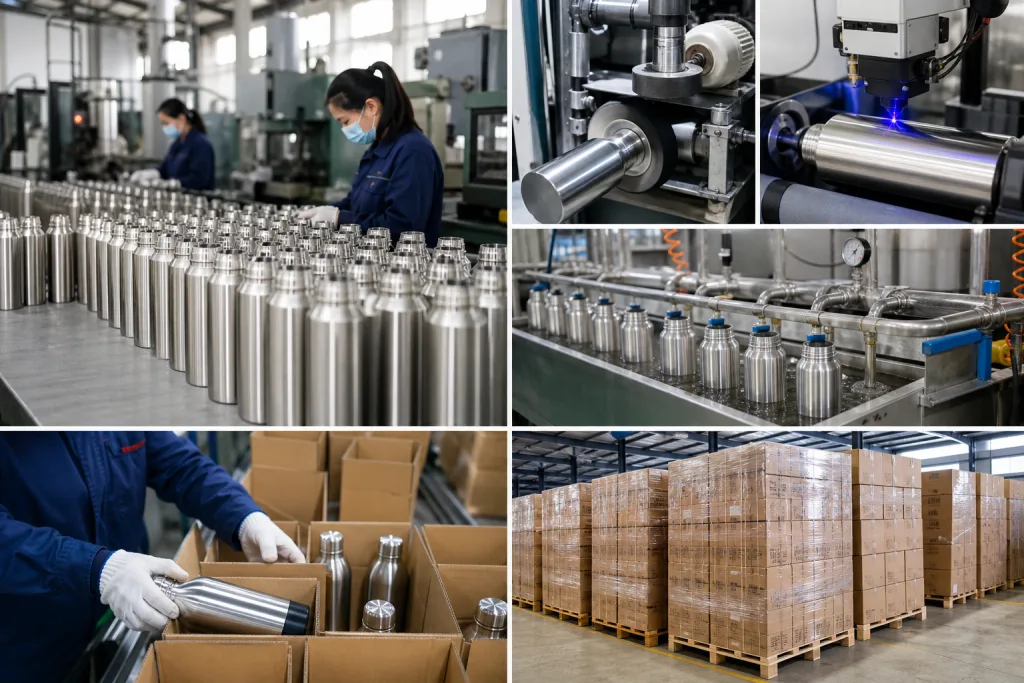
At BottleForge Industrial in Hangzhou, Zhejiang, typical MOQ starts at 1,000 pcs per color per model, with normal lead time around 35 days after sample approval. The jump from 100 samples to 5,000 units is where process stability gets exposed. We ship plenty of repeat programs in that range, and the ones that stay smooth always lock the spec first. Your job is to make that jump predictable.
Steel and vacuum failures first
If the bottle body is off, nothing else matters. The costliest failure in a factory thermos order is weak vacuum or mixed material, because you usually find it after decoration and packing are already paid. We have seen QC pull finished samples, cut the carton, and then find a bad vacuum hold after the logo and gift box were done. That hurts.
Common body failures
- Heat retention misses target because the vacuum seal leaks at the pinch-off
- Rust spots show up from low-grade steel or grinding dust left on the line
- Dents appear around the shoulder because the outer wall gauge is too thin, often 0.35 mm where 0.4 mm should have been used
- Base wobble comes from uneven bottom forming, which QC catches on a flat granite table
A lot of buyers ask a thermos supplier for “304 stainless” and stop there. This is the wrong question to ask. You need to confirm whether both inner and outer walls are SUS304, and whether the mill cert matches the PO, because we have seen a typo on a PO change 304 outer to 201 by mistake. If you sell in Europe, ask for material declarations for REACH and LFGB-contact requirements. For North America, confirm testing to relevant FDA-contact expectations and, if the product is for kids, any applicable ASTM or CPSIA-related packaging and component controls.
The vacuum needs a clear pass/fail rule. A serious manufacturer thermos program should include 100% vacuum inspection on the line, then a sampling heat-retention test by batch. If your order is 10,000 pcs, ask the thermos factory for its actual vacuum rejection rate. On a stable stainless bottle line, we run under 1.5% vacuum-related rejects before packing. If the number is 4% or 5%, the math doesn't work. It usually means the welding, sealing, or handling is unstable, and we have seen this go sideways after a weak neck weld on the vacuum station.
You are not buying stainless steel as a commodity. You are buying forming accuracy, weld consistency, vacuum integrity, and process discipline.
For outdoor retail, I would rather see a slightly higher FOB China price—say USD 3.80 instead of USD 3.45 on a 750 ml powder-coated bottle—if it includes thicker material and a tighter vacuum control plan. That extra USD 0.35 is cheaper than field returns. We ship plenty of 750 ml bottles, and the buyer often flags shoulder dents first, not color shade. A customized thermos that fails performance tests damages your brand faster than a delayed shipment.
Lids leak more than bodies
Most complaint photos from end users point to the same part: the lid, not the bottle body. In thermos custom projects, buyers spend 3 times more discussion time on Pantone color than on thread fit, gasket hardness, or vent design. That is the wrong priority. On our line, QC pulled the sample twice last month because a 0.3 mm thread mismatch caused seepage even though the body weld was clean.
A lid system fails in plain factory ways. The silicone ring comes in 0.5 mm undersized. The PP thread shrinks too much after molding and the cap feels smooth in first assembly, then loose after 48 hours. A push-button stopper passes the golden sample but starts leaking after 600 press cycles. A carry handle cracks because the gate position is off or the resin grade was swapped on the PO. We see these issues with any thermos vendor or thermos supplier. They are controllable if the spec is tight and the line follows it.
Here is what you should specify with your thermos manufacturers or suppliers thermos team:
- Leak test: 100% inverted water test for 30 minutes, plus random hot-water test
- Torque window: defined tightening range so caps are not under- or over-tightened in assembly
- Gasket material: food-contact silicone, odor-free, hardness commonly 50-60 Shore A
- Life cycle: 500 to 1,000 open-close cycles for threaded caps; more for heavy retail use
- Drop test: packed or unpacked criteria, usually 3-5 drops depending on channel
If you are sourcing a distributor thermos line for resale, ask for interchangeable lid control. Some bottle platforms let one lid run across 3 body sizes. Sounds efficient. We have seen this go sideways when tolerance drift starts and the 500 ml cap fits the 750 ml bottle on one cavity but not the next. Ask for a gauge check or a master sample sign-off for every lid-body pairing, not just one platform approval.
For a customizable thermos used by outdoor retailers, I usually recommend simpler closures over one-touch systems unless the order volume covers full validation. The math does not work on a 2,000-piece MOQ if you want button-cycle testing, hot-fill checks, and transit abuse tests on every revision. A standard screw cap with a well-designed silicone gasket is boring, and that is good. We ship more of these because claim rates stay under 0.8% after China-to-Europe or North America transit.
Decoration is where margins disappear
Decoration defects do not stop a bottle from holding heat. They kill sell-through and create ugly sorting cost. In design vacuum bottle wholesale, this is where too many promotional thermos orders bleed margin. We have seen cartons pass insulation test, then fail at packing because the logo sat 3 mm off-center, the powder coat scratched with a fingernail, or one pallet ran darker than the approved chip.
Split decoration methods by failure risk, not by what looks good on a mood board. Silkscreen works for simple 1-2 color logos and the math usually works at 3,000 pcs MOQ. Laser engraving lasts, but the mark changes if coating thickness shifts from 60 to 80 microns, so QC pulled the sample under the light box before mass run. Heat transfer gives you full-wrap artwork, though registration drift and edge lift around the seam are the usual headaches. Powder coating sells the premium look, but bad pretreatment or weak phosphate cleaning shows up fast as chips at the base ring and bottle mouth.
Before approving a thermos customized order, lock these points in writing:
- Color reference: Pantone code or approved physical swatch
- Color tolerance: practical visual tolerance agreed per batch
- Logo position: centerline and height from base, not “as sample” only
- Adhesion test: cross-hatch tape test standard after curing
- Abrasion test: especially important for outdoor and thermos promotional use
For matte powder-coated bodies, coating thickness often sits around 60-80 microns. That range matters. Below 60, coverage gets weak and scratch resistance drops. Above 80, the surface starts to orange-peel and edge chipping gets worse, especially near the thread start. A solid manufacturer thermos partner in Zhejiang should already run a dry-film gauge on the line, but this is the wrong thing to leave to memory; put it on the spec sheet.
Be careful with the cheapest thermos bulk quotation if the order mixes two logo methods. We have seen a low FOB price hide slower hand touch-up, looser cosmetic grading, or extra rework at final packing. One buyer flagged this after finding silver logos from 2 cartons with different gloss levels, even though the PO only said “metallic finish” and missed the gloss target. If your retail channel is premium outdoor, define sealed approval samples and cosmetic limits clearly. If the channel is event gifting, minor under-base paint marks may be acceptable to hold cost. Different channels need different QC. One standard for all sounds clean, but it goes sideways fast.
Packing damage starts on paper
Buyers often blame the courier or forwarder when bottles land with dents. We’ve seen the issue start earlier, on the packing spec sheet. A stainless bottle is heavy for its size. A 500 ml unit can hit 320-380 g before color box, so carton compression, divider spacing, and top support matter more than they do on light plastic drinkware.
For a standard 500-750 ml thermos factory order, the common failures are boring and expensive: carton count pushed too high, board grade too soft, no 10 mm top-bottom buffer, and a polybag that stops dust but still lets painted bodies rub. Parcel handling is rough. If you sell online, especially as a thermos distributors or distributors thermos program, this is where claims start. We had one buyer push for 36 pcs per master carton to save freight; QC pulled the sample, and the sidewall dent showed up after the second drop.
You should specify:
- Carton board: 5-ply export carton as a baseline; stronger if bottle weight is high
- Carton gross weight: keep under about 15 kg where practical for easier handling
- Inner protection: egg-crate dividers, EPE, or molded pulp depending on finish sensitivity
- Drop standard: define whether master carton must pass 76 cm or similar transit simulation
- Barcode rules: FNSKU, carton label, pallet mark, or retailer routing labels if required
A cheap carton can wipe out the savings from a low bottle price. We’ve seen a supplier thermos quote move by only USD 0.08 per unit between weak packing and upgraded packing with thicker board and EPE caps. The math doesn’t work if arrival dent claims hit 6%. If your order ships FOB Ningbo or Shanghai from Zhejiang, ask for a packed drop test, loaded carton photos, and one gross-weight shot on the scale before balance payment.
If you run Amazon or other e-commerce programs, tell the thermos suppliers team at the RFQ stage, not after artwork starts. This is the wrong question to ask late. Retail pack size, barcode position, and suffocation warning copy need to be locked before we run samples on the line. We’ve seen this go sideways over one small PO typo: outer carton mark said 24 pcs, packing list said 20 pcs, and the buyer flagged the whole batch. The bottle is not ready just because the bottle body is ready.
QC must be written, not verbal
The phrase “we will inspect carefully” is useless on a PO. For stable custom thermos production from China, QC needs written checkpoints, defect photos, and numbers. Verbal promises start arguments. Written limits give both sides something the line, QC, and the buyer can actually follow.
A reliable thermos manufacturer workflow usually runs with three gates:
- Pre-production approval: sign off the master sample, artwork, packaging, and test plan; we usually tape the approved carton to the sample shelf so the line does not run from an old file
- In-line inspection: catch coating, print, and assembly issues before 100% of units are finished; QC pulled the sample at 200 pcs on one recent order and found logo drift at 1.8 mm
- Final random inspection: use AQL with a formal sampling plan before shipment; this is where leakage, vacuum hold, and carton mark errors get counted, not argued about
For stainless bottle orders, AQL 2.5 for major defects and 4.0 for minor defects is a solid starting point. Major defects include leakage, failed vacuum performance, sharp burrs, or wrong logo. Minor defects include light under-base scuffing or small print variation within agreed tolerance. If your channel is premium retail, tighten the cosmetic limit and write it down in mm or with approved photos. If it is a mass promotional thermos campaign, the math does not work if you inspect it like luxury giftware.
Ask your thermos manufacturers or manufacturers thermos partner to define defect categories before production starts, not after inspection begins. Put batch traceability on the bottle or carton by production date or lot code. A buyer flagged one claim from Germany last year, and we isolated the affected lot in under 2 hours because the outer carton code matched the daily report.
At factory level, practical metrics beat slogans. A Zhejiang line producing 300,000 units per month can still be the wrong fit if it cannot hold print alignment within ±1.5 mm or if rework runs past 3%. We have seen large plants miss this because output looked good on paper. A mid-sized thermos factory with 35-day lead time, disciplined in-line checks, and a torque wrench record for the lid station will often ship cleaner goods.
If you are new to a thermos supplier, start with one color, one logo position, and one lid option. Small start. Less noise. Complexity is where failures hide: mixed lids at packing, a typo on the PO, or two logo locations getting crossed on the silk screen table. Run the first lot, review the defect data, then scale.
What to lock before paying deposit
Before you pay a deposit, the big risks should already be cut down. That is where experienced buyers in thermos custom and thermos customizable programs separate themselves from first-time importers: they pin down the details instead of leaving half-decisions buried in 17 email threads. On our side, once the sample room signs off a drawing with a 0.5 mm tolerance, the line has something real to run.
Before deposit, your thermos distributor or brand team should hold a purchase package that is plain and complete. Fancy is irrelevant. Precision matters. This is the wrong stage to ask for “best price” without a locked spec, because the math does not work if the lid, print size, and carton standard are still moving.
- Product spec sheet: lock capacity, dimensions, net weight, steel grade, wall thickness, and insulation target; if body height shifts even 3 mm, carton fit and gross weight change with it
- Decoration sheet: lock method, Pantone, location, size, orientation, and approved artwork file; we have seen buyers flag a logo rotation after mass production because the PO only said “front center”
- Packaging spec: lock gift box or white box, carton count, carton size, and barcode placement; QC pulled the sample before and found the EAN label printed on the short side when the Amazon warehouse required the long side
- Testing and compliance list: lock REACH, LFGB, FDA-contact declarations, and BSCI or ISO documentation if your sourcing policy asks for them; if this comes up after deposit, production usually stalls at document review
- Commercial terms: lock MOQ, FOB price in USD, sample charge, lead time, payment terms, and spare parts policy; for some caps we also write the extra gasket ratio, such as 1% free spares
For example, a 750 ml powder-coated customized thermos with one-color silkscreen logo may sit at MOQ 1,000 pcs, sample lead time 7-10 days, production 30-45 days, and FOB China price around USD 3.50-5.20 depending on lid style, steel weight, and packing. Add a custom color box, and your cost may rise by USD 0.28-0.65. We ship this type of bottle often, and the buyer usually pushes back first on the lid cost, not the body. Ask the thermos vendor to break out those cost drivers line by line.
That is how you make design vacuum bottle wholesale workable instead of risky. A solid factory thermos partner in Zhejiang should not resist this level of detail. Frankly, we prefer it. Clear specs cut disputes, chargebacks, and the usual “but we thought” problem on both sides. Once the order is engineered properly, your outdoor retail line or branded campaign stands a better chance of shipping on time, matching spec, and landing saleable cartons at the warehouse.
Spec your stainless thermos project before production starts
Send your target capacity, logo method, MOQ, and packaging needs. We will review failure risks, recommend specs, and quote a workable China factory plan.
Frequently asked questions
What MOQ is normal for design vacuum bottle wholesale?
For a standard stainless design vacuum bottle wholesale program, MOQ is usually 1,000 pcs per color per size. Some thermos suppliers in China may offer 500 pcs for stock colors with simple one-color printing, but the unit cost is higher and color or lid options are limited. If you need a new mold, custom lid, or full custom packaging, MOQ often moves to 3,000-5,000 pcs. For outdoor retail, 1,000-2,000 pcs is a sensible starting point because it gives enough quantity to stabilize coating and print quality without overcommitting stock. Always confirm whether MOQ applies per SKU, per color, or per combined order, because that changes your real buying cost.
How do I compare quotations from different thermos manufacturers fairly?
Do not compare only FOB unit price. Ask each thermos manufacturer to quote the same structure: capacity, steel grade, wall thickness, lid material, logo method, individual box, carton count, and testing included. A quote of USD 3.60 and one of USD 4.05 may actually be close if the cheaper option uses thinner 0.35 mm steel, weaker packaging, or excludes logo setup and compliance paperwork. Also compare lead time, MOQ, spare lid policy, and defect handling terms. For a thermos bulk order, I would request photos of production lines, packed cartons, and a written AQL standard. That tells you more than a polished PDF quotation.
What tests should I require for a custom thermos order?
At minimum, require a leak test, heat-retention test, coating adhesion test, and carton drop check. A practical heat target for a 500-750 ml bottle is water filled at about 95°C remaining above 55°C after 12 hours at room temperature. For lids, specify 100% inverted leak testing for 30 minutes. For Europe, ask for REACH and LFGB-related declarations where applicable; for North America, confirm food-contact compliance expectations with your thermos supplier. If the bottle is for kids or includes special accessories, add more checks. Good manufacturers thermos teams also keep in-line records for vacuum rejection rate and decoration defects, not only final inspection results.
Which decoration method is safest for promotional thermos projects?
It depends on your artwork and channel, but the safest low-risk option is usually one-color or two-color silkscreen on a stable powder-coated surface. It is cost-efficient, easy to control, and suitable for most promotional thermos orders above 1,000 pcs. Laser engraving is more durable, but the effect changes by coating thickness and metal finish, so you need approved samples. Heat transfer works for full-wrap graphics but carries more risk on registration and edge lifting. If your campaign is price-sensitive, avoid combining too many effects on one bottle. Every extra process raises defect probability. Ask your thermos factory to provide abrasion and tape-test results before mass production starts.
How long does production usually take for customized thermos orders from Zhejiang?
For a normal customized thermos order using an existing bottle shape, expect 7-10 days for pre-production sampling and about 30-45 days for mass production after sample approval and deposit. Busy season can push this to 50 days, especially before major holiday shipping peaks. If you add a new mold, unusual lid tooling, or retail packaging with multiple inserts, development can add another 15-25 days. Factories in Zhejiang with monthly output around 200,000-300,000 units can move faster, but speed only helps if artwork and packaging are approved early. If you need delivery for a seasonal launch, work backward from ex-factory date, not only from vessel departure.