Key Takeaways
- Most leakage and insulation claims trace back to 4 missing specs: gasket material, vacuum test standard, thread tolerance, and torque range.
- For design thermos wholesale, common MOQ is 1,000 pcs per color and repeat lead time is usually 35-45 days from Zhejiang, China.
- A 0.5 mm inner and 0.4-0.5 mm outer 18/8 stainless body costs more, but usually cuts dent and welding complaints by 20-30% versus lighter builds.
- Use AQL 2.5 for major defects and 4.0 for minor defects, plus 100% vacuum and leak checks before carton packing.
You can sign off a clean rendering, match the hand sample, and still receive a stainless thermos order that turns into claims. We have seen heat retention miss by 4-6 hours on the same body shape, lids seep after carton drop, and Pantone drift show up from one lot to the next under a light box. Last winter a buyer flagged bottom pads popping off after two weeks in Canada; QC pulled the sample and found the glue spread was too thin on the line. That is the real job in design thermos wholesale: this is not about picking a pretty bottle. It is about removing failure points before PO release.
If you buy for outdoor retail or promotional programs, you need a spec that holds up in real factory conditions in Zhejiang, China, not on a sales sheet. On our side, the math starts with hard numbers and process limits: 0.4 mm or 0.5 mm 304 stainless, a realistic MOQ of 1,000 to 3,000 units, 35 to 45 days lead time, and an inspection plan tied to AQL. We run into the same pushback all the time—buyers ask for 500 pcs, custom color, two box versions, and 30 days. The math does not work. China can make excellent customized thermos products, but only if the details are locked before tooling, screen printing, and vacuum testing start.
Where attractive designs usually fail
Buyers usually start with the silhouette, finish, and logo position. Fair enough. On custom thermos wholesale jobs, that is rarely where the failure starts. The trouble is under the skin: weak welds at the shoulder seam, powder coat cure drifting below target, silicone odor after hot-fill, lid torque swinging from 0.8 N·m to 1.4 N·m, or a retail box 12 mm too loose that lets transit damage happen on the first drop. We have seen QC pull a good-looking sample, cut it open, and find the weld line was the real problem.
For outdoor retailers, the risk is function. A bulk thermos for hiking or ski use needs to hold temperature, open with gloves on, and take a fall from a car seat or a pack side pocket without the lid cracking. For promotional thermos programs, the risk is batch consistency. You may need 5,000 units split across 4 logo versions, all landing on one event date. If the buyer flagged a 12% print shade shift on one version, the shipment is already in trouble even if the bottle itself passes. This is the wrong question to ask: “Does the sample look good?” Ask whether the line can repeat it for all 5,000.
From a Zhejiang factory view, most avoidable problems start before mass production. The RFQ says stainless thermos, custom logo, gift box, then stops there. No salt spray hours. No coating thickness in μm. No hot-hold test. No carton drop standard. Then the manufacturer thermos team fills the gaps with its house process, the same one we run for a basic promo order with MOQ 1,000. Sometimes that works. Often it does not. We have even had a PO with the lid color typoed, and nobody caught it until pre-production sample review.
You should build the spec around failure modes, not around catalog language. For example:
- Define body material as SUS304 inner and outer, or SUS316 inner if chloride exposure matters.
- Set vacuum retention target, such as 95°C filled water, after 6 hours not below 60°C at 20°C ambient.
- Define coating with cure method and adhesion requirement, such as cross-hatch test at 100/100.
- Define leak test as 100% inverted test for 30 minutes, not random check only.
- Define retail pack compression and outer carton drop test for Amazon or parcel channels.
That is how a factory thermos project stays commercial. If not, the job turns into an argument after arrival, and the math does not work for either side once replacements, air freight, and claim photos start coming in.
When vacuum insulation is the weak point
The core promise in any thermos custom program is temperature retention. If it misses spec, the logo and finish do not matter. We usually see insulation claims traced to 3 factory issues: unstable vacuum on the line, weak copper coating coverage on the inner wall, or a micro-leak at the weld or seal after aging. QC pulled samples before where the leak was small enough to pass a first look, then failed after a 24-hour hold test.
Buyers often ask for one hot-hold number and stop there. That is the wrong question to ask. One supplier tests with 98°C water, full fill, no preheat; another runs 95°C, preheats the bottle, then records after 6 hours at 24°C ambient. Both quotes look good on paper. They are not the same test. We have even seen a PO typo switch 95°C to 85°C, and the whole comparison went sideways.
What to specify
- Capacity tolerance: within ±3% of nominal volume.
- Test fill temperature: 95°C ±1°C.
- Ambient test room: 20°C to 25°C.
- Hot retention: for a 500 ml bottle, 6 hours ≥60°C; for premium outdoor retail, 12 hours ≥50°C.
- Cold retention: 12 hours with ice-water mix, target ≤10°C or define remaining ice percentage.
- 100% vacuum check before assembly, plus aging sample retention test every lot.
A capable thermos manufacturer in China should already run vacuum testing stations. Ask one direct question: do they do 100% online vacuum inspection or only batch sampling? At BottleForge scale, for example, a line capacity of 300,000 units per month means nothing if the vacuum station misses bad bodies before coating and packing. We ship decorated scrap in that case, and the math does not work. On our side, the line uses a vacuum gauge station before final assembly, because catching one failed shell early is cheaper than reworking 1,000 printed pieces.
Watch material downgrades as well. A supplier thermos offer that is USD 0.40 lower often means a thinner inner wall, like 0.28 mm instead of 0.32 mm, or weaker vacuum process control. In the current Zhejiang market, a 500 ml double-wall 304 stainless bottle with powder coat and one-color print can vary roughly from USD 3.20 to USD 5.80 FOB China depending on wall thickness, lid structure, finish, and packing. If the quote is sitting at the bottom of that range, ask what got cut. We have seen buyers flag retention drift later, and by then the savings are gone.
In stainless drinkware, low price often shows up later as poor retention consistency, not just obvious cosmetic defects.
Leaks start in the lid, not body
When buyers say a bulk thermos shipment leaked, they usually point at the bottle body first. Most of the time, that is the wrong question to ask. We see more failures in the lid system: thread mismatch, gasket compression set, weak vent geometry, straw assembly tolerance drifting by 0.2 mm, or closing torque that changes from shift to shift because the line ran without a fixed torque sample.
This gets riskier on a customizable thermos with a new cap design. A standard screw lid has years of line data behind it. A fresh cap with a carry handle, push button, lock clip, and two-material overmold adds more failure points, more mold adjustments, and more buyer signoffs. We have seen this go sideways when a customer wanted a fancy cap at 3,000 pcs MOQ but did not budget for two or three sampling rounds. If you are building a distributor thermos program for different markets, keep the cap simple unless the margin covers development rework.
Specs that prevent leakage claims
- Gasket material: food-grade silicone, define Shore A hardness such as 50 ±5.
- Torque range: for example 8-12 kgf·cm for standard threaded lids.
- Leak test: 100% upside-down for 30 minutes and random dynamic shake test.
- Thermal cycle: 20 cycles from hot fill to room temperature to check seal creep.
- Spare gasket policy: include 1% extra for promotional thermos or service-heavy retail programs.
If the thermos customized design uses a flip lid or auto-open function, ask for life-cycle testing up front. A reasonable baseline is 3,000 to 5,000 open-close cycles for promotional use and 10,000 cycles for outdoor retail. QC pulled the sample on one project after hot-water soak because the colored mouthpiece kept a plastic smell after 4 hours at 95°C. Check whether the lid resin complies with REACH and LFGB where needed, and whether any colored contact parts can pass odor testing after hot water exposure.
For distributors thermos orders, request a pre-production torque master sample and keep it signed. We run into trouble when this step gets skipped. The factory may tighten lids one way on day shift and another way near shipment cutoff, especially when the PO date was revised and the line had to catch up. Too loose leaks in transit. Too tight brings user complaints, thread wear, and sometimes cap marks that the buyer flagged at incoming inspection. Good QC controls both.
Coatings, prints, and color drift problems
Most design thermos wholesale projects go wrong at finishing, not at the bottle body. The approved matte powder coat sample looks clean, then bulk cargo shows gloss shift, orange peel, thin edge cover at the shoulder, or a logo that fails a tape pull test after 7 days. We see this on the line. These are process-control gaps, not random defects, and the usual cause is loose finishing specs on the PO.
For a customized thermos, the usual finish options are powder coating, spray paint, transfer print, silk screen, laser engraving, or UV print. Each one has a limit. Powder coat takes abuse and hides small surface marks, but Pantone matching is never exact from batch to batch. Screen print works at volume from 3,000 pcs up, but fine gradients and 0.2 mm lines are where QC pulled the sample. Laser stays permanent, but the visual effect is flat unless the coating stack was built for contrast.
If you buy a thermos promotional item, decoration usually drives the order more than 2 extra hours of heat retention. That is normal. Still, the wrong question to ask is whether a cheap screen logo will look “premium” on every surface. A low-cost screen print on textured powder will not read like offset print on paper, and we have seen buyers flag this after approval because the mockup looked too clean.
- Set color tolerance to a practical visual standard approved by master sample; if exact retail color is critical, discuss Delta E target in advance.
- Require adhesion test, such as cross-hatch 100/100 after cure.
- For outdoor use, ask for abrasion testing and 24 to 48 hours salt spray on exposed metal parts.
- Define logo position tolerance, for example ±1.5 mm for centered front print.
- Define print artwork file type and line width minimums so the factory thermos team does not improvise.
China finishing shops in Zhejiang can do solid work, but consistency comes down to jigging, oven cure control, and lot discipline. If your order mixes 6 colors at 1,000 units each, do not assume all 6 will run on the same day or from the same powder batch; we ship reorders where this point decides whether the match is acceptable or not. Ask the manufacturers thermos team to hold one retain sample from each color lot, labeled by date and batch card. That small step saves arguments when a repeat order 6 months later needs to match the first shipment.
Material shortcuts that create returns
Stainless grades get mixed inside one bottle, and this is where returns start. Buyers see 304 stainless on the quote and assume the full set is 304. Often it is only the body. We have seen the line run with a 304 body, then a lower-grade tea filter, lid plate, screw, or straw because the PO did not call out each part.
For most custom thermos programs, SUS304, also called 18/8, is the baseline for inner and outer body. If the bottle is meant for salty drinks, acidic use, or a premium outdoor line, a SUS316 inner is a fair upgrade, but the math does not work for every project because cost moves up fast on larger volumes. What you should reject is vague wording like stainless inner on the PI. We have seen one PO typo turn “304 inner” into “stainless inner,” and QC pulled the sample only after polishing.
Wall thickness decides both dent resistance and shipping weight. A 500 ml bottle with 0.5 mm inner and 0.5 mm outer holds up better in drop tests than one built at 0.4/0.35 mm, though it comes in heavier and costs more per piece. For promo programs, 0.4/0.4 mm is common. For retailer orders, 0.5 mm inner with 0.4 or 0.5 mm outer is a standard ask. Request the actual gauge by component, not just “thicker wall.” This is the wrong question to ask. We check it with an ultrasonic thickness gauge on the body and neck area because those two spots drift first.
Do not forget non-metal parts:
- PP, Tritan, or ABS in lids should be specified by grade and compliance requirement.
- Silicone should be food-contact compliant and low odor after hot soak. We usually run a 95°C soak check, and the buyer flags it fast if the seal smells off.
- Bottom pads should define adhesive type and low-temperature performance.
- Handles and straps should define pull-force requirement, such as 15 kg static load for 1 hour.
A solid thermos supplier should have test reports ready for REACH, LFGB, FDA-contact claims where applicable, plus factory compliance files such as BSCI or ISO 9001 if your customer asks for them. Ask before sample approval, not after booking cargo. We have seen this go sideways: documents came late, the forwarder held the booking, and the vessel moved 12 days later instead of the planned cutoff.
Packaging damage is usually self-inflicted
You can make a solid bottle and still get a claim because the pack was built for shelf display, not courier abuse. We see this a lot when thermos distributor and thermos vendor programs shift into e-commerce, especially Amazon FBA. The unit box looks clean on the screen, then the corner takes a hit, the cap rubs through during vibration, and QC pulled samples with ring marks on the painted finish after one truck run.
Packaging needs its own spec sheet. If your thermos manufacturers quote says white box, that tells you almost nothing. Ask for board grade, insert material, shipper pack count, carton burst or edge crush target, barcode position in mm, and drop standard. For a 500 ml stainless unit, a gift box that passes retail display can still fail in parcel shipping; we usually add a stronger outer master with dividers and check fit with a 3 mm shake test. This is the wrong question to ask: “Do you include packaging?” Ask what the packaging is built to survive.
What usually works
- Individual polybag or tissue to prevent finish abrasion; the buyer flagged this after metallic paint scratched inside a tight box.
- EPE or molded pulp support for premium packs, depending on presentation target and drop risk.
- Outer carton suitable for 5-layer export standard, sized to avoid dead space; if the line leaves too much void, bottles start walking inside the case.
- Carton drop test from 76 cm for standard retail shipments; if the sales channel is stricter, raise the standard before mass production, not after a claim.
- FNSKU and carton labels confirmed before mass print for Amazon programs; we have seen one PO typo on a carton mark turn 2,000 units into relabel work.
If you source supplier thermos products from Zhejiang, ask for a packaged drop-test video before final payment. It saves time. We ship these every week, and arguing from photos later usually goes sideways. Also verify carton gross weight. Keep it below around 18 kg to 20 kg where possible for easier handling and lower damage rate; once cartons get heavier, warehouse teams drag them instead of lifting cleanly.
Lead time is part of packaging risk. If you approve box artwork late, the bottle may be finished but still waiting on cartons, so the factory starts moving completed goods around the warehouse. That is where scratches and barcode mix-ups show up. We have seen orders slip from 12 days to 18 days just because outer cartons missed print booking. For most design thermos wholesale orders, keep packaging artwork frozen at least 20 days before shipment.
Inspection plans that catch real defects
The last failure mode is weak QC planning. We hear “please do inspection” on a lot of POs, then nobody defines the defects that trigger claims. QC pulled the sample, counted 12 small paint dots, and the line still missed the two issues that drive returns: slow seepage at the stopper and weak heat retention after 6 hours. AQL is useful only if the checklist matches how the flask is used.
For stainless drinkware, a workable pre-shipment plan mixes workmanship with function. AQL 2.5 for major and 4.0 for minor is a common starting point, and some outdoor chains ask us to run tighter. Looking strict on paper is the wrong question to ask. The job is to block defects that turn into refunds, replacement freight, and marketplace penalties after arrival.
- Critical defects: sharp edges a finger can catch on, failed food-contact compliance, severe leakage found in a 100% fill test.
- Major defects: vacuum failure, thread malfunction, wrong logo, obvious dent over 3 mm, unstable base that rocks on a flat table.
- Minor defects: small paint dust points, slight print offset within approved tolerance.
Build the inspection checklist around actual use. On our floor, that means the checks below, not a stack of generic forms:
- 100% leak test in production.
- Sampling for hot retention using your agreed method.
- Lid torque measurement.
- Coating adhesion and visual color comparison to sealed master.
- Barcode scan verification and assortment check.
- Carton count, carton markings, and drop-check on packed goods.
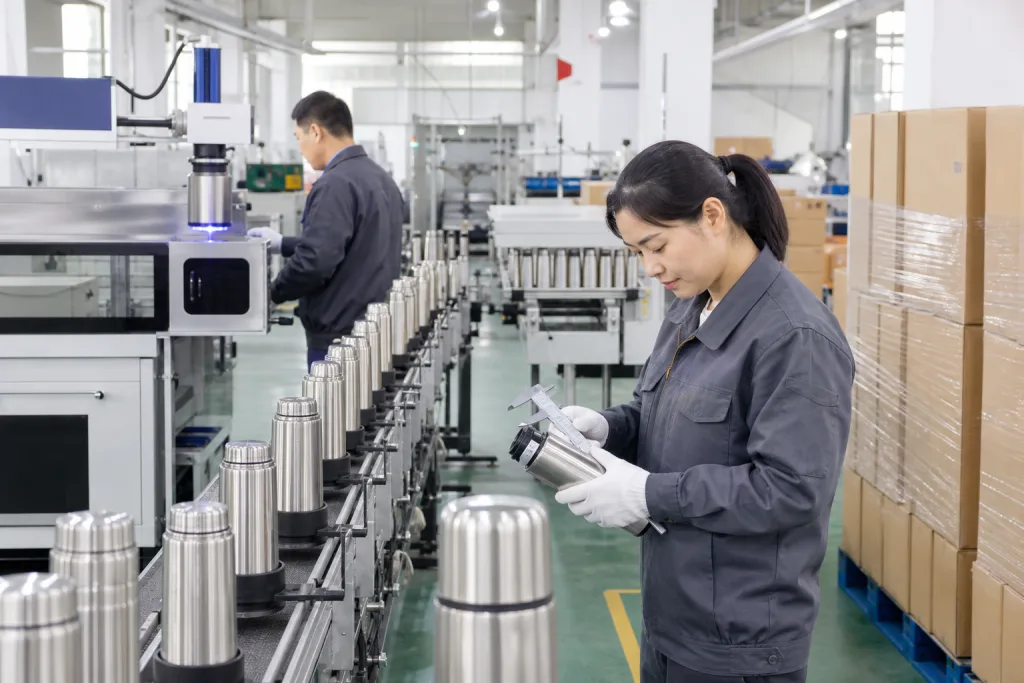
A good thermos factory in China should support inline QC, not just end-of-line sorting. If defects show up only at final inspection, you already paid for wasted powder coating, screen printing, and assembly labor. We’ve seen this go sideways. One buyer flagged 8% logo skew at final, and the whole batch had to be reworked after packing. That is why experienced buyers ask for an in-process report when 20% to 30% of goods are completed.
If this is your first design thermos wholesale project, keep the first PO disciplined: 1 or 2 body colors, one lid structure, one packaging format, and MOQ around 1,000 to 2,000 units per SKU. We usually tell buyers to hold decoration variables first, then add SKUs after the line runs clean for 2 or 3 repeats. The math doesn’t work if you launch 6 colors, 3 box styles, and mixed lids on the first order. Complexity is not free, even in Zhejiang, China, where supply chains are mature.
Build your thermos spec before you place the PO
Send your target capacity, lid type, finish, logo method, and packaging needs. We will review failure risks, MOQ, and lead time before sampling starts.
Frequently asked questions
What MOQ is realistic for design thermos wholesale orders?
For a standard 500 ml stainless model with one body color and one logo, a realistic MOQ is usually 1,000 pieces per SKU from a Zhejiang, China factory. If you want multiple Pantone colors, special lids, or customized thermos packaging, expect 2,000 to 3,000 pieces per variant to keep unit cost under control. Some supplier thermos offers advertise 500 pieces, but that often means limited color choice, stock lids, or higher pricing. New mold development for a custom thermos cap or base can push practical MOQ above 3,000 pieces because tooling amortization and setup waste have to be covered. If your program is for outdoor retail, keeping the first order simple is usually smarter than forcing a low MOQ with too many design changes.
How much should a custom stainless thermos cost in bulk?
For thermos bulk orders, price depends on steel grade, wall thickness, finish, lid complexity, and packaging. A common range for a 500 ml double-wall 304 stainless bottle is about USD 3.20 to USD 5.80 FOB China. Add around USD 0.15 to USD 0.45 for premium powder coat or multi-process decoration, and more if you need a unique customizable thermos lid or gift box. A 316 inner, thicker 0.5 mm walls, or a flip-top cap can raise cost further. If a factory thermos quote is much lower than the market range, check whether the body is thinner, leak testing is not 100%, or the package is downgraded. For promotional thermos projects, the cheapest quote often creates the most claim cost later.
Which tests matter most before shipping a bulk thermos order?
The most important tests are usually 100% leak check, 100% vacuum check, and sampling for heat-retention performance using a fixed method. For a manufacturer thermos project, I would also require lid torque measurement, coating adhesion by cross-hatch, barcode verification, and a packed-carton drop check. If the item is aimed at outdoor retail, add life-cycle testing for lids at 5,000 to 10,000 open-close cycles and handle pull-force testing around 15 kg static load. For compliance, buyers in Europe often ask for REACH and LFGB-related documentation; North American buyers may ask for ASTM-related packaging or product safety references depending on the program. AQL alone is not enough if the checklist ignores function.
Is 304 stainless enough, or should we specify 316?
For most distributor thermos, promotional thermos, and general retail use, SUS304 is the right balance of cost and performance. It is standard for quality double-wall drinkware and works well for water, coffee, and most daily beverages. Specify it clearly for both inner and outer body if that matters to your customer. SUS316 usually makes sense when the bottle is positioned as premium outdoor gear, used with more aggressive contents, or sold into a market that expects a higher corrosion margin. You do not need 316 on every project, but you do need clear wording on the PI and test reports. The bigger mistake is leaving parts unspecified, then discovering the filter, screw, or lid plate uses a cheaper grade than expected.
How long does production take for a customized thermos order from China?
For a repeat design using existing tooling, normal lead time is about 35 to 45 days after deposit, artwork approval, and sample sign-off. A new custom thermos with fresh molds, especially a new lid structure, can take 45 to 60 days or more depending on tool complexity and testing rounds. Packaging approval often becomes the hidden delay, so lock gift box artwork at least 20 days before shipment. During peak season in Zhejiang, China, coating and packaging queues can add a week if your approvals come in late. If you need third-party inspection, build that into the schedule before ETD rather than after cargo booking. Good supplier thermos planning is mostly about freezing specifications early and avoiding last-minute color or logo changes.