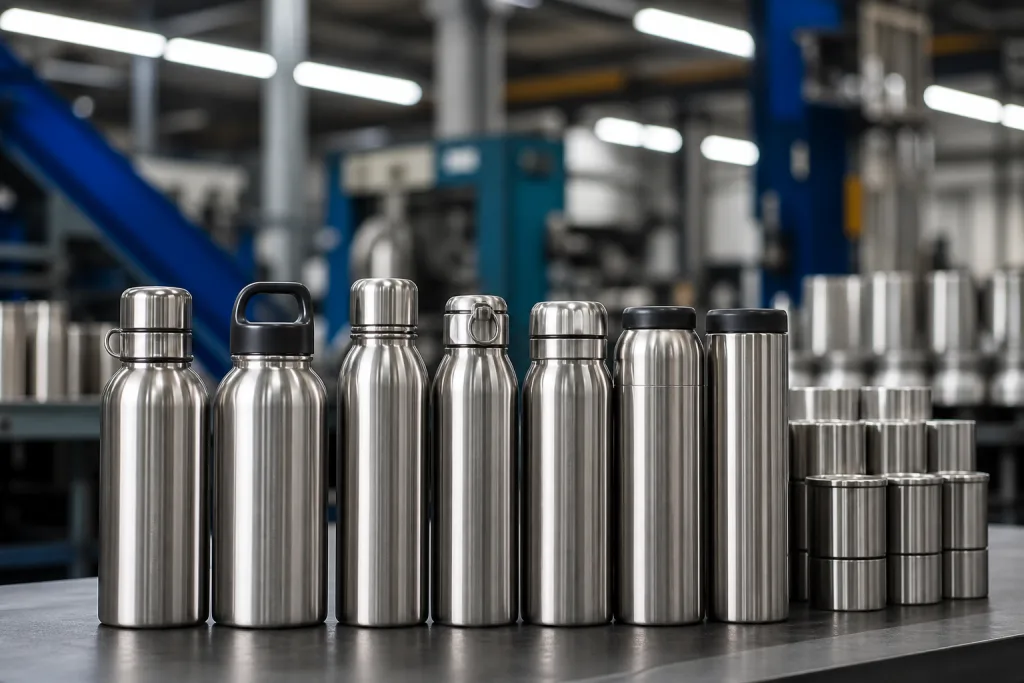
Key Takeaways
- Typical MOQ for a custom stainless thermos starts at 500 units per color and 1,000 units for a fully new body shape
- A 500 ml double-wall bulk thermos often lands at USD 3.20-6.80 FOB China before special packaging
- Sampling usually takes 7-12 days, and mass production takes 25-40 days after deposit and artwork approval
- Decoration, lid complexity, and gift box packing can add 12%-35% to your thermos bulk cost
You can get a stainless bottle quote in one email. That’s the easy part. The number often hides what decides whether the launch lands on time: mold cost, print limits on a curved body, carton pack-out, leak-risk parts, and the real production window on the line in China. We’ve seen this go sideways over a 0.5 mm logo line, a lid gasket fit, or a PO typo on carton marks. If you buy design thermos in bulk for outdoor retail or promotional campaigns, one bad assumption can push landed cost up by 8% to 20%.
The practical way to buy is to break the job into cost drivers and timing gates. This is the right question to ask. A 500 ml custom thermos with one logo is not the same build as a powder-coated, gift-boxed, customized thermos with two lids and retail labeling; QC pulled samples before with scratch marks from the gift-box insertion step, and the buyer flagged it fast. At BottleForge Industrial in Zhejiang, China, we run quotes from MOQ 500 to 3,000 units per SKU, with stainless thermos capacity around 300,000 units per month and standard lead times of 25 to 40 days.
What really sets the unit price
For a custom design thermos in bulk, shape is only the first line on the costing sheet. The unit price usually moves on six points: steel grade, body weight, lid structure, surface finish, logo process, and packing spec. On a standard 500 ml vacuum bottle, we usually quote food-contact 18/8 stainless for the inner wall, then compare 18/8 or 201 for the outer shell. If the bottle is for outdoor retail, 18/8 inside and outside is the safer call. We have seen buyers push 201 outside to save USD 0.18, then QC pulled the sample after a salt-spray check showed early rust marks near the base seam.
Body weight changes the number faster than most buyers expect. A bottle built with 0.4 mm inner wall and 0.5 mm outer wall costs more than a lighter 0.3/0.4 mm structure, and on the line you feel it as soon as you pick up the body after vacuuming. The shelf feel is better. Transit loss is lower. On a 500 ml model, that change can shift FOB pricing by USD 0.20 to 0.45 per unit. This is the wrong question to ask: “Can you match the same look cheaper?” The better question is the actual wall thickness in mm.
- Entry promotional thermos: USD 3.20-4.10 FOB for 1,000 units, simple shape, one-color print, standard white box.
- Mid-range customizable thermos: USD 4.30-5.40 FOB for 1,000 to 3,000 units, powder coat, laser logo, better lid, color carton.
- Retail outdoor customized thermos: USD 5.60-6.80 FOB for 3,000 units, premium coating, carry loop, gift box, barcode labels.
If a thermos manufacturer or thermos supplier sends a low quote, ask what they cut out. In our factory, the usual places are thinner steel, cheaper paint, a simpler silicone seal, or a weaker export carton like a 5-ply box instead of 7-ply. The savings are real. The risk is real too. We ship from Zhejiang every week, and we have seen two bottles look almost the same in photos while one fails a drop test at 76 cm and the other passes. The math does not work if you save a few cents and then eat claims on denting, smell, or leaking lids.
MOQ tiers that change your options
MOQ is not just a sales rule. It connects straight to coil and tube buying, powder coating line time, screen setup, and even whether the master carton lands at 12 pcs or 24 pcs. For buyers sourcing bulk thermos or thermos bulk for outdoor retail and promo programs, we usually quote in three working tiers. This is the right question to ask early. We have seen POs get stuck because the buyer wanted 4 logo positions on a 500 pc run, and the math didn’t work.
Stock shape, custom branding
This is the fastest route for promotional thermos projects and distributor thermos programs that need to ship this quarter. You keep the existing factory thermos body and change the logo, color, or pack-out. Typical MOQ is 500 units per color per size; on some laser engraving jobs we can do 300 units if the lid, body, and carton are standard. Once the buyer flags mixed logo positions or split carton assortments, MOQ usually moves back to 1,000 units because the line adds handwork at packing and QC has more points to check. On our side, one extra logo location means another jig setup, not just another artwork file.
Stock shape, custom color and packaging
For a more retail-ready thermos custom program, MOQ usually starts at 1,000 units. That gives the coating line enough volume to run cleanly and pays for custom color cartons, hangtags, inserts, or FNSKU labels without spreading setup cost over too few pieces. We run this tier a lot for thermos distributors and thermos vendor buyers because it keeps brand impact up without loading the warehouse with slow stock. A common pushback is “Can you do 600 pcs with a custom PMS carton?” Usually no. QC pulled the sample, the color was fine, but the carton printer still had a plate charge and 1,000-sheet minimum.
New mold or unique body profile
If you want a body silhouette nobody else has, expect 2,000 to 5,000 units and a mold charge. A simple cap or base tooling can cost USD 800 to 1,500. A new bottle body tool can run USD 3,000 to 8,000 depending on complexity. We have seen this go sideways when a buyer jumps into full body tooling before confirming shelf fit, cup-holder diameter, or leak test targets. In most manufacturers thermos projects, a custom lid is the smarter spend than a full new body because the shopper notices the top first, while tooling cost stays far lower. On the factory floor, even a 1.5 mm change at the neck can mean new gauges and another round of sample correction.
For most first orders, you save money by using a proven bottle platform and customizing the finish, lid color, logo, and packaging before investing in full tooling.
Decoration costs add up quickly
A custom thermos usually gets expensive on decoration, not on steel. Buyers stare at the bottle price and miss the print cost: extra ink passes, masking tape on the line, hand placement at the jig, and reject rate all move the final FOB. On a standard stainless thermos, we run silk screen, heat transfer, laser engraving, digital print, and powder coat with spot graphics.
For a one-color logo on a straight-wall body, silk screen is normally the lowest-cost option. At 1,000 pcs, add about USD 0.08 to 0.18 per unit, plus screen setup. The line is simple. Laser engraving gives a cleaner outdoor look and usually adds USD 0.12 to 0.25; QC pulled one sample last month where the logo depth was light on a curved panel, so placement matters. Full-wrap heat transfer can add USD 0.35 to 0.80 depending on coverage and yield loss, and this is where we’ve seen the math go sideways.
- Powder coat finish: usually +USD 0.25 to 0.55 versus plain spray paint; film thickness on the line is often checked around 60–80μm.
- Two-position logo: usually +USD 0.06 to 0.15 over one position; the second hit needs another fixture alignment.
- Pantone color matching: adds setup cost in most cases, especially under 1,000 units; buyers often push back when the PO says “close to PMS” instead of a code.
- Individual polybag, insert, barcode label: often +USD 0.10 to 0.30 combined; one wrong barcode sticker can hold a full carton.
If you are buying design thermos in bulk for a distributor thermos catalog or a branded outdoor line, check margin before you approve decoration. This is the wrong question to ask late. A heavily printed promotional thermos looks sharp in a mockup, but in mass production scratches, 1 to 2 mm logo drift, and edge alignment show up fast. That means more rework and can affect AQL outcomes. A practical target is one or two controlled processes unless the order is above 3,000 units.
Ask your thermos manufacturer, thermos factory, or thermos suppliers whether the artwork goes on before or after final assembly. That small process detail changes scuff risk, yield, and schedule. We ship both ways depending on the model, and the buyer flagged this before on a lid-and-body set where post-assembly handling left rub marks near the base.
Lead times from sample to vessel
Lead time in China is never one number. It is a chain of approvals, and if one approval slips by 2 days, the vessel booking can slip with it. For stainless vacuum bottles from Zhejiang, we usually build the schedule from sample approval back to ex-factory date, not the other way around. On the line, even a 0.3 mm logo shift on a screen print sample can stop the next step.
- Quotation and drawing confirmation: 1 to 3 days, assuming the PO, logo file, and print-size note all match. We have seen a buyer type the wrong Pantone on the PO and lose a full day.
- Pre-production sample: 7 to 12 days for existing model customization. If we run laser logo on a stock bottle, QC can usually pull the sample faster.
- Tooling sample: 15 to 25 days if a new lid or body mold is needed. A new lid project often waits on mold polishing and fit check before we send anything out.
- Mass production: 25 to 40 days after sample approval and deposit. This depends on order size, color count, and whether the packaging line is hand-assembling gift boxes or running standard cartons.
- Final inspection and booking: 3 to 7 days. If inspection is at AQL 2.5 and the buyer asks for a drop test rerun, add time.
- Sea transit: around 25 to 35 days to Europe, 20 to 30 days to North America West Coast.
The fastest projects are stock-shape thermos custom orders with laser logo and standard cartons. We ship those with less drama. The slowest jobs are customized thermos programs with molded parts, 2 or 3 round color approvals, and gift packaging assembled by hand at the packing table. The math does not work if you want all that on a rushed timeline.
Three things delay orders most often:
- Artwork files not matching print area or curvature limits. A wrap file may look fine on screen, then fail once we check the bottle shoulder radius.
- Lid color approval changes after sample sign-off. The buyer flagged this on one order after we had already matched the master chip and started material prep.
- Packaging edits after die-line confirmation. A 2 mm insert change can force a new fit test for the bottle and lid set.
If you work with thermos manufacturers or suppliers thermos teams regularly, ask for a backward schedule tied to your in-store date. This is the right question to ask. For example, if you need inventory in a European warehouse by October 1, you may need cargo ready in China by August 20. That means approved sample around mid-July. Buyers who start in September for Q4 often end up paying air freight on at least part of the order, and we have seen this go sideways even on 3,000-piece runs.
Quality checkpoints worth paying for
A cheap thermos bulk order gets expensive fast once returns start. The checkpoints that matter are vacuum performance, leak resistance, coating adhesion, and carton drop results. If a supplier only talks about surface finish and logo print, this is the wrong question to ask—QC pulled plenty of pretty samples that still failed a 1.2 m drop.
For vacuum bottles, ask for heat-retention data with the method written on the report: fill with 95°C water, test in 23°C room temperature, and record the result after 6 or 12 hours. Labs do not all run the same setup, so one report is not equal to another. On a 500 ml outdoor bottle, above 60°C after 6 hours is normal in the mid-market. Premium models can hold more, but only if the same method, fill volume, and lid position were used. We have seen buyers compare two reports and miss that one lab tested with 480 ml, which skews the math.
Leak testing should be 100% on the line, not sample-only. We run inverted leak checks after capping, and the buyer usually wants that written into the SOP. For finished goods inspection, many buyers use AQL 2.5 for major defects and 4.0 for minor defects. For outdoor retail, that balance works. For promotional thermos campaigns with aggressive pricing, some buyers accept looser appearance standards, but they still keep leak testing tight. Last season one buyer flagged 3 dripping lids in a 1,200 pcs lot, and that was enough to hold shipment.
- Common compliance requests: REACH, LFGB, FDA-contact declaration, BPA-free statement.
- Factory system signals: BSCI audit, ISO-style process control, incoming material inspection records.
- Packaging validation: drop test on master carton, barcode scan test, shipping mark confirmation.
At factory level, a reliable manufacturer thermos partner should also track weld consistency, powder-coat adhesion, and silicone seal hardness. On our side, QC checks powder-coat adhesion with a cross-hatch cutter, and silicone shore hardness gets logged against the approved sample. These are not brochure points. They decide whether a reorder runs smoothly or the first season turns into claim emails. It does not matter if you buy from thermos manufacturers, thermos supplier networks, or a direct factory thermos source in China; the inspection checklist needs sign-off before production starts, not after the PO typo is already printed on 800 cartons.
How outdoor and promo buyers should quote
Outdoor retailers and promotional brands buy the same bottle for different jobs, so we quote them differently. Outdoor retail usually cares about shelf impact, drop resistance, and season-to-season repeat orders staying consistent. Promo buyers push harder on landed cost, 10- to 15-day replenishment windows, and a logo program that stays simple on the line.
If you are an outdoor buyer sourcing design thermos in bulk, ask for three price bands on the same silhouette: basic, retail, and premium. Put the upgrades next to the numbers. This is the right question to ask. You should see what each USD 0.30 to 0.50 adds in real terms, like spray paint versus powder coat, or screen print versus laser marking. On our line, QC pulled a sample last month where the powder coat measured 68 to 75 microns and held up better in carton rub testing than standard spray. Ask the thermos distributor or thermos factory to quote with and without gift box packing, because gift boxes often cut container loading harder than buyers expect; we have seen 1,200 pcs drop to 900 pcs on the same pallet plan once the box height changed by 18 mm.
If you are a promotional brand, request the quote in a matrix. Ask for 500, 1,000, 3,000, and 5,000 unit breaks, with decoration and packaging split out as separate line items. That makes supplier comparisons cleaner. The buyer flagged this more than once: one factory bundled a white box, another used an egg-crate insert, and the math did not match until we unpacked the assumptions line by line.
A useful RFQ should include:
- Capacity, dimensions, and target net weight.
- Steel specification, such as 304 inner and 304 outer.
- Lid type, seal material, and color finish.
- Logo method, size, and position count.
- Packaging style and barcode requirement.
- Quality level, AQL standard, and compliance documents needed.
- Trade term such as FOB Ningbo or FOB Shanghai.
The better your RFQ, the easier it is to compare offers from thermos vendor, thermos distributor, and manufacturer thermos sources in Zhejiang and the rest of China. We ship quotes faster when the RFQ is tight. A vague RFQ usually produces a nice opening price, then the buyer adds a barcode sticker, a second logo position, or a silicone color match, and the number moves. We have even seen a PO typo on lid color code turn black into dark navy, so details matter early.
Get a costed thermos quote with real lead times
Send your capacity, target price, logo method, and packaging spec. We will quote MOQ, tooling, FOB pricing, and production timing from Zhejiang, China.
Frequently asked questions
What is the normal MOQ for a design thermos in bulk order?
For an existing stainless vacuum bottle with your logo, the normal MOQ is 500 units per color and size. If you want a custom body color, printed box, and barcode labels, 1,000 units is more realistic because coating and packaging setup become more efficient. For a fully new shape, most China factories ask for 2,000 to 5,000 units plus tooling. A custom lid can sometimes start lower, around 1,000 to 2,000 units. If a supplier quotes below 300 units for a fully customized thermos, check whether they are using leftover stock components or charging a high setup fee hidden in the unit price.
How much does a custom stainless thermos usually cost FOB China?
A common 500 ml double-wall stainless bottle usually costs USD 3.20 to 4.10 FOB for a simple promotional version at 1,000 units. A better outdoor-grade custom thermos with powder coat and laser mark is often USD 4.30 to 5.40. Premium retail packs with gift box, carry loop lid, and stronger finish can reach USD 5.60 to 6.80 or more. Tooling is separate if you change the body or lid mold. Sea freight, duty, and local warehousing are not included in FOB pricing, so your landed cost can end up 20% to 45% above the bottle price depending on destination and pack-out.
How long does production take for thermos bulk orders?
For a stock bottle with custom logo, sampling normally takes 7 to 12 days after artwork is confirmed. Mass production is usually 25 to 40 days after sample approval and deposit. Add 3 to 7 days for final inspection and export booking. If you need a new mold, development can add 15 to 25 days before bulk production even starts. During peak months, especially before Q4, some Zhejiang and other China factories run longer by 7 to 10 days. If your project includes gift boxes, assembly inserts, or multiple lid colors, build in at least one extra week so packaging does not become the bottleneck.
What decoration method is best for outdoor retail thermos products?
For outdoor retail, powder coat plus laser engraving is usually the safest combination. Powder coat resists scratching better than simple spray paint, and laser logos do not chip like ink can. This combination often adds around USD 0.35 to 0.80 per unit over a basic painted and screen-printed bottle, but it reduces appearance complaints and gives a more premium hand feel. If you need strong color graphics, heat transfer works, but it has tighter artwork limits on curved bodies and usually increases reject risk. For promotional campaigns under tight budgets, one-color screen print is still the most cost-efficient option, generally adding only USD 0.08 to 0.18 per unit at 1,000 pieces.
What quality documents should I ask for when buying from thermos manufacturers in China?
Start with food-contact compliance documents that match your market, such as REACH or LFGB for Europe and FDA-related declarations for the US. Ask for material declarations for the stainless steel and silicone parts, plus BPA-free statements where relevant. For process control, request the factory’s inspection flow, leak-test method, and AQL standard; AQL 2.5 major and 4.0 minor is a common starting point. If you sell through retailers, BSCI audit status is often useful, and barcode verification matters if you need FNSKU or retail labels. A serious thermos factory should also provide carton specs, drop-test standards, and vacuum retention test data with a clearly defined test method.