Key Takeaways
- For a 500ml stainless steel custom thermos, typical MOQ is 1,000-3,000 units per color, with FOB China pricing often at USD 3.80-6.90 depending on lid, finish, and decoration
- Vacuum performance should be written into the spec: for example, 12-hour hot retention above 55°C and cold retention 24 hours below 10°C
- A practical bulk thermos QC plan uses AQL 2.5 major and 4.0 minor, plus 100% checks for vacuum, leakage, logo position, and barcode match
- Normal lead time for design thermos bottle wholesale is about 7-12 days for samples and 30-45 days for mass production after approval
You are not buying a sketch on a screen. You are buying 2,000 to 20,000 insulated bottles that need to survive ocean freight, pass REACH checks, hold heat, and still sit right on a retail shelf or in a promo kit. This is where design thermos bottle wholesale orders slip. The drawing gets approved, but the spec sheet is still thin. We’ve seen this go sideways after a 1.2 m drop test, when the carton passed but the lid thread started binding on 6 out of 24 pcs.
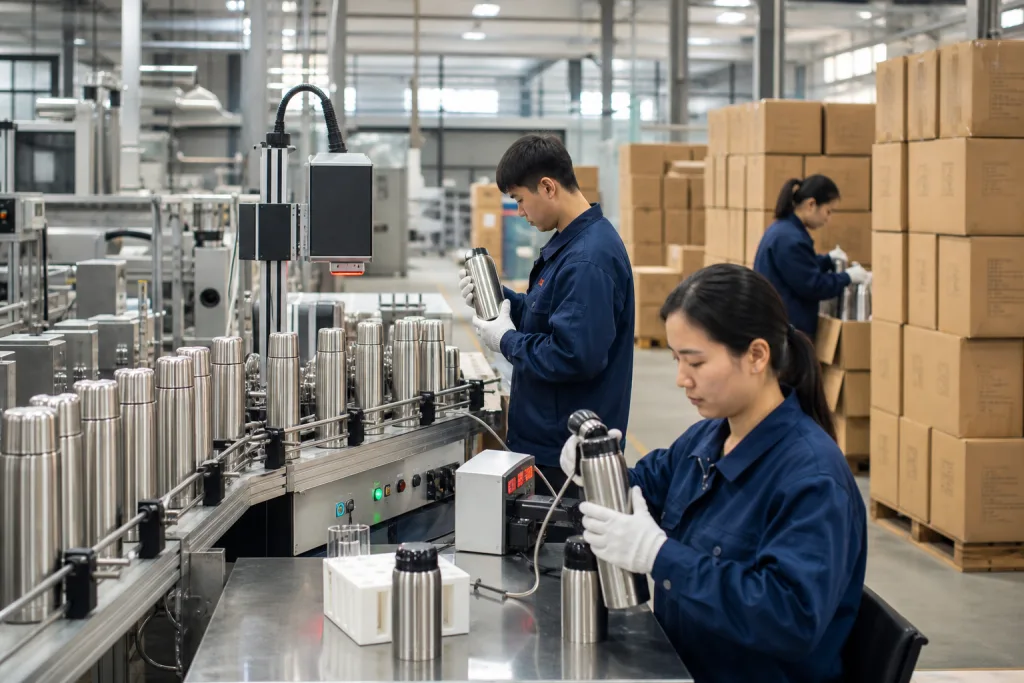
At our factory in Zhejiang, China, we see the same pattern from outdoor retailers and promotional brands. The buyer wants a custom thermos with a clean profile and a low FOB price, then flags color drift or dent risk after sampling. The order only gets predictable when you lock steel grade, wall construction, coating, print method, packaging, and AQL before the first sample run. QC pulled the sample once because the PO said “matt black” and the artwork file said “rubber black” — that 1-word typo cost 5 days. If you want a bulk thermos order to land without rework, think like a product engineer first and a merchandiser second. Frankly, asking price first is the wrong question.
Start with the order brief
Let’s use a real buyer case from the line. You’re an outdoor retailer in Germany or a promo brand in the US, and you need a 750ml stainless steel bottle for a fall launch. Quantity is 5,000 units. Sales split is clear: 3,000 units for retail and 2,000 units for a corporate gifting program. You send the RFQ to three thermos suppliers in China, and the first round of pricing looks close. Then the gap shows up. A serious factory does not stop at color and logo. We ask how the bottle will be used, what carton size you need, which market it enters, and whether the buyer cares most about margin, shelf look, or 12-hour heat retention. Last month a buyer flagged a 1mm logo shift on a gift-box mockup; that issue matters more than a headline unit price.
Your order brief should include:
- Capacity: 500ml, 750ml, or 1L usable fill volume
- Body construction: double-wall vacuum stainless steel
- Steel grade: 304 inside and outside for standard use, 316 interior only if you need higher corrosion resistance
- Target price: for example FOB Ningbo USD 4.80 max at 5,000 units
- Decoration: silkscreen, laser, UV print, or powder coat with logo
- Retail or promo packaging: white box, color box, PDQ, or mailer-safe pack
- Compliance: REACH, LFGB, FDA contact compliance, and packaging rules
At BottleForge Industrial in Zhejiang, China, our stainless thermos capacity is up to 300,000 units per month across standard sizes, but that number means little if the spec sheet is half done. This is the wrong question to ask: “What’s your best price?” For a design thermos bottle wholesale project, vague requests create fake savings. We’ve seen buyers cut USD 0.20 on the opening quote, then lose USD 0.60 in reprints, repacking, or an approval delay that pushes ex-factory from 12 days to 18 days. QC pulled a sample last quarter because the PO said “mat black” but the artwork file called for fine-texture powder coat.
The cheapest customized thermos quote is often the least complete quote.
If you buy as a thermos distributor or run distributors thermos programs across several markets, write one master spec sheet before requesting samples. It saves time, and the math works. One clean brief with carton marks, barcode position, and lid structure avoids back-and-forth on every later step. We ship faster when the first document is tight.
Choose the bottle construction carefully
Body construction is usually where a bulk thermos project starts bleeding cost. The shape may look clean on screen and still run badly on the line. Change the shoulder radius by 2-3mm, widen the base, or make the thread deeper, and you change tooling cost, leak risk, and daily output. We have seen buyers push for a slimmer neck for looks, then QC pulled the sample and found cap torque went out of range. For outdoor retail, buyers usually care about drop resistance, heat hold, and grip texture. For promo programs, the buyer flags logo area, carton count, and landed price.
For most design thermos bottle wholesale orders, the safest starting point is a 0.4mm inner wall and 0.5mm outer wall in 18/8 stainless steel, with a vacuum gap and copper-coated inner liner if stronger thermal performance is needed. Typical bottle weight for a 500ml model is 260-340g depending on shape and lid. A 750ml bottle is commonly 360-480g. Thicker steel does feel better in hand, but this is the wrong question to ask if the item ships by courier; the math doesn't work once the packed weight crosses the next freight bracket.
Common construction choices
- Inner/outer material: SUS304 is standard; SUS316 interior can add around 8-15% material cost
- Lid style: screw cap, carry loop cap, flip straw lid, or cup-cap
- Bottom type: flat welded base or anti-slip silicone pad
- Finish: spray paint, powder coating, brushed steel, or PVD
If you need a customizable thermos for both retail and corporate gifting, stay away from overbuilt lids unless the client has a clear use case. More lid parts mean more tooling, more assembly errors, and more after-sales questions about replacement components. We run plenty of repeat orders where a basic threaded lid with a food-grade silicone gasket beats a fancy flip structure on both defect rate and cost. One common issue: the straw lid looks good in the mockup, then the buyer comes back after pilot run because the hinge pin loosened after a 1-meter drop test.
Ask your thermos supplier for section drawings or cutaway photos, not just lifestyle pictures. You need the neck thread tolerance, gasket hardness, vacuum method, and a clear view of the base weld. On our side, we check weld cleanup and thread fit with a go/no-go gauge before mass production. Good thermos manufacturers in Zhejiang should show these production details, not only renderings. That is how you separate a real factory thermos source from a trading-only quote.
Build the decoration around usage
Decoration is where sales slides hit the line. The brand team asks for a soft-touch matte body, a full wrap graphic, a metallic logo, and individual names on one SKU. The factory team asks for a finish that passes tape pull, survives claimed dishwasher cycles, and does not scuff after 12 days in carton transit. Both points are fair. One finish stack has to fit the target cost and ship date, and we have seen this go sideways when the PO says “premium finish” but gives no test standard.
For outdoor retail, powder coating is the safer pick. It covers small scratches better than wet spray paint and gives better hand grip on a 500ml bottle with condensation. Standard powder coat adds roughly USD 0.18-0.35 per unit over bare stainless depending on color and volume. We run a thickness check on the line, and if the coat builds too heavy near the shoulder, thread fit starts getting tight. Laser engraving lasts and looks clean, but on powder coat it exposes the stainless underlayer, so logo contrast lives or dies on body color. Silkscreen costs less for simple 1-color artwork, often around USD 0.05-0.12 per print position at volume. UV full-color printing suits promotional thermos designs with gradients or dense brand art, but test it first with cross-hatch adhesion and abrasion checks. This is the wrong question to ask: “Which print looks best?” Ask which one still looks good after carton rub and handling.
For a customized thermos order, ask these questions before sample approval:
- Will the logo sit on a curved body where distortion shows once the sample is rotated by hand?
- What is the maximum printable height and wrap angle—180° or 220° on this body?
- Does the artwork align with seam marks, pad print position, or bottle taper near the base ring?
- Is Pantone matching required, and what is the tolerance?
If your client calls it a custom thermos but wants six names, three colors, and a retail UPC on each variant, treat it as a packaging and data job, not just a print job. That changes carton sorting, master carton labels, and final inspection flow. We ship plenty of Amazon and 3PL orders, and QC pulled the sample more than once because the FNSKU label matched the wrong lid color. In that case, a barcode 1mm too low is less serious than a correct barcode on the wrong variant.
Good thermos vendors say no before production, not after claims start. That saves money. In China, especially in high-output areas like Zhejiang, the suppliers thermos buyers keep are usually the ones that push back on weak artwork files, missing bleed, or a PO typo before the first screen is burned.
Price the order without guessing
You do not need every thermos supplier to show a perfect cost sheet. You do need to know which line items move the number. For a 500ml manufacturer thermos with standard screw lid, powder coat body, and 1-color silkscreen, a normal FOB China range at 3,000 units might be USD 3.80-4.90. A 750ml version with carry lid and color box might move to USD 4.80-6.20. Change the lid structure, add a rubber-paint finish, or open a new mold, and the price climbs fast. On our line, a lid with one extra PP insert and a wider handle gate can add more cost than buyers expect.
Here is a practical way to compare quotations from thermos manufacturers:
- Base bottle: stainless body, lid, standard gasket, standard carton; check if the body is from an existing 304 stainless line or a new drawing
- Decoration: coating, logo process, print locations; a second print position often adds less than a custom Pantone powder run
- Packaging: white box vs color box can differ by USD 0.18-0.60; if the buyer flagged an insert fit issue, cost changes again
- Testing and compliance: third-party lab cost, usually spread across the order; QC pulled the sample before send-out, but the lab fee still sits on the PO
- Tooling: new cap, new base, or new body mold if design is not from existing line; this is where the math can stop working
For design thermos bottle wholesale, MOQ is usually tied more to decoration and packaging than to the bottle itself. A common MOQ is 1,000 units for an existing body in one color, but if you want a customized thermos with a custom box and multiple SKUs, practical MOQ may become 2,000-3,000 units per item. New tooling for a cap or body can range from USD 1,500 to USD 8,000 depending on complexity. We have seen buyers ask for 1,000 units split across 4 box designs and 3 lid colors; this is the wrong question to ask, because the bottle body is not the production bottleneck—the carton print run and changeover on the line are.
Also ask whether the quote is FOB Ningbo, FOB Shanghai, or EXW. Zhejiang factories often ship through Ningbo because it is efficient for drinkware exports. If you compare one supplier thermos quote on EXW and another on FOB, the cheaper number may not be cheaper. We ship plenty through Ningbo, and the difference is not academic: one PO last season showed EXW on the first page and FOB on the last page after a typo correction. Procurement mistakes often come from freight terms, not steel cost.
For distributor thermos business, leave 2-3% budget buffer for approved changes after pre-production sample. That is cheaper than forcing a weak spec into mass production. We have seen this go sideways over a 1.5mm logo shift or a carton drop-test failure, and fixing it before mass run costs less than rework after 3,000 units are packed.
Approve samples like a production buyer
A sample is not one thing. On a serious thermos bulk order, we ask buyers to approve 3 stages: a reference sample, a pre-production sample, and a packaging sample. Too often, a buyer signs off the pretty sample only, then the line runs and the mass goods leak, pick up odor, or land in cartons that fail a 5-layer burst check.
The reference sample confirms shape, capacity, and surface finish. The pre-production sample needs to match the real build: actual materials, actual decoration process, and final packaging layout. If your bottle is a thermos customizable item with several logos or names, ask for a sample set with the hardest artwork on it—the small serif text, the wrap seam, the metallic ink version. We have seen this go sideways when QC pulled the sample and the buyer had approved only the easiest 1-color logo.
Run practical checks on the pre-production sample:
- Leak test: invert for 30 minutes, then horizontal roll test
- Vacuum check: hot water fill and temperature drop over 6 and 12 hours
- Coating adhesion: cross-hatch tape test
- Odor check: after hot water and 24-hour closure
- Thread fit: open-close cycle at least 50 times
- Drop check: packed sample from 76cm if mail-order use is likely
Sample lead time in China is normally 7-12 days for standard bodies with custom finish, and 15-25 days if new tooling is required. Don’t squeeze this stage to save 3 days. The math doesn’t work. On new molds, we sometimes catch a 0.3 mm thread mismatch or a laser logo position drift before mass production; fixing that at sample stage is cheap, fixing 5,000 pcs is not.
At this point, lock the golden sample and sign a sample approval sheet with photos, Pantone callouts, barcode list, carton dimensions, net weight, and gross weight. Put the date, PO number, and revision on it too. We ship against documents, not memory. One typo on a barcode list or one missed carton size can hold a booking for 2 days, so this is the right place to be strict.
Control mass production and inspection
Once production starts, run a control plan that is simple on paper and strict on the line. On a 5,000-unit order, do not wait until all cartons are sealed before you check quality; we have seen this go sideways. Ask for an in-line update after the first 300-500 bodies finish coating and logo decoration, then book final inspection when at least 80% of goods are packed. That timing matters. It gives the factory a window to fix print shift, coating bubbles, or a lid-thread issue before the whole lot is locked in cartons.
A sensible QC checklist for stainless thermos wholesale should include:
- Appearance: dents, scratches, coating bubbles, color variation; QC pulled the sample under 6500K light to catch shade drift on matte black
- Logo: position tolerance, legibility, missing print, rubbing resistance; we usually mark the logo window in mm on the approved artwork
- Function: leak test, vacuum retention spot checks, lid thread engagement; the line normally runs a 3-minute inverted leak test
- Safety: burrs at mouth, loose parts, odor, gasket fit; a finger swipe on the rim still finds bad deburring faster than a long meeting
- Packaging: insert orientation, barcode scan, carton drop resistance; one wrong inner tray direction can scuff 24 bottles in a master carton
For finished goods, many buyers use AQL 2.5 for major defects and 4.0 for minor defects. Critical defects should be zero accepted, especially leakage, sharp edges, wrong barcode, or mold contamination. On a 5,000-unit order, your third-party inspector can sample according to ANSI/ASQ Z1.4 and still add 100% checks for vacuum indicator and leak risk if the factory process allows it. This is the wrong question to ask: “Did you inspect?” Ask instead which points got 100% checked and which stayed at sampling level.
If you are supplying outdoor chains, ask the thermos factory to keep test records by lot number. We usually tie the record to a production date and line sheet, so if the buyer flagged a complaint 43 days later, we can trace it back fast. If you are supplying promotional clients, ask for carton-level SKU mapping so distributors thermos shipments do not mix logo variants. We once saw a PO typo swap two imprint versions, and mixed cartons created claims faster than small cosmetic defects.
BottleForge Industrial follows documented in-process controls, and our normal lead time is 30-45 days after sample approval for standard stainless thermos orders. During peak Q3 season, book earlier. China capacity gets tight fast when holiday and outdoor programs overlap, and the difference is often 12 days vs 18 days just waiting for paint-line slots.
Prepare shipping and after-sales reality
The last mistake in design thermos bottle wholesale is thinking the job ends when inspection passes. It does not. We count it finished when the cartons land, the labels scan on first pass, and the bottles sell without a wave of claims. Build shipping and after-sales into the PO from day one. On our line, QC pulled a sample once that passed leak test but failed carton scan because the outer mark used an old SKU suffix.
For ocean freight, lock master carton size and weight early. A typical 500ml bottle pack might run 24 units per carton, around 50 x 34 x 28cm, with gross weight near 9-11kg depending on packaging. If you switch to premium color boxes with 3mm EPE inserts, carton cube climbs fast and freight per unit can jump 5-12%. The buyer usually asks about bottle price first. That is the wrong question to ask. For thermos distributor and thermos distributors business, margin is often fixed before import, so carton cube can wipe out the math.
Before shipment, make sure your files are consistent:
- Shipping marks match PO and destination
- UPC or FNSKU matches each SKU exactly
- Carton quantities match booking and warehouse intake rules
- Compliance files are stored with the shipment record
After delivery, track three numbers: defect rate, carton damage rate, and sell-through feedback by SKU. If your first order comes in under 0.8% functional claim rate and under 1.5% visual claim rate, that is a healthy result for a customized thermos program. If claims run higher, break it by lot and shipment date, not by opinion. We have seen this go sideways when one pallet had strap rub on coated bottles, or when a PO typo changed one barcode digit and the buyer flagged it at intake. Check the root cause: coating friction, gasket compression after 72 hours, wrong barcode, or freight damage.
The buyers who scale cleanly with thermos supplier partners in Zhejiang and wider China usually keep one running spec, one approved sample file, and one post-shipment review sheet. Simple works. We ship repeat orders faster when that file stack is clean, because the line is not guessing whether the lid torque was 1.2 N·m or 1.8 N·m on the last batch. It is not glamorous, but this is how a one-off promotional thermos order turns into a repeatable manufacturer thermos program.
Send your thermos spec and get a practical quote
Share capacity, lid style, finish, logo, packaging, and target price. We will review feasibility, MOQ, lead time, and QC points before sampling.
Frequently asked questions
What MOQ should I expect for design thermos bottle wholesale?
For an existing stainless bottle shape, MOQ is usually 1,000 units per color for a simple custom thermos order with one logo and standard white box. If you need a custom color box, multiple print variants, or several lid colors, practical MOQ often moves to 2,000-3,000 units per SKU. New mold projects can require 3,000-5,000 units to make tooling cost workable. At our Zhejiang, China factory, sample-friendly development is possible on standard bodies, but decoration and packaging still drive the real MOQ. If a thermos supplier offers a very low MOQ, check whether the price includes setup fees, carton assortment costs, and packaging changes.
How do I know if a stainless thermos will actually keep drinks hot?
Do not accept vague claims like “excellent insulation.” Put a measurable target into the spec. A common standard for a 500ml or 750ml vacuum bottle is hot retention above 55°C after 12 hours and cold retention below 10°C after 24 hours, tested from a near-boiling fill under controlled conditions. Ask your thermos manufacturer for their internal test method and whether they use a vacuum inspection process on every bottle or only by sampling. You can also request random retained samples from mass production. If thermal performance matters for outdoor retail, avoid complex lids that sacrifice sealing pressure just to look innovative.
Which logo method is best for a promotional thermos order?
It depends on usage. For low-cost promotional thermos runs, 1-color silkscreen is usually the most economical at scale and works well on smooth bottles. For longer-lasting branding, laser engraving is cleaner and more durable, especially on powder-coated bodies where the stainless reveal gives contrast. If your artwork is full color or photo-like, UV print is possible, but you should test adhesion and rubbing resistance before approval. On most 3,000-5,000 unit orders, decoration adds anywhere from USD 0.05 to USD 0.45 per bottle depending on process and positions. Ask your thermos supplier to show real production samples, not only digital mockups.
What quality checks matter most before shipment?
For stainless thermos orders, the non-negotiable checks are leakage, vacuum retention, logo accuracy, coating finish, and barcode correctness. A useful final inspection uses AQL 2.5 for major defects and 4.0 for minor defects, with zero acceptance for critical issues such as leakage, sharp mouth edges, wrong SKU labels, or contamination. On top of sample-based inspection, many buyers ask for 100% vacuum or leak-related checks during production. If your goods go to Amazon, add FNSKU scan checks and carton labeling verification. If they go to retail, focus more on shelf appearance, color consistency, and transit-safe packaging.
How long does a custom thermos wholesale order usually take from China?
For standard bottle bodies with custom color and logo, sampling usually takes 7-12 days after artwork and Pantone confirmation. Mass production is commonly 30-45 days after sample approval and deposit, depending on quantity, lid complexity, and season. If you need a new mold, add roughly 15-30 days for tooling and validation. Peak season in China, especially from late summer into Q4, can stretch schedules if you book late. A realistic timeline for a 5,000-unit customized thermos order is about 6-8 weeks from approval to FOB shipment, assuming packaging files are ready and revisions are limited.