Key Takeaways
- Lock core specs before pricing: material grade, wall thickness, finish, logo method, and packaging can move cost by USD 0.25-1.80 per unit
- For custom stainless drinkware in Zhejiang, practical MOQ is often 1,000-3,000 pcs per color, with 35-55 day lead time after sample approval
- Use AQL 2.5 major / 4.0 minor and test at least 32 pcs from a 5,000-10,000 unit lot before final payment
- A single leak, coating, or carton failure can turn a good FOB price into a landed cost increase of 8-15%
You are not buying a sketch. You are buying a production run that has to survive freight, compliance checks, retail handling, and end use. This is where a lot of design drinkware wholesale jobs go sideways. A nice rendering turns into a bad lid fit, weak coating adhesion, a leaking growler, or a logo that lands 2 mm off center on 20,000 pieces.
If you source from Zhejiang or wider China, treat the order like an engineering job, not a catalog purchase. Start with one SKU family, lock the spec, price the risk, approve the pre-production sample, and inspect to AQL before balance payment. We run it that way on the line. It works for wholesale canteen lines, bulk drinkware for promotions, and beer growler wholesale bulk programs for retail.
Start with one commercial brief
A buyer in Europe sends us this brief all the time: one coordinated line for outdoor retail and e-commerce. The range covers a 750 ml wholesale canteen, a 30 oz travel tumbler, a 64 oz wholesale growler, and a 6 oz alcohol flask wholesale bulk SKU. The brand owner wants a matte palette, laser logo on premium models, and a lower-cost silkscreen version for one promo channel. Annual forecast is 48,000 units, and the first purchase order is 8,000 pieces across four SKUs. On our side, the line would sample this with a 74 mm neck gauge and a powder-coat color card on the bench.
The first mistake is sending ten factories in China a photo and asking for “your best wholesale drink bottle price.” This is the wrong question to ask. You will get ten prices based on ten different builds, and the math doesn't work if you compare them side by side. The 750 ml canteen bulk item might be quoted in 18/8 stainless by one factory, 18/0 outer plus 18/8 inner by another, and single-wall by a third. Lids might be PP, Tritan, or a stainless cap shell with a PP core. Packaging might be a plain polybag or a color box with drop-test inserts. We have seen buyers flag a 12% price gap, then QC pulled the sample and found one quote was for 0.3 mm outer wall, not 0.5 mm.
Write the commercial brief like a purchasing document, not a mood board. A usable first RFQ should include:
- Volume and dimensions: 750 ml body, target diameter 74 mm, height 285 mm
- Construction: double-wall vacuum, 304 inner and outer, copper plating if thermal target requires it
- Wall thickness: 0.4 mm inner / 0.5 mm outer for the canteen; 0.5/0.5 mm for the bulk growler
- Finish: powder coat, Pantone reference, 20-30 gloss units if matte is critical
- Decoration: laser engraving 35 x 35 mm or 1-color silkscreen
- Packaging: individual white box, barcode label, master carton count and burst strength
- Market compliance: REACH, LFGB or FDA, CA Prop 65 if needed, packaging requirements for EU or North America
At BottleForge Industrial in Hangzhou, Zhejiang, we usually see quote variance narrow by 60-70% once this level of detail is fixed. That is not paperwork for its own sake. It stops hidden spec drift before production starts. We run into this on cap tooling, coating gloss, even carton count. One PO last month had the growler typoed as 640 oz instead of 64 oz, and that single line would have wasted two days on sampling if nobody caught it.
Price the build, not the photo
After the brief is locked, pricing starts to mean something. For a 1,500-piece MOQ per color, a 750 ml design drinkware wholesale canteen in China may land around USD 3.60-5.20 FOB. We usually see the spread come from steel grade, coating line control, cap structure, and pack-out spec. A 64 oz beer growler wholesale unit can be USD 6.80-9.80 FOB because the body pulls more steel, the neck and lid parts get heavier, and sealing parts are less forgiving on the line. A simple single-wall alcohol flask in bulk may be USD 1.10-1.90 FOB. A vacuum beer tumbler wholesale bulk item can sit around USD 2.80-4.20 FOB. Last month a buyer flagged a quote gap of USD 0.48, and the reason was a thicker lid insert plus an egg-crate inner, not factory margin.
The biggest cost swing is usually not labor. It is material and process. Move from 201 to 304 stainless and cost rises fast. Change the outer wall from 0.4 mm to 0.5 mm and the unit weight climbs, which also changes freight math. Add textured powder coat plus laser logo, and now you add booth time, masking, and more reject risk if the logo burns too deep. We have seen QC pull samples for color dust points after powder coat, then reject 6 pcs from a 200-pc check. Ask for a custom lid mold and tooling can run USD 2,500-8,000 depending on complexity. If the order is only 3,000 pcs, this is the wrong question to skip—the mold cost has to be absorbed somewhere.
What a serious quotation should break out
- FOB Ningbo or Shanghai basis
- Tooling or mold cost, if any
- Sample cost and sample lead time, often 7-12 days for simple decoration and 20-30 days for new mold parts
- MOQ by SKU, color, and logo method
- Carton size, GW/NW, and container loading quantity
- Test cost if third-party lab reports are required
For procurement managers, the better comparison is not the lowest unit price. It is the lowest risk-adjusted landed cost. A factory in Zhejiang quoting USD 0.22 more per piece but holding tolerances, passing AQL, and shipping on day 42 can be cheaper than a supplier that slips to day 49 and forces air freight on 1,200 units. We ship enough replacement orders to know how this goes sideways. On one PO, the buyer typed the wrong logo method and priced silk print instead of laser; the gap looked small until the correction hit the schedule. One decision like that can wipe out a quarter of margin on drinkware wholesale programs.
You do not buy drinkware bulk by the gram, but grams tell you fast whether the factory is building the same product you approved. We run incoming and final weight checks because a 12-15 g gap is usually not an accident.
Approve samples like production controls
After pricing, the order is not safe yet. Sample approval is where we turn a quote into a production standard the line can follow. For the scenario above, ask for three sample stages if the item has enough custom work: a blank structure sample, a color and logo sample, and a pre-production sample made with actual bulk materials, actual fixtures, and the same oven settings we run for mass goods.
The blank sample answers mechanical points first. Does the growler cap thread smoothly after 3 open-close cycles? Is the handle weld clean with no sharp burr on the TIG weld spot? Does the flask hinge open to the correct angle without side-play? Does the canteen base sit flat with less than 1 mm rock on a granite table? The decorated sample checks visual points the buyer usually flags: Pantone match, logo position, laser burn depth, screen registration, and powder coat feel. The pre-production sample matters most because QC pulled the sample from the same line logic as bulk production. If a factory skips that step, we've seen this go sideways.
For design drinkware wholesale, put measurable limits on the approval sheet:
- Color tolerance: visual match under D65 light, approved by signed sample
- Logo position: ±1.5 mm
- Height/diameter: ±1.0 mm to ±1.5 mm depending on part
- Vacuum performance: cold retention or heat retention target stated in hours
- Leak test: zero leakage after inverted test for 30 minutes
- Coating adhesion: cross-hatch test pass, no peeling with 3M tape under agreed standard
If the item is for e-commerce or Amazon FBA, add barcode location, FNSKU readability, carton mark format, and drop test expectations before mass production. This is not a paperwork detail; it is a cost control point. We ship to 6 North American buyers every season who miss this, then get hit with relabeling or rework charges at the warehouse because the outer carton mark or barcode panel was placed 12 mm off the packing drawing. Our factory planning in China usually allocates 10-15 days for sample revision cycles, and that is normal. The math doesn't work if you rush approval and then have to sort 5,000 wrong pieces after coating and logo application.
Set the factory QC gates early
Good factories do not wait for final inspection to catch defects. We build QC gates into the line from day one. For a custom drinkware wholesale order, ask what the factory checks at incoming material, during production, and at final random inspection. Ask for the actual checkpoint sheet, not a polished answer. If they stay vague, this is the wrong question to skip, and we’ve seen it go sideways over a 0.8 mm mouth tolerance.
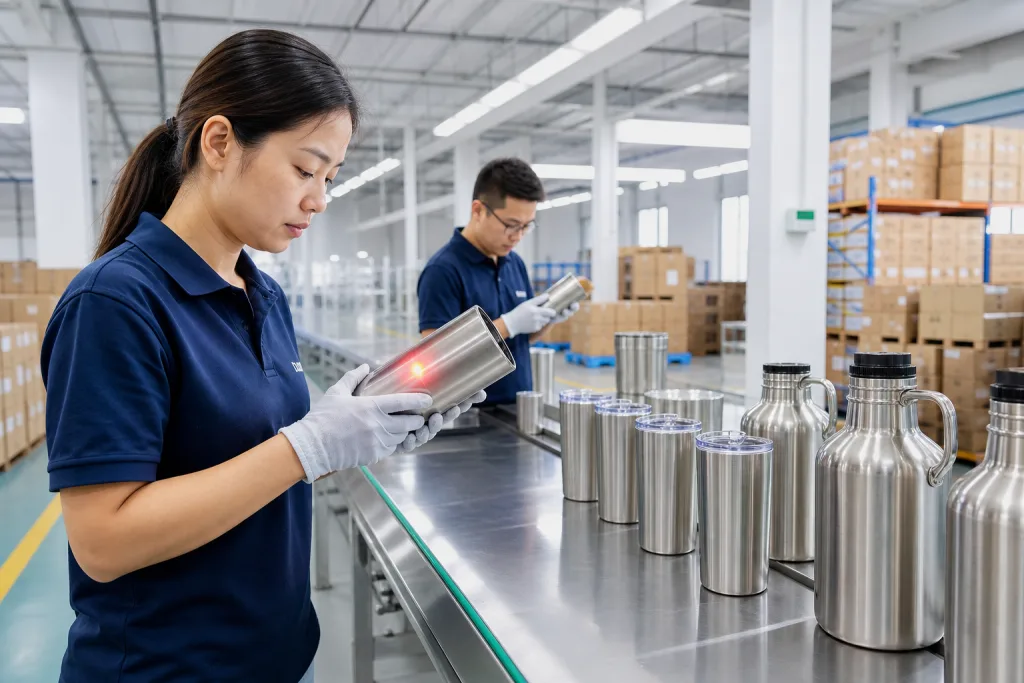
A workable QC plan for this buyer setup starts with incoming checks on steel, plastic, paint, and packaging. Verify steel grade certification for contact parts, lid resin type, gasket hardness, and carton compression strength. On our floor, QC pulled the sample and checked gasket hardness with a Shore A durometer because one buyer flagged lids popping open during drop test. During forming and welding, check body dimensions and mouth fit with a caliper and go/no-go gauge. After vacuuming, test thermal retention and vacuum integrity on a defined percentage of units. After powder coating and decoration, inspect color consistency, orange peel, scratches, pinholes, and logo placement against the approved sample. Before packing, run 100% leak testing and assembly checks if the lid structure is new; otherwise the math doesn’t work on returns.
At our Zhejiang operation, monthly capacity can exceed 400,000 units across insulated and single-wall categories, but capacity means nothing if the gates are loose. We ship volume every month, and the line still stops if QC finds a weld shadow or a barcode typo on the PO. The basic buyer-level checklist should include:
- Inspection standard: AQL 2.5 major / 4.0 minor unless your program needs tighter limits
- Sampling: for a lot of 8,000 pcs, use the applicable sample size from the AQL table, typically around 200 pcs depending on inspection level
- Critical defects: zero acceptance for sharp edge, accessible rust, chemical odor, leakage, wrong barcode, or missing safety warning where required
- Major defects: dent, severe coating failure, unstable base, wrong logo position beyond tolerance
- Minor defects: slight print speck, small non-visible finish variation within approved standard
If the order includes bulk canteen and beer tumbler in bulk SKUs in the same shipment, inspect each SKU separately. Mixed-lot logic hides defects, and we have seen one 12,000 pcs shipment pass on paper while one lid fit issue sat only in the smaller SKU. Also ask for inline photos from production day 1 and day 3. A solid China factory sends these without drama. It cuts argument later, especially when the buyer flagged color drift from the master sample after the first coating run.
Watch the problem areas nobody photographs
Most RFQs stop at body shape and logo position. That is where the photos look good. Claims usually start in the parts nobody shot. On wholesale growler and beer growler in bulk orders, sealing is the first place we see trouble. A buyer approves a brushed cap shell, then skips the gasket compound, vent structure, and torque range. The line runs. The goods ship. Then cartons arrive with seepage after transport or the unit leaks under carbonation use. For canteen wholesale products, we see more complaints on the lid hinge pin, carry loop pull test, or straw assembly fit than on the bottle body itself.
Ask blunt questions on the hidden parts. What silicone hardness is used for the seal, 50 or 60 Shore A? Is the thread rolled or cut? Is the straw PE or silicone? What curing window is used for the powder coat, and what reject rate did QC pull last month? On our side, if a supplier cannot give numbers like 180 to 200°C bake range or a lid torque target in N·m, that is the wrong question to skip. A factory that runs its process knows the numbers, and usually has them on the line sheet or next to the torque tester.
Packaging gets missed too often. We have seen buyers spend 3 weeks on Pantone approval, then accept a weak divider. A 40 ft HQ may carry thousands of units, but one soft carton spec can push dent rate past 3%. For heavy beer tumbler wholesale bulk or growler bulk items, keep carton gross weight under 18 kg where possible, set edge crush for sea freight stacking, and confirm inner fitment with an actual packed sample. If your channel is DTC, ask for at least one transit-style drop test at sample stage. We have seen this go sideways when the sample passed, but the PO packing note had a typo and the insert board dropped from 3 mm to 2 mm.
Common preventable failures include:
- Logo orientation inconsistent because the fixture reference point was never locked; the buyer flagged it after 600 pcs were packed
- Cap color mismatch because the plastic masterbatch and powder coat were matched separately under different light boxes
- Vacuum loss due to weak process control after base sealing; QC pulled the sample and found pressure drift on the leak tester
- Rust spots from poor passivation or stainless contamination during polishing, often around the rim weld area
- Barcode scan failure because labels were applied over textured coating with too much orange peel
For alcohol flask bulk programs, do not skip odor testing. This complaint moves fast, especially in North America. Adhesive, coating, or gasket smell will get noticed the first time a customer opens the unit. A simple 24-hour closed-odor check on retained samples catches a lot of trouble before shipment. We usually bag 3 samples, hold them sealed overnight, then open and score odor side by side at the QC table.
Balance lead time against shipping risk
Once bulk approval is signed off, the next fight is timing. Buyers burn 12 days on design comments, then ask the line to recover those 12 days in production. That is where defects start showing up. On our side in Zhejiang, a normal custom order runs 35-55 days after pre-production sample approval and deposit receipt. If the order needs a new lid mold, add 20-30 days for tool build, T1 trial, and correction; we usually check fit with a go/no-go gauge before releasing the next sample. Before Q4, standard lead times across China often stretch by 7-15 days. Asking for the old date anyway is the wrong question.
For the 8,000-piece scenario, stage production. We run the simpler canteen bulk and alcohol flask wholesale SKUs first while the growler sealing parts finish validation, instead of letting one silicone leak test hold the whole PO. We have seen this go sideways when one vent plug misses a 0.3 mm tolerance and every SKU sits waiting. Book packaging early too. Printed boxes, hangtags, and instruction leaflets delay shipments more often than the bottle body, and the buyer flagged this on one PO last season after a carton print typo held packing for 4 days.
Shipping terms matter as much as ex-factory timing. Most buyers still work FOB Ningbo or Shanghai. Confirm cargo readiness date, final carton dimensions, and pallet policy before booking; QC pulled the sample carton to recheck CBM after one buyer changed the insert and added 6 mm to the master carton height. If the goods are going to Amazon or a 3PL, lock carton labeling and ASN format early. One missing FNSKU or outer carton mark can trigger relabeling charges, missed delivery appointments, and extra warehouse handling. The math doesn't work if you save 2 days on packing and lose 10 days at destination.
Protect yourself commercially as well:
- 30% deposit / 70% balance after passed inspection is still common
- State defect handling and rework responsibility in the PO; we have seen buyers assume factory-side sorting while the PO says nothing
- Keep approved sample, signed spec sheet, and carton artwork as contract documents; we usually stamp the golden sample and seal it in the sample room
- Request production schedule updates every 7 days
Procurement managers who keep this discipline usually buy drinkware bulk with fewer emergencies. It is not glamorous. It works. We ship this way whether the program is wholesale drinkware for retail, canteen bulk for promotions, or beer growler wholesale bulk for a craft beverage line.
How the order closes without surprises
After final inspection passes, run one last document check. New buyers skip this, and we’ve seen it go sideways. Put the inspection report, approved sample, and commercial documents side by side and check them line by line: PO quantity, overrun allowance, logo version, barcode file, carton marks, and shipping documents. QC pulled the sample from the sealed retain box before this step on one order last month. The product looked fine, but the outer carton carried the wrong SKU, and a clean shipment turned into a warehouse claim. We also catch basic errors here—a PO typo, pallet count off by 2, or carton mark text that does not match the packing list.
In this case, the order closed cleanly because every checkpoint had a hard number behind it. MOQ was 1,500 pcs per color for the canteen and 1,000 pcs for the flask. Lead time was 42 days after approval. Major defects were capped by AQL 2.5. Vacuum, leak, and adhesion tests were set before the line started, not argued about at the end. During final inspection, two cartons failed compression, so the Zhejiang supplier repacked before loading. That is the right move. Debating fault after arrival does not pay anyone’s demurrage bill.
This is how we ship design drinkware wholesale from China without surprises. You do not need a perfect factory. You need one that can turn your design into a controlled process, show records at each stage, and fix trouble before it becomes dead inventory. The wrong question to ask is whether the rendering looks premium. Ask how the PO is controlled on the floor, who signs the golden sample, and what happens if a 6 mm logo shift shows up at in-line inspection. Whether you are buying wholesale canteen programs, growler wholesale assortments, alcohol flask in bulk, or the next best wholesale drink bottle for your brand, the result depends less on the concept sheet and more on the discipline behind the PO.
Send your spec and get a practical factory review
Share your target SKU, MOQ, market, and artwork. We will flag cost drivers, likely QC risks, and a realistic China production plan within 1 business day.
Frequently asked questions
What MOQ should I expect for custom design drinkware wholesale?
For stock-body items with custom color and logo, MOQ is usually 1,000-3,000 pcs per SKU per color in China. A simple silkscreen logo on a standard sports bottle may start at 1,000 pcs. Double-wall vacuum canteens and wholesale growler models more often start around 1,500 pcs because setup loss and coating runs are higher. If you need a new lid, handle, or body mold, practical MOQ can jump to 5,000-10,000 pcs plus tooling. Ask the factory to separate MOQ by body, color, logo method, and packaging. A quote that says only “MOQ 1,000” is often incomplete and can become a problem when you place the PO.
How do I compare quotes from different drinkware wholesale factories fairly?
Build a comparison sheet with at least 12 lines: material grade, wall thickness, capacity tolerance, lid material, gasket type, finish, logo method, packaging, MOQ, lead time, test reports, and trade term. Also compare weight per unit. A canteen that is 35-60 g lighter than other quotes may use thinner steel or different construction. Ask every supplier to quote FOB Ningbo or Shanghai, the same carton spec, and the same logo size. If one supplier in Zhejiang is USD 0.40 higher but includes a 0.5 mm outer wall, REACH report support, and a 40-day lead time, it may be the better buy than a cheaper quote built on weaker assumptions.
What tests matter most for bulk canteen and wholesale growler orders?
For insulated canteen bulk items, focus on leak test, vacuum retention, coating adhesion, dimensional fit, odor, and dishwasher warning accuracy if applicable. For wholesale growler and beer growler bulk programs, sealing performance is the priority because cap and gasket failure create returns fast. Use a 30-minute inverted leak test at minimum and specify torque range if the closure design needs it. For decorated products, run cross-hatch adhesion and tape pull checks. If you sell into Europe or North America, verify food-contact compliance such as REACH-related requirements, LFGB or FDA depending on market, and ask for migration testing when materials or coatings are new.
What lead time is realistic for a first custom order from China?
If you are using an existing bottle body and only customizing color, logo, and packaging, 35-55 days after sample approval is realistic. A simple stock flask or single-wall bottle can be faster, around 25-35 days in quieter months. New mold parts usually add 20-30 days before bulk lead time starts. Sample development itself often takes 7-12 days for standard decoration and 10-20 days if several revisions are needed. During peak season in Zhejiang and other China manufacturing hubs, add another 7-15 days buffer. The safest schedule is sample approval by mid-month, production start right after deposit, and vessel booking based on confirmed carton data.
How should I handle QC and payment on a wholesale drinkware order?
The standard structure is 30% deposit and 70% balance after passed pre-shipment inspection. Use a written specification sheet, approved sample, and packaging artwork as contractual references. Set inspection standard in the PO, usually AQL 2.5 major and 4.0 minor for general drinkware wholesale orders. For lots around 5,000-10,000 pcs, the third-party inspector will normally sample around 200 pcs depending on the table and inspection level. Critical defects should be zero tolerance: leakage, rust on contact areas, wrong barcode, sharp edges, or major odor. Do not release balance only on photos. Ask for the inspection report, carton count confirmation, and at least a few lot-coded retained samples.