Key Takeaways
- A workable custom MOQ for stainless bottles is usually 1,000 to 3,000 pcs per SKU, with sample lead time around 7 to 12 days
- For 18/8 stainless vacuum bottles, FOB China pricing often lands at USD 2.80 to 6.50 depending on size, finish, lid tooling, and print method
- Use AQL 2.5 for major defects and AQL 4.0 for minor defects, plus 100% leak testing before carton packing
- Most launch delays come from vague specs: define capacity tolerance, logo position, coating adhesion, barcode placement, and carton drop requirements before PO
You are not buying a bottle. You are buying a spec that has to pass sampling, pilot run, compliance testing, container loading, and retail complaints. Design drink bottle wholesale breaks down at these handoff points all the time. The drawing looks clean. The golden sample looks clean. Then 8,000 units land with powder coat cross-hatch failing at 2B, logos sitting 1.8 mm off-center, or lids leaking after 7 days on a 60° inversion test. We’ve seen this go sideways. The loss is bigger than replacements: delayed launch dates, Amazon return claims, and a distributor asking why the line changed after approval.
A disciplined sourcing process fixes most of it. At our end in Zhejiang, we run drawing review to mass production in 30 to 45 days if the spec reads like a purchase document instead of a mood board with four color swatches and no Pantone callout. This is the wrong question to ask: buyers often ask for the lowest unit price first, but the math doesn't work if QC pulled the sample later and found a 0.6 mm lid-gap issue across 3 cartons. Whether you need wholesale canteen, drinkware bulk, or a beer growler wholesale bulk project, the logic stays the same: lock details early, inspect against a real standard, and keep tolerance arguments off the final invoice.
The order starts with one SKU
Here’s a real buyer case we see on the line. A North American brand owner is launching a premium hydration line with one 750 ml vacuum bottle in matte navy, carry lid, laser logo, and a retail color box. First PO is 6,000 units, split to two warehouse destinations. If sell-through is good, the range later expands into canteen wholesale, beer tumbler bulk, and a matching bulk growler set. We ship this kind of launch every season, and the first question is usually not color. It’s carton count per destination and whether the PO typo says “navy mat” or “matte navy.”
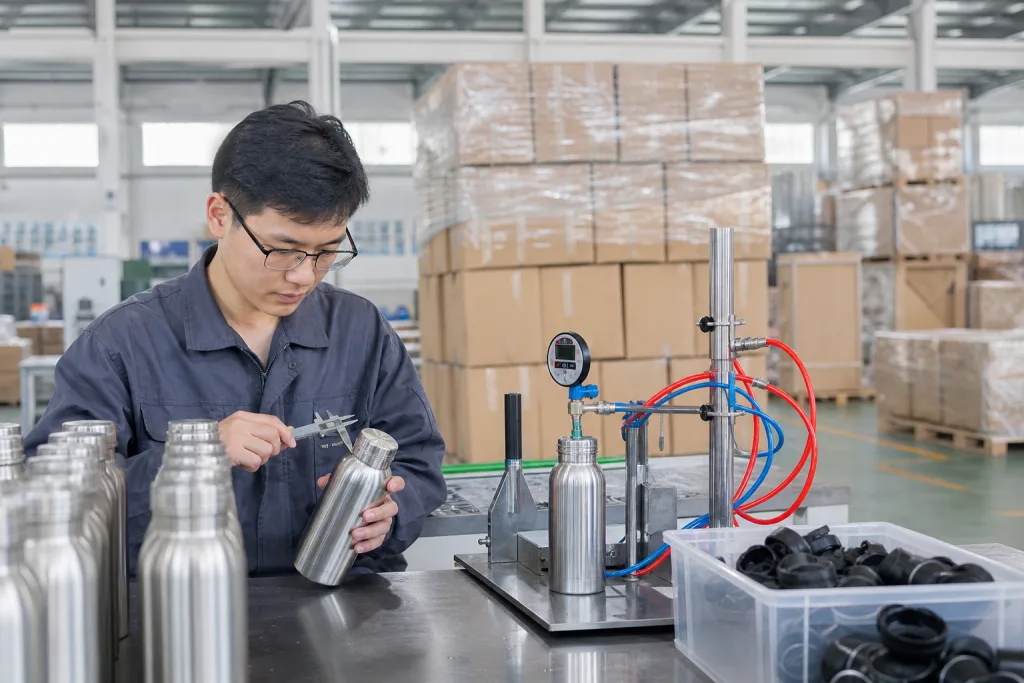
New buyers usually ask for “the best wholesale drink bottle.” That is the wrong question to ask. A factory in Zhejiang, China cannot quote cleanly until the build is fixed. No fixed spec, no real price. Start with the non-negotiables, and lock them before sampling. Our sales team will open a BOM sheet, and QC will check the drawing callouts against the sample cup mouth with a digital caliper.
- Body material: SUS304 inner and outer, or 304 inner and 201 outer if you are chasing a lower landed cost.
- Structure: double-wall vacuum, copper plating optional.
- Capacity: 750 ml nominal, with tolerance of plus or minus 3%.
- Wall thickness: 0.4 mm inner, 0.5 mm outer is common for premium feel.
- Mouth diameter: 44 mm if you want easier ice fill and brush cleaning.
- Finish: powder coat, 60 to 80 micron target thickness.
- Decoration: 1-color silk screen or laser engraving.
- Packaging: white box, kraft box, or retail color box with barcode panel.
Once that sheet is set, the factory can say if your target price works or not. For example, 6,000 pcs of a 750 ml 304/304 bottle with powder coat and laser logo might quote at around USD 3.60 to 4.40 FOB Ningbo, depending on lid complexity and carton setup. The spread is not random. A simple PP carry lid and standard master carton land at one end; a heavier lid with more parts, foam inserts, and a stricter drop-test carton push it up. We’ve seen buyers push for a custom look, then flag the quote as “too high” after the sample stage. The math doesn’t work that way. Add a custom molded lid and your tooling may be USD 1,200 to 3,500 with 20 to 30 days extra development time. On our side, that usually means a new mold trial, leak test, and torque check before mass production.
You do not control cost by negotiating after the quote. You control cost by simplifying the specification before tooling and sample approval.
What your RFQ must actually say
A usable RFQ for design drink bottle wholesale reads like an engineering checklist, not a marketing brief. Vague RFQ, vague result. We’ve seen brand teams send one JPG, a target price, and no cap structure; then the buyer flagged a 3 mm logo shift later and the argument started. Procurement managers usually know this.
Your RFQ should include:
- Annual volume estimate: 6,000 pcs trial, 24,000 pcs annual forecast.
- Incoterm: FOB Ningbo or Shanghai, not just “China price.”
- Compliance market: EU REACH, LFGB if needed, US FDA, California Proposition 65 if relevant.
- Performance requirement: no leakage after upside-down test for 30 minutes; heat retention 12 hours above 55°C from 95°C fill; cold retention 24 hours below 10°C with ice-water start.
- Print standard: logo position tolerance plus or minus 1.5 mm; Pantone reference; scratch resistance expectation.
- Packaging spec: export carton size, drop test level, FNSKU or carton label format if going to Amazon FBA.
- Inspection standard: AQL level, sample size, defect definitions.
If you buy drinkware wholesale across several categories, build one common spec sheet template and run it across every project. Your wholesale growler, alcohol flask wholesale bulk, and wholesale canteen programs can share the same approval logic even if the bottle height changes from 210 mm to 285 mm. That keeps the line clean and the approval trail clear. This is the wrong question to ask: “Is the product similar?” Ask whether the test method and sign-off standard are the same.
Typical MOQ ranges you can expect
In Zhejiang, about 7 out of 10 factories will quote 500 pcs for stock color and stock lid combinations. For real custom work, the MOQ is higher. We ship this every month, and the math doesn’t work at tiny volumes once you add custom coating, screen setup, and carton print plates.
- Vacuum bottle custom color: 1,000 pcs per size
- Travel tumbler with custom print: 1,000 to 2,000 pcs
- Beer growler in bulk with custom carton: 1,000 pcs
- Alcohol flask bulk with embossed gift box: 2,000 pcs
- Glass bottle with sleeve and bamboo lid: 2,000 to 3,000 pcs
If a supplier offers a low MOQ with full customization, ask what is standard and what is actually custom. We’ve seen this go sideways. Often the body mold is standard, the lid comes from an existing tool, and only the logo changes on the silk-screen station. That’s fine if you price it that way. It’s not fine if your sales team presents it as exclusive and the PO later shows “stock shape” in a small typo nobody caught.
Sampling is where costs hide
After RFQ alignment, sampling starts. Costs hide here. We see buyers lose 12 days vs 18 days because the sample target was never written down, and the line kept guessing from a marked-up PDF. Split the work into clear stages:
- Reference sample: confirms shape and size from existing mold. We usually check key points with a digital caliper, not by eye.
- Pre-production sample: confirms actual finish, logo, lid fit, and packaging. This is where QC pulled the sample and found a 0.8 mm logo shift or a lid torque issue.
- Golden sample: physically signed off and held by both sides for production comparison. One stays at your side, one stays on our sample rack with the PO number.
For a standard bottle, sample lead time is usually 7 to 12 days. If you need a new lid tool, expect 20 to 30 days for T1 tooling sample and another 7 to 10 days for revisions. Sample fees in China vary widely. A stock-body custom-color bottle may cost USD 50 to 120 delivered by courier. A fully developed sample with new mold work can run into several hundred dollars before tooling deposit. Buyers often push back on sample cost, but this is the wrong question to ask; ask what is being proved in each round, because one extra round with a re-sprayed Pantone lid can cost more time than the fee itself.
What should you check at sample stage? Appearance is only one part. Check weight consistency, thread engagement, gasket compression, and whether the base sits flat on a table. We run a simple flatness check on a granite table, and if the bottle rocks, the sample is not ready. Ask for exact unit weight in grams and carton gross weight. Freight cost often changes more from packaging density than from unit ex-works price. We have seen a buyer save USD 0.18 on unit price, then lose it on a taller carton that loaded 180 pcs less per pallet.
For design-heavy projects, insist on a specification page signed by both parties after sample approval. Include photos with dimensions marked. Add thread spec, logo position in mm, coating reference, and carton pack-out like 24 pcs/ctn if that is the agreed setup. This matters when your order later expands into canteen bulk, growler bulk, or beer tumbler wholesale bulk and a different production line tries to match an old sample by eye. We have seen this go sideways after a PO typo changed matte black to matt black silver rim, and the buyer flagged it only after packing.
A practical rule: if the sample is not good enough to photograph for your sales sheet, it is not approved. Simple. Do not approve “close enough” on coating texture or logo alignment because mass production usually widens variation, not tightens it. On the line, a 1 mm print drift that looks minor on one sample becomes a full lot complaint once 3,000 pcs are packed.
How the factory builds your cost
Buyers push on unit price first. We see it every week. If you know where the money goes, the negotiation gets cleaner and the buyer stops asking the wrong question.
For a stainless vacuum bottle, the cost blocks are steel, lid parts, surface finish, decoration, packaging, and scrap rate. A 304/304 body costs more than 304/201, and the delta is not small when the tube wall is 0.5 mm and the order is 3,000 pcs. It also gives you a cleaner premium claim in Europe and North America. A plain PP screw lid is cheap. A multi-part handle lid with silicone strap and metal pin is not. Powder coat adds cost over plain spray, and a dishwasher-safe finish adds more. On one line, QC pulled the sample at 72 hours because the powder coat looked thin at the rim.
Indicative FOB China pricing for custom bulk drinkware at 1,000 to 5,000 pcs can look like this:
- 500 ml single-wall sports bottle: USD 1.20 to 2.20
- 750 ml vacuum bottle: USD 3.20 to 4.80
- 900 ml handled tumbler: USD 4.50 to 6.80
- 64 oz beer growler wholesale: USD 6.50 to 9.50
- 8 oz alcohol flask in bulk: USD 1.60 to 3.20
If your target sits below that band, something gives. Lower steel grade, thinner wall, simpler lid, basic packaging, or a higher MOQ. We had a buyer flag a PO typo once—“304/301” instead of 304/201—and the quote went sideways for two days. Ask the supplier for the option tree, not a flat no. Good factories in Zhejiang can usually send 2 or 3 costed choices within 24 to 72 hours. The math does not lie.
Lead time drives cost too. Standard mass production is 30 to 45 days after deposit and sample approval. In peak season, 45 to 60 days is the safer call. A factory running 600,000 to 1,000,000 units per month can still push a 1,000-piece run back if a 50,000-piece repeat order lands on the line first. We ship by line priority, not by who shouts loudest. Put the shipment week into the PI, lock artwork fast, and do not let a late logo proof eat your schedule.
QC points before goods leave Zhejiang
This is the step buyers skip after the sample looks clean. Bad move. On drinkware, the field complaints usually come from lid sealing, coating, or packing, not the steel cylinder. We’ve seen a 12-day sea shipment turn into a full claim because one gasket was cut 0.3 mm off.
Your QC plan should cover incoming material, in-line checks, and final inspection. At final random inspection, use ANSI/ASQ Z1.4, General Level II, with AQL 2.5 for major defects and 4.0 for minor defects. Critical defects stay zero tolerance. QC pulled the sample on the line with a caliper and a torque tester; that is where the real numbers show up.
Major defects for drinkware
- Leakage from lid or body weld
- Wrong logo artwork or wrong Pantone color
- Sharp burrs on mouth or thread
- Vacuum failure on insulated items
- Barcode unreadable or wrong carton labeling
Minor defects
- Small paint dust points beyond agreed visual distance
- Logo shift within non-critical range
- Light carton scuffing if retail box is not display-critical
For insulated products, ask for batch vacuum verification. Some factories run a boil test, others use vacuum detection equipment; both work if the result is logged by lot number. For coated bottles, ask for a cross-hatch tape test on representative pieces. For lids, 100% leak test is worth the labor. A bottle leaking at 1% sounds small. It is not. The buyer flagged it after 18 returns on a 2,000-piece order.
If your order mixes beer growler in bulk, beer tumbler in bulk, or alcohol flask wholesale, inspect each SKU under its own defect rule. A small cosmetic mark on an industrial bulk growler may pass. The same mark on a gift-box flask gets rejected fast, and the math does not work any other way.
Also check the basics if your customer asks for them: BSCI or Sedex audit status, ISO 9001 practice, and traceability from carton code to production date. These do not replace inspection. They save time when a carton code is typoed on the PO and we need to pull the lot in one call.
Shipping, claims, and the second PO
Inspection passed? You are not done. The last 10% is document control and post-arrival feedback. We still see simple misses here: a PO shows “matte black lid,” the carton mark says “black cap,” and the booking gets held for a check. Match the commercial invoice, packing list, carton marks, and origin details to your booking line by line. If you sell into Amazon FBA, confirm FNSKU placement, carton weight limits, and pallet rules before loading; on our line, QC pulled the sample carton and checked label position with a 50 mm placement window. Rework in a US or EU warehouse costs far more than fixing labels in China.
For sea freight, ask for carton dimensions early. One packaging change can shift container utilization by 5% to 12%. On a 40HQ shipment, that is real money. We have seen a color box grow by 8 mm, then the master carton lost one row and the loading plan changed the same day. If your bottle uses a retail color box, test carton drop performance. The buyer flagged this once after a 6-side drop test: the bottle was fine, but the box corner collapsed and retail rejected the lot. A pretty box with weak corner crush strength creates hidden returns.
When goods arrive, open a statistically useful sample right away. Do it that week. Do not wait until your distributor complains. Record leak rate, visible damage rate, and packaging nonconformance by lot code; we usually mark the outer carton and inner bag with the same lot label so tracing is fast. Share data back to the factory within 7 days if there is a problem. A serious supplier in Zhejiang or elsewhere in China usually moves faster when you send lot code, carton number, and defect photos. Broad complaints waste days, and we have seen this go sideways.
The second PO is where you get terms that matter. If the first order shipped on time, passed AQL, and showed less than 0.5% field complaint rate, lock annual pricing against steel fluctuation assumptions and reserve capacity for your next launch. Ask for the capacity number in writing—say 30,000 pcs per month on the same paint line—not vague priority. This is the right time to expand from one design drink bottle wholesale SKU into drinkware wholesale collections such as wholesale growler, wholesale canteen, and coordinated drinkware bulk programs for distributors.
If the first order did not go well, do not jump straight to a new supplier. First ask whether the problem was supplier capability or your own unclear spec. This is the wrong question buyers skip. In B2B sourcing, both are common. We have seen a leak claim traced back to a drawing that showed no torque spec for the lid, and the line ran it by feel. The cheaper lesson is fixing the process before repeating the order.
Send your bottle spec and get a real factory review
Share your drawing, target price, and quantity. We will flag risk points, suggest cost options, and quote practical MOQ and lead time from Zhejiang.
Frequently asked questions
What is a realistic MOQ for design drink bottle wholesale?
For a standard stainless bottle using an existing body mold, realistic custom MOQ is usually 1,000 pcs per size and color. If you want a stock color with only a logo change, some China suppliers will accept 500 pcs. If you need a new lid mold, embossed detail, or custom retail box, MOQ often moves to 2,000 to 3,000 pcs because packaging and setup costs spread better there. For categories like beer growler wholesale or alcohol flask bulk, MOQ depends heavily on packaging. A simple brown box keeps MOQ lower. A gift box, insert tray, and barcode set can push the minimum up by 1,000 pcs.
How much should I budget per unit for custom stainless drinkware?
For FOB pricing from Zhejiang, budget around USD 3.20 to 4.80 for a 750 ml double-wall 304 stainless bottle at 1,000 to 5,000 pcs. A simpler single-wall sports bottle may land at USD 1.20 to 2.20. Larger handled tumblers often run USD 4.50 to 6.80, while a 64 oz bulk growler can reach USD 6.50 to 9.50. Decoration changes the number quickly: laser engraving is usually modest, while multi-color printing, textured powder coat, and retail packaging add visible cost. If a quote is far below market, check steel grade, wall thickness, and whether testing or leak inspection is actually included.
What quality checks matter most before shipment?
Start with 100% leak testing, especially on insulated bottles, growlers, and flasks. Then verify vacuum performance by batch, coating adhesion, logo position, and carton integrity. Use a written inspection standard such as ANSI/ASQ Z1.4 General Level II with AQL 2.5 for major and 4.0 for minor defects. Major defects should include leakage, wrong artwork, unreadable barcodes, sharp edges, and vacuum failure. Ask the factory to hold a golden sample and compare mass production against it. Also confirm carton count, gross weight, and label format before booking. These checks prevent the most common retail and FBA failures.
Which compliance documents should I request for Europe and North America?
At minimum, request material declarations and test reports relevant to your market. For Europe, buyers often ask about REACH and, depending on channel, LFGB for food-contact confidence. For the US, FDA-related food-contact compliance and Proposition 65 screening may be relevant. If your customer requires it, ask for ASTM-related packaging or product safety references where applicable, plus factory social audit status such as BSCI or Sedex. Do not accept an old generic report without checking whether it matches your exact SKU, coating, lid material, and decoration. A test on bare stainless does not automatically cover a powder-coated bottle with printed logo.
How long does a first custom order usually take from RFQ to shipment?
For an existing mold project, a realistic schedule is 2 to 5 days for quotation alignment, 7 to 12 days for samples, 3 to 7 days for revisions and approval, then 30 to 45 days for mass production after deposit. That puts many first orders at roughly 45 to 65 days total. If you add new tooling, especially a custom lid, add about 20 to 30 days for mold development and T1 sample review. Peak season in China can stretch production to 50 or 60 days. The usual delay is not factory speed. It is waiting for artwork approval, packaging confirmation, or unclear performance specs.